
Chebe Powder for Hair: Benefits, How to Use It, and the Honest Truth About Growth
 Maya Thompson
📅 September 24, 2026
⏱ 11 min read
What Is Chebe Powder?
Chebe powder is a traditional hair treatment from Chad, in Central Africa, used for generations by Basara Arab women famous for exceptionally long, thick hair — often reaching waist or hip length despite having fragile, tightly coiled type 4 hair that is notoriously prone to breakage. The powder is made primarily from the roasted, ground seeds of the Croton zambesicus plant (sometimes called Lavender Croton), blended with other natural ingredients such as mahaleb (a fragrant cherry seed), clove, gum arabic, natural resins, and traditionally mixed with karkar oil.
In recent years, chebe has traveled far beyond Chad. It now shows up in natural hair stores, online shops, and social media routines around the world, usually marketed with one big promise: hair growth. That promise deserves a closer, more honest look — because what chebe actually does is both more interesting and more limited than most sellers admit.
The Honest Truth: Does Chebe Powder Make Hair Grow Faster?
Let’s get the most important point out of the way first: chebe powder does not make your hair grow faster from the scalp. The rate at which your hair grows is determined mainly by genetics, age, health, and hormones — roughly half an inch per month for most people — and no powder applied to the hair shaft changes that.
What chebe does is arguably just as valuable: it helps you keep the length you already grow. Coarse, curly, and coily hair breaks easily. Every centimeter that snaps off at the ends cancels out the centimeter your scalp just grew. By coating the hair shaft, sealing in moisture, and improving elasticity, chebe reduces breakage — so over months of consistent use, hair appears to grow longer because less of it is breaking off.
This distinction matters, and honest experts make it. As trichology-informed commentators have noted, chebe is technically not a hair growth product since it is traditionally applied to the lengths and braids rather than the scalp — but because it hydrates and strengthens the strand, fragile curls can grow much longer without breaking. Be skeptical of any brand or article that promises chebe will “grow your hair in 30 days” or double your growth rate. That is marketing, not evidence.
One more honesty note: there are no published clinical trials testing chebe powder on human hair. Everything we know comes from centuries of traditional use and modern anecdotal reports. Traditional use over generations is meaningful, but it is not the same as controlled scientific evidence — and a trustworthy source should say so.
What Chebe Powder Can Realistically Do for Your Hair
With expectations set correctly, here is what consistent, correct chebe use can plausibly deliver:
1. Better length retention
This is chebe’s signature benefit. By reinforcing the hair shaft and keeping it moisturized inside protective styles, chebe helps fragile ends survive. For people whose hair “never grows past shoulder length,” the real problem is usually breakage, not growth — and length retention is exactly the right fix. For the full picture on what genuinely helps, see our guide to how to grow natural hair faster.
2. Improved moisture retention
The powder, mixed with oils or butters, forms a coating that slows moisture loss from the hair shaft. Dry, porous hair — especially type 3c to 4c curls — benefits most, since natural scalp oils struggle to travel down twists and coils.
3. Greater elasticity and fewer split ends
Well-moisturized hair stretches instead of snapping. Regular chebe treatments can leave hair feeling softer and more pliable, which means less breakage during detangling and styling. The American Academy of Dermatology’s breakage-prevention guidance, summarized by Healthline, makes the same underlying point: most “growth” problems in textured hair are actually breakage problems.
4. A reason to protective-style consistently
The traditional chebe routine involves braiding or twisting the hair and leaving the treatment in for days. That low-manipulation routine itself protects hair — fewer wash days, less combing, less heat. Some of chebe’s reputation probably belongs to the protective styling habit it encourages.
What Chebe Powder Cannot Do
Honesty cuts both ways. Chebe will not:
- Speed up the growth rate of hair from your follicles.
- Regrow hair lost to genetics, hormones, or medical conditions.
- Repair split ends — nothing does; only a trim removes them.
- Work overnight. Visible length-retention results take weeks to months of consistent use.
- Replace the basics: gentle cleansing, conditioning, and low-manipulation styling still matter more than any single ingredient.
Real vs. Fake Chebe Powder: How to Spot the Difference
As chebe’s popularity has grown, so has the market for diluted or fake versions. Genuine chebe powder has a few tell-tale traits:
- Color and texture: dark brown, fine but slightly grainy — not a neon-bright or perfectly uniform powder.
- Smell: earthy and herbal, with warm notes from clove and mahaleb — not perfumey or chemical.
- Source: authentic powder is sourced from Chad, often through women’s cooperatives associated with suppliers like Miss Sahel. Sellers who can name their supply chain are more trustworthy than mystery powder in unmarked bags.
- Price: real chebe is labor-intensive to produce (roasting, hand-grinding, sieving). Suspiciously cheap bulk powder is a red flag.
Fake or heavily diluted chebe may do nothing at best — and at worst, unknown fillers can irritate the scalp. Buy from reputable sellers, and check reviews that mention the powder’s color, smell, and texture.
3 Ways to Use Chebe Powder (Compared)
There isn’t one single “correct” method. The three common approaches differ in mess, strength, and convenience:
| Method | How it works | Best for | Downsides |
|---|---|---|---|
| Traditional paste | Powder mixed with oil (and optionally shea butter) into a paste, applied to damp hair in sections, then braided and left for days | Maximum effect; type 4 hair; protective-style wearers | Messy; stains fabrics; time-consuming |
| Chebe-infused oil | Powder steeped in warm oil, then strained out; the strained oil is used like a regular hair oil | Beginners; fine or low-porosity hair; anyone who hates gritty residue | Milder effect; straining is fiddly |
| Chebe butter mix | A teaspoon of powder blended into shea butter or a hair cream, used as a sealant on damp hair | Easy maintenance between full treatments | Can build up; needs clarifying washes |
What Is Karkar Oil? (Chebe’s Traditional Partner)
You will often see chebe sold together with karkar oil, and it’s worth knowing what it is. Karkar is a traditional Chadian oil blend — typically sesame oil infused with animal fat (traditionally ostrich or beef fat) and fragranced — used as the carrier for chebe paste. Modern commercial versions are usually plant-based blends scented to mimic the original.
Does karkar oil itself do anything special? Honestly, its main job in the routine is as a rich carrier that helps the powder spread and stick. Any good penetrating oil (coconut, olive) or sealing butter (shea) can play the same role — our best hair oils for natural hair comparison can help you pick one. Don’t pay a premium for karkar oil expecting extra growth effects — the chebe routine works with plain oils too. If you like the traditional scent and your hair likes heavy oils, it’s a pleasant addition; if not, skip it without guilt.
Step-by-Step: The Traditional Chebe Paste Method

If you want the full traditional experience, here is the method most consistent with how it is actually used in Chad:
What you’ll need
- 2–4 tablespoons of authentic chebe powder (more for long or thick hair)
- 2–4 tablespoons of a carrier oil — karkar oil is traditional; olive, coconut, or castor oil all work
- 1–2 tablespoons of shea butter (optional, for a thicker, more moisturizing paste)
- Water or leave-in conditioner in a spray bottle
- Wide-tooth comb, shower cap, and an old dark towel or shirt (chebe stains)
The process
- Start with clean, damp hair. Lightly mist your hair — damp, not dripping. Damp hair absorbs the treatment better and sections more easily.
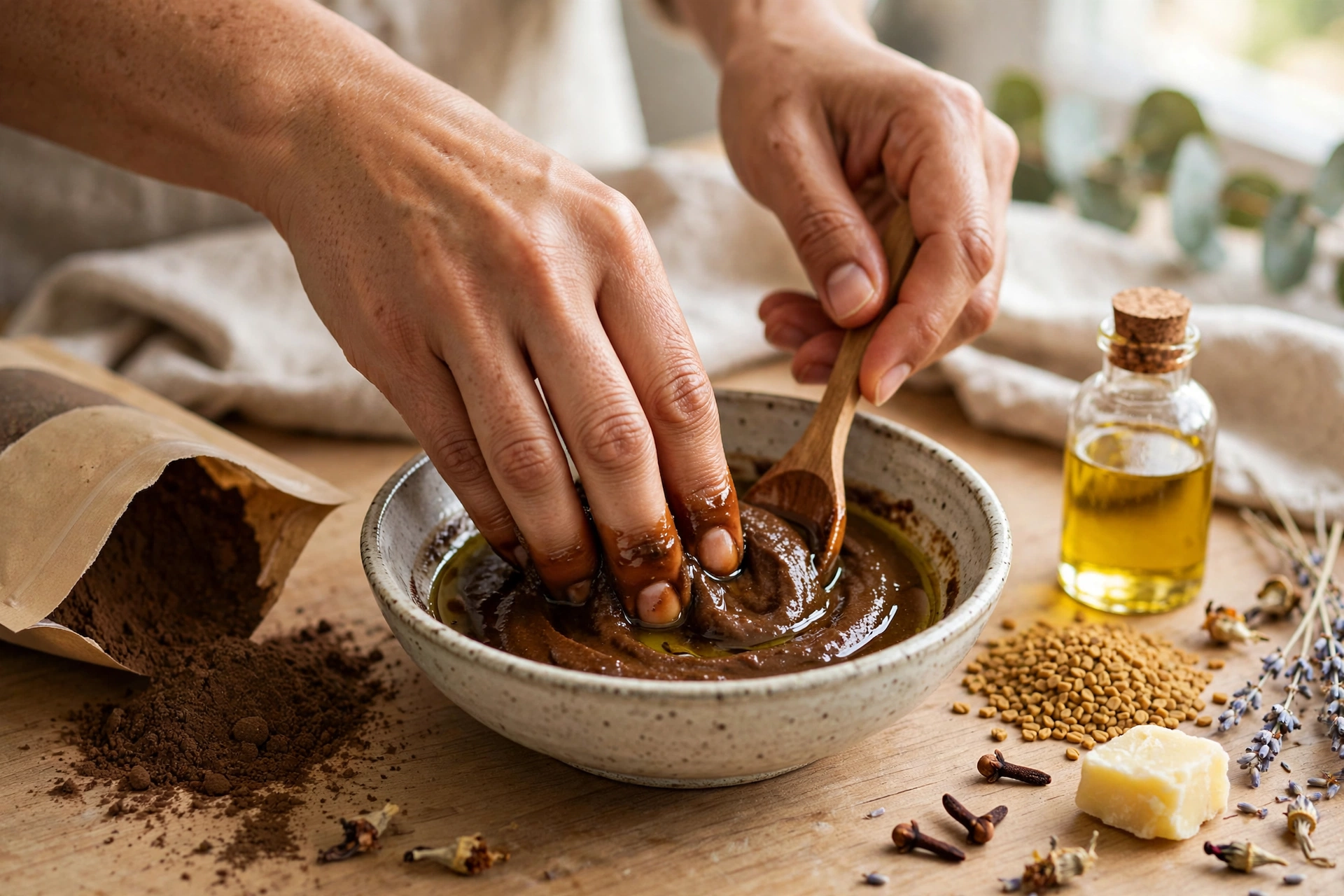
- Mix the paste. Combine the powder and oil in a bowl and stir until smooth. Add shea butter if using. Aim for a spreadable, henna-like consistency.
- Section your hair into 4–8 parts. Working in sections is non-negotiable — it ensures every strand gets coated.
- Apply from mid-shaft to ends. This is the critical detail most beginners get wrong: do not apply chebe to your scalp. Traditional users keep it off the scalp, where the gritty powder can clog pores, trigger itching, or worsen dandruff. Coat the lengths generously.
- Detangle gently each section with a wide-tooth comb to distribute the paste evenly.
- Braid or twist each finished section. This keeps the treatment in place and minimizes tangling.
- Cover with a shower cap if leaving it on overnight, to protect your bedding.
- Leave it for several days — traditional users re-mist and reapply every 3–5 days, keeping the hair braided for a week or more. Then rinse thoroughly with lukewarm water and a gentle shampoo, and deep-condition afterward.
How Often Should You Use It — and When Will You See Results?
For the paste method, most routines reapply every 3–5 days while the hair stays in braids. For infused oil or butter, once or twice a week as part of your normal routine is plenty. Be patient: because chebe works through breakage reduction, you need at least 6–8 weeks of consistent use before judging length retention. Take a photo of your hairline-to-ends on day one and compare monthly — memory is unreliable, photos aren’t.
Side Effects, Risks, and Who Should Skip Chebe
Natural does not mean risk-free. Be aware of the following:
- Scalp irritation: the most common complaint, usually from applying paste to the scalp. Keep it on the lengths, and if you have a sensitive scalp, start with the strained infused-oil method instead.
- Dryness or stiffness: some users find the paste drying if they skip the oil or leave it too long without re-moisturizing. Always pair chebe with water/leave-in first (liquid before powder).
- Buildup: the coating that protects your hair can also accumulate. Use a clarifying shampoo every few weeks if you use chebe regularly.
- Staining: chebe permanently stains light fabrics, pillowcases, and clothing. Plan accordingly.
- Fine or low-porosity hair: heavy paste can weigh down fine strands and sit on top of low-porosity hair rather than absorbing. If your hair is fine, try the infused-oil method first — and if you’re low porosity, you may prefer a lighter treatment like our flaxseed gel for low porosity hair recipe instead.
Patch test first: apply a small amount of your chebe mixture behind your ear or on your inner arm, wait 24 hours, and check for redness or itching before a full application. If you are pregnant, nursing, or managing a scalp condition, check with a dermatologist first.
Frequently Asked Questions
Does chebe powder grow hair faster?
No. It doesn’t change your growth rate — it reduces breakage so you retain more of the length your scalp already produces. That distinction is the key to using it with realistic expectations.
Can I apply chebe powder to my scalp?
Traditional practice says no, and modern reports of itching and dandruff flare-ups back that up. Keep the paste on the mid-lengths and ends. If you want scalp benefits, use a scalp-specific treatment instead.
How long do I leave chebe in my hair?
Traditional users leave the paste in braids for several days, reapplying every 3–5 days. A minimum of a few hours works for a one-off treatment, but the length-retention effect comes from repeated, consistent use.
Is chebe powder good for low porosity hair?
It can be, but the heavy paste method may sit on the surface. Low-porosity hair usually does better with the strained infused-oil version or lighter treatments applied to damp, warm hair.
Can I mix chebe with my conditioner?
You can stir a small amount into a deep conditioner for a milder treatment, but the paste may make rinsing difficult. Most people get better results keeping chebe as a separate step.
Does chebe powder expire?
Dry powder keeps for a year or more in a cool, dark, airtight container. Mixed paste with water should be used within a few days and refrigerated; oil-only infusions last several weeks.
Will chebe change my curl pattern?
No evidence suggests it permanently alters curl pattern. Hair may look looser while heavily coated, but that washes out.
Can men use chebe powder?
Yes. Hair is hair — the breakage-reduction mechanism works the same regardless of gender. Men with coily or curly hair who are growing it out use chebe the same way, usually in the infused-oil form for convenience.
Will chebe powder help with dandruff?
Probably not, and it may make it worse if paste gets on the scalp. Chebe is a strand treatment, not a scalp treatment. For flakes, use a proper anti-dandruff approach and keep chebe on the lengths.
The Bottom Line
Chebe powder is not a miracle growth serum — it’s a traditional anti-breakage treatment, and that is genuinely useful. If your hair breaks faster than it grows, a consistent chebe routine inside protective styles can help you finally retain length. Buy authentic powder, keep it off your scalp, pair it with moisture, and give it two months before judging. For more honest, hype-free natural hair care, explore the rest of PickHonestly.
Disclaimer: This article is for informational purposes only and is not medical advice. Chebe powder has not been evaluated in clinical trials for hair. If you have a scalp condition, significant hair loss, or concerns about hair thinning, consult a board-certified dermatologist.
