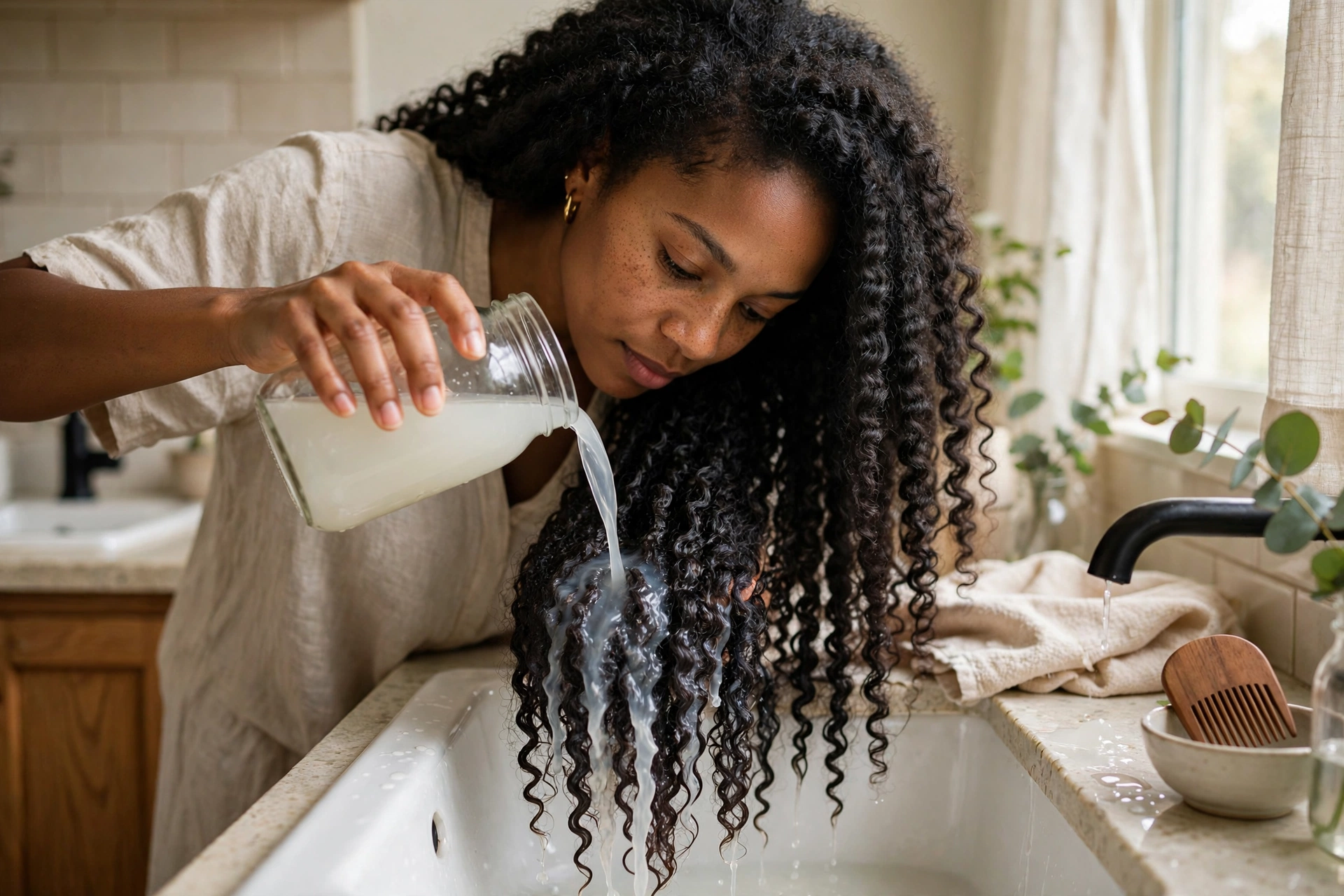
Rice Water for Hair Growth: Does It Work? The Honest Guide (Recipe + Natural Hair Tips)
 Maya Thompson
📅 September 29, 2026
⏱ 15 min read
Rice water might be the most talked-about DIY hair treatment on the internet right now. Social media is full of jars of cloudy liquid, dramatic before-and-after photos, and claims that it can make your hair grow inches in weeks. The practice itself is ancient — but the hype is brand new.
At PickHonestly, we don’t do hype. So this honest guide to rice water for hair growth does what the viral videos don’t: it separates what rice water can actually do for your hair from what it can’t, backs every claim with real evidence (and tells you honestly where the evidence runs out), gives you a safe step-by-step recipe, and — most importantly for our readers — explains exactly how to use it on natural and curly hair without wrecking your strands through protein overload.
What Is Rice Water for Hair?
Rice water is exactly what it sounds like: the cloudy, starchy liquid left behind after rice is soaked or boiled. As a hair treatment, it has centuries of history behind it. During Japan’s Heian period, court ladies reportedly soaked their floor-length hair in fermented rice water (called Yu-Su-Ru) to keep it strong and glossy. In China, the women of the Red Yao tribe in Huangluo village — sometimes called the “world’s longest-haired village” — have traditionally washed their hair with fermented rice water, and their waist-length hair has become legendary.
That history is real and fascinating. But it’s worth being clear about what it is: tradition and anecdote, not a clinical trial. Nobody has ever run a controlled study proving that the Yao women’s famous hair length comes from rice water rather than genetics, diet, minimal chemical processing, or a lifetime of gentle hair handling. Keep that distinction in mind as you read everything else here — including every claim you see on social media.
What’s Actually in Rice Water — and Why It Matters
When you soak rice, a small amount of the grain’s chemistry leaches into the water. The components that matter for hair are:
- Inositol — a naturally occurring carbohydrate. This is the most interesting ingredient: laboratory research suggests inositol can penetrate damaged hair and keep working even after rinsing, which is unusual for a rinse-out ingredient. Healthline’s overview of rice water notes this research as the basis for rice water’s reputation as a damage-repair aid.
- Amino acids — the building blocks of protein. Hair is made of keratin, a protein, so amino acids are relevant to hair strength — though the amounts in homemade rice water are small and unpredictable.
- Starch — coats the hair shaft, adding temporary slip and body. This is what makes detangling easier. The flip side: starch can also draw moisture out of hair, which is why overuse leaves some people’s hair feeling dry and stiff.
- B vitamins, vitamin E, zinc, magnesium, and manganese — present in small amounts. Here’s the honest caveat: most of the research linking these nutrients to hair health studied people who were deficient in them and took them by mouth. Pouring trace amounts onto your hair is not the same thing, and we shouldn’t pretend it is.
The key takeaway: rice water contains genuinely useful stuff, but in low, inconsistent concentrations. That inconsistency is the whole story of DIY rice water — which is why the “does it work” question has such a nuanced answer.
Rice Water for Hair Growth: The Honest Answer
Let’s answer the headline question directly: there is no clinical evidence that rice water makes hair grow faster. Dermatologists are remarkably consistent on this point. Aside from proven treatments like minoxidil and prescription options, very few topical treatments have scientific backing for actually growing hair — and the rate your hair grows is largely determined by genetics.
So why do so many people swear their hair got longer? The likely explanation is length retention, not faster growth. Rice water can reduce breakage and make hair smoother and easier to detangle. When your ends stop snapping off, you keep more of the length your hair was already growing. Over a couple of months, that genuinely reads as “longer hair” — but the follicle didn’t speed up; you just stopped losing what it produced.
There’s also a common mix-up worth clearing up. A 2022 systematic review published in the Journal of Drugs in Dermatology reviewed ten studies and found promising mechanisms for hair growth — but it studied rice bran extract, not homemade rice water. Rice bran is the nutrient-rich outer layer of the grain, and it’s removed during milling — your grocery-store white rice doesn’t have it. Rice bran extract in a formulated product is a fundamentally different thing from the starchy soak water in your mason jar. Conflating the two is one of the biggest sources of misinformation on this topic.
And the Yao women? Their hair is real, and their tradition is real — but attributing it solely to rice water ignores everything else: genetics, a traditional diet, and hair that has likely never been bleached, relaxed, or heat-damaged. Dermatologists have also pointed out that people who adopt traditional hair rituals often simultaneously improve their overall hair habits — less heat, gentler handling — and rice water gets the credit for all of it.
One more important note: if you’re experiencing actual hair loss or shedding — not just slow growth, but clumps in the drain or widening parts — don’t start with your pantry. The American Academy of Dermatology recommends seeing a dermatologist for hair loss, because many causes have effective, proven treatments, and delaying them costs you time you can’t get back.
The bottom line: rice water won’t speed up your growth rate, and anyone promising inches in weeks is selling something. But “won’t grow hair faster” is not the same as “useless” — as a strengthening, smoothing rinse that helps you keep your length, it has real, modest value. That distinction is the honest center of this whole guide.
What Rice Water CAN Do for Natural Hair
For natural and curly hair specifically, rice water’s real benefits are practical ones:
- Easier detangling. The starch coating adds slip, which means less tugging and fewer snapped strands on wash day. For coily hair that’s prone to tangling, that alone is meaningful — and it lines up with the AAD’s guidance on caring for natural hair, which emphasizes minimizing breakage through gentle handling.
- Frizz reduction and smoothness. Fermented rice water has a slightly lower pH, which helps the hair cuticle lie flatter — translating to less frizz and more shine.
- Improved elasticity. The amino acids and inositol can help hair stretch a little more before snapping, which is exactly what fragile natural hair needs.
- Length retention. Less breakage plus better elasticity means you keep more of what grows. If your goal is longer natural hair, retention is where the real gains happen — see our guide on how to grow natural hair faster for the full retention strategy.
None of these are miracles. All of them are real, modest, and worth having — as long as you respect the protein side of the equation, which we’ll get to.
Fermented vs Plain vs Boiled Rice Water
Not all rice water is the same. Here’s how the three common preparation methods compare:
| Method | How It’s Made | Strength | Best For | Watch Out For |
|---|---|---|---|---|
| Plain soak | Rice soaked 30 min–2 hrs, strained, used immediately | Mildest | First-timers; fine or low-porosity hair; sensitive scalps | Weakest effect; use within a day |
| Fermented | Soaked water left at room temperature 24–48 hrs until mildly sour | Strongest | High-porosity or damaged hair; frizz control | Higher protein load; spoilage risk; sour smell |
| Boiled | Rice cooked with extra water; the leftover water is used | Medium | Quick option when you’re already cooking rice | Heat may degrade some vitamins; let it cool fully first |
Fermentation is the traditional method for a reason: it lowers the pH of the liquid (better for smoothing the cuticle) and increases the antioxidant content. But it also concentrates the protein-like compounds — which is exactly why beginners, and anyone with low-porosity or protein-sensitive hair, should start with the plain soak instead.
How to Make Fermented Rice Water for Hair (Step-by-Step)
This is the classic method. Read all the steps before you start — the hygiene details matter more than the recipe does.
Step 1: Rinse the Rice
Measure 1/2 cup of uncooked white rice and rinse it thoroughly under running water, swishing with your hand. This first rinse washes away surface dust, dirt, and any residues — you don’t want those on your scalp. Discard this rinse water.
Step 2: Soak
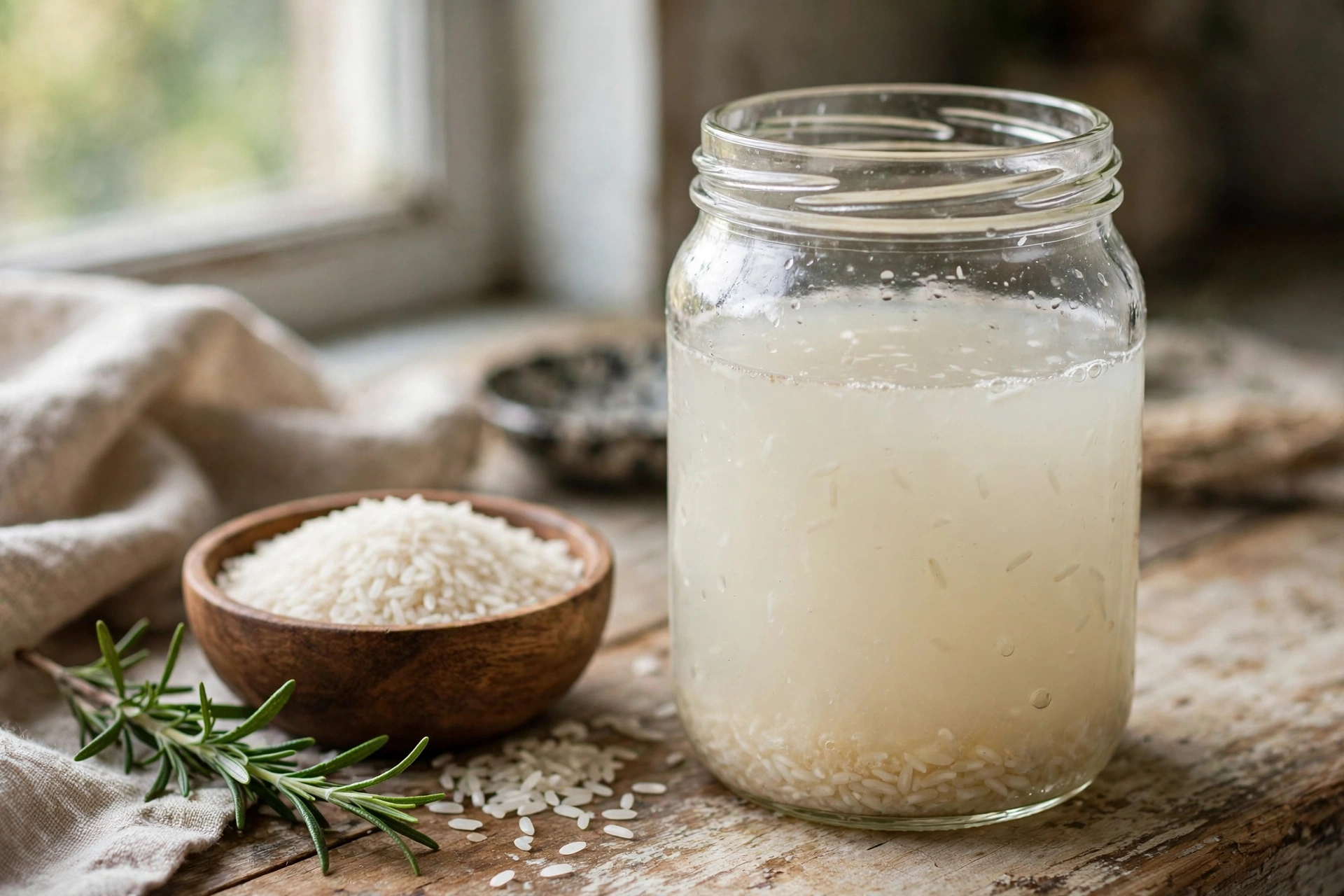
Place the rinsed rice in a clean bowl or jar and add 2 to 3 cups of clean water. Swirl it around until the water turns visibly cloudy and milky — that’s the starch releasing. Cover loosely and let it soak for 30 minutes to 2 hours at room temperature.
Step 3: Strain and Ferment
Strain out all the rice (cook it — don’t waste it). Pour the cloudy water into a clean glass jar — not plastic, which can harbor odors and bacteria in scratches. Cover the jar loosely (a cloth or a lid left ajar; fermentation needs a little airflow) and leave it at room temperature for 24 to 48 hours.
It’s ready when it smells mildly sour, like plain yogurt. That sourness means fermentation happened and the pH has dropped — which is what you want. If it smells strongly rotten, putrid, or you see any mold or slime: throw the entire batch out, wash the jar thoroughly, and start over. Never use spoiled rice water on your hair or scalp.
Step 4: Dilute and Store
Fermented rice water is concentrated. Before use, dilute it roughly 1:1 with clean water (one part rice water to one part water) — especially if this is your first time or your hair is fine or low-porosity. Store any unused portion in a sealed container in the refrigerator for up to 7 days, then discard and make a fresh batch.
Step 5: Patch Test Before Full Use
Before pouring anything new all over your scalp, dab a small amount on the skin behind your ear or on your inner forearm. Wait 24 to 48 hours. If you get redness, itching, or irritation, don’t use it. This is especially important if you have eczema or a sensitive scalp.
How to Use Rice Water on Natural and Curly Hair
Here’s the method that works best for textured hair:
- Shampoo first. Wash your hair with a gentle, sulfate-free shampoo as usual. Rice water works best on clean hair — product buildup blocks it from coating the strands evenly.
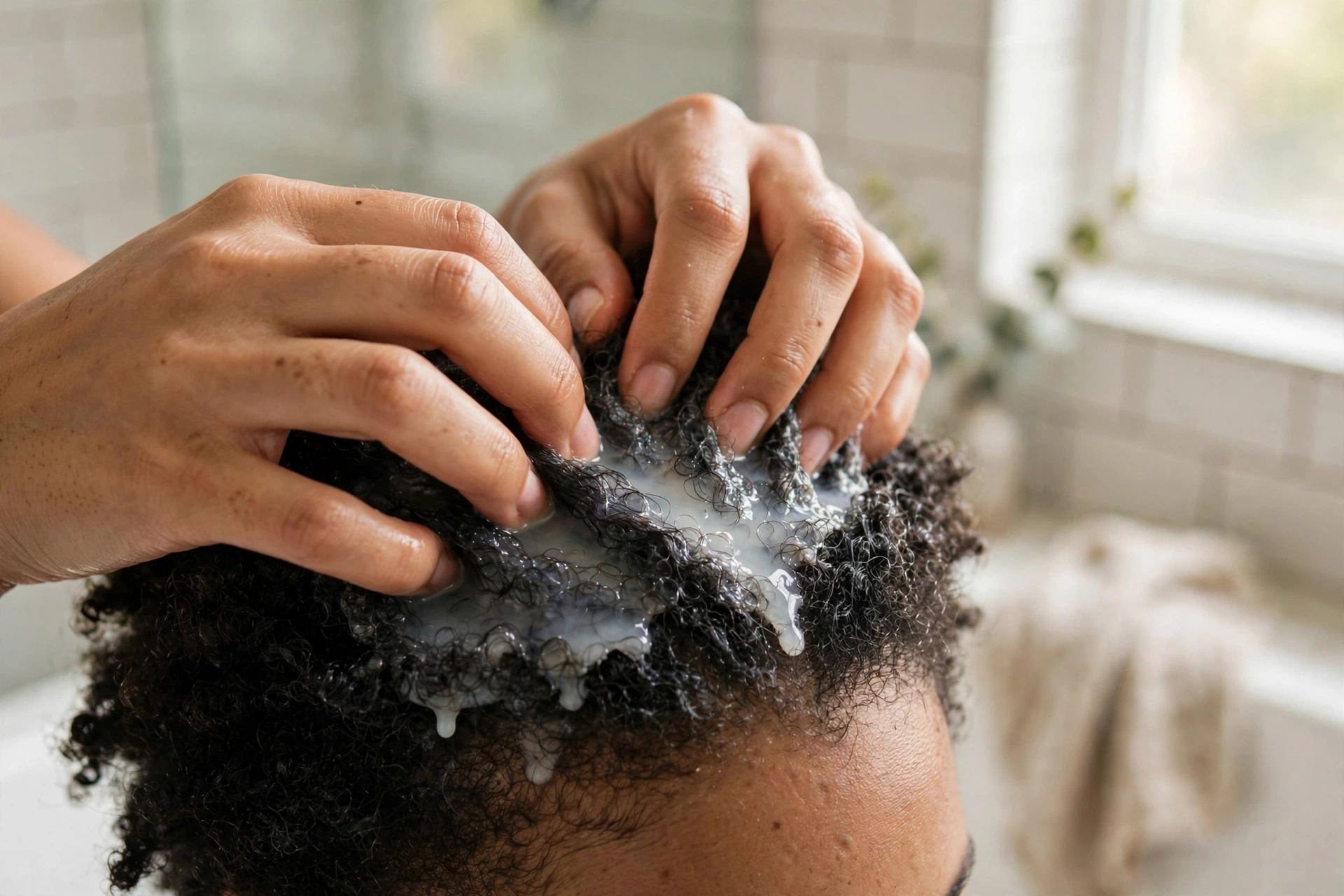
- Pour it on. Working in sections, slowly pour the diluted rice water over your hair, making sure the strands are fully saturated from roots to ends. Gently massage it into your scalp for a minute or two.
- Wait 10–20 minutes. Put on a shower cap and let it sit. Don’t leave it on for hours and definitely not overnight — longer is not better here.
- Rinse thoroughly. Rinse with lukewarm water until the water runs clear. Rice water is starchy; leftover residue is what causes stiffness.
- Always condition after. Follow with your regular conditioner or deep conditioner. Rice water is a protein-leaning treatment, so you need to rebalance with moisture. Our guide on how to moisturize natural hair explains the protein-moisture balance in detail.
How often? This is where hair type matters most:
| Hair Type | Suggested Frequency | Why |
|---|---|---|
| High-porosity or damaged hair | Once a week | Absorbs and benefits from the protein-like compounds most |
| Normal/medium porosity | Every 2 weeks | A safe middle ground for maintenance |
| Low-porosity or fine hair | Once a month | Prone to protein overload; start here and adjust only if hair responds well |
Not sure which category you’re in? Take our natural hair porosity test before you start — it takes two minutes and it genuinely changes the advice.
A note for Curly Girl Method followers: plain homemade rice water (just rice + water, no additives) is compatible with the Curly Girl Method — it contains no sulfates or silicones. Just be aware it functions as a light protein treatment, so count it toward your protein side of the routine.
Who Should Be Careful With Rice Water
Rice water is low-risk, but “low-risk” isn’t “no-risk.” Take these seriously:
- Protein-sensitive hair. Rice water behaves like a light protein treatment. If your hair already gets stiff and straw-like from protein treatments, rice water will likely do the same. Signs of protein overload: hair feels rough, stiff, or “crunchy” when dry; increased snapping during combing; loss of stretch and elasticity. If that happens, stop the rice water and switch to moisture-only conditioning for a few weeks.
- Low-porosity and fine hair. Your cuticles are tightly closed, so protein-like compounds sit on the surface and build up instead of absorbing. Start with the plain soak (not fermented), heavily diluted, once a month — and honestly, some low-porosity heads do better skipping rice water entirely.
- Eczema or sensitive scalps. Patch test first, as described above. Fermented products can irritate compromised skin barriers.
- Active hair loss. As noted earlier, see a dermatologist first rather than experimenting in the kitchen.
- Everyone: never leave rice water on overnight, never use a batch that smells rotten or shows mold, and never apply it to broken or irritated scalp skin.
Rice Water vs Store-Bought Rice Protein Products
You’ve probably noticed rice water-inspired products on shelves — shampoos, conditioners, and leave-ins built around hydrolyzed rice protein. Here’s the honest comparison:
| DIY Rice Water | Store-Bought Rice Protein Products | |
|---|---|---|
| Active ingredient | Whole proteins, amino acids, inositol — at low, variable concentrations | Hydrolyzed rice protein — proteins broken into small peptides that can actually interact with the hair fiber |
| Consistency | Changes with rice variety, soak time, water, and fermentation | Standardized dose, batch to batch |
| Formulation | Just rice + water — no preservatives, no pH balancing | pH-balanced, preserved against bacteria, often paired with moisturizers |
| Cost & effort | Nearly free, but takes prep time and spoils in days | Costs money, zero prep, shelf-stable |
| Best for | Experimenting; people who enjoy DIY; light, occasional treatments | Anyone who wants reliable, repeatable results |
Neither option is “better” in some absolute sense — but they are different tools. DIY rice water is a fun, cheap experiment with a low ceiling. Hydrolyzed rice protein products are the more reliable way to get the protein benefit, because the ingredient is properly sized and dosed rather than left to chance. If you try DIY for a month and find the results inconsistent, that’s your sign to look at formulated products instead of fermenting harder.
Frequently Asked Questions
Does rice water actually make hair grow faster?
No — there is no clinical evidence that rice water accelerates the rate of hair growth, which is largely determined by genetics. What it can do is reduce breakage and improve manageability, which helps you retain the length your hair already grows. Longer-looking hair over time is real; faster-growing hair is not.
Is fermented rice water better than plain rice water?
For frizz control and smoothing, yes — fermentation lowers the pH, which helps the cuticle lie flat, and increases antioxidant content. But fermented rice water is also more concentrated and more likely to cause protein overload, especially on fine or low-porosity hair. Beginners should start with the plain soak.
How often should I use rice water on natural hair?
Once a week is the ceiling for high-porosity or damaged hair; every two weeks suits normal hair; once a month (or less) is the safe starting point for low-porosity or fine hair. Stop immediately if your hair starts feeling stiff or straw-like — that’s protein overload.
Can I leave rice water in my hair overnight?
Don’t. Leaving rice water on for hours or overnight dramatically increases the risk of protein overload, stiffness, and scalp irritation — and there’s no evidence it improves results. Ten to twenty minutes as a rinse, then rinse it out and condition.
Is rice water good for 4c hair?
It can be, with caution. 4c hair is fragile and prone to breakage, so the strengthening and detangling benefits are genuinely useful — but 4c hair is also frequently low-porosity and protein-sensitive. Use the diluted plain soak first, once a month, always follow with a deep conditioner, and watch for stiffness. If your hair hates protein treatments, it will likely hate rice water too.
Can rice water cause protein overload?
Yes — this is the most common way rice water goes wrong. Signs include hair that feels rough, stiff, or crunchy when dry, more snapping during combing, and a loss of elasticity. The fix: stop all protein (including rice water) and focus on moisture-rich conditioning for a few weeks until your hair’s stretch returns.
How long does homemade rice water last?
Plain (unfermented) rice water should be used the same day. Fermented rice water keeps for up to 7 days in a sealed container in the refrigerator. Discard it if it develops a strongly rotten smell, visible mold, or a slimy texture — when in doubt, throw it out and make a fresh batch.
Should I use white rice or brown rice?
White rice is the standard choice and what most traditional recipes use. Brown rice contains the bran layer (where many nutrients live), but it also makes a heavier, starchier water and there’s no evidence it performs better as a hair rinse. Either works; white rice is simpler and more predictable.
Do I apply rice water before or after shampoo?
After shampoo, on clean damp hair. Shampooing first removes buildup so the rice water can coat the strands evenly. Rinse the rice water out after 10–20 minutes, then follow with conditioner.
Are store-bought rice water products better than DIY?
They’re more consistent. Products with hydrolyzed rice protein deliver a standardized, properly-sized protein dose in a pH-balanced, preserved formula — DIY rice water can’t match that reliability. DIY is nearly free and fun to try; formulated products are the better choice if you want dependable results.
Can rice water help with dandruff or hair loss?
There’s no solid evidence that rice water treats dandruff. For hair loss specifically, don’t rely on kitchen remedies — see a dermatologist, since many types of hair loss have effective medical treatments and early intervention matters.
Disclaimer: This article is for informational purposes only and is not medical advice. Rice water is a cosmetic home treatment with limited scientific evidence behind it. If you have a scalp condition, eczema, or hair loss, talk to a dermatologist before trying new treatments.
