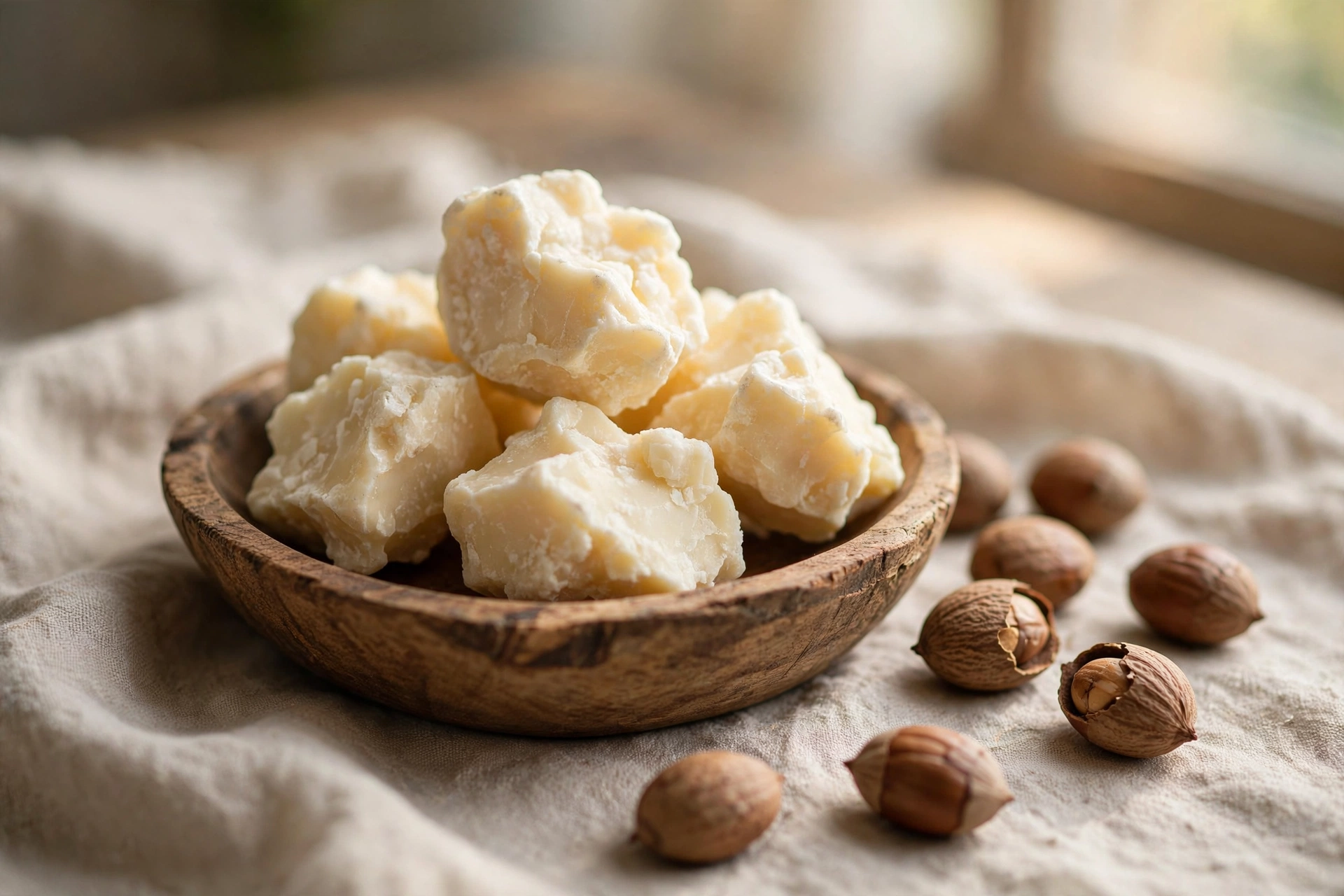
Shea Butter for Natural Hair: Honest Benefits, Myths & How to Use It
 Maya Thompson
📅 October 18, 2026
⏱ 16 min read
Shea butter is one of the most recommended ingredients for natural hair — and one of the most misunderstood. Scroll through any natural-hair forum and you’ll find people claiming it grows hair faster, works as sunscreen, and fixes everything from dandruff to split ends. Some of that is true. A lot of it isn’t.
This guide is the honest version: what shea butter actually does for natural hair, what the research really says (spoiler: it’s thinner than the marketing suggests), how to use it without the buildup and greasiness that make so many naturals give up on it, and the myths you can safely ignore.
What Shea Butter Actually Is
Shea butter is the fat extracted from the nuts of the shea tree (Vitellaria paradoxa), which grows across West and East Africa. It has been used for centuries across Africa for cooking, skin care, and hair care — long before it became a staple ingredient in Western natural-hair products.
Chemically, it’s mostly fatty acids: oleic acid, stearic acid, linoleic acid, and palmitic acid. It also contains vitamins A and E, plus a group of compounds called triterpenes (including amyrin and lupeol) that have documented anti-inflammatory properties. The unsaponifiable fraction — the part that doesn’t turn into soap — is unusually high for a plant fat (roughly 7–10%), which is why it feels richer and more “active” than, say, coconut oil.
That richness is the whole story of shea butter in one sentence: it’s a heavy, waxy emollient. Everything it does well for hair flows from that. Everything people complain about flows from that too.
What Shea Butter Can and Can’t Do for Natural Hair
Let’s get the honesty out of the way first, because this is where most articles about shea butter go wrong — including several currently ranking on page one for this topic.
| Shea butter CAN | Shea butter CANNOT |
|---|---|
| Seal moisture into the hair shaft (it’s an occlusive — it traps water that’s already there) | Add moisture by itself — it contains no water, so on dry hair it just seals in dryness |
| Soften coarse, dry-feeling hair and smooth the cuticle | Grow hair faster or wake up dormant follicles — no study supports this |
| Reduce breakage by lubricating strands and cutting down friction | Repair split ends or reverse protein/heat damage — nothing topical truly “repairs” damaged hair |
| Calm a dry, irritated scalp (its triterpenes have documented anti-inflammatory activity) | Act as sunscreen — dermatologists estimate its SPF at only 3–4, far below the SPF 30 minimum |
| Work as a sealant in the LOC/LCO method, a pre-poo, or a deep-conditioner booster | Work well for everyone — fine or low-porosity hair often finds it too heavy |
The single most important row in that table is the first one. Shea butter is a sealant, not a moisturizer. Water is the moisturizer; shea butter is the lid that keeps the water from evaporating. Apply it to damp, freshly conditioned hair and it locks hydration in beautifully. Apply it to dry hair expecting softness and you’ll get greasy, still-dry hair — the number one reason people say “shea butter didn’t work for me.”
What the Research Actually Says (Honestly)
Here’s something the top-ranking articles gloss over: Healthline’s guide to shea butter for hair states plainly that shea butter “hasn’t been extensively studied or reported on in scientific journals” when it comes to hair. Most of the confident claims you’ll read online are extrapolated from skin research or pure anecdote. That doesn’t mean shea butter is useless — it means we should describe its benefits by mechanism, not by miracle.
What we do have:
- Anti-inflammatory triterpenes: a 2010 study on triterpene compounds from shea fat found anti-inflammatory and chemopreventive effects — but it was conducted on mice, testing skin inflammation, not human hair or scalps. It supports the traditional use of shea for irritated skin, and plausibly a calm scalp, but it’s not proof shea butter treats dandruff or grows hair.
- Emollient/moisture-sealing effect: shea butter’s high concentration of fatty acids makes it an effective occlusive. Studies on skin show it slows water loss; the same barrier logic applies to the hair shaft, which is why it works well as the “O/C” (oil/cream) step in LOC/LCO routines.
- Scalp comfort: Healthline notes shea butter’s anti-inflammatory properties “might also help reduce redness and scalp irritation” — note the careful “might.” That’s the right level of confidence for the current evidence.
What we don’t have: any clinical trial showing shea butter accelerates hair growth, any evidence it meaningfully protects hair from UV damage, or any proof it penetrates the hair shaft the way some articles claim. One popular natural-hair site claims shea butter “absorbs into the hair strand/shaft” — the chemistry says otherwise. Heavy butters largely coat the shaft; that’s exactly why they’re good sealants, and there’s no shame in saying so.
Raw vs Refined Shea Butter: Which Should You Buy?
This choice matters more than most people realize, because “shea butter” on a label can mean very different products.
Unrefined (raw) shea butter
This is shea butter as it comes from traditional processing: ivory or beige-colored, with a nutty, smoky smell, and a soft-but-firm texture. It retains the most vitamins, triterpenes, and unsaponifiables — the compounds behind its skin-soothing reputation. If you want the “real thing” for DIY recipes, this is it. Downsides: the smell bothers some people, the texture can be grainy, and quality varies between batches and sellers.
Refined shea butter
Refined shea is bleached and deodorized — white, odorless, and smooth. It’s more consistent and easier to formulate with, which is why most commercial products use it. The trade-off: refining strips out some of the vitamins and beneficial compounds. It’s still a perfectly good emollient and sealant, just a less “active” one.
Grades, colors, and what “yellow shea butter” means
Shea butter is graded A through E, with Grade A being the highest quality (raw, unrefined, pure). What you’ll actually see in stores:
- Ivory/beige: natural color of raw shea butter. This is what unprocessed shea looks like.
- Yellow: usually dyed with borututu root or palm oil — a traditional West African practice, not a sign of higher quality. Some sellers imply yellow = better; it isn’t, it’s just colored.
- White and odorless: refined. Consistent and neutral, but with fewer of the raw compounds.
- East vs West African: East African shea (often labeled “nilotica”) tends to be softer and higher in oleic acid; West African is firmer and more common. For hair, the difference is minor — texture preference more than performance.
Our honest take: for DIY hair recipes, buy Grade A unrefined shea butter from a reputable seller. For store-bought products, don’t stress about raw vs refined — a well-formulated conditioner with refined shea plus humectants will outperform raw shea smeared on dry hair every time.
Shea Butter vs Cocoa Butter vs Mango Butter
These three get confused constantly. Here’s how they actually compare for natural hair:
| Shea Butter | Cocoa Butter | Mango Butter | |
|---|---|---|---|
| Texture | Soft, creamy, melts at body temperature | Hard, brittle at room temperature | Semi-soft, lighter than shea |
| Heaviness on hair | Heavy — best for coarse, thick, high-porosity hair | Very heavy and waxy — can feel stiff on hair | Lightest of the three — better for fine or low-porosity hair |
| Smell | Nutty/smoky (raw) | Chocolatey | Mild, slightly sweet |
| Best hair use | Sealant, pre-poo, whipped DIY butters | Better in commercial formulas than DIY — too hard to work with raw | Good starter butter if shea feels too heavy |
| Anti-inflammatory compounds | High (triterpenes, amyrin) | Lower | Moderate |
If shea butter has ever felt too heavy or greasy on your hair, mango butter is worth trying before you write off butters entirely — it’s the same idea in a lighter package.
How to Use Shea Butter on Natural Hair (5 Ways That Actually Work)
Every method below follows the same golden rule: shea butter goes on damp hair, never dry hair — unless it’s a pre-poo you’re about to wash out. Here’s how to use it:
1. As a sealant (the LOC or LCO method)

This is shea butter’s highest and best use. After your leave-in conditioner (the “L” and “C” — liquid and cream), smooth a pea-sized amount of shea butter over each section to seal everything in. Warm it between your palms first until it melts — never drag solid chunks through your hair. For a refresher on getting moisture into your hair before sealing, see our guide on how to moisturize natural hair.
2. As a pre-poo treatment
Apply melted shea butter to dry hair in sections 20–30 minutes before shampooing, focusing on the ends. It reduces the stripping effect of shampoo and cuts down on tangling during the wash. It rinses out easily because you’re following with shampoo — this is the one time “dry hair” application is fine. Our hot oil treatment guide covers the same principle with oils.
3. As a deep-conditioner booster
Melt a tablespoon of shea butter and stir it into your regular deep conditioner before applying. The butter adds extra slip and sealing power to the treatment. This works especially well in winter or for high-porosity hair that loses moisture fast. If you like DIY treatments, our DIY deep conditioner recipes pair well with this trick.
4. For twist-outs, braid-outs, and protective styles
A thin layer of shea butter (or whipped shea butter, recipe below) on each section before twisting gives definition, reduces frizz, and keeps the style moisturized for days. Use sparingly — too much weighs the style down and attracts lint.
5. On the scalp — sparingly, and not for dandruff
A light massage with melted shea butter can soothe a dry, tight-feeling scalp thanks to those anti-inflammatory triterpenes. But be honest with yourself: if you have flaking, itching dandruff or seborrheic dermatitis, shea butter is not a treatment. The American Academy of Dermatology’s guidance for African American hair emphasizes proper cleansing and conditioning routines for scalp health — see a dermatologist if flakes persist, because no butter fixes a medical scalp condition.
Whipped Shea Butter DIY Recipe

Raw shea butter straight from the tub is dense and hard to distribute. Whipping it with a light oil transforms it into a fluffy, easy-to-apply butter. Here’s how:
Step 1: Measure your ingredients
You’ll need 1/2 cup of raw, unrefined shea butter and 2 tablespoons of a light carrier oil — jojoba, grapeseed, or sweet almond oil all work. The oil thins the butter so it spreads instead of sitting in clumps. (Coconut oil works too, but it firms the whip back up; lighter oils keep it fluffy.)
Step 2: Melt gently — never boil
Place the shea butter in a heat-safe bowl over a pot of simmering water (a double boiler). Melt it slowly on low heat, stirring occasionally. Don’t use a microwave if you can avoid it — uneven hot spots can scorch the butter and destroy some of its beneficial compounds. Remove from heat as soon as it’s fully liquid.
Step 3: Cool it down (this step matters)
Let the melted butter cool at room temperature for 15–20 minutes, then refrigerate for another 20–30 minutes until it’s semi-solid and opaque — like softened butter, not liquid. Skipping this step is the number one reason whipped shea butter turns out runny.
Step 4: Whip it
Beat with a hand mixer or stand mixer for 5–7 minutes until it turns pale, fluffy, and roughly doubles in volume. Add a few drops of an essential oil (lavender or tea tree) at the end if you like — optional, and skip it if your scalp is sensitive.
Step 5: Store it properly
Scoop into a clean, dry glass jar with a lid. Store at cool room temperature, away from direct sunlight. Use clean, dry hands or a small spoon every time — introducing water is what makes DIY butters go rancid early. Properly stored, your whipped shea butter lasts 3–6 months.
Step 6: Use it right
Apply a pea-sized amount per section to damp hair as a sealant, or use it for twist-outs. A little goes a very long way — if your hair looks greasy, you used too much, not the wrong product.
Shea Butter and Hair Porosity: Who Should Skip It
Not every natural head loves shea butter, and porosity is usually the reason. If you haven’t tested yours, our hair porosity test guide walks you through the simple at-home methods.
- High porosity hair: shea butter’s best customer. Your cuticles lift easily and lose moisture fast, so a heavy occlusive sealant is exactly what you need. Use it generously as a sealant and in pre-poos.
- Low porosity hair: proceed with caution. Tightly closed cuticles plus a heavy butter equals buildup sitting on top of the hair, which blocks moisture from getting in — the opposite of what you want. If you use shea butter, use tiny amounts on damp (not wet) hair, apply heat (a warm towel or hooded dryer) to help it absorb, and clarify regularly.
- Fine natural hair: shea butter can weigh your strands down and make them look limp and thin. Try mango butter or a shea-based commercial product (where it’s diluted with lighter ingredients) instead of raw shea.
- Oily or flaky scalp: keep shea butter off the scalp or use it very sparingly. Heavy butters on an already-oily scalp invite buildup and can make flaking worse.
Troubleshooting: Grainy Texture, Rancidity, and Buildup
Why is my shea butter grainy? Graininess happens when melted shea butter cools too slowly — the fatty acids crystallize unevenly. It’s harmless and still works fine, but if the texture bothers you, remelt it completely and cool it quickly (the whipped recipe above, with its refrigeration step, prevents this).
Does shea butter expire? Yes. Raw, unrefined shea butter lasts about 18–24 months; refined lasts longer, up to 2–3 years. Rancid shea butter smells sharp, sour, or “off” instead of nutty — if yours smells wrong, throw it out. Rancid fats can irritate skin and scalp.
How do I remove shea butter buildup? If your hair starts feeling coated, dull, or “waxy,” that’s buildup. A clarifying shampoo (used occasionally, not every wash) removes it. Then go back to using smaller amounts on damp hair. Buildup is a dosage problem, not a shea butter problem.
Can I use shea butter every day? You can, but most people shouldn’t need to. Daily heavy application leads to buildup fast. Two to three times a week as a sealant — or just on wash day and mid-week refresh — is plenty for most natural hair.
Frequently Asked Questions
Does shea butter grow hair faster?
No — there is no scientific evidence that shea butter accelerates hair growth or stimulates follicles. Hair grows at its genetically set rate (about half an inch per month). What shea butter does is reduce breakage by sealing in moisture and lubricating strands, so you retain more of the length you grow. That retention is often mistaken for faster growth.
Is raw or refined shea butter better for hair?
Raw (unrefined, Grade A) retains more vitamins and anti-inflammatory compounds, making it the better choice for DIY recipes. Refined shea butter is still an effective sealant and emollient — it’s just less “active.” For commercial products, the formulation matters more than whether the shea inside is raw or refined.
Can I put shea butter on dry hair?
Only as a pre-poo you’re about to wash out. As a leave-in or sealant, always apply to damp hair. Shea butter contains no water, so on dry hair it seals in dryness and just makes hair greasy.
Does shea butter clog pores or cause acne?
Shea butter is generally considered non-comedogenic (rated 0–1 on comedogenic scales, which measure facial pore-clogging). But those ratings are for facial skin, not scalps, and heavy over-application can still cause buildup. Keep it off your face and hairline if you’re breakout-prone, and don’t cake it onto the scalp.
Is shea butter good for low porosity hair?
It can work, but it’s not the easiest match. Use very small amounts on damp hair, and consider lighter alternatives like mango butter or grapeseed oil if you keep getting buildup. Heat helps — a warm towel after application improves absorption.
What’s the difference between yellow and white (ivory) shea butter?
Ivory/beige is the natural color of raw shea butter. Yellow shea butter is traditionally dyed with borututu root or palm oil — it’s a cosmetic/aesthetic tradition, not a quality upgrade. White, odorless shea butter has been refined.
Can shea butter treat dandruff?
It can soothe a dry, tight scalp, but it is not a dandruff treatment. True dandruff (seborrheic dermatitis) is a medical condition that needs antifungal or medicated treatment — see a dermatologist if flaking persists. Masking flakes with butter can make things worse.
I’m allergic to tree nuts — is shea butter safe?
Shea comes from a tree nut, so caution is warranted. However, refined shea butter contains very little of the proteins that trigger nut allergies, and clinical reports of shea allergy are rare. If you have a severe nut allergy, do a patch test first and check with your allergist — don’t take a blog’s word for it.
Shea butter vs coconut oil: which is better for natural hair?
They do different jobs. Coconut oil can penetrate the hair shaft and reduce protein loss; shea butter mostly coats and seals. Many naturals use both — coconut oil (or another penetrating oil) under shea butter as the sealant. If your hair hates coconut oil (some low-porosity hair does), shea butter alone on damp hair works fine.
How long does whipped shea butter last?
About 3–6 months at cool room temperature if you keep water out of the jar. Always use clean, dry hands or a spoon. If it develops a sour or sharp smell, it’s rancid — discard it.
The Honest Bottom Line
Shea butter earns its place in a natural-hair routine — as a sealant, a pre-poo, and a DIY butter base, especially for coarse, thick, or high-porosity hair. It doesn’t grow hair, doesn’t replace sunscreen, and doesn’t moisturize on its own. Used correctly — small amounts, on damp hair, matched to your porosity — it’s one of the most cost-effective ingredients you can own. Used incorrectly — globs on dry hair, daily, on a flaky scalp — it’s the reason half the internet thinks shea butter is a scam. The butter was never the problem. The method was.
Disclaimer: This article is for informational purposes only and isn’t medical advice. Shea butter is a cosmetic ingredient, not a treatment for hair loss, dandruff, eczema, or any medical condition. If you’re dealing with persistent shedding, scalp pain, or flaking, see a dermatologist. Always patch-test new products or DIY recipes before full use.
