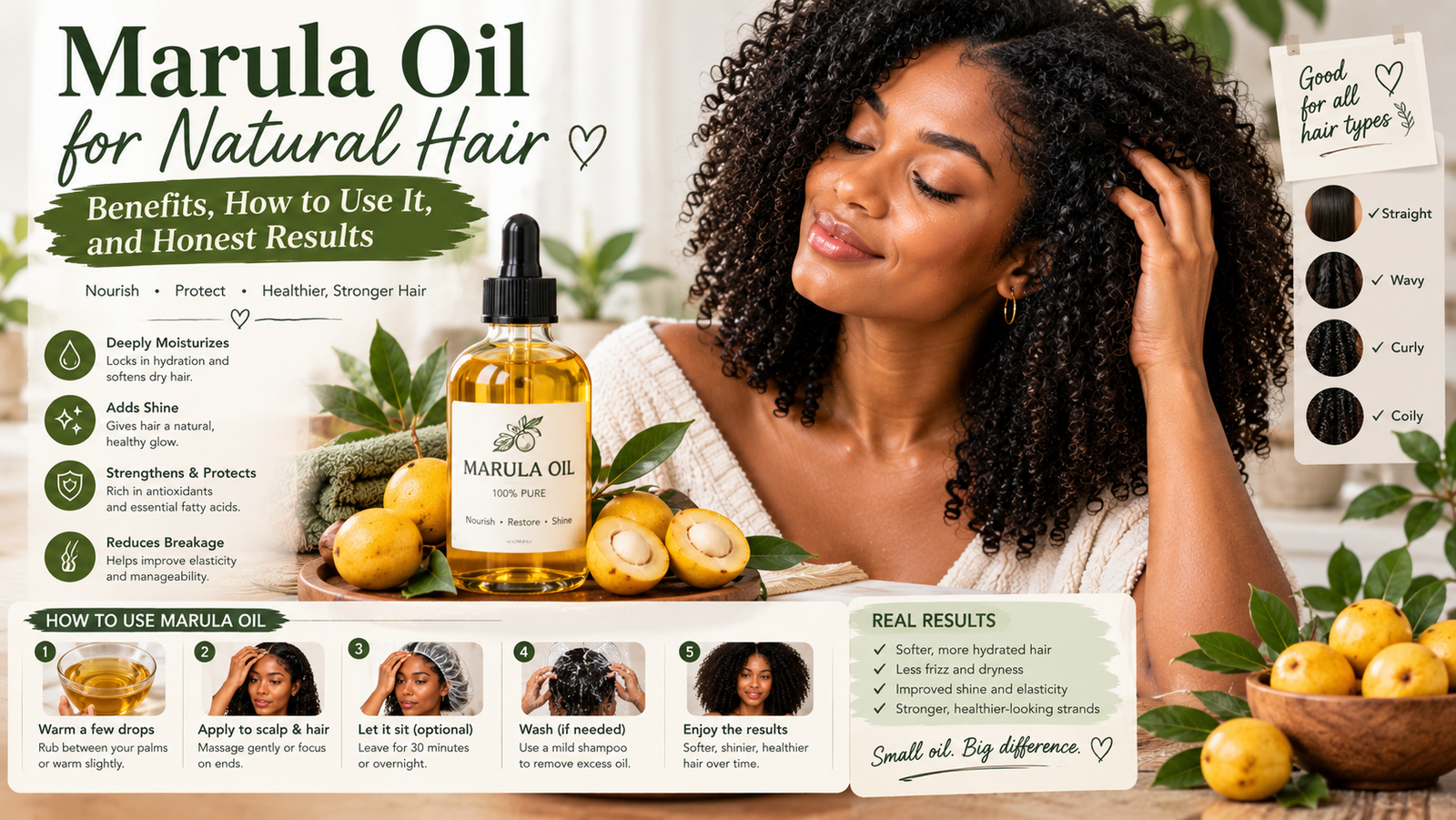
Marula Oil for Natural Hair — Benefits, How to Use It, and Honest Results
If you’ve been searching for a lightweight oil that actually absorbs into natural hair instead of just coating the surface, marula oil for natural hair deserves serious attention. It’s been used in southern Africa for centuries as a skin and hair treatment — and the science behind why it works is more straightforward than most trending ingredients.
I’ve been testing marula oil on my natural hair for nine weeks, using it as both a scalp treatment and a sealant in my LOC routine. Here’s the honest breakdown — what it does, what it doesn’t, and exactly how to use it on natural hair.
What Is Marula Oil?
Marula oil is cold-pressed from the kernels of the marula fruit — the nut inside the seed of Sclerocarya birrea, a tree native to southern and eastern Africa. The oil has been used by the Tsonga people of southern Africa for generations to moisturize skin and condition hair, long before it appeared in mainstream hair care products.
What makes marula oil stand out from other plant oils is its fatty acid composition:
- Oleic acid (omega-9): 70–78% — unusually high oleic acid content gives marula oil its ability to penetrate the hair shaft rather than just coat the outside
- Linoleic acid (omega-6): 4–7% — supports scalp health and reduces inflammation
- Palmitic and stearic acids — contribute to the oil’s stability and gentle conditioning properties
- Vitamin C and E — antioxidants that protect hair from environmental oxidative damage
- Antioxidant phytochemicals — flavonoids and procyanidins with antimicrobial properties that support scalp health
The high oleic acid content is the key factor — oleic acid has a smaller molecular structure than many other fatty acids, giving it partial penetration ability similar to coconut oil, without the protein-buildup issue that coconut oil causes on some natural hair types.
Marula Oil Benefits for Natural Hair
1. Deep Moisture Without Heaviness
Most oils heavy enough to work on natural hair — castor oil, shea butter — come with a heaviness that weighs down coils or leaves visible residue. Marula oil is different. Despite its penetrating ability and strong conditioning properties, it absorbs quickly and leaves no greasy residue on the hair or scalp.
In nine weeks of use, I applied it as the oil step in my LOC routine after my leave-in conditioner on every wash day. The moisture retention improvement was noticeable within the first two weeks — hair stayed softer for longer into the week, and the dry and rough feeling that used to start on day two was pushed back to day four or five. For natural hair, that’s a meaningful difference.
2. Frizz Reduction Without Weight
Marula oil’s high oleic acid content smooths the hair cuticle effectively — the same mechanism that makes argan oil popular for frizz control. The difference is that marula oil is slightly heavier than argan oil, which makes it more effective on 4A and 4B textures where argan oil alone doesn’t provide enough coating.
Applied as a finishing oil over dry styled natural hair, a small amount of marula oil smooths frizz and adds a healthy shine without the flattening effect that heavier oils produce. On wash-and-go styles and twist-outs, it keeps the definition intact while reducing the dry, matte appearance that natural hair can have without any oil at all.
3. Strengthens Natural Hair Strands
The vitamin E content in marula oil — particularly tocopherols — provides antioxidant protection that slows the oxidative damage to hair proteins that accumulates from UV exposure, heat, and environmental pollution. This kind of protection doesn’t show up dramatically in the short term but compounds over months of consistent use into noticeably stronger, more resilient hair strands.
This is especially relevant for natural hair that’s styled frequently — the repeated manipulation of coiling and uncoiling, detangling, and styling creates friction that generates free radicals at the hair strand level. Marula oil’s antioxidant profile provides a meaningful buffer against this kind of cumulative damage.
4. Scalp Health and Antimicrobial Benefits
The procyanidins and flavonoids in marula oil have documented antimicrobial activity — they inhibit the growth of Malassezia, the fungus responsible for dandruff and seborrheic dermatitis. For natural hair wearers who use protective styles that can create scalp conditions favorable to Malassezia growth, a weekly scalp massage with marula oil provides ongoing preventive maintenance.
Combined with the scalp massage technique, marula oil as a scalp treatment supports both the physical circulation benefits of massage and the antimicrobial benefits of the oil itself. Our guide on scalp serums for natural hair covers how to incorporate scalp oil massage into a complete scalp care routine.
5. Works Across Different Porosity Types
This is where marula oil has a practical advantage over many other natural oils. Its oleic acid-dominant profile means it penetrates better than surface oils like argan on high porosity natural hair, but its lighter feel and faster absorption mean it doesn’t build up on low porosity natural hair the way coconut oil can. It sits in the middle of the porosity spectrum in terms of usefulness — genuinely beneficial across a wider range of natural hair types than most oils.
How to Use Marula Oil on Natural Hair
As the Oil Step in the LOC Method
Apply marula oil over your leave-in conditioner on wash day while hair is still damp. Work a small amount through each section after the leave-in has been distributed. The oil seals in the moisture from the leave-in as hair dries and its partial penetration ability adds an internal conditioning layer that surface oils can’t provide.
For 4B and 4C hair, follow the marula oil with a heavier cream or shea butter as the cream step — marula oil alone may not be heavy enough as the final sealant on the driest natural hair textures. For 3C and 4A hair, marula oil works well as the final sealant without needing a cream on top.
See our full guide on how to moisturize natural hair for the complete LOC method explained step by step.
As a Pre-Poo Before Washing
Apply marula oil to dry natural hair 30–45 minutes before shampooing. Work through in sections from scalp to ends. Cover with a shower cap. The oil forms a protective layer over the hair shaft that reduces the protein loss and swelling damage that shampoo causes during the wash process.
Warming the oil first maximizes this protective effect — place a small amount in a glass bowl inside a larger bowl of hot water for two to three minutes before applying. See our hot oil treatment guide for the full pre-poo method.
As a Scalp Massage Oil
Part hair into sections and apply marula oil directly to the scalp. Massage each section for two to three minutes using circular motions with your fingertips. The combination of the oil’s antimicrobial properties and the circulation stimulation from massage makes this a useful twice-weekly scalp treatment — particularly after removing a protective style.
Add three to five drops of rosemary essential oil to your marula oil before applying for additional DHT-blocking and circulation benefits. The research on rosemary oil for hair growth combines well with marula oil’s scalp-conditioning properties. See our rosemary water guide for more on rosemary’s scalp benefits.
As a Finishing Oil After Styling
Warm a small amount between your palms and smooth over dry styled natural hair. A pea-sized amount is enough for shoulder-length hair — use slightly more for longer or thicker hair. Focus on the ends and any frizzy sections. The immediate shine and frizz reduction makes it one of the better finishing oils for natural hair styles that need a polished look without looking product-heavy.
Marula Oil vs Other Popular Natural Hair Oils
| Oil | Weight | Penetration | Best For | Best Hair Type |
|---|---|---|---|---|
| Marula Oil | Light-medium | Partial | Moisture, frizz, scalp health | All types, 3C–4B |
| Argan Oil | Light | Surface | Shine, frizz control | 3A–4A |
| Castor Oil | Very heavy | Surface | Sealing, edges | 4B–4C |
| Coconut Oil | Medium | Deep penetration | Pre-poo, protein protection | Medium-high porosity |
| Jojoba Oil | Light | Surface (absorbs fast) | Daily sealing, low porosity | All types |
| Pumpkin Seed Oil | Medium | Partial | DHT blocking, scalp health | 3C–4C |
Marula oil fills the gap between argan oil (too light for drier textures) and castor oil (too heavy for daily use). For natural hair types from 3C to 4B that find argan oil insufficient but castor oil too heavy, marula oil is the right weight.
See our complete hair oils comparison guide for a full breakdown of every major natural hair oil.
How to Choose a Good Marula Oil Product
As with batana oil and pumpkin seed oil, quality varies significantly across the marula oil market:
- Color: Pure cold-pressed marula oil is pale yellow to golden. Clear or water-white marula oil has been refined — refining removes the antioxidants and phytochemicals that give it its benefits
- “Cold-pressed” or “unrefined”: Look for these terms on the label. Heat extraction degrades the vitamin E and oleic acid content
- Ingredient position: Sclerocarya birrea (kernel oil) should be the first or primary ingredient. If it’s listed fourth or fifth, you’re mostly paying for whatever carrier oil comes before it
- Source: Products that specify African sourcing are more likely to be authentic — marula trees grow in southern and eastern Africa, and products from the region have more verifiable supply chains
Frequently Asked Questions About Marula Oil for Natural Hair
Is marula oil good for 4C natural hair?
Marula oil works well for 4C hair as a pre-poo, scalp treatment, and as the oil step in LOC — but for the driest 4C textures, follow it with a heavier cream or shea butter as the final sealant. Marula oil’s weight sits between argan and castor oil, which means it provides better conditioning than argan on 4C hair but may not create a thick enough barrier on its own for hair that loses moisture very quickly. For a complete 4C routine, see our guide on best products for 4C natural hair.
Can I use marula oil on low porosity natural hair?
Yes — marula oil works better on low porosity hair than most heavier oils because it absorbs faster and is less likely to coat the already-resistant low-porosity cuticle without absorbing. Apply it to hair that’s still warm from the shower for best absorption, and use a small amount — low porosity hair doesn’t need as much product as high porosity hair to see the benefit. Our porosity guide covers how to identify your type and adjust product amounts accordingly.
How does marula oil compare to argan oil for natural hair?
Marula oil is slightly heavier and more moisturizing than argan oil — it has higher oleic acid content and stronger conditioning properties. For looser curl patterns (3A–3C), argan oil is usually sufficient and lighter. For tighter natural hair textures (4A–4B), marula oil provides noticeably better conditioning. Both are good finishing oils — marula oil adds more moisture, argan oil adds more shine with less weight.
How often should I use marula oil on natural hair?
As a sealant in your LOC routine: every wash day. As a finishing oil between washes: as needed, usually every two to three days on dry sections. As a scalp treatment: two to three times per week. There’s no benefit to applying more than a small amount at once — marula oil is lightweight but still accumulates on the scalp and hair shaft with overuse. Clarify monthly to remove any buildup.
Does marula oil help natural hair grow?
Marula oil supports the scalp conditions that allow healthy growth — its antimicrobial properties reduce scalp inflammation, and its vitamin E content protects the follicle environment from oxidative damage. It doesn’t directly accelerate growth rate (hair grows about half an inch per month regardless), but stronger strands that break less retain more length over time. For the full picture on natural hair growth, see our guide on how to grow natural hair faster.
Final Thoughts
Marula oil for natural hair fills a practical gap that most other oils don’t: it’s light enough for daily use without buildup, heavy enough to condition textures that argan oil can’t fully address, and its partial penetration ability provides internal conditioning that surface-only oils can’t match. The antioxidant profile adds long-term strand protection that compounds with consistent use.
Start with it as the oil step in your LOC method on wash day. Use a small amount — it goes further than it looks — and give it six weeks of consistent use before evaluating. That’s enough time for the moisture retention improvement to become clearly measurable.
More from PickHonestly on natural hair oils and scalp care:
- Best Hair Oils for Natural Hair — Complete Comparison
- Batana Oil for Natural Hair — What It Is and Does It Work
- Pumpkin Seed Oil for Natural Hair
- How to Do a Hot Oil Treatment for Natural Hair
- How to Moisturize Natural Hair — Complete Guide
- Natural Hair Care Routine for Beginners
Prices accurate as of publication and may vary. Always verify current pricing before purchasing.