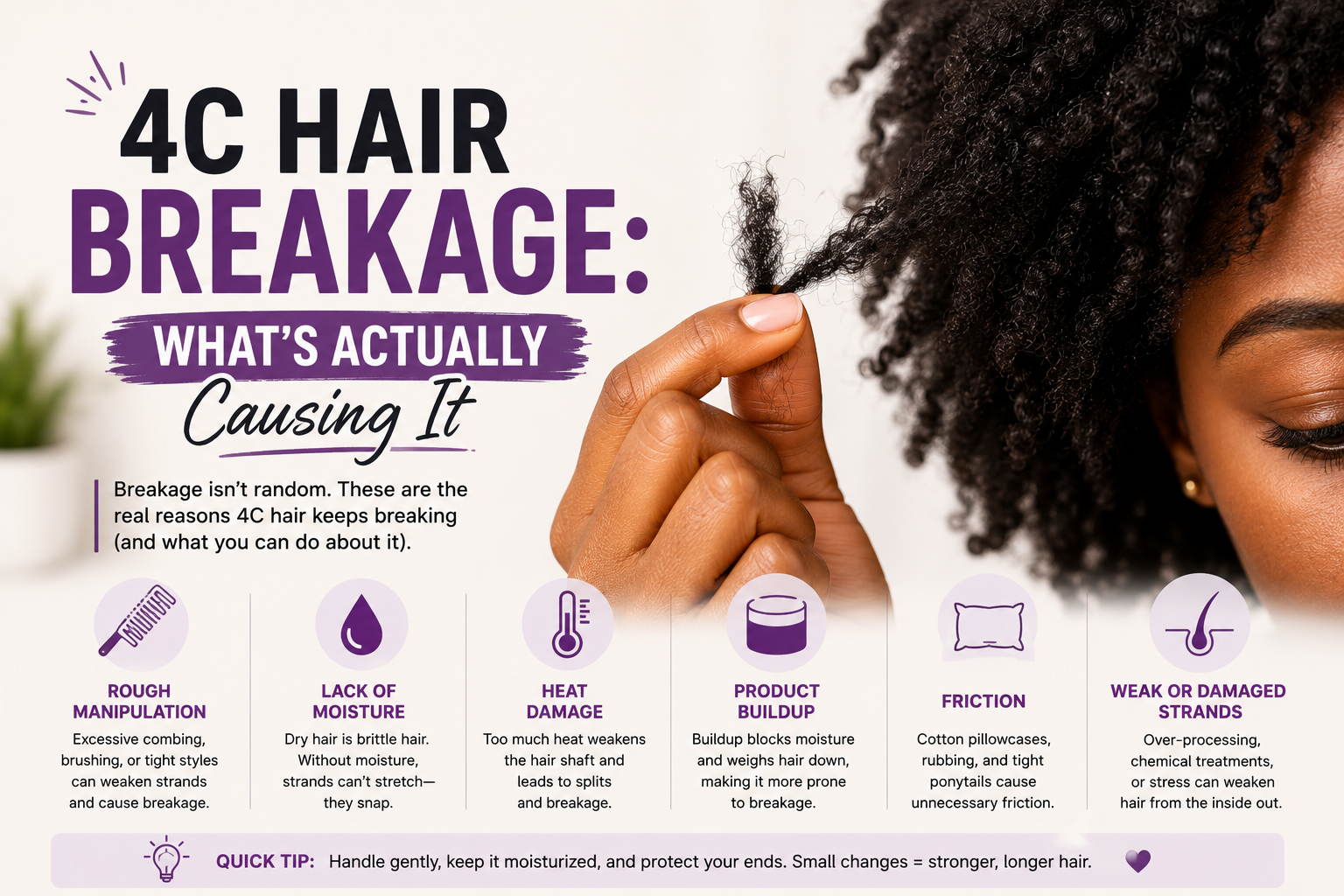
4C Hair Breakage: What’s Actually Causing It
Why 4C Hair Breaks More Than Other Hair Types
4C hair has the tightest curl pattern out of all the natural hair types, with coils bending back on themselves multiple times along a single strand. A detailed breakdown of the science behind this explains that every one of those bends becomes a structural weak point, since stress from combing, styling, or just gravity concentrates right at the curve instead of spreading evenly down the strand the way it would on straighter hair.
The Actual Research Behind This
This isn’t just a theory floating around online. A study published in the International Journal of Dermatology found that African hair has a flatter, elliptical shape compared to the rounder cross-section of other hair types, and that flatter shape combined with the curved growth pattern genuinely lowers resistance to breakage under everyday tension. A separate study also found a higher cuticle-to-cortex ratio in this hair type, with more wear starting near the root specifically.
Why Moisture Loss Makes Everything Worse
4C hair loses water into the air faster than straighter hair types, especially in low humidity. A strand that feels fine in the morning can genuinely be bone dry by evening if it wasn’t properly moisturized and sealed. Dry strands snap under tension that healthy, moisturized strands would normally handle just fine.
The Five Real Causes Behind Most 4C Hair Breakage
Breakage almost always traces back to one of a handful of root causes, and figuring out which one applies to you changes what actually needs to change in your routine.
Detangling the Wrong Way
A complete guide on detangling 4C hair makes a point worth repeating: conditioning your hair while you detangle is one of the single best things you can do to reduce breakage. The more your hair gets tugged on dry, without any slip, the more likely a strand snaps at its weakest bend instead of the knot just loosening.
Heat and Chemical Damage
Heat styling weakens the internal bonds inside the hair shaft, and it’s not reversible once the damage sets in. A breakdown of common breakage causes also points to chemical treatments, relaxers, bleach, and even keratin treatments, as contributing factors if the hair isn’t cared for properly afterward. If you’ve had a keratin treatment recently, our piece on keratin treatment aftercare covers the specific routine needed to avoid adding breakage on top of a chemical process your hair’s already recovering from.
Too Much Tension From Styling
Tight braids, ponytails, and twists pull directly at the root and along each bend in the strand. Protective styles genuinely help reduce daily manipulation, but styled too tightly, they can quietly introduce a different kind of stress instead of preventing it entirely.
Wet Hair Handling Habits
Hair is at its most fragile when it’s wet, and rubbing it dry with a regular towel is rougher than most people realize. The fibers in a standard cotton towel snag and pull on wet strands in a way that adds up over time, even if no single towel-dry session feels damaging in the moment.
Not Trimming Regularly
Split ends don’t heal, they only travel further up the strand the longer they’re left alone. Most guides recommend a trim every 8 to 12 weeks specifically to catch split ends before they turn into a longer section of damaged hair working its way upward.
What Actually Stops 4C Hair Breakage
Moisture and sealing form the real foundation here. A guide focused specifically on prevention recommends regular deep conditioning to restore elasticity, paired with a sealing oil afterward to help lock that moisture in rather than letting it evaporate right back out.
Gentle Detangling Tools Matter
A wide-tooth comb, or honestly just fingers, works far better than a fine-tooth comb for 4C hair specifically. Detangling from the ends upward, rather than starting at the root and dragging a comb all the way down, also reduces how much tension hits the weakest points along the strand.
Protecting Hair Overnight
A satin or silk pillowcase, or a bonnet if you prefer, cuts down on the friction a cotton pillowcase causes overnight. This single change is one of the easiest to make and genuinely reduces both breakage and moisture loss while you sleep.
How to Tell Breakage Apart From Normal Shedding
This confuses a lot of people, understandably. Losing 50 to 100 strands a day is completely normal for everyone, regardless of hair type. Breakage looks different from shedding once you know what to check for.
The Simple Check
A shed hair has a small white bulb at one end, the root. A broken hair has no bulb at all, just a flat, snapped end, sometimes at an inconsistent length compared to the rest of your hair. If you’re finding a lot of short, bulb-less strands, that’s breakage, not normal shedding, and it’s worth addressing directly rather than assuming it’s just part of a healthy hair cycle.
Building a Weekly Routine Around Breakage Prevention
Consistency matters more here than any single product or technique done occasionally. A basic weekly rhythm tends to work better than sporadic effort followed by weeks of neglect.
What a Solid Week Actually Looks Like
Deep condition once a week, moisturize and seal every two to three days depending on how dry your specific hair runs, and detangle only when hair is wet and coated in conditioner or a leave-in product. Protective styling in between stretches out how often you’re handling your hair at all, which on its own cuts down on cumulative mechanical stress.
Patience Is Part of the Actual Fix
Real improvement takes a few full wash cycles to actually show up, not overnight. Hair that’s already been growing out with damage along the strand won’t repair itself, but new growth coming in under a better routine will genuinely be stronger, and that difference becomes obvious over a few months of consistency.
Common Mistakes People Make Fighting 4C Hair Breakage
- Assuming protective styles automatically prevent breakage, when a style that’s too tight just shifts the stress somewhere else instead.
- Detangling dry hair out of habit, instead of adding conditioner or a detangling spray first for actual slip.
- Skipping regular trims, letting split ends travel further up the hair shaft over months of being ignored.
Worth saying plainly: 4C hair breakage responds well to consistency more than any single miracle product. A steady moisture-and-seal routine, gentle handling, and looser protective styles fix most of the root causes without needing anything complicated. Give any new routine a fair few weeks before deciding whether it’s actually working, since hair changes show up slower than most people expect.
Building Out a Full Product Routine
Once the habits above are in place, the right products genuinely make the routine easier to stick with. Our breakdown of tested products for 4C natural hair covers specific picks worth considering once you’ve got the underlying causes of breakage handled first. And if you’re building a broader natural hair routine beyond just breakage specifically, our guide on natural hair care products for black hair is worth a look too.
Quick Questions People Ask
Why does 4C hair break more than other hair types?
The tight coil pattern creates repeated structural weak points along each strand, and research shows the flatter, curved shape of this hair type genuinely lowers resistance to breakage under normal tension.
Does protective styling stop 4C hair breakage?
It helps by reducing daily manipulation, but a style that’s too tight can introduce its own stress. Loose, well-installed protective styles work best.
How often should I trim 4C hair to prevent breakage?
Every 8 to 12 weeks is a common recommendation, mainly to catch split ends before they travel further up the strand and cause more damage.
Is dry detangling bad for 4C hair?
Yes, generally. Detangling with conditioner or a detangling spray for slip significantly reduces how much tension hits the hair compared to combing it dry.
Can heat styling cause permanent breakage in 4C hair?
Heat damage to the internal hair structure isn’t reversible once it happens, which is why minimizing heat exposure matters more for 4C hair specifically than for straighter, less fragile hair types.
Bottom Line on 4C Hair Breakage
4C hair breakage almost always traces back to a specific, identifiable cause, moisture loss, rough detangling, heat, tension, or skipped trims, not bad luck or naturally “difficult” hair. Address the actual cause consistently, and breakage genuinely slows down over time.