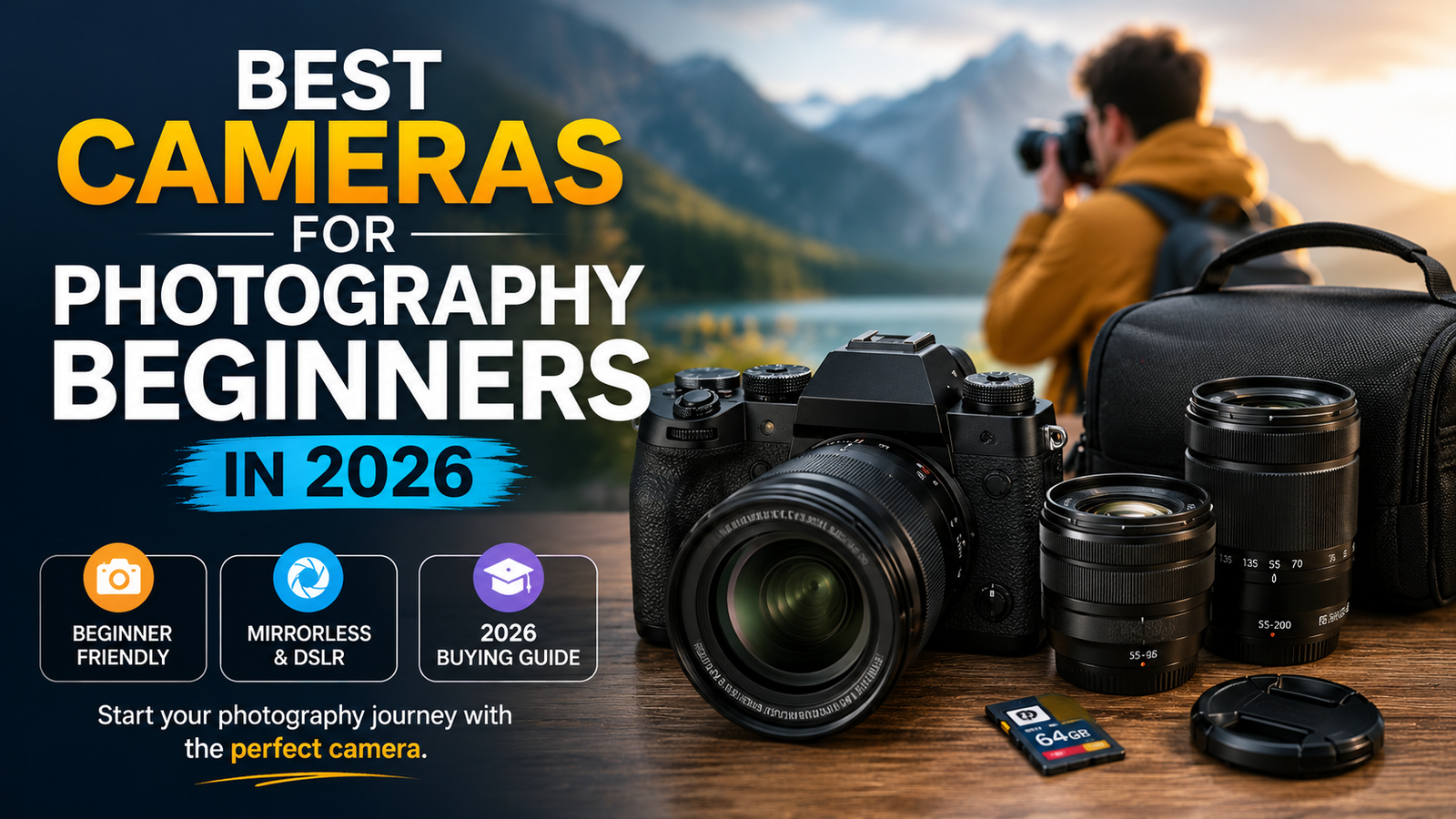
Best Cameras for Photography Beginners in 2026 — Honest Picks
Buying your first camera is genuinely confusing. Every review you read assumes you already know what a crop sensor is, why mirrorless matters, or what APS-C means. You don’t need a photography degree to pick a good beginner camera — you just need someone to cut through the jargon and tell you what actually matters.
I’ve been shooting with different cameras across different budgets for years. Here’s what I’d actually recommend to someone starting out in 2026, without any brand loyalty attached to it.
What to Look for in a Beginner Camera
Before getting into specific models, three things matter more than anything else when picking your first camera:
- Ease of use on auto. You’ll spend your first few months on auto or semi-auto modes. A camera that takes good shots in auto without fighting you is worth more than one with specs you can’t use yet.
- Room to grow. The best beginner cameras teach you something. Manual controls should be accessible when you’re ready — not buried in menus five levels deep.
- A lens ecosystem that makes sense. The camera body matters less than the lenses you’ll buy later. Starting with a brand that has affordable, good-quality lenses available is a long-term advantage.
Best Cameras for Photography Beginners in 2026
1. Canon EOS Rebel SL3 — Best Overall Beginner DSLR
Best for: First-time DSLR buyers who want straightforward controls and great image quality
The SL3 is the smallest DSLR Canon makes, which matters more than you’d think. A camera you’ll actually carry beats a better camera sitting at home. It shoots 24MP stills with Canon’s reliable autofocus, handles decent video (4K, though with a crop), and has a fully articulating touchscreen that makes shooting from odd angles much easier than cameras without one.
Canon’s Guided UI mode literally walks you through settings on-screen as you adjust them — explaining what aperture does as you turn the dial. For complete beginners, that feature alone is worth the price of admission.
Specs at a glance:
- 24.1MP APS-C sensor
- 4K video (1.6x crop) / 1080p full width
- Fully articulating touchscreen
- Dual Pixel AF for smooth video autofocus
- Battery life: ~1,070 shots per charge
- Weight: 359g body only
- ✅ Smallest, lightest DSLR available — easy to carry daily
- ✅ Guided UI explains settings in real time
- ✅ Excellent Canon lens ecosystem with affordable options
- ✅ Reliable autofocus that rarely misses
- ❌ 4K video has a significant crop, limiting wide-angle shooting
- ❌ Single SD card slot
2. Sony ZV-E10 II — Best Mirrorless for Beginners
Best for: Content creators, vloggers, and anyone who shoots video as much as photos
Sony’s ZV-E10 II is built specifically with beginners in mind — and it shows. The side-flip screen, built-in directional microphone, and one-touch background defocus button make it genuinely easier to use than most cameras at this price. Image quality is strong thanks to Sony’s 26MP APS-C sensor, and the autofocus — particularly for tracking faces — is among the best in this price range.
If you’re planning to use this for YouTube, Instagram reels, or any kind of video content alongside photography, the ZV-E10 II makes more sense than a DSLR. It’s designed for exactly that use case.
Specs at a glance:
- 26MP APS-C Exmor R sensor
- 4K 60fps video
- Side-flip fully articulating screen
- Real-time face/eye/subject tracking AF
- Built-in directional 3-capsule microphone
- ✅ Excellent video autofocus — faces lock on and stay locked
- ✅ Side-flip screen ideal for vlogging and selfie-style shooting
- ✅ 4K 60fps at this price is genuinely impressive
- ✅ Compact, lightweight body
- ❌ Battery life is shorter than DSLRs — carry a spare
- ❌ E-mount lenses can be expensive compared to Canon’s EF-S range
3. Fujifilm X-T30 II — Best for Learning Manual Photography
Best for: Beginners who want to learn photography properly, not just take good photos on auto
Fujifilm cameras are different. Physical dials for shutter speed, ISO, and exposure compensation sit on top of the camera body — you can see your settings without turning the camera on. For learning manual photography, this tactile feedback is genuinely valuable. You start understanding exposure intuitively because you’re physically turning dials, not navigating menus.
The X-T30 II also has Fujifilm’s film simulation modes — 18 different colour profiles that replicate classic film stocks. Shots straight out of camera look good without any editing. It doesn’t have in-body image stabilization, which is the main trade-off compared to competitors.
- ✅ Physical dials make learning manual exposure intuitive
- ✅ Film simulation modes produce beautiful JPEG colours straight out of camera
- ✅ Excellent build quality for the price
- ✅ Strong APS-C image quality
- ❌ No in-body image stabilization
- ❌ Smaller battery — plan for a spare on longer shoots
4. Nikon D3500 — Best Budget Beginner Camera
Best for: Beginners on a tighter budget who want a reliable DSLR that just works
The D3500 is several years old now but still holds up as one of the best budget cameras for photography beginners because it gets the fundamentals right. The 24.2MP sensor produces genuinely good images in good light, battery life is exceptional (around 1,500 shots per charge — better than most newer cameras), and the Guide Mode walks beginners through every setting in plain language.
You won’t get 4K video or a flip screen, but for still photography on a limited budget, image quality per dollar is hard to beat. Refurbished units and used copies are widely available at very reasonable prices.
- ✅ Outstanding battery life — 1,500+ shots per charge
- ✅ Excellent image quality from a proven sensor
- ✅ Affordable — especially refurbished or used
- ✅ Guide Mode explains everything for absolute beginners
- ❌ No 4K video, no flip screen, no Wi-Fi built in
- ❌ Discontinued — limited to used/refurbished market
DSLR vs Mirrorless: Which Should a Beginner Choose?
This question gets overcomplicated online. Here’s the practical version:
Choose a DSLR if: You mainly shoot photos, you want longer battery life, and you’re budget-conscious. DSLRs also have larger optical viewfinders, which some beginners find easier to use than electronic ones.
Choose mirrorless if: You shoot a lot of video, you want the camera to be as compact as possible, or you want the most current autofocus technology. Mirrorless is where camera development is focused right now, which means more new lenses and faster improvements.
Either works fine for a beginner. The camera you’ll actually carry and use is more important than which technology it uses.
What Kit Lens to Get With Your First Camera
Almost every beginner camera is sold as a kit with an 18-55mm zoom lens. Buy the kit. It’s not the sharpest lens in the world, but it covers a useful range — wide enough for landscapes, long enough for portraits — and it’s the right lens to learn on. Once you’ve shot a few hundred rolls on it, you’ll know exactly what you want next.
The one upgrade worth considering early is a 50mm f/1.8 prime lens. They’re affordable across Canon, Sony, and Nikon systems, and the f/1.8 aperture lets in significantly more light than the kit lens — better low-light shots and that background blur (bokeh) effect you see in portrait photography.
Frequently Asked Questions
What is the best camera for a photography beginner in 2026?
The Canon EOS Rebel SL3 is the most well-rounded beginner DSLR — it has real teaching features, good image quality, and access to Canon’s affordable lens range. For video-focused beginners, the Sony ZV-E10 II is the stronger choice. Both are excellent starting points depending on how you plan to use the camera.
Is a DSLR or mirrorless better for beginners?
For most beginners focused on photography, a DSLR is still a practical choice — better battery life, more affordable lenses, and proven reliability. For video and content creation, mirrorless cameras like the Sony ZV-E10 II have better autofocus and more compact bodies. Neither is wrong — it depends on your primary use.
How much should a beginner spend on their first camera?
A solid beginner camera with kit lens runs between $500–$900 new. The Canon SL3 and Sony ZV-E10 II both fall in this range. You can spend less with a used Nikon D3500 (under $300 used) or more with a Fujifilm X-T30 II. Spending significantly more than $1,000 as a beginner rarely pays off — technique matters more than gear at the start.
Should I buy a new or used camera as a beginner?
Used cameras are a legitimate option. Camera bodies are generally durable, and a used DSLR from a reputable seller — checked for shutter count and physical condition — can save you significant money. The Nikon D3500 and Canon Rebel T7 are particularly good used purchases because they were produced in large quantities and are well-understood.
What accessories do I actually need with my first camera?
Three things genuinely matter: a spare battery (especially for mirrorless), a fast SD card (Class 10 or UHS-I minimum), and a decent camera bag to protect the investment. Everything else — filters, extra lenses, lighting gear — comes later once you know what you actually need it for.
Final Thoughts
The best camera for a beginner is the one you’ll use consistently. That usually means one that’s comfortable to carry, doesn’t overwhelm you with controls from day one, and produces results you’re happy with while you’re still figuring things out.
The Canon EOS Rebel SL3 hits all three criteria better than most cameras at its price. The Sony ZV-E10 II is the right choice if video is part of your plans. The Fujifilm X-T30 II is the one to pick if you want to genuinely learn photography rather than just take photos.
Start shooting. The learning happens through use, not through research.
🛒 See Canon EOS Rebel SL3 on Amazon →
Also on PickHonestly: CMF Buds Pro 2 vs JLab Go Air Pop — best budget earbuds under $50 tested honestly.
Prices accurate as of publication. Always verify current pricing before purchasing.