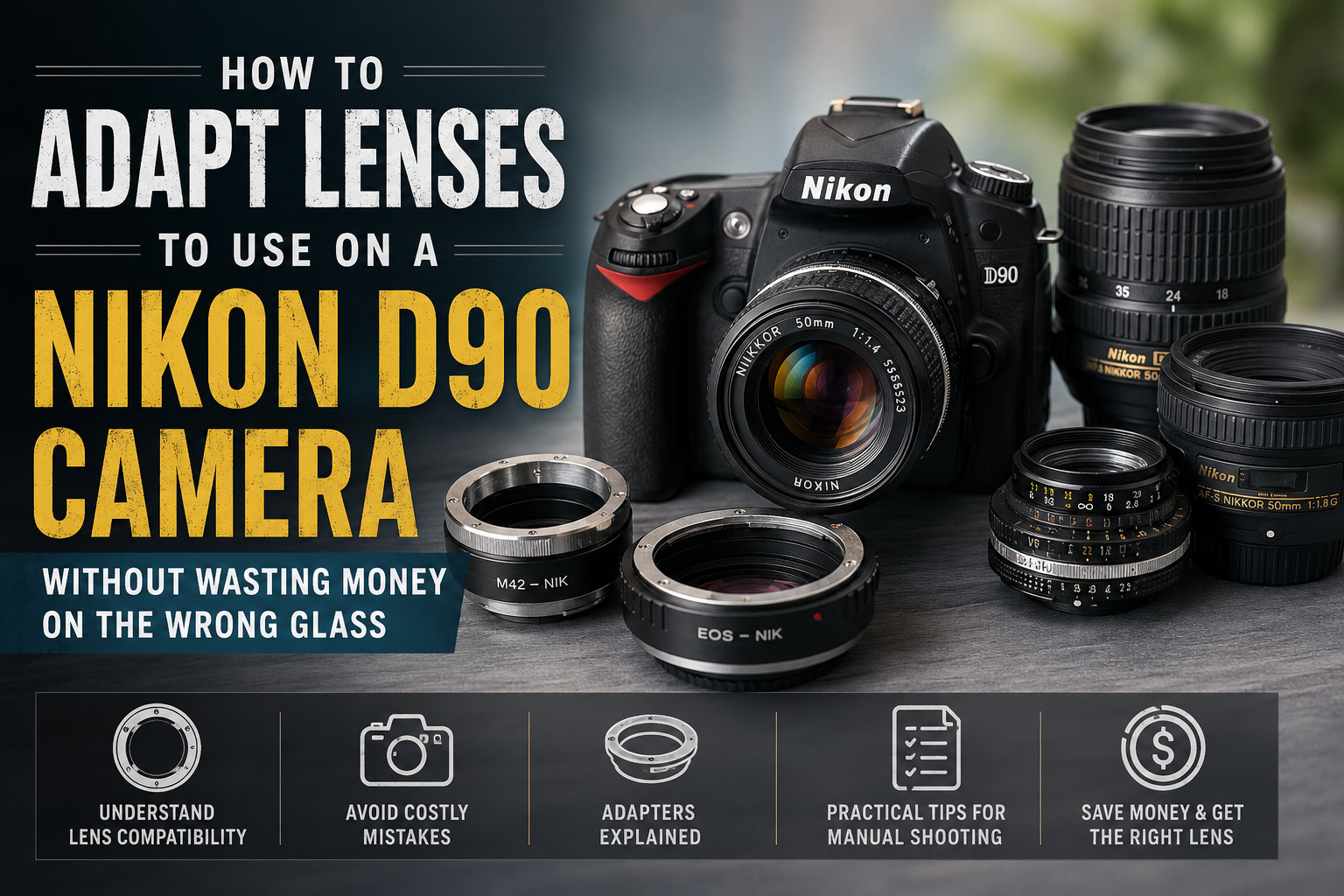
How to Adapt Lenses to Use on a Nikon D90 Camera
If you just picked up a Nikon D90, or you’ve had one sitting in a drawer for years, you’ve probably run into the same question every D90 owner eventually asks: can I adapt lenses to my Nikon D90 camera, and if so, which ones? Maybe it’s an old manual-focus lens from a relative, a Sigma zoom you found secondhand, or even a Canon lens you already own from a different system. The honest answer is: it depends on the mount, the lens generation, and what you’re willing to give up in terms of autofocus and metering.
This guide walks through exactly how lens adaptation works on the D90, which lenses mount safely, which ones can actually damage the camera, and what to expect once everything’s attached. It’s written for people who just want a straight answer, not a spec sheet. If you’re still deciding on a body and lens combo in general, our guide to the best cameras for photography beginners is worth a look before you go lens-shopping.
Why Lens Compatibility Gets Confusing on the D90
The D90 uses Nikon’s F-mount, which has been around since 1959 with only minor revisions. That’s the good news — it means an enormous range of lenses, spanning six decades, can physically attach to the camera. The bad news is that “physically attaches” and “works properly” are two very different things on this camera.
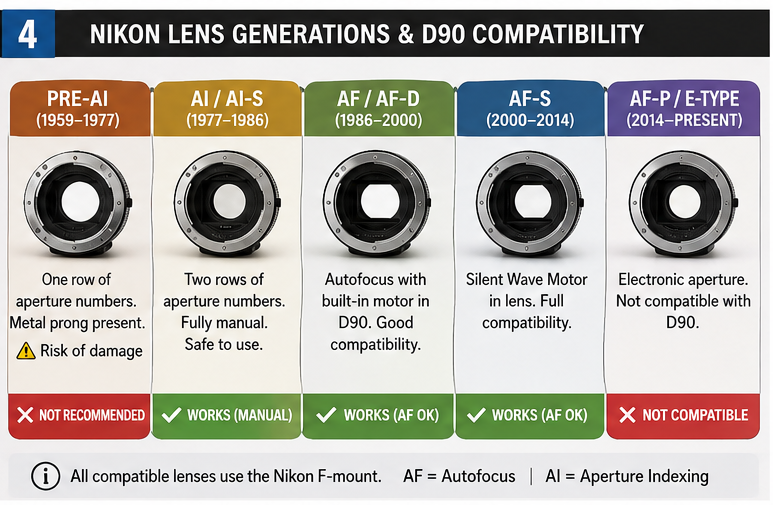
The D90 sits in an odd spot in Nikon’s lineup. It has a built-in autofocus motor, which puts it a step above the D40, D60, and D3000-series bodies that can only autofocus with AF-S lenses. But it’s still an older-generation sensor and metering system, so newer AF-P lenses and E-type lenses (which control aperture electronically instead of mechanically) simply won’t function correctly on it. One thing worth knowing before you buy anything: always check whether a lens is “AF-P” in its name, because those are a hard no on the D90.
Understanding Camera Lenses and How They Talk to the D90
Before adapting anything, it helps to actually understand camera lenses and how Nikon’s naming system reflects real mechanical differences, not just marketing:
- AF-S lenses have their own focus motor built in. These autofocus perfectly on the D90 and are the safest, easiest option for most people.
- AF and AF-D lenses rely on a mechanical screwdriver-style coupling inside the camera body to drive focus. Since the D90 has that motor, these lenses autofocus just fine, though metering is a bit more limited on some.
- AI and AI-S lenses are older manual-focus lenses from the late 1970s through the 1980s. They mount safely on the D90, but you’ll be doing everything manually — focus and exposure.
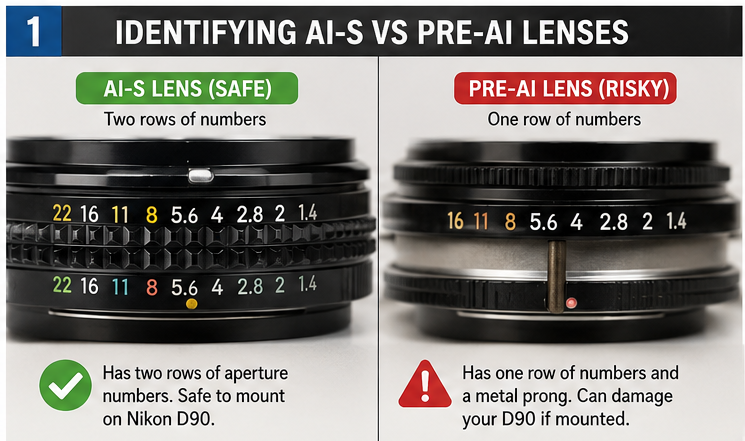
- Pre-AI lenses, made before 1977, are the ones to be genuinely careful with. They have a metal prong on the aperture ring that can physically collide with the D90’s internal AI indexing tab, and mounting one without modification risks real damage to the camera or lens.
In practical use, most people adapting older glass to a D90 are dealing with AI, AI-S, or third-party manual lenses, so it’s worth learning to recognize a Pre-AI lens on sight — if the aperture ring only shows one row of numbers instead of two, leave it off the camera. Nikon’s own compatibility notes, summarized well in Ken Rockwell’s lens compatibility chart, break this down lens by lens if you’re ever unsure about a specific model.
How to Adapt Lenses to a Nikon D90 Camera: What Actually Works
Here’s where things get practical, and this is really the core of how to adapt lenses to a Nikon D90 camera without ending up with the wrong glass.
Nikkor AI/AI-S lenses mount natively — no adapter required. You’ll lose autofocus and in-camera metering (the D90’s meter only activates in Manual mode with these lenses), but the glass itself performs the same as it always did. Many people notice these older primes actually hold up beautifully on modern sensors, especially for portraits.
Sigma camera lenses for Nikon are usually built with the F-mount already integrated, so there’s no adapter step at all — you just attach the lens like any native Nikkor. The one caveat is generation: older Sigma HSM lenses designed for film-era Nikon bodies sometimes behave inconsistently with the D90’s metering, so it’s worth checking a specific model’s compatibility notes before buying used.
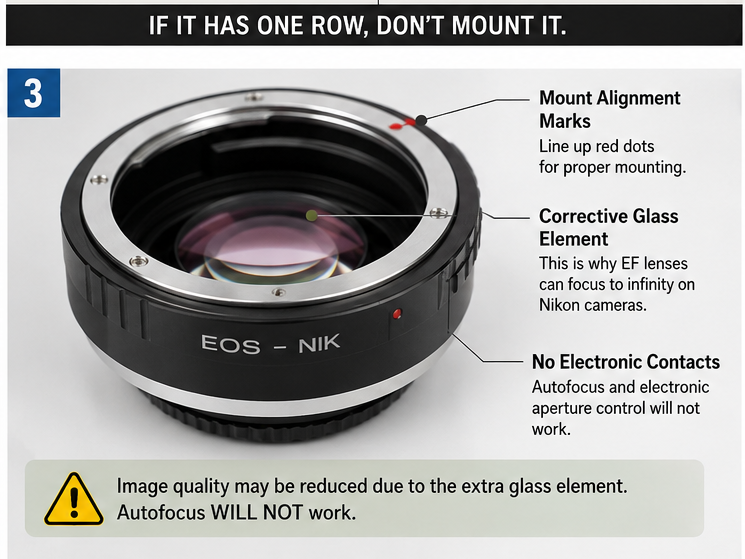
Canon lenses, unfortunately, are the one category that genuinely can’t be adapted with a simple mechanical ring. Canon’s EF mount has a shorter flange distance than Nikon’s F-mount, meaning there isn’t enough physical space to bridge the two systems without adding a corrective glass element. Cheap “Canon EF to Nikon F” adapters exist, but they include an extra lens element that noticeably softens image quality, and autofocus won’t function at all. If you’re weighing canon t5 camera lenses against a Nikon-native option, honestly, buying a used AI or AI-S Nikkor lens will almost always give better results than adapting Canon glass.
Older manual lenses from other brands (Pentax screw-mount, M42, Olympus OM, etc.) require a passive adapter ring, which is inexpensive and widely available. These work in the same manual-everything mode as AI lenses — no electronic communication, no autofocus, no metering, but full image quality.
Common Mistakes People Make When Adapting Lenses
A few mistakes come up again and again in forums and repair shops alike:
- Forcing a Pre-AI lens onto the body. This is the single most damaging mistake, and it’s avoidable just by checking the aperture ring before mounting anything unfamiliar.
- Buying a cheap glass-element adapter expecting native image quality. Adapters with corrective optics, like Canon-to-Nikon versions, always cost you some sharpness and contrast.
- Assuming AF-P lenses will “sort of” work. They won’t autofocus, and on some D90 units the shutter won’t even release with an AF-P lens mounted.
- Skipping the aperture ring lock. AI and AI-S lenses need their aperture ring set correctly and, on some models, locked at minimum aperture for the camera to read exposure at all.
Practical Tips for Manual Shooting on the D90
Since most adapted lenses on the D90 mean manual focus and manual exposure, a few habits make a real difference:
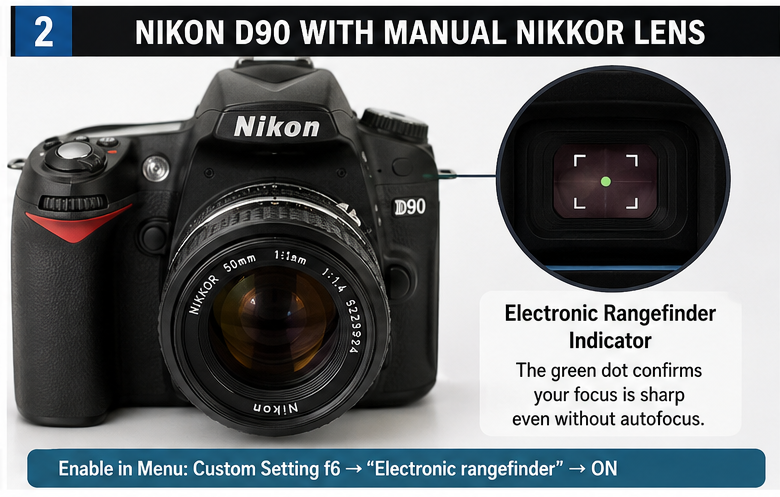
- Turn on the electronic rangefinder in the viewfinder (accessible in the camera menu) — it gives you a focus confirmation dot even without autofocus.
- Shoot in Manual mode and use the in-camera light meter, which still works with non-CPU lenses once you’re in M mode.
- Consider a focusing screen with a split prism, sold aftermarket for older Nikon bodies, if you shoot manual lenses often.
- Stop down and check depth of field visually before firm shots, since there’s no electronic aperture preview with fully manual glass.
Nikon shooters testing the D90 directly, including the hands-on optics review at Imaging Resource, have noted that metering and TTL flash control simply switch off with non-CPU lenses — so it’s better to plan your workflow around Manual mode than to fight the camera on this.
A Note on More Expensive Lenses and White Camera Lenses
People sometimes assume adapting cheaper lenses is the only reason to explore this — but plenty of D90 owners go the other direction too, hunting down some of the most expensive camera lenses secondhand because older professional glass from the film era can be bought for a fraction of its original price and still performs beautifully on a DX sensor like the D90’s. On the flip side, if you’re drawn to white camera lenses (the light-colored barrels associated with certain long telephoto primes), know that most of those are modern AF-S super-telephotos designed for full-frame bodies — they’ll work on the D90 optically, just with a significant crop factor to account for.
Expert-Style Advice Before You Buy an Adapter
After comparing recommendations from long-time Nikon shooters and repair technicians, the advice tends to converge on a few points: stick with native F-mount glass where possible, treat Pre-AI lenses as off-limits unless professionally converted, and skip glass-containing mount adapters entirely unless there’s truly no alternative. A detailed breakdown of Nikon’s lens mount generations at Fstoppers is a good reference if you want to dig deeper into any specific lens era before buying.
FAQ
Can I use Canon lenses on a Nikon D90?
Not without a corrective-optics adapter, and even then autofocus won’t work and image quality suffers. It’s rarely worth it compared to buying native Nikkor glass.
Will old manual Nikon lenses damage my D90?
AI and AI-S lenses are safe. Pre-AI lenses (pre-1977) can physically damage the mount unless they’ve been converted, so always check the aperture ring first.
Do Sigma lenses work on a Nikon D90 without an adapter?
Yes, as long as they’re built in Nikon F-mount, which most Sigma lenses for Nikon are. No adapter is needed.
Does the Nikon D90 meter with non-CPU lenses?
Only in Manual exposure mode. Other modes disable the shutter release when a non-CPU lens is attached.
Can I autofocus with AF-D lenses on the D90?
Yes — the D90 has the built-in focus motor needed for AF and AF-D lenses to autofocus.
Conclusion
Adapting lenses to a Nikon D90 camera really comes down to knowing which era and mount your lens belongs to. Native F-mount Nikkors, whether brand new AF-S models or decades-old AI glass, are the safest and most rewarding path. Third-party options like Sigma slot in just as easily. Cross-brand adapting, especially from Canon, is technically possible but rarely worth the compromise in image quality and lost autofocus. Spend five minutes checking your lens’s mount type before buying anything, and you’ll save yourself both money and a possible trip to a repair shop.