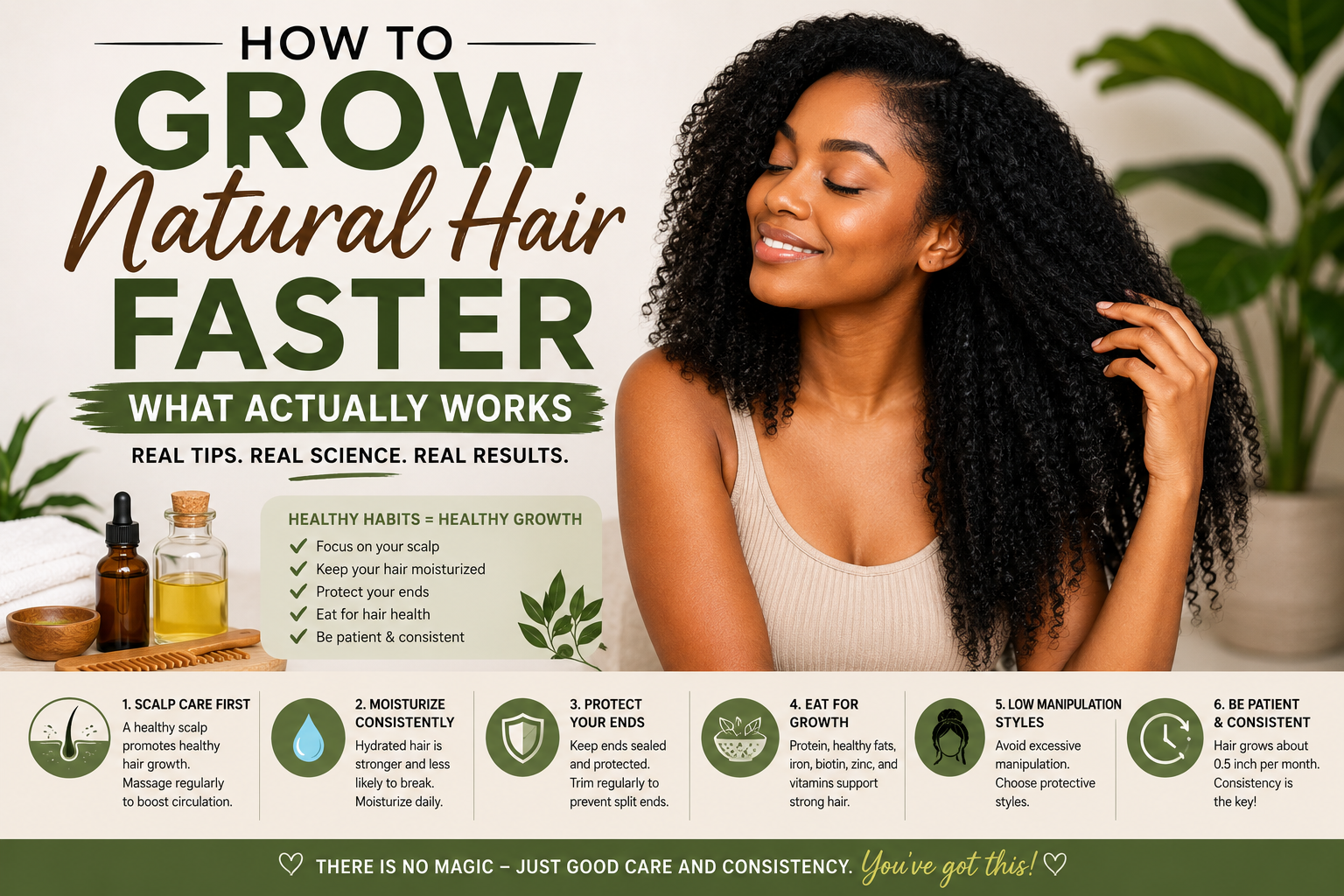
How to Grow Natural Hair Faster — What Actually Works
Natural hair grows. That’s the first thing worth knowing — your hair is growing right now, whether you can see it or not. The reason most people feel stuck at the same length for years isn’t that their hair stopped growing. It’s that their hair is breaking off at roughly the same rate it’s growing in.
Length retention — keeping the hair that grows — is what actually moves the needle. This guide covers what genuinely works, based on what I’ve seen make a consistent difference over three years of paying close attention to my own natural hair.
How Fast Does Natural Hair Actually Grow?
Hair grows about half an inch per month on average — roughly six inches per year. That’s true for almost everyone regardless of hair type. Natural hair doesn’t grow slower than straight hair, despite what you may have heard. What’s different is how much of that growth natural hair retains.
The tight curl pattern of natural hair means strands rub against each other more than straight hair does. That friction causes single-strand knots, tangles, and breakage. Without the right care, natural hair can break off almost as fast as it grows — leaving length seemingly stuck in place for years.
The goal isn’t to speed up growth. It’s to stop breakage so the growth you already have actually shows up as length.
What Actually Helps Natural Hair Grow Longer
1. Deep Condition Every Single Week
This is the single most impactful thing you can do for natural hair length retention. Deep conditioned hair is more elastic — it stretches instead of snapping when it encounters tension from detangling, styling, or even wind. Dry, brittle hair breaks. Moisturized, elastic hair doesn’t.
Apply deep conditioner to freshly shampooed damp hair, cover with a shower cap, add heat if possible, and leave on for at least 30 minutes. Do this every wash day without skipping. Most people who see dramatic length retention improvements made deep conditioning consistently the first change they made.
For specific product recommendations, our guide to the best deep conditioners for natural hair covers what works across different hair types.
2. Retain Moisture Between Washes
Dry hair breaks. It’s that simple. Natural hair that stays moisturized between wash days holds onto length because it stays flexible and resilient rather than brittle and snappy.
The LOC method — Liquid, Oil, Cream — is the most effective way to keep natural hair moisturized between washes. Apply a water-based leave-in to damp hair, follow with a light oil to slow moisture evaporation, then seal with a cream or butter. Refresh dry sections every 2-3 days without fully rewetting your hair.
See our full breakdown of how to moisturize natural hair for the complete method explained step by step.
3. Handle Your Hair Less
Every time you touch your natural hair — detangling, restyling, pulling, manipulating — you create opportunities for breakage. The less you handle natural hair, the more length it retains.
This doesn’t mean never touching your hair. It means being intentional about when and how. Style your hair in a way that lasts multiple days so you’re not redoing it every morning. Detangle only on wash day when conditioner provides slip. Avoid running fingers through your hair throughout the day — it creates tangles and breaks individual strands.
4. Wear Protective Styles
Protective styles — twists, braids, buns, updos — tuck the ends of your hair away where they can’t rub against clothing, pillowcases, or each other. The ends are the oldest and most fragile part of natural hair. Keeping them protected dramatically reduces the breakage that causes length to stall.
The rule with protective styles: install them on properly moisturized hair, don’t make them too tight, and don’t leave them in so long that your hair starts matting underneath. Two to four weeks for most protective styles is a reasonable window — long enough to give your hair a break, short enough that you can still monitor moisture levels and catch any breakage early.
5. Sleep on Satin or Silk
Cotton pillowcases cause friction. Six to eight hours of that friction every night pulls moisture from natural hair and creates tangles that lead to breakage. This is one of the most underrated causes of length stalling — and one of the easiest to fix.
Switch to a satin or silk pillowcase, or sleep with a satin bonnet. Either works. Within a week you’ll notice your hair feels softer in the morning and has less matting at the back — the area that gets the most pillowcase contact. Over months, that reduced friction adds up to real length retention.
6. Be Careful With Heat
Occasional heat styling on properly moisturized natural hair won’t ruin your length goals. Frequent heat styling without proper protection will. High heat damages the protein structure of the hair shaft — and that damage is permanent. Damaged hair breaks easily and doesn’t hold moisture.
If you use heat regularly, apply a heat protectant every single time and use the lowest temperature that achieves the result you want. Take extended breaks from heat — six to eight weeks between straightening sessions gives your hair time to recover. If your natural hair has been heat damaged, our deep conditioning guide covers the Briogeo repair mask, which is one of the better options for recovering damaged natural hair.
7. Trim When Needed — Not on a Schedule
The idea that regular trims make hair grow faster is one of the most persistent myths in natural hair care. Trims don’t affect growth — hair grows from the scalp, not the ends. What trims do is remove split ends that would otherwise travel up the hair shaft and cause more breakage.
Trim when your ends are visibly split or when they feel rough and snagged during detangling — not on a fixed schedule. Over-trimming is a real reason some people never gain length. Look at your ends honestly and trim only what’s actually damaged.
8. Take Care of Your Scalp
Healthy hair starts at the scalp. A clean, stimulated scalp produces healthier hair from the root. Massage your scalp for three to five minutes on wash day — this increases blood flow to the follicles and supports healthy hair production. Use your fingertips, not your nails.
Rosemary oil has real research behind it for scalp health and hair growth. Dilute a few drops in a carrier oil like jojoba and massage into the scalp two to three times per week. It won’t dramatically speed up growth, but consistent use over several months shows real results in edge density and overall scalp health.
What Doesn’t Work (Despite What You’ve Heard)
Supplements alone won’t grow your hair faster. Biotin supplements are massively marketed for hair growth. If you have a genuine biotin deficiency, supplementing helps. If you don’t, extra biotin does nothing for growth rate. Most people who take biotin and notice results were also changing their hair care routine at the same time — that’s what made the difference.
Castor oil applied to ends doesn’t grow hair. Castor oil is a good sealant — it’s thick and creates a barrier that slows moisture loss. That’s useful. But it doesn’t stimulate growth. Apply it where it’s useful: as a sealant over leave-in, and on the scalp if you like the massaging practice.
Protective styles don’t grow hair by themselves. Protective styles reduce breakage by reducing manipulation. If you install a protective style on dry, brittle hair and don’t maintain moisture underneath, you’ll take it down to find more breakage than if you’d left your hair out. The style protects; moisture is still your job.
Natural Hair Growth by Hair Type
3A and 3B Natural Hair
Looser curl patterns retain length more easily because there’s less coil-on-coil friction. The basics still apply — deep conditioning, moisture retention, protective styles — but this texture can generally handle more manipulation without immediate breakage. Focus on keeping ends moisturized and trimming split ends promptly.
3C and 4A Natural Hair
These textures sit in the middle — more prone to tangling and breakage than looser curls, but generally easier to manage than 4B and 4C. Deep conditioning weekly and wearing protective styles regularly are the two highest-impact habits for length retention at these textures.
4B and 4C Natural Hair
The tightest coil patterns are the most prone to single-strand knots, tangles, and breakage. Length retention at 4B and 4C requires the most intentional care — weekly deep conditioning without exception, the LOC method for between-wash moisture, satin at night, low manipulation styling, and protective styles for extended periods. The hair absolutely grows. The challenge is keeping it.
Our guide to the best products for 4C natural hair covers specific product recommendations for the driest, most fragile natural hair textures.
Frequently Asked Questions
How long does it take to grow natural hair?
Hair grows about half an inch per month — six inches per year. How quickly you see length depends on how much breakage you’re experiencing. Reduce breakage significantly and you can see several inches of retained length in a year. The habits that matter most: deep conditioning weekly, moisture retention between washes, protective styles, and satin at night.
Why does my natural hair grow but then break off?
This is the most common natural hair length frustration. Hair breaks off at roughly the same rate it grows, leaving length stuck in place. The causes are almost always: not deep conditioning regularly enough, hair drying out between washes, too much manipulation, no protective style use, or sleeping on cotton. Address those five things and retained length follows.
Does trimming natural hair help it grow?
Trimming doesn’t affect growth rate — hair grows from the scalp and trimming the ends has no connection to that. What trimming does is remove split ends before they travel up the hair shaft and cause more breakage. Trim when ends are visibly damaged — not on a fixed schedule and not more than what’s actually split or rough.
What vitamins help natural hair grow?
If your diet is genuinely deficient in something — iron, vitamin D, zinc, or B vitamins — addressing that deficiency can improve hair health. But supplements work for deficiencies, not as growth accelerators for people who are already adequately nourished. The most consistent “vitamins” for natural hair growth are moisture, protective styles, and reduced manipulation — none of which come in a capsule.
Does scalp massage help natural hair grow?
There is research supporting scalp massage for hair thickness and density — it increases blood flow to follicles. Used consistently alongside rosemary oil, it supports a healthy scalp environment. It won’t double your growth rate, but it’s a useful habit that costs nothing and takes five minutes per wash day.
Final Thoughts
Growing natural hair longer isn’t about finding the right product or the right supplement. It’s about stopping breakage — and breakage comes from dryness, friction, and too much manipulation. Fix those three things and your natural hair will retain the length it’s already growing.
Start with the basics: deep condition every wash day, keep hair moisturized between washes using the LOC method, sleep on satin, handle your hair less. Give it three months of consistency before judging whether it’s working. Natural hair changes slowly — and then all at once.
More from PickHonestly on natural hair care:
- Best Leave-In Conditioners for Natural Hair
- Best Deep Conditioners for Natural Hair
- Best Sulfate-Free Shampoos for Natural Hair
- How to Moisturize Natural Hair — Complete Guide
- Best Products for 4C Natural Hair
Prices accurate as of publication. Verify current pricing before purchasing.