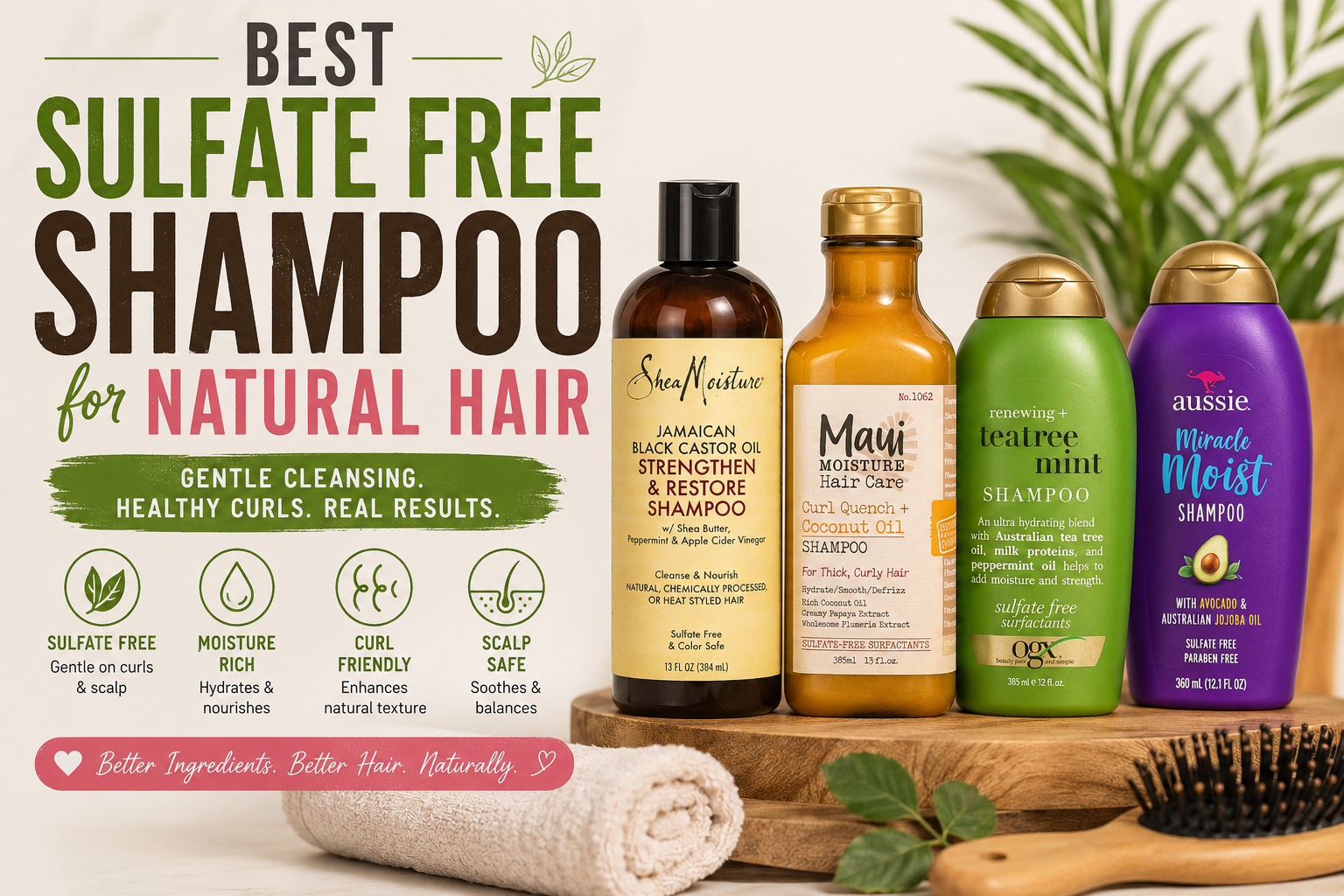
Best Sulfate-Free Shampoos for Natural Hair (2026) — Honest Review
If your natural hair feels dry, rough, or stripped after every wash — your shampoo is probably the problem. Most regular shampoos contain sulfates, and sulfates are too strong for natural hair. They clean, yes. But they clean out everything, including the moisture your hair actually needs.
Switching to a sulfate-free shampoo made a bigger difference to my natural hair than any conditioner or oil I’ve ever tried. Here’s what I actually recommend after testing a lot of them.
What Are Sulfates and Why Do They Hurt Natural Hair?
Sulfates are cleaning agents — sodium lauryl sulfate (SLS) and sodium laureth sulfate (SLES) are the most common ones. They create that thick lather we’re all used to from regular shampoo.
The problem is they’re too good at their job. Natural hair — especially coily and curly textures — already struggles to keep moisture in because of the tight curl pattern. When you add a sulfate shampoo on top of that, it strips away what little moisture the hair had. You’re left with hair that’s clean but completely dry.
Sulfate-free shampoos use gentler cleaning ingredients that remove dirt and buildup without that level of stripping. Your hair still gets clean — it just doesn’t get dried out in the process.
Best Sulfate-Free Shampoos for Natural Hair in 2026
1. SheaMoisture Jamaican Black Castor Oil Shampoo — Best Overall
Best for: All natural hair types, especially dry and damaged hair
This is the one I recommend first to anyone asking about sulfate-free shampoos for natural hair. Jamaican black castor oil has been used for decades in natural hair care because it strengthens the hair while cleansing — not just after, but during the wash itself. Combined with peppermint for scalp stimulation, this shampoo leaves hair clean without that dry, squeaky feeling that sulfate shampoos cause.
It lathers less than regular shampoo — that’s normal and expected with sulfate-free formulas. Less lather does not mean less clean. Work it into the scalp in sections, massage well, and rinse thoroughly. That’s all it needs.
- ✅ Cleans without stripping natural oils
- ✅ Jamaican black castor oil strengthens while cleansing
- ✅ Works on all natural hair types from 3A to 4C
- ✅ Easy to find at most drugstores
- ✅ Affordable price for the size
- ❌ Less lather than regular shampoo — takes getting used to
- ❌ May not remove very heavy product buildup — use a clarifying shampoo monthly if needed
Price: $11–$14
2. Mielle Organics Babassu Oil & Mint Deep Conditioning Shampoo — Best for Very Dry Hair
Best for: Natural hair that feels dry no matter what you do
Mielle’s babassu oil shampoo is different from most because babassu oil actually penetrates the hair shaft — it doesn’t just sit on the surface. This means your hair gets moisture during the wash, not just after. If your natural hair is the kind that feels dry an hour after washing no matter what products you use, this shampoo is worth trying.
The mint keeps the scalp feeling clean and fresh. Use it on wash day before deep conditioning and you’ll notice your hair feels softer even before you apply the conditioner.
- ✅ Babassu oil penetrates hair for moisture during washing
- ✅ Great for persistent dryness that other shampoos don’t fix
- ✅ Works well for 4B and 4C hair specifically
- ❌ Harder to find in stores — mostly online
- ❌ Smaller bottle than some alternatives
Price: $10–$13
3. TGIN Moisture Rich Sulfate-Free Shampoo — Best for Sensitive Scalp
Best for: Natural hair with a sensitive or dry scalp
TGIN (Thank God It’s Natural) makes this shampoo specifically for natural hair that needs moisture, not just cleanliness. Honey as a key ingredient means it’s a humectant — it pulls moisture toward the hair while washing instead of pushing it away. For people who struggle with a dry, itchy scalp alongside dry hair, this combination works better than most options.
It’s gentle enough to use weekly without worrying about over-stripping. Great for people who are new to sulfate-free shampoos and want something that feels similar to regular shampoo.
- ✅ Honey adds moisture while cleansing — not just after
- ✅ Very gentle on sensitive or dry scalps
- ✅ Good option for beginners switching from regular shampoo
- ✅ No sulfates, parabens, or silicones
- ❌ Not strong enough for heavy buildup from thick styling products
Price: $12–$15
4. Kinky Curly Come Clean Shampoo — Best Clarifying Sulfate-Free Shampoo
Best for: Monthly deep cleanse without sulfates
Every natural hair routine needs a clarifying shampoo once a month — product buildup from creams, butters, and oils blocks moisture from getting into the hair shaft over time. Most clarifying shampoos contain sulfates. Kinky Curly’s Come Clean is one of the few that clarifies effectively without them, using mandarin orange extract to break down buildup naturally.
Use it once a month maximum — it’s stronger than a regular sulfate-free shampoo and will dry out the hair if used every week. Always follow with a deep conditioner when using this one.
- ✅ Removes product buildup without sulfates
- ✅ One of the only genuinely effective sulfate-free clarifying shampoos
- ✅ Natural ingredients — no harsh chemicals
- ❌ Use monthly only — too drying for weekly use
- ❌ More expensive than weekly shampoo options
Price: $13–$16
How to Wash Natural Hair with Sulfate-Free Shampoo — The Right Way
Switching to sulfate-free shampoo is only half the equation. How you wash matters just as much as what you use.
- Detangle before washing. Wet, tangled natural hair breaks. Detangle dry or slightly damp hair before getting in the shower — use a wide-tooth comb or your fingers, working from ends to roots.
- Focus shampoo on the scalp only. Natural hair doesn’t need shampoo scrubbed through the length. Apply it to the scalp, massage well, and let the rinse water carry it through the rest. Scrubbing through the length causes friction and breakage.
- Work in sections. Divide your hair into four sections. This keeps it manageable and makes sure you actually clean the whole scalp.
- Rinse thoroughly. Sulfate-free shampoos can leave residue if not rinsed well. Take an extra 30 seconds rinsing each section.
- Deep condition immediately after. Never let natural hair sit without moisture after washing. Apply deep conditioner right away.
How Often Should You Use Sulfate-Free Shampoo on Natural Hair?
Once a week works for most natural hair types. Some people with very dry 4C hair do better washing every 10-14 days and co-washing (using conditioner only) in between.
How quickly your scalp gets oily and how much product you use between washes are the best guides — not a fixed schedule. If your scalp feels clean after 10 days, there’s no reason to wash sooner.
Once a month, replace your regular sulfate-free shampoo with a clarifying shampoo like Kinky Curly Come Clean to remove buildup that regular washing can’t fully clear.
What to Look for When Buying Sulfate-Free Shampoo for Natural Hair
Not all sulfate-free shampoos are the same. Here’s what actually matters:
- No SLS or SLES — these are the main sulfates to avoid. Check the ingredients list, not just the front label.
- Moisturizing ingredients — look for shea butter, honey, aloe vera, glycerin, or natural oils in the first half of the ingredients list.
- No silicones — silicones (dimethicone, cyclopentasiloxane) build up over time and block moisture. Avoid them in shampoos unless you’re also clarifying regularly.
- No heavy alcohols — some short-chain alcohols like cetyl alcohol are fine, but isopropyl alcohol and SD alcohol dry hair out.
Frequently Asked Questions
Is sulfate-free shampoo better for natural hair?
Yes — for almost all natural hair types. The tight curl pattern of natural hair makes it harder for the scalp’s natural oils to travel down the hair shaft, so natural hair is already prone to dryness. Sulfate shampoos make this worse by stripping the oils that are there. Sulfate-free shampoos clean the scalp without that level of drying.
Why does my hair still feel dry after switching to sulfate-free shampoo?
The shampoo is usually not the only issue. Check whether you’re deep conditioning every wash day, applying leave-in on wet hair before sealing with oil, and sleeping on satin instead of cotton. Switching shampoo alone won’t fix dryness if the rest of the routine isn’t supporting moisture retention. Our full natural hair care guide covers the complete routine in detail.
Can I use sulfate-free shampoo every day?
No — even sulfate-free shampoos will dry out natural hair if used daily. Once a week is usually enough. Daily washing removes too much moisture and strips the scalp’s natural oils.
Do sulfate-free shampoos work for 4C hair?
Yes — 4C hair actually benefits the most from sulfate-free shampoos because 4C is the driest hair type. The tight coil pattern already makes moisture retention difficult. Regular sulfate shampoos make it significantly worse. All four shampoos recommended here work well for 4C hair specifically.
What is the difference between sulfate-free and clarifying shampoo?
Sulfate-free shampoo is gentle and meant for weekly use — it cleans without stripping. Clarifying shampoo removes heavy buildup that regular washing can’t clear, and it’s stronger. Some clarifying shampoos contain sulfates, some don’t. Use a gentle sulfate-free shampoo weekly and a clarifying shampoo once a month.
Final Thoughts
Switching to a sulfate-free shampoo is one of the most straightforward improvements you can make to a natural hair routine. The difference shows up within the first few washes — hair retains moisture better, feels softer after washing, and needs less product to stay moisturized between wash days.
Start with the SheaMoisture Jamaican Black Castor Oil shampoo — it’s affordable, widely available, and works across all natural hair types. Add the Kinky Curly Come Clean once a month for clarifying. That combination handles most natural hair cleansing needs without any sulfates.
More from PickHonestly on natural hair care:
- Best Products for 4C Natural Hair
- Complete Natural Hair Care Guide
- Best Natural Hair Care Products for Every Step
- Best Natural Hair Care Products — What’s Worth Buying
Prices accurate as of publication. Verify current pricing before purchasing.