
Silk for Natural Hair: What It Actually Does (and Doesn’t Do)
What Silk Actually Does for Natural Hair
Silk for natural hair has two genuinely proven benefits, and everything else brands claim is a variation on these two. Understanding the mechanics matters, because it tells you exactly what to expect — and what to ignore.
1. Less friction means less breakage
Every night you shift your head 30 to 40 times in your sleep, and each movement drags your strands across your pillowcase. Cotton is a rough, absorbent fiber; its surface catches the raised cuticle layers of coily hair like sandpaper on wood shingles. Silk’s surface is smooth on a microscopic level, so hair glides instead of catching.
The size of the difference is now measurable. In November 2025, an independent textile research institute tested 22-momme mulberry silk against cotton using precision lab equipment (a Texture Analyzer TA-416) on real human hair — including curly and coily samples. Silk produced 34% less friction than cotton; cotton generated 51% more hair-damaging friction than silk. (Honest caveat: the study was commissioned by a silk brand, Mulberry Park Silks, though run by an independent lab. It’s real data, not a peer-reviewed journal paper.) Read the full independent friction study.
Dermatologists say the same thing without the marketing: Consumer Reports’ expert review of silk pillowcases quotes hair educators explaining that cotton catches the shingled cuticle layer and tears it, and that curly hair — whose cuticle naturally lifts where the wave pattern is strongest — needs the gentlest surface most.
What does less friction mean in practice? Fewer tangles to detangle in the morning, fewer single-strand knots, fewer snapped ends, and less frizz where the cuticle has been roughed up. It does NOT mean your hair will grow faster — it means the length you grow is less likely to break off before you see it. This is length retention, and for natural hair, length retention is everything. For more on keeping the length you grow, see our guide to growing natural hair faster — and our friction-free detangling guide, since morning tangles are where friction damage usually happens.
2. Silk keeps moisture where it belongs — in your hair
Cotton is highly absorbent. Overnight, it wicks away the natural oils on your scalp and the leave-in conditioner, oils, and creams you applied before bed. For natural hair — which already holds onto moisture less well than straight hair — this nightly siphoning is a real problem. You can do a perfect evening routine and still wake up dry, because your pillowcase drank half of it.
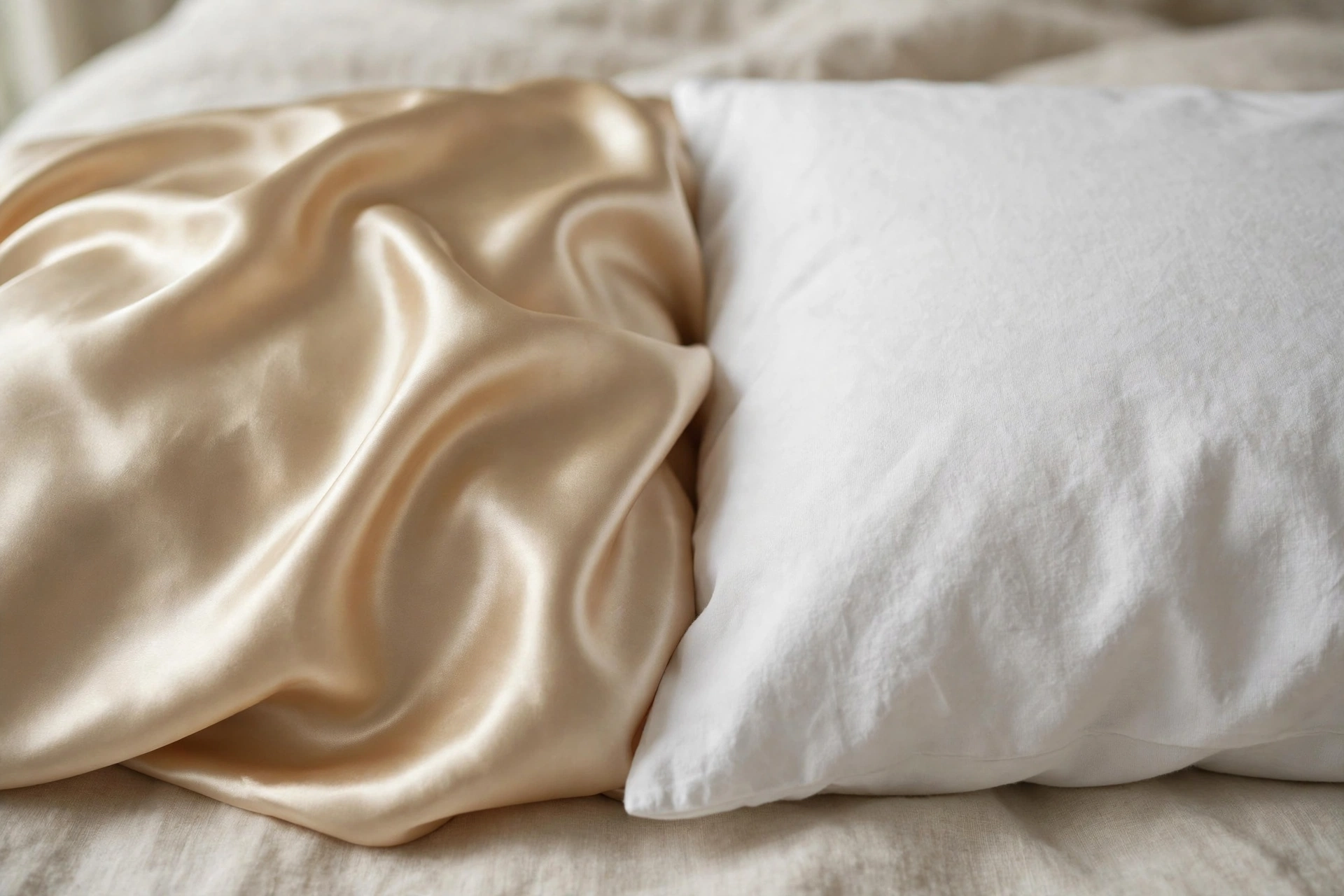
Silk absorbs far less. Dr. Janiene Luke, an associate professor of dermatology at Loma Linda University, told Consumer Reports there is real evidence that silk pillowcases absorb less moisture than typical cotton ones, and that the benefit is “more pronounced for hair, especially curly and textured hair.” The logic is a domino effect: silk doesn’t absorb your moisture, so your hair stays moisturized, and moisturized hair isn’t as prone to breakage. Consumer Reports’ dermatologist-backed review covers this in detail.
One practical note: this also means silk preserves your style. Twist-outs, braid-outs, and wash-and-go definition survive the night better on silk because the fabric isn’t roughing up the curl pattern or stealing the product holding it together.
What Silk CAN’T Do (Honest Limits)
Silk brands would love you to believe a pillowcase is a hair treatment. It isn’t. Here is what silk will not do, no matter what the product page says.
It won’t stop hair loss or shedding
Real hair loss — alopecia, postpartum shedding, stress-related shedding, hereditary thinning — comes from inside the follicle, not from your pillowcase. No fabric can reach the follicle. Dermatologists are explicit about this: Consumer Reports’ review notes that while silk may prevent breakage, it will not prevent hair loss, which is caused by medical or hereditary factors. Reducing breakage and stopping shedding are two completely different things, and a brand that blurs them is selling to you, not informing you.
It won’t feed your hair protein or amino acids
Some brands claim that because silk contains the amino acids sericin and fibroin, sleeping on it transfers them into your hair and skin. Doctors say this is not true — silk fabric does not deliver nutrients into your strands. Products that genuinely contain silk derivatives are topically applied or injected in controlled formulations; a pillowcase is neither. If you want protein, use an actual protein treatment — silk is a surface, not a treatment.
It won’t replace conditioning or a real routine
Silk preserves the condition your hair is in; it doesn’t create condition. If your hair is dry, damaged, and protein-deficient, a silk pillowcase will keep it exactly as dry, damaged, and protein-deficient as it was — just with less friction added overnight. Silk is an amplifier of a good routine, not a substitute for one. Our 4C hair care routine guide covers the foundational steps silk works best alongside.
It won’t protect your edges if the bonnet is too tight
This one matters for 4C wearers. A silk bonnet with a too-tight elastic band can cause exactly the kind of mechanical stress silk is supposed to prevent — constant tension on the hairline. The American Academy of Dermatology warns that tight hairstyles and accessories that pull can cause traction alopecia, and a bonnet edge digging into your hairline all night counts. Silk the material is gentle; a badly fitted bonnet is not. Size and elastic matter as much as fabric — more on that below.
4 Ways to Use Silk for Natural Hair
1. Silk pillowcase — the easiest upgrade
Swap your cotton pillowcase for silk and every strand gets the low-friction treatment with zero effort. Best for: people who hate wearing anything on their head at night, short hair, and anyone whose bonnet keeps sliding off. The trade-off: your hair still moves around the pillow, so you get less frizz protection than with a bonnet. Bonus: your skin gets the smooth surface too.
2. Silk bonnet — maximum protection for coily hair
A bonnet wraps your hair completely, so strands barely touch anything while you sleep. For long, dense 4C hair this is the gold standard — nothing else keeps twist-outs intact and edges smooth like full containment. The trade-off: fit matters. Too loose and it slides off by 3 a.m.; too tight and it stresses your edges. Look for adjustable bands or tie-style bonnets, and get a size big enough for your actual hair volume (many “standard” bonnets are designed for straight hair).
3. Silk scarf or wrap — for styled hair and daytime
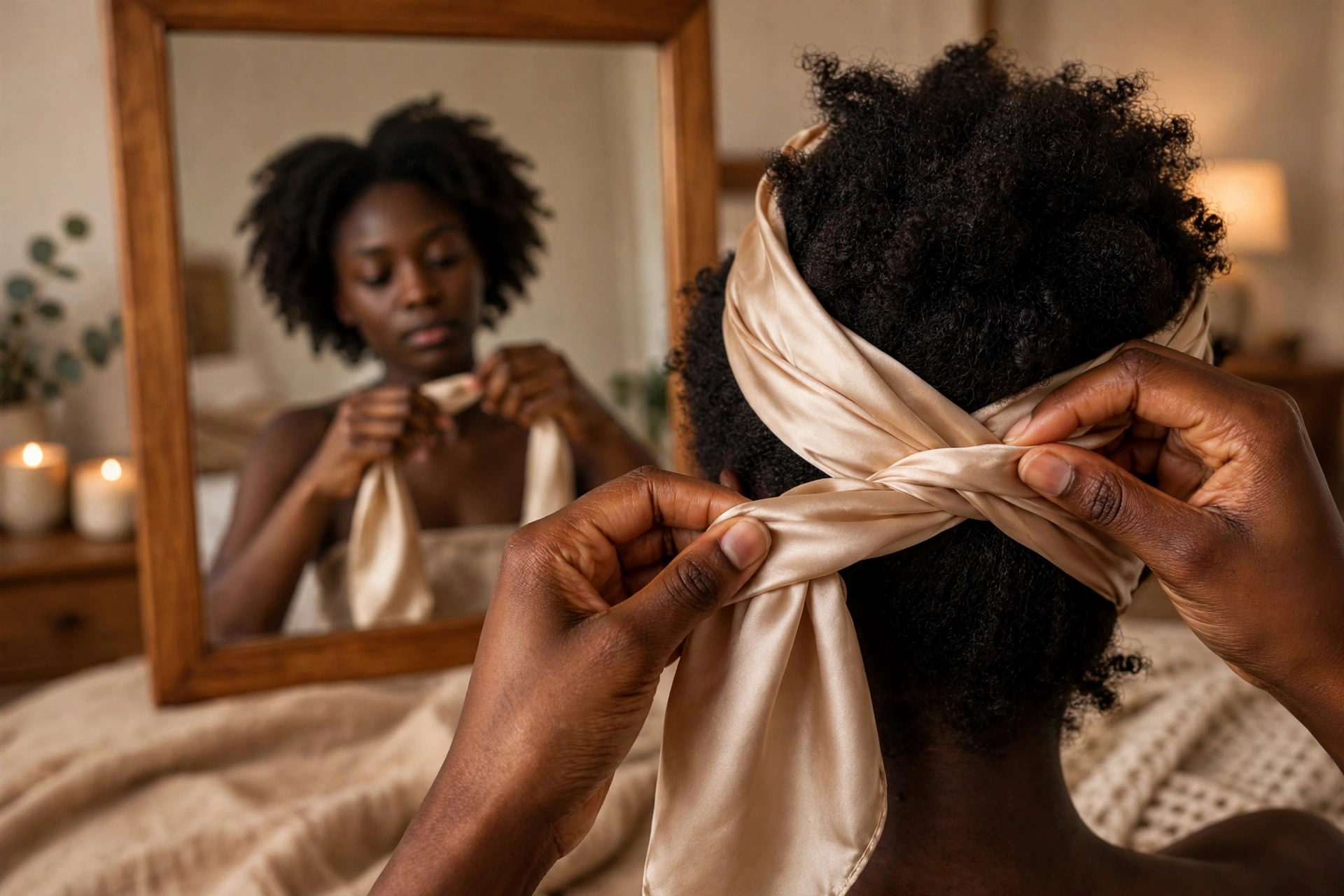
A silk scarf wrapped around your hair protects styled hair (silk presses, wraps, roller sets) overnight and doubles as daytime protection in wind, dust, and dry air. Wrapping takes practice, but it gives you more control over lay-down edges than a bonnet. Also useful over protective styles — a scarf over braids or twists keeps them neat and frizz-free for weeks longer.
4. Silk scrunchies — small upgrade, real difference
Regular elastic bands create a single line of concentrated friction and tension; silk scrunchies distribute pressure and let hair glide. Swap them for pineappling, puffs, and loose buns. They’re cheap, and unlike a bonnet, you’ll use them every day.
How to Wear a Silk Bonnet on 4C Hair (Step by Step)
Most bonnet tutorials assume fine, straight hair. Here’s the version for thick, coily hair.
Step 1: Prep your hair loosely
Never stuff a tangled wash-and-go into a bonnet. Loosely pineapple your hair (one high loose ponytail with a silk scrunchie), or gather it into 2-4 loose twists or braids. The goal is controlled, not tight — you want to prevent tangling, not stretch your hair flat.
Step 2: Moisturize first if it’s wash day (or refresh day)
Apply your leave-in and seal with oil BEFORE the bonnet goes on — this is exactly what silk preserves overnight. Bonnet on dry, unmoisturized hair just preserves dryness.
Step 3: Flip forward and scoop
Flip your head forward so your hair falls away from your neck. Hold the bonnet open with both hands and scoop all your hair up into it in one motion, starting from the nape. For very long hair, fold the length in loosely before scooping.
Step 4: Position the band on your forehead, not your hairline
This is the edges-protection step. The band should sit on your forehead skin (about an inch above your hairline), not on the baby hairs themselves. Tuck any loose edge hairs gently inside — they should not be trapped under elastic tension.
Step 5: Secure without strangling
If your bonnet has an adjustable slider or ties, tighten until it stays put when you shake your head gently — no tighter. The “two-finger test”: you should be able to slide two fingers under the band. If you can’t, it’s too tight and your edges will pay for it.
Step 6: Morning release
Remove the bonnet before you start moving around. Shake your hair out gently from the roots; don’t rake through it. Refresh with a light mist of water or leave-in only where needed — one advantage of silk is that most days you won’t need a full re-style.
Silk vs Satin vs Cotton: The Honest Comparison
Here’s the comparison the silk brands don’t want you to read carefully — because the honest answer is that satin is a legitimate alternative.
| Factor | Real Silk | Satin | Cotton |
|---|---|---|---|
| What it is | Natural protein fiber from silkworms | A weave, not a fiber — usually polyester | Natural plant fiber |
| Friction on hair | Lowest (34% less than cotton in lab tests) | Low — similar glide to silk | Highest — rough, catches cuticles |
| Moisture absorption | Very low — keeps oils in hair | Very low — polyester doesn’t absorb | High — wicks moisture away overnight |
| Breathability | Excellent — temperature regulating | Poor — polyester traps heat | Good |
| Durability | Years with proper care | Months — pills and thins | Years |
| Care | Hand wash or delicate cycle, air dry | Machine washable | Machine washable |
| Price | $$$ (real mulberry silk costs real money) | $ (very affordable) | $ |
| Ethics | Not vegan (silkworm-derived) | Vegan-friendly | Varies |
The honest verdict: for hair protection specifically, a good satin bonnet or pillowcase delivers most of silk’s benefit — low friction, low moisture absorption — at a fraction of the price, with easier washing, and it’s vegan. Silk’s real advantages are breathability (matters if you sleep hot), longevity, and natural-fiber preference. If budget is the constraint, buy satin and spend the savings on a good deep conditioner — that will do more for your hair than the fiber difference ever could. If you want the best and can afford it, real mulberry silk is the premium choice.
How to Buy Real Silk (and Spot the Fakes)
The word “silk” on packaging means almost nothing. Here’s how to buy the real thing.
- Look for “100% mulberry silk” on the label. “Silk-like,” “silky,” “satin silk,” or just “silk” without a percentage usually means polyester satin. If the listing won’t say 100%, it isn’t.
- Check the momme count: 19–25 is the sweet spot. Momme (mm) measures silk weight and density. Below 19 is thin and wears out fast; 22–25 is durable and luxurious. For pillowcases, 22 momme is the standard recommendation; for bonnets, 19+ is fine.
- Charmeuse weave for pillowcases. Charmeuse is the smooth, lustrous weave that gives silk its glide. For bonnets, either charmeuse or a double-layer construction works — double-lined bonnets (silk inside and out) last longer and don’t flip inside-out at night.
- Both sides should be silk. Cheap pillowcases put silk on one side and polyester on the other. You sleep on both sides — check the listing for “both sides 100% silk.”
- Price is a signal. Real 22-momme mulberry silk cannot be manufactured and sold for $9.99. If the price looks like satin, it is satin. Expect to pay a real premium for a real silk pillowcase; bonnets and scarves cost less since they use less fabric.
- Size matters for 4C hair. Measure your hair’s actual volume. Many bonnets are sized for straight, fine hair — look for “XL,” “extra-large,” or bonnets marketed specifically for curly/coily hair with adjustable bands. A bonnet that compresses your hair flat is doing the opposite of protecting it.
- The burn test (for the committed). Real silk burns slowly, smells like burnt hair (it’s protein), and leaves a crushable ash. Polyester melts into a hard black bead. Only useful if you can sacrifice a thread from a seam — don’t burn your new bonnet.
How to Care for Silk
Silk is strong but hates abuse. Wash pillowcases every 3–4 days (they collect scalp oils, sweat, and product residue — a dirty pillowcase of any fabric can irritate your scalp), bonnets weekly. Use cold water and a gentle or silk-specific detergent — regular detergent enzymes eat protein fibers. Hand wash when you can; if you machine wash, use a mesh laundry bag on the delicate cycle. Never wring silk — press the water out in a towel. Air dry away from direct sunlight, which yellows and weakens the fiber. Skip the dryer entirely. Treated well, good silk lasts years; a polyester satin bonnet typically pills within months.
Who Should Skip Silk (Honest Take)
- Tight budget? Buy quality satin. The hair-protection difference between satin and silk is small; the price difference is not. A $10 satin bonnet + a $30 deep conditioner beats a $60 silk pillowcase alone, every time.
- Vegan? Silk comes from silkworms. Satin (polyester) or plant-based alternatives are the ethical choice, and they protect hair just fine.
- Very short hair (TWA stage)? There’s less hair to tangle and less surface contact. A satin pillowcase is plenty; a bonnet may not even stay on.
- Expecting miracles? If you’re buying silk to fix breakage caused by chemical damage, heat abuse, or tight styles, the fabric isn’t the problem. Silk preserves — it doesn’t repair. Fix the cause first; add silk after.
Frequently Asked Questions
Does a silk pillowcase really prevent hair breakage?
It reduces one cause of breakage: overnight friction. Lab testing measured 34% less friction on hair for 22-momme mulberry silk versus cotton, and dermatologists confirm silk’s smooth surface protects the cuticle, especially for curly hair. But “prevent breakage” is too strong — silk won’t stop breakage from chemical damage, heat styling, or rough handling. Think of it as removing one source of damage, not all of them.
Silk vs satin: which is better for 4C hair?
For hair protection alone, they’re close — both are smooth and non-absorbent. Real silk wins on breathability, durability, and natural-fiber feel; satin wins on price, easy washing, and vegan-friendliness. Most people with 4C hair will get excellent results from a quality satin bonnet. Choose silk if you sleep hot, want the longest-lasting option, or prefer natural fibers — and buy real 100% mulberry silk, not “silky” polyester.
Is a silk bonnet or a silk pillowcase better?
A bonnet protects more because it fully contains your hair — no contact with anything all night. A pillowcase is easier (nothing to wear, nothing to slide off) and also benefits your skin. If breakage and style preservation are the priority, bonnet wins. Many people use both: bonnet for the hair, silk pillowcase as backup for the nights the bonnet comes off — and for the skin benefits.
Can I sleep with wet hair in a silk bonnet?
No — or at least, not soaking wet. Hair should be at least 70% dry before going under silk. Wet hair is at its most fragile (water stretches and weakens the strand), and trapping sopping hair in a non-breathable wrap overnight invites mildew smells and scalp issues. Damp is fine; dripping is not.
Why does my silk bonnet keep falling off?
Usually one of three things: the elastic is worn out, the size is wrong for your hair volume, or it’s too loose to begin with. Fixes that actually work: switch to an adjustable-slider or tie-style bonnet, size up to XL for thick coily hair, or layer a silk scarf over the bonnet. A bonnet that slides off every night is protecting nothing — replace it rather than tolerating it.
Will a silk pillowcase stop my hair from shedding?
No. Shedding comes from the follicle (growth cycle, hormones, stress, medical causes); a pillowcase can’t reach the follicle. Silk reduces breakage — strands snapping mid-shaft from friction — which is a different thing from shedding. If you’re seeing excessive shedding, see a dermatologist; no fabric will fix it.
Is silk vegan or cruelty-free?
Conventional silk is not vegan — it’s produced by silkworms, which are killed in standard production. “Peace silk” (where moths emerge before harvest) exists but is rare and expensive. If this matters to you, polyester satin is the practical vegan alternative and protects hair comparably.
How often should I wash a silk pillowcase?
Every 3–4 days — the same as any pillowcase. Silk’s smooth surface doesn’t make it self-cleaning; it still collects scalp oils, sweat, and product residue that can transfer back to your scalp and clog follicles. Hand wash cold with gentle detergent, air dry.
Can I use silk with protective styles like braids or twists?
Absolutely — this is one of silk’s best uses. A silk scarf or bonnet over braids, twists, or locs keeps them neat and frizz-free for weeks longer, which means fewer re-dos and less manipulation damage. Pair it with our protective styles guide for the full routine.
Does silk work for low porosity hair?
Yes — arguably low porosity hair benefits most from the moisture-retention side, since it struggles to absorb moisture in the first place and can’t afford to lose what little it holds overnight. Silk doesn’t add moisture (nothing topical “adds” it except water), but it stops your cotton pillowcase from stealing it.
The Bottom Line
Silk for natural hair is one of the rare beauty claims with real mechanics behind it: less friction, less moisture loss, less morning breakage — with lab measurements and dermatologists to back it up. It’s not a treatment, not a growth aid, and not magic. Buy real silk if you can afford it and value the breathability and longevity; buy good satin if you’d rather spend the difference on products that actually repair hair. Either way, stop sleeping on bare cotton — your ends will notice the difference within a week.
Disclaimer: This article is for informational purposes only and is not medical advice. If you’re experiencing significant hair loss, shedding, or scalp problems, please see a board-certified dermatologist.