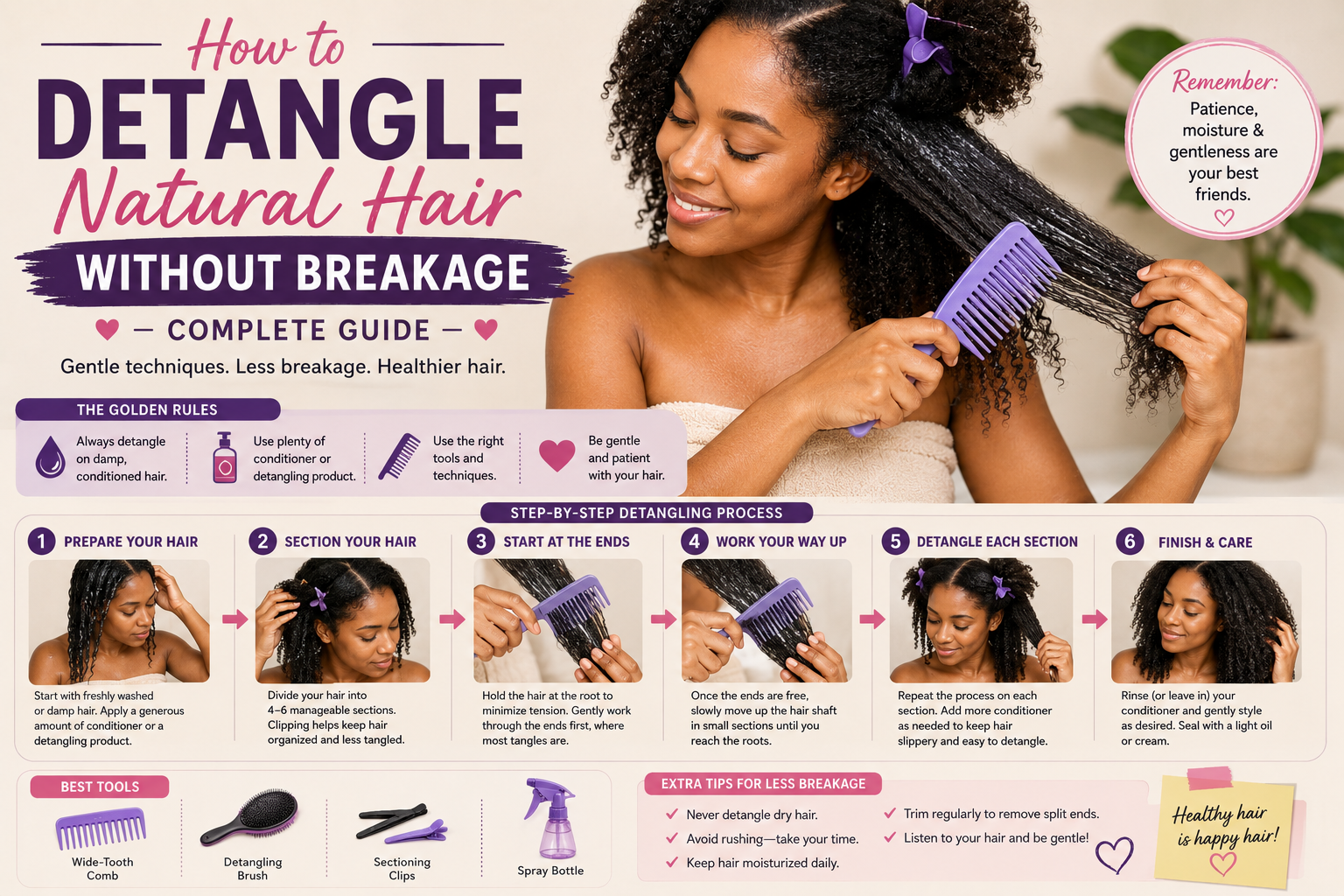
How to Detangle Natural Hair Without Breakage — Complete Guide
Detangling is the part of wash day most people dread — and for good reason. Done wrong, it causes more breakage than almost anything else in a natural hair routine. The sound of hair snapping while you comb through is something every natural hair person knows, and it’s almost always avoidable.
I used to lose significant amounts of hair every wash day. After changing how I detangle — not what products I use, just the method — the breakage dropped to almost nothing. Here’s exactly what made the difference.
Why Natural Hair Breaks During Detangling
Natural hair tangles more than straight hair because the tight curl pattern causes strands to wrap around each other. When two strands wrap tightly enough, they form single-strand knots — small knots at the end of individual hairs that catch everything they touch and cause tearing when combed through.
The breakage most people experience during detangling comes from three things:
- Combing through dry hair, which has no slip and snaps under the friction of a comb
- Starting from the roots and forcing knots down the shaft instead of removing them from the ends first
- Using tools that are too fine-toothed for natural hair’s texture
Fix those three things and detangling becomes manageable — still time-consuming on thicker hair, but no longer a source of significant breakage.
How to Detangle Natural Hair Without Breakage — Step by Step
Step 1 — Never Detangle Dry Hair
This is the most important rule. Dry natural hair has no slip — nothing to help your comb or fingers move through it without friction. Every knot you encounter on dry hair means you’re either forcing the comb through (breaking the hair) or pulling it out from the root. Neither is acceptable.
Detangle on wash day while your conditioner is in, or after applying leave-in conditioner to wet hair. The conditioner or leave-in provides slip — a slipperiness that lets knots release instead of tighten when you encounter them.
Step 2 — Divide Your Hair into Sections
Trying to detangle all your natural hair at once is how you end up with an impossible tangled mass in the middle of a shower. Divide your hair into four to eight sections before you start — more sections for longer or thicker hair.
Use clips or hair ties to keep the sections you’re not working on out of the way. Work one section at a time, completely finish it, clip it away, then move to the next. This makes the process faster overall and prevents already-detangled sections from re-tangling while you work.
Step 3 — Start from the Ends, Not the Roots
Always start detangling from the ends of your hair and work upward toward the roots. This is the opposite of what feels instinctive, but it’s the only method that actually works on natural hair.
Starting from the roots pushes knots and tangles down toward the ends, compressing them tighter as you go. By the time you reach a major tangle, you’ve got the weight and tension of the entire length of hair pulling against it. That’s what causes breakage.
Starting from the ends means you remove small knots one at a time as you work upward. Each knot has only a few inches of hair below it providing tension — much more manageable.
Step 4 — Use Your Fingers First
Before introducing a comb or brush, work through each section with your fingers. Your fingers are more sensitive than any tool — you can feel a knot before you force something through it, and you can gently tease it apart rather than ripping through it.
Finger detangling takes longer but causes significantly less breakage, especially on 4C hair. Once you’ve worked through the major tangles with your fingers, a wide-tooth comb moves through much more easily and with much less force.
Step 5 — Follow with a Wide-Tooth Comb
After finger detangling, use a wide-tooth comb to smooth out what’s left. Start from the ends again, hold the hair above where you’re combing with your other hand to reduce tension on the roots, and work your way up gradually.
If you hit resistance, don’t force it. Put the comb down, work through the knot with your fingers, then try again. Forcing a comb through resistance is exactly where most breakage happens.
Wide-tooth combs work. Fine-tooth combs and brushes do not — they’re designed for straight hair and create too much friction and tension on natural hair, especially when wet.
Step 6 — Hold the Hair Above Where You’re Working
When you comb through a section, hold the hair between your fingers just above where the comb is working. This reduces the tension that would otherwise travel up to the roots and cause pain or tearing.
This technique — sometimes called “anchoring” — is especially important for children’s natural hair and for any tender areas like the nape of the neck and edges where hair is more fragile.
Best Products for Detangling Natural Hair
Best Leave-In for Detangling: Kinky Curly Knot Today
This is the leave-in I recommend most specifically for detangling. Apply it to soaking wet hair and it provides enough slip that a wide-tooth comb moves through with noticeably less resistance. Works on 3A through 4C hair. See our full leave-in conditioner guide for more options.
Best Deep Conditioner for Detangling: Mielle Organics Babassu Oil & Mint
Deep conditioner provides more slip than leave-in for the initial detangling step. Detangle while rinsing out your deep conditioner on wash day — the rinse water and the conditioner together create the ideal slip for working through knots. Our deep conditioner guide covers the best options for different hair types.
Detangling Natural Hair by Type
Detangling 3A and 3B Natural Hair
Looser curl patterns tangle less severely and detangle more quickly. Finger detangling followed by a wide-tooth comb on wash day is usually sufficient. These textures can sometimes handle detangling on dry hair with a detangling spray — though wash-day detangling with conditioner is always safer and causes less breakage.
Detangling 3C and 4A Natural Hair
These textures tangle more than looser curls. Always detangle on wash day with conditioner in. Divide into at least four sections. Finger detangle first, then wide-tooth comb. Budget 20-30 minutes for the full detangling process on medium-length hair.
Detangling 4B and 4C Natural Hair
The tightest coil patterns tangle most severely and require the most patience. Detangle only on wash day with conditioner in — never between washes. Divide into six to eight sections or more. Always finger detangle first, and be prepared to spend 45 minutes to an hour on the full process for longer 4C hair. This is normal — it doesn’t mean anything is wrong with your hair or your technique.
For 4C hair specifically, our 4C hair product guide covers the best leave-ins and conditioners for reducing detangling difficulty.
Should You Detangle Wet or Dry?
Wet — with conditioner or leave-in in. This is the consistent recommendation across all natural hair textures for a reason. Wet hair with conditioner in has slip. Dry hair has none.
The one partial exception is very loose curl patterns (3A, some 3B) that can sometimes be detangled on dry hair using a detangling spray or lightweight leave-in. Even then, wet detangling causes less breakage.
For everything 3C and tighter — always wet, always with conditioner or leave-in.
How Often Should You Detangle Natural Hair?
Once a week on wash day is the right frequency for most natural hair types. Detangling more often than that causes more manipulation and more breakage, not less.
Between wash days, don’t try to comb through your hair. If it feels tangled, apply a small amount of leave-in or oil and gently finger-smooth the surface. Save full detangling for wash day with conditioner providing slip.
Protective styles — twists, braids, or buns — reduce how much your hair tangles between wash days because the hair isn’t loose and rubbing against itself and everything it touches. If you’re struggling with constant tangles, protective styling reduces the problem significantly. Our guide on growing natural hair longer covers protective styling as a length retention strategy in more detail.
Common Detangling Mistakes
Combing from root to tip. This forces knots down and compresses them. Always ends to roots.
Rushing. Detangling natural hair takes time — especially 4B and 4C hair. Rushing means forcing, and forcing means breakage. If you don’t have time to detangle properly, put your hair in a protective style instead of combing through it quickly.
Using fine-tooth combs or brushes. These are the wrong tools for natural hair. Wide-tooth comb and fingers only.
Detangling sopping wet hair without product. Water alone reduces some friction, but it’s not enough. You need conditioner or leave-in in your hair to provide real slip.
Skipping sections. Trying to detangle all your hair at once leads to re-tangling already done sections. Work in sections, clip each one when done, don’t skip.
Frequently Asked Questions
How do I detangle severely matted natural hair?
Severely matted natural hair requires patience and oil, not force. Apply a generous amount of a penetrating oil like coconut or olive oil to the matted section and let it sit for 15-30 minutes. Then work through very gently with your fingers only — no combs until the mat has been mostly loosened. Work from the outside edges of the mat inward. This takes time. If the mat is extremely tight and extensive, a professional stylist may be the right call to avoid unnecessary damage.
Why does my natural hair always tangle overnight?
Cotton pillowcases create friction that tangles natural hair overnight. Switch to a satin bonnet or satin pillowcase — the smooth surface significantly reduces overnight tangling. Also, putting hair in a loose protective style before bed (a pineapple — loose ponytail at the top of the head — for longer hair, or twists for shorter hair) reduces the tangling that comes from hair moving freely while you sleep.
What is the best tool for detangling 4C natural hair?
Your fingers first, always. For 4C hair specifically, finger detangling with a rich conditioner in the hair causes the least breakage. Once major knots are loosened by hand, a wide-tooth comb can be used to smooth sections. Avoid fine-tooth combs and brushes entirely on 4C hair — they create too much tension for the tight coil pattern.
How do I reduce single-strand knots on natural hair?
Single-strand knots are caused by loose hair ends curling back on themselves. Protective styles that keep the ends tucked away reduce them significantly. Keeping hair trimmed removes the most knot-prone ends. Keeping hair well moisturized reduces the dry, rough texture that makes knots more likely to form. There’s no way to completely eliminate them on natural hair, but these habits keep them manageable.
Can I detangle natural hair with a brush?
Not recommended for wet natural hair — brushes create too much friction and tension on the tight curl pattern and cause significant breakage. On dry natural hair that’s been stretched (by a blowout or banding), a wide paddle brush can sometimes be used carefully. For standard wet detangling on wash day, fingers and wide-tooth comb only.
Final Thoughts
Detangling natural hair without breakage comes down to a few consistent habits: always work on wet hair with conditioner or leave-in for slip, always start from the ends, always use your fingers first, and never rush.
The time investment is real — detangling 4C hair properly takes longer than most people expect when they first start. That time is worth it. The alternative is losing the length you worked to grow from breakage that was entirely preventable.
More from PickHonestly on natural hair care:
- Best Leave-In Conditioners for Natural Hair
- Natural Hair Care Routine for Beginners
- How to Grow Natural Hair Faster
- Best Deep Conditioners for Natural Hair
- Best Products for 4C Natural Hair
Prices accurate as of publication. Verify current pricing before purchasing.