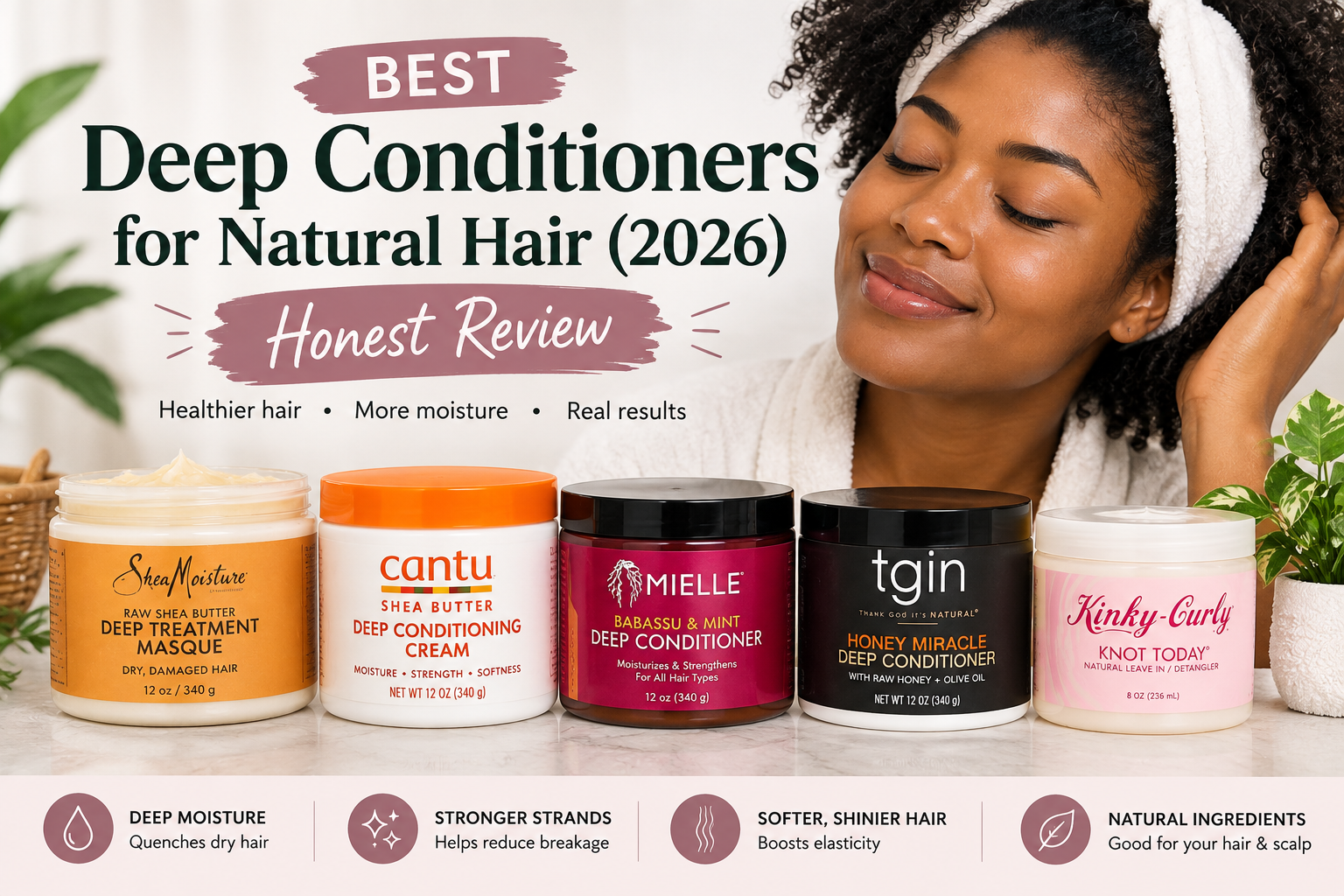
Best Deep Conditioners for Natural Hair (2026) — Honest Review
Deep conditioning is the one step that makes the biggest difference in natural hair — more than any leave-in, oil, or styling product. I’ve seen people spend hundreds on products and still have dry, breaking hair because they skip deep conditioning or rush through it. And I’ve seen people with simple, affordable routines with thriving natural hair because they deep condition every single week without fail.
After testing a lot of deep conditioners over the years, here’s what I actually recommend.
Why Deep Conditioning Matters So Much for Natural Hair
Regular conditioner sits on the hair for a minute or two and rinses off. It smooths the cuticle and adds surface softness, which is useful — but it doesn’t go deeper than that.
Deep conditioner works differently. It’s designed to penetrate the hair shaft, not just coat the outside. The combination of richer ingredients, longer processing time, and heat opens the cuticle enough to allow moisture and protein to actually get inside the hair. That’s what makes the difference you can feel for days, not just an hour.
For natural hair — which already struggles to retain moisture because of the tight curl pattern — deep conditioning is not optional. Skipping it consistently leads to dry, brittle hair and breakage that seems to come from nowhere.
How to Deep Condition Natural Hair the Right Way
Before getting into specific products, the method matters as much as what you use:
- Apply to freshly shampooed, damp hair. Not dripping wet, not dry — damp. Clean hair absorbs conditioner better than hair with product buildup on it.
- Work through in sections. Divide hair into 4-6 sections. Apply deep conditioner generously from mid-shaft to ends, then work through each section to make sure it’s fully coated.
- Cover with a shower cap. This traps heat from your scalp and helps the conditioner penetrate better.
- Add external heat if possible. A hooded dryer, heat cap, or even sitting in a warm bathroom makes deep conditioner work significantly better — especially for low-porosity hair where the cuticle is tighter and harder to open.
- Leave on for at least 20-30 minutes. Most people rush this step. The longer you leave it, the more it works. 30-45 minutes is ideal.
- Rinse with cool water. Cool water closes the cuticle back down after conditioning, sealing in what the deep conditioner put in.
Best Deep Conditioners for Natural Hair in 2026
1. Mielle Organics Babassu Oil & Mint Deep Conditioner — Best Overall
Best for: All natural hair types, especially dry and damaged hair
Babassu oil is one of those ingredients that genuinely does what it claims. It’s light enough to actually penetrate the hair shaft — unlike coconut oil, which works for some hair types and causes protein buildup in others. This deep conditioner uses babassu oil alongside biotin, honey, and peppermint to strengthen hair while adding real moisture, not just surface softness.
I’ve recommended this to more people than any other deep conditioner because the results are consistent. Hair comes out softer, detangling becomes easier, and the effects last most of the week — not just until the next morning. Use it every wash day with heat for 30 minutes minimum.
- ✅ Babassu oil penetrates rather than just coating the hair
- ✅ Noticeable softness and elasticity after the first use
- ✅ Works well on 3C through 4C hair
- ✅ Biotin adds strength alongside moisture
- ✅ Affordable for the results it delivers
- ❌ Small jar — goes fast on thick or long hair
- ❌ Strong mint scent that some people find overpowering
Price: $10–$16
2. TGIN Honey Miracle Hair Mask — Best for Very Dry Natural Hair
Best for: 4B and 4C hair that is persistently dry or brittle
Honey is a humectant — it pulls moisture from the air into the hair shaft and holds it there. TGIN built this mask around raw honey as the primary active ingredient, and for very dry natural hair it delivers better moisture retention than most other options at this price point.
After applying it on damp 4C hair and leaving it for 30-40 minutes with a shower cap, the difference is obvious immediately when rinsing. Hair comes out softer, more pliable, and significantly easier to detangle. The honey also has natural antibacterial properties that keep the scalp healthy over time.
- ✅ Honey provides real, lasting moisture for very dry hair
- ✅ Excellent results on 4B and 4C hair specifically
- ✅ Reduces breakage from detangling noticeably
- ✅ No sulfates, parabens, or mineral oil
- ❌ Very thick — needs to be worked through carefully in sections
- ❌ Jar empties fast on longer or thicker hair
Price: $12–$16
3. Briogeo Don’t Despair, Repair! Deep Conditioning Mask — Best for Damaged Natural Hair
Best for: Color-treated, heat-damaged, or chemically processed natural hair
When natural hair is genuinely damaged — over-processed, heat-damaged, breaking more than usual — most drugstore deep conditioners aren’t enough. Briogeo’s repair mask uses rosehip oil, argan oil, algae extract, and B vitamins in a formula that addresses both moisture loss and protein loss, which is what damaged hair actually needs.
It costs more than the others on this list, but a small amount goes a long way, and the results on damaged natural hair are meaningfully better than cheaper options. Use it weekly for a month on damaged hair, then every two weeks once hair starts recovering.
- ✅ Targets both moisture and protein — what damaged hair needs most
- ✅ Works across all natural hair types from 3A to 4C
- ✅ Noticeable improvement in hair strength and elasticity
- ✅ A little product goes a long way
- ❌ Significantly more expensive than drugstore options
- ❌ More than needed for healthy hair — save it for when hair is struggling
Price: $36–$42
4. SheaMoisture Manuka Honey & Yogurt Hydrate + Repair Protein Power Treatment — Best Protein Deep Conditioner
Best for: Natural hair that breaks easily or feels limp and weak
Not all deep conditioning is about moisture. Hair also needs protein to maintain its structure and strength. If your natural hair breaks when you stretch it even slightly, or if it feels mushy and weak when wet, your hair is protein-deficient — and adding more moisture won’t fix it.
This SheaMoisture treatment uses jamaican black castor oil and a protein blend to rebuild hair structure. Use it once a month, not every week — too much protein makes hair stiff and prone to breakage too. Follow with a moisture-focused deep conditioner the next wash day to balance things out.
- ✅ Addresses protein deficiency that moisture alone can’t fix
- ✅ Noticeably stronger hair after consistent monthly use
- ✅ Good for hair recovering from chemical treatments
- ❌ Use monthly only — overuse causes protein overload
- ❌ Hair can feel stiff if left on too long
Price: $14–$18
How to Choose the Right Deep Conditioner for Your Natural Hair
The right deep conditioner depends on what your hair actually needs — not what’s most popular or most expensive.
If your hair is dry and breaks easily: Start with a moisture-focused deep conditioner like the Mielle Babassu or TGIN Honey Miracle. Use weekly with heat.
If your hair is damaged from color or heat: Use the Briogeo Repair mask weekly until hair recovers, then switch to a regular moisture deep conditioner.
If your hair feels mushy or weak when wet: This is protein deficiency. Use the SheaMoisture protein treatment once a month, alternating with a moisture deep conditioner.
If your hair absorbs nothing (low porosity): Use heat every time you deep condition. Without heat, the cuticle on low-porosity hair stays closed and conditioner can’t penetrate. A heat cap or hooded dryer is worth the investment for low-porosity natural hair.
Deep Conditioning by Hair Type
3A and 3B Hair
Looser curl patterns are less prone to dryness than tighter coils but still benefit from weekly deep conditioning. Use lighter formulas — heavy masks can weigh down the curl pattern. The Mielle Babassu conditioner works well for these textures. Leave on for 20-25 minutes.
3C and 4A Hair
These textures sit between looser and tighter curl patterns. Standard moisture deep conditioners work well. Use weekly with a shower cap. The Mielle or TGIN options are both suitable. Leave on for 25-30 minutes with heat for best results.
4B and 4C Hair
The driest natural hair textures need the most from deep conditioning. Use a rich, honey or butter-based formula like TGIN Honey Miracle. Apply generously, cover tightly with a shower cap, add heat, and leave on for at least 30-40 minutes. Never skip this step on 4C hair — the difference between hair that retains moisture all week and hair that’s dry by day two comes down to this.
For more on taking care of 4C hair specifically, see our full guide to the best products for 4C natural hair.
Frequently Asked Questions
How often should I deep condition natural hair?
Once every wash day — which for most natural hair types means once a week. Very dry or damaged natural hair may benefit from twice a week during recovery. Fine or low-porosity hair sometimes only needs it every two weeks if it starts feeling limp from too much conditioning.
Can I deep condition without heat?
Yes, but results are better with heat — especially for low-porosity hair. Without heat, the cuticle stays more closed and conditioner has a harder time penetrating. If you don’t have a hooded dryer, sit in a warm bathroom after applying, or wrap a warm towel around your shower cap. Even a little heat helps.
How long should I leave deep conditioner on natural hair?
Minimum 20 minutes. 30-45 minutes gives better results. Some people leave it on for a few hours or overnight for very dry hair — this is safe as long as you’re using a moisture-focused conditioner without heavy protein, and you cover your hair to avoid drying out.
What’s the difference between deep conditioner and regular conditioner?
Regular conditioner is a rinse-off product meant to smooth the cuticle and add surface softness — it works in 2-3 minutes. Deep conditioner has richer ingredients designed to penetrate the hair shaft, and it needs time and heat to work properly. They serve different purposes and you need both in a natural hair routine.
Can I deep condition too much?
Yes, with moisture-heavy conditioners, over-conditioning causes hair to feel limp, weak, and overly soft when wet — this is called hygral fatigue. Once a week is usually the right frequency. If hair starts feeling weak and stretchy when wet, reduce to every two weeks and add a protein treatment monthly to restore balance. See our guide on how to moisturize natural hair for more on the moisture-protein balance.
Final Thoughts
Deep conditioning is the most impactful step in a natural hair routine — not the most exciting, not the most expensive, but the most important. Get this right and everything else in your routine works better.
Start with the Mielle Babassu deep conditioner if you’re not sure where to begin. Use it every wash day with heat for 30 minutes. Give it four weeks before judging whether it’s working. Natural hair changes slowly — consistency matters more than anything else.
More from PickHonestly on natural hair:
- Best Sulfate-Free Shampoos for Natural Hair
- How to Moisturize Natural Hair — Complete Guide
- Best Products for 4C Natural Hair
- Complete Natural Hair Care Guide
Prices accurate as of publication. Verify current pricing before purchasing.