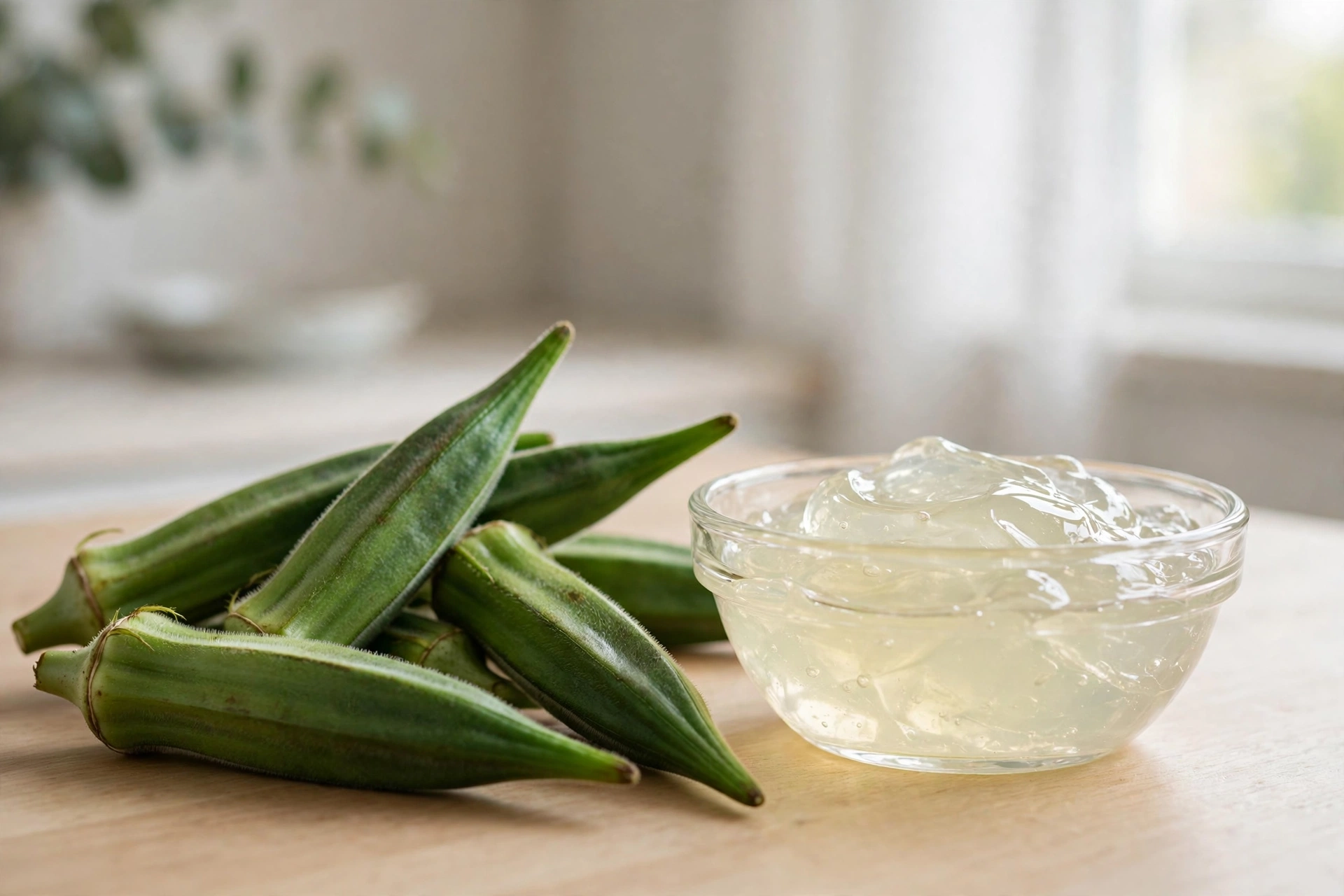
Okra Gel for Natural Hair: Honest Benefits, DIY Recipe & What It Can’t Do
If you’ve spent any time in the natural-hair corners of TikTok and YouTube lately, you’ve probably seen someone raving about okra gel for natural hair. It’s been called a flaxseed-gel alternative, a detangling miracle, and — in one viral video — a “chemical-free keratin treatment.” Some of those claims are fair. Some are not.
Okra gel does one thing exceptionally well: it gives wet hair the kind of slip that makes detangling 4C hair dramatically less painful. Everything else it does is more modest — and a few popular claims are outright wrong. This guide is the honest version: what okra gel can genuinely do for your hair, the safety step almost every tutorial skips, a recipe that actually works, and a clear list of what it cannot do.
What Is Okra Gel, and What Is the Mucilage Actually Doing?
Okra (Abelmoschus esculentus), also called lady’s finger or bhindi, is a green pod vegetable whose claim to fame — culinarily and cosmetically — is mucilage. Mucilage is a thick, slippery substance made of large polysaccharide molecules (mostly galacturonic acid, rhamnose, and galactose) that the plant stores in its pods. When you cut okra and heat it in water, those polysaccharides dissolve into the water and the liquid turns into a clear, silky gel.
That gel is the whole product. It is not an oil, it is not a protein, and it is not an active treatment in the drug sense. It is a water-based polysaccharide film. On hair, that film does two physical things: it lubricates (reducing friction between strands) and it forms a light coating that slows moisture from evaporating. That sounds unglamorous, but for tightly coiled hair — where strands tangle, snag, and snap during detangling — lubrication is arguably the single most valuable thing a DIY product can offer.
Worth knowing: okra as a food is genuinely nutritious. Per USDA data, 100 g of raw okra contains meaningful amounts of vitamins C and K, plus folate, vitamin A, calcium, and magnesium — and Healthline’s review of okra’s nutrition covers those food benefits in detail. But those are food nutrients. Nobody has shown that boiling okra pods transfers meaningful vitamin amounts into the strained gel, or that those vitamins do anything when sitting on top of your hair. When a blog claims okra gel “stimulates follicles with biotin,” treat it as marketing, not science.
What Okra Gel Can Honestly Do for Natural Hair
Strip away the hype and the honest benefits are still worth your time — especially if you have type 4 hair and wash day usually ends with broken strands in the comb.
1. It gives wet hair serious slip, which means less breakage
This is okra gel’s strongest, most evidence-consistent benefit — and the one that matters most for 4C hair. The mucilage film dramatically reduces friction between strands, so a wide-tooth comb glides instead of catching. Less catching means fewer snapped strands, and fewer snapped strands means you keep more of the length you grew. Notice the wording: okra gel doesn’t make your hair grow faster. It helps you keep what grew. That distinction is the difference between honesty and hype, and it’s the reason okra gel pairs so well with a proper pre-poo detangling routine.
2. It helps hair hold onto moisture a little longer
The polysaccharide coating acts as a mild humectant-emollient film: it slows how fast water evaporates from damp hair. Used on freshly washed, damp hair before sealing with an oil or cream, it can extend that post-wash softness by a day or so. It will not, however, replace a deep conditioner or a leave-in formulated with real conditioning agents — the film is thin and temporary.
3. It smooths frizz and helps curls clump
That same coating lays down the cuticle and encourages neighboring strands to clump into defined curl families instead of puffing apart. On 3C–4B hair this shows up as better curl definition with a soft hold; on 4C hair the effect is more “controlled, stretched coils” than glossy ringlets. Think of it as a light styling aid, not a maximum-hold gel — it won’t give you the firm cast of a commercial gel, and in humid weather it can leave hair feeling soft but undefined.
4. It can calm an itchy, dry scalp
The cool, wet mucilage is soothing on a dry, tight-feeling scalp, and the polysaccharides are mildly moisturizing. If your scalp itches because it’s simply dry, an okra-gel scalp treatment can give real relief. What it won’t do: cure dandruff, seborrheic dermatitis, or fungal scalp conditions. Those are medical conditions; if flakes persist for more than a couple of weeks despite gentle care, see a dermatologist rather than reaching for another kitchen remedy.
What Okra Gel Can’t Do (Honesty First)
Every top-ranking article we read for this guide made at least one of these claims. None of them holds up:
- It does not make hair grow faster. Human hair grows about half an inch per month, and no topical gel changes that rate. What okra gel can do is reduce the breakage that eats your growth — which, for many naturals, is functionally the same as “growing longer hair” but without the false promise.
- It will not regrow bald spots. If you have thinning or patchy loss, that needs a dermatologist’s diagnosis (telogen effluvium, traction alopecia, hormonal causes all need different treatment). A gel cannot restart dormant follicles.
- It is not a protein treatment. Okra pods contain about 2 g of protein per 100 g as food, but the strained gel carries very little of it — and plant protein in a rinse-out film is not the same as a hydrolyzed-protein treatment. If your hair needs protein, you need a real protein treatment, not okra.
- It is not a “chemical-free keratin treatment.” One viral video (over 24 million views) suggested an okra-and-cornflour mixture gives silky straight hair like keratin. It doesn’t. Coating hair in gel temporarily smooths it — the effect washes out and no bonds in the hair are altered.
- It does not “balance scalp pH” in any proven way. Several blogs repeat this; we found no measurement or study supporting it. It’s a plausible-sounding claim with zero evidence behind it.
- It is not proven antibacterial or antifungal. Okra shows some antimicrobial activity in lab-dish (in vitro) studies of extracts — a very long way from “this gel treats scalp infections.” Don’t skip real treatment for real infections.
The Safety Step Nobody Talks About: Always Cook It — Never Use It Raw
Here’s the thing almost no okra-gel tutorial mentions: raw okra can irritate skin. A field study of okra farm workers (Matsushita et al., 1989, published in the Japanese Journal of Rural Medicine) found that 46% of 186 workers reported skin problems from handling the crop — mostly itching and redness on the arms, neck, and fingers, with the prickly hairs (trichomes) on the pods and leaves identified as a main culprit. Patch testing confirmed both irritant and allergic reactions in some workers. You can read the full study on J-Stage — it’s a real peer-reviewed paper, and it directly concerns raw okra plant parts, not the cooked gel.
What does that mean for your hair? Two things. First, always boil or simmer the okra — never use raw okra juice or the popular overnight raw soak on your scalp. Heat breaks down the irritating components and releases the mucilage you actually want. Second, do a patch test first: dab a little cooled gel on your inner forearm, wait 24 hours, and only proceed if there’s no redness or itching. If you know you’re sensitive to plants in the mallow family (hibiscus, cottonseed, marshmallow root — yes, they’re relatives), be extra cautious.
One more safety note: because homemade okra gel has no preservatives, it spoils fast. If it smells sour, looks cloudy with particles that weren’t there before, or feels different from when you made it, throw it out. Fresh gel is nearly odorless.
Boiled Gel vs Overnight Soak: Which Method Is Better?
Most tutorials teach one of two methods: simmering chopped okra in water (the boil method) or soaking chopped okra in water overnight (the soak method). They are not equal.
| Method | How it works | Gel strength | Safety | Verdict |
|---|---|---|---|---|
| Boiled gel (simmer 10–15 min) | Heat extracts mucilage efficiently | Thick, strong slip | Cooking neutralizes the irritating compounds; safest option | Recommended |
| Overnight soak (12–15 hours, raw) | Mucilage slowly leaches into cold water | Thin, watery — noticeably less slip | Raw okra sits on the skin/scalp risk from the prickly hairs and proteolytic compounds | Skip it — weaker gel and the one method with a real irritation risk |
The soak method survives in tutorials because it feels “raw and natural.” But the entire point of the gel is mucilage, and boiling releases far more of it — while also being the method that addresses the one documented safety concern. Boil it. Every time.
How to Make Okra Gel for Hair: Step by Step
This makes about 1 cup of gel — enough for one full application on medium-length 4C hair, or two applications on shorter hair.
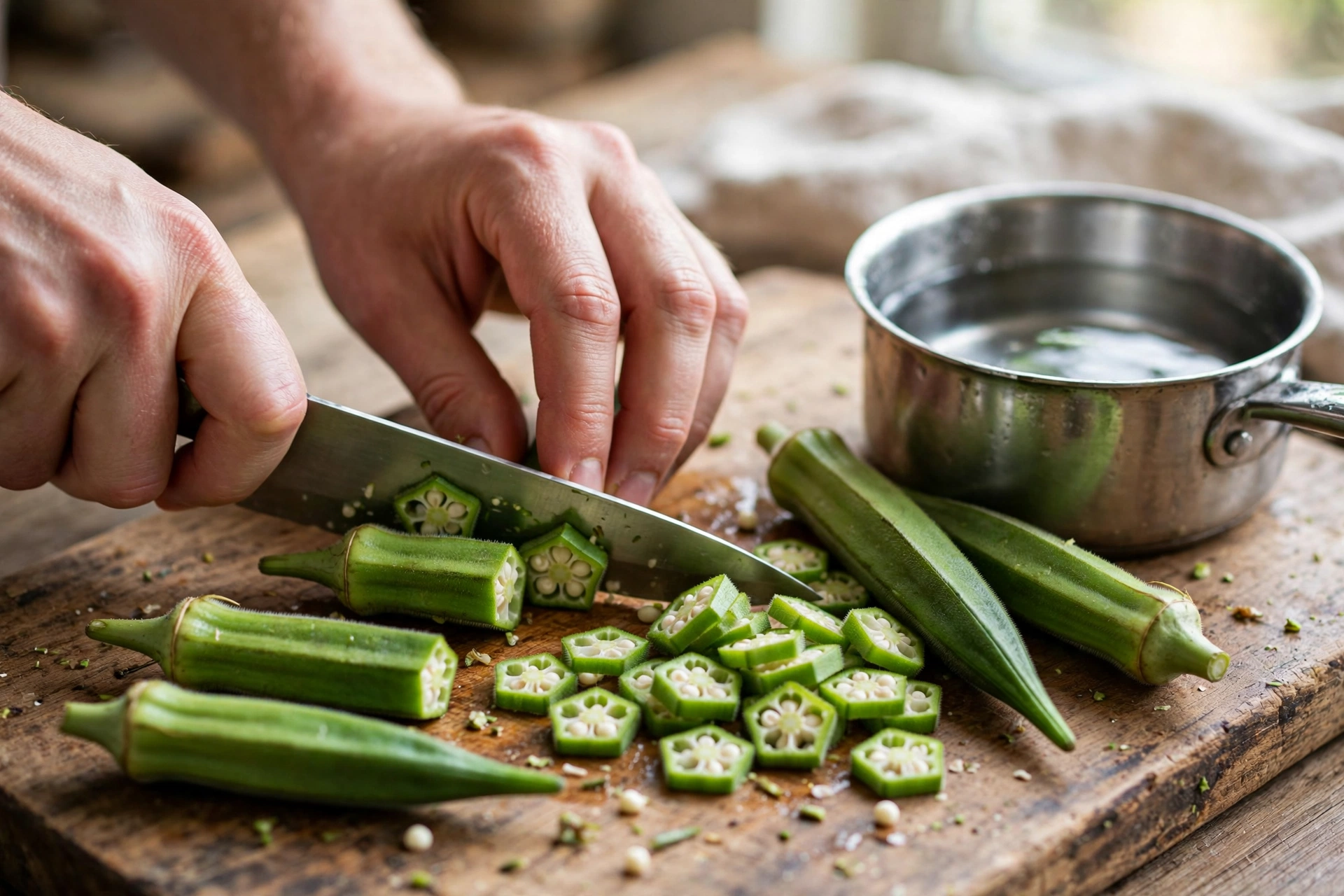
You will need: 8–10 fresh okra pods, 2 cups of filtered water, a fine-mesh sieve or cheesecloth, a clean glass jar with a lid, and optionally 1 teaspoon of pure aloe vera gel and 2–3 drops of rosemary or lavender essential oil.
Step 1: Choose and wash the okra
Pick firm, bright-green pods — avoid soft, brown-spotted ones. Wash them thoroughly under running water to remove any field residue, and pat them dry.
Step 2: Slice into thin rounds
Trim off the stem caps and slice the pods into rounds about ¼-inch thick. Thinner slices expose more surface area, which releases more mucilage.
Step 3: Simmer — don’t blast-boil
Put the slices in a saucepan with 2 cups of water, bring to a gentle boil, then reduce to a low simmer for 10–15 minutes, stirring occasionally. You’ll see the water turn thick and slippery — that’s the mucilage releasing. Don’t walk away: the mixture foams and can boil over.
Step 4: Cool slightly, then strain while warm
Let it cool for 5–10 minutes (warm, not cold — the gel strains much more easily while warm). Pour through a fine-mesh sieve or cheesecloth into a bowl, pressing the solids with a spoon to squeeze out every drop of gel. Discard the solids.
Step 5: Add your extras (optional)
Once the gel is at room temperature, stir in the aloe vera gel and essential oil if using. Skip the essential oils entirely if your scalp is sensitive — the plain gel works fine on its own.
Step 6: Jar it and refrigerate
Pour into your clean glass jar, seal, and refrigerate immediately. Use a clean spoon or pump bottle each time you take some out — fingers in the jar introduce bacteria and cut the shelf life in half.
Step 7: Check before every use
Give it the sniff test. Fresh okra gel is nearly odorless and pours like a light hair gel. Sour smell, fizz, or visible mold means it’s done — make a fresh batch.
4 Ways to Use Okra Gel on Natural Hair
Okra gel is versatile, but not every use is equal. Ranked by how much value each one actually delivers:
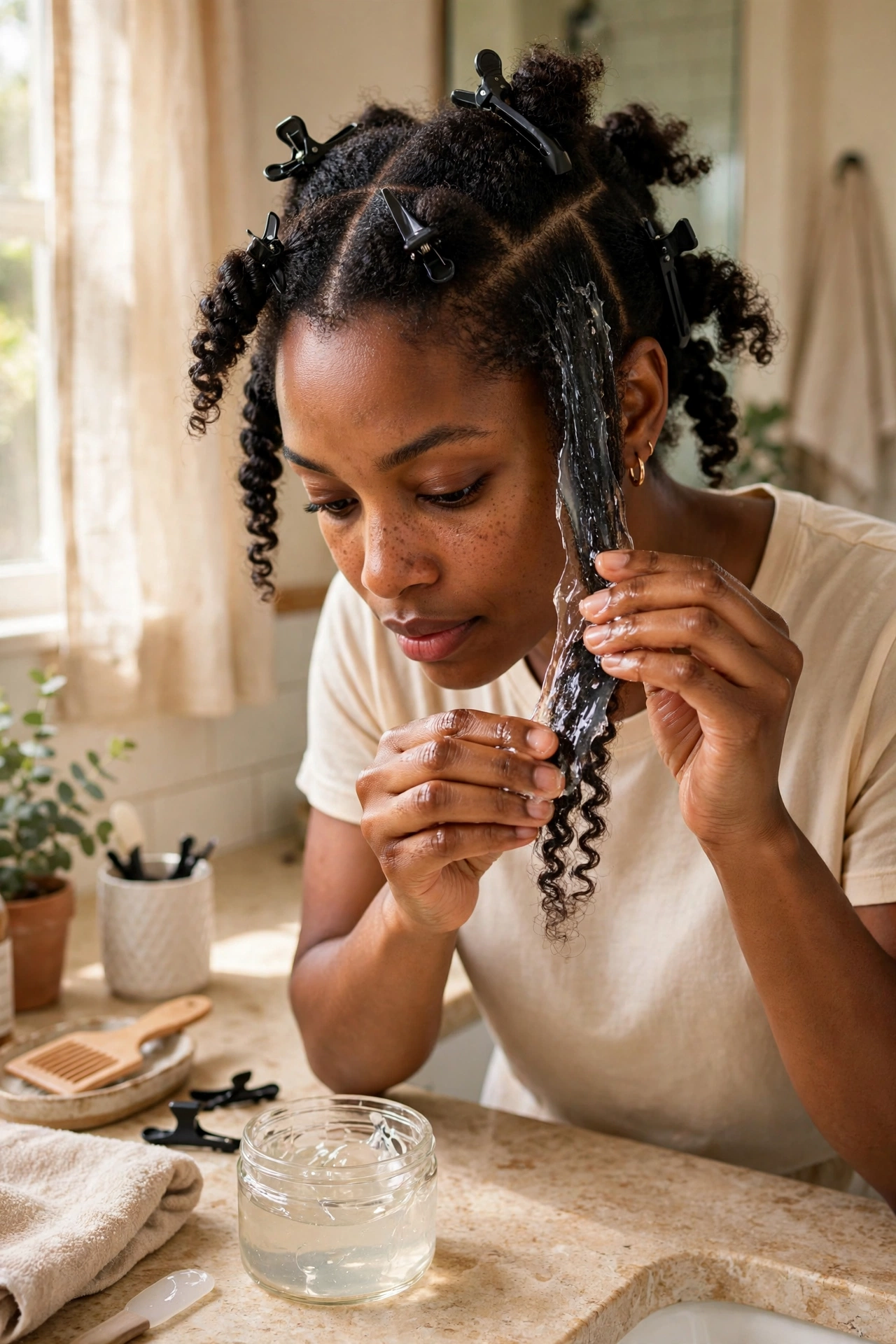
1. As a pre-poo detangler (the best use for 4C hair)
Section dry or damp hair into 4–6 twists. Work a generous amount of gel through each section from ends to roots, then detangle with a wide-tooth comb or your fingers. The slip lets the comb pass through with far less pulling. Leave it on for 20–30 minutes, then shampoo as normal — the gel rinses out cleanly. If wash day usually costs you a sink full of broken hair, try this once and compare.
2. Mixed into your deep conditioner
Stir 2–3 tablespoons of okra gel into your regular deep conditioner before applying. The gel’s film-forming polysaccharides add slip and help the conditioner spread through dense hair more evenly, so you use less product for better coverage. Apply with heat (a shower cap for 20–30 minutes) for the best penetration.
3. As a light leave-in or curl refresher
Smooth a thin layer over damp hair in sections, then seal with an oil or cream. On wash day this gives soft definition and frizz control for a day or two. As a mid-week refresher, mist hair with water and smooth a little gel over frizzy sections. Keep the layer thin — thick layers dry stiff and flake on some hair types.
4. As a scalp-soothing treatment
Part hair in sections and massage plain gel directly into the scalp. Leave 15–20 minutes, then rinse or shampoo out. This is genuinely soothing for a dry, tight scalp — but as noted above, it’s comfort, not medicine: persistent flakes, sores, or itching that doesn’t improve need a dermatologist.
Okra Gel for Low Porosity Hair
Low porosity hair has tightly closed cuticles, which means films sit on the hair rather than absorbing in. Okra gel is lightweight enough that many low-porosity naturals love it — it’s gentler than heavy butters and doesn’t have the protein risk of some masks. But the same film-forming property can backfire: repeated leave-in use without clarifying can leave a coating that makes hair feel stiff or look dull.
The safe approach for low porosity: use okra gel as a rinse-out (pre-poo or deep-conditioner booster), not as a daily leave-in. If you do leave it in, keep it to wash day only, and clarify with a gentle shampoo every 2–3 weeks. A strand porosity test takes two minutes and tells you which camp you’re in; our flaxseed gel guide for low porosity hair covers the same film-buildup logic in more detail, and flaxseed gel behaves almost identically in this regard.
Okra Gel vs Flaxseed Gel vs Aloe Vera Gel
These three get compared constantly, and they really are siblings: all are water-based plant gels, all are preservative-free, and all target the same “natural styler/conditioner” slot. Here’s how they differ:
| Okra gel | Flaxseed gel | Aloe vera gel | |
|---|---|---|---|
| Main action | Slip + light film; best detangler of the three | Hold + definition; best styler of the three | Light hydration + scalp soothing; gentlest |
| Hold | Very light, soft | Medium — gives a real cast | Minimal |
| Slip for detangling | Excellent | Good | Moderate |
| Prep effort | Slice, simmer 10–15 min, strain | Boil seeds 5–8 min, strain (fiddly while hot) | Scoop from leaf or buy pre-made |
| Shelf life (fridge) | 5–7 days | 1–2 weeks | 1–2 weeks (fresh); months (commercial) |
| Biggest drawback | Can feel slimy to work with; film buildup on low porosity | Straining is a hassle; can flake | Store-bought versions often contain alcohol or additives |
| Best for | 4C wash-day detangling and pre-poos | Wash-and-go definition | Scalp care and light daily moisture |
Many naturals end up using two of the three: okra gel for wash-day slip, flaxseed gel for styling hold. There’s no rule against combining them — a 50/50 mix gives you slip and hold in one jar.
How Often to Use It and How to Store It
| Hair situation | How often | Best format |
|---|---|---|
| 4C hair, tangles easily on wash day | Every wash day (weekly) | Pre-poo detangler |
| Dry, dull hair needing moisture support | 1–2 times per week | Deep-conditioner booster |
| Curly/coily hair, frizz control | Wash day + mid-week refresh | Thin leave-in layer |
| Low porosity hair | Weekly, rinse-out only | Pre-poo or conditioner mix |
Storage rules (non-negotiable for a preservative-free product): refrigerate in a sealed jar and use within 5–7 days. For longer storage, freeze it in an ice-cube tray, then move the cubes to a freezer bag — they keep for up to 3 months. Thaw one cube at room temperature when you need it; don’t microwave it. Frozen okra pods work just as well as fresh for making the gel, by the way — the mucilage survives freezing fine.
Who Should Skip Okra Gel
- Anyone with a known mallow-family allergy (okra, hibiscus, cottonseed, marshmallow root) — patch test first, no exceptions.
- Eczema or broken/irritated scalp — a homemade, unpreserved gel on compromised skin is a bad idea; heal the scalp first.
- If you’re hoping to fix real hair loss — thinning, shedding clumps, or bald patches need a diagnosis, not a vegetable. The American Academy of Dermatology’s healthy-hair tips are a good starting point, and a dermatologist is the right next step.
- If you hate slime — honest lifestyle note: okra mucilage feels like what it is. If the texture bothers you, flaxseed gel gives a similar film with less “snail” factor.
Frequently Asked Questions
Does okra gel make hair grow faster?
No. Hair grows at roughly half an inch per month regardless of what’s on it. Okra gel reduces breakage, which lets you retain more length — that’s the real mechanism behind every “it made my hair grow” testimonial.
Can okra gel cause hair loss or shedding?
The cooked gel itself doesn’t cause hair loss. What can cause problems is heavy-handed application on a sensitive scalp (friction from aggressive massaging), leaving spoiled gel on the scalp, or using raw okra — which is why this guide insists on boiling and patch testing. If you notice increased shedding after starting any new product, stop using it and see whether the shedding normalizes.
Can I leave okra gel in my hair overnight?
You can, but there’s little benefit and some risk: a damp, preservative-free gel sitting on your scalp for 8 hours is an invitation to odor and microbial growth, and pillowcase transfer is real. 20–30 minutes as a pre-poo or a thin leave-in layer on wash day gets you 95% of the benefit.
Can I use frozen okra instead of fresh?
Yes. Frozen okra releases mucilage just as well — thaw it first, then simmer exactly as you would fresh. This is also the cheapest option in US grocery stores, where fresh okra is often $3–4/lb.
Will okra gel straighten my hair?
No. A viral video claimed an okra mixture works like a keratin treatment, but coating hair in gel only smooths it temporarily. Nothing in okra alters the hair’s internal bonds the way keratin or relaxer treatments do.
Does okra gel work on 4C hair specifically?
It’s one of the better DIY options for 4C hair precisely because slip is 4C hair’s scarcest resource. Use it as a pre-poo detangler in sections — that’s where it outperforms commercial products that cost ten times more.
Okra water vs okra gel — what’s the difference?
“Okra water” usually means the thin liquid from the overnight soak method; “okra gel” means the thick boiled preparation. The gel has far more mucilage and far more slip. Given the safety concerns with the raw soak, the gel is the better product on both counts.
Will okra gel change my hair color?
No. Unlike henna or black tea rinses, okra gel is colorless and doesn’t deposit pigment. It’s safe on color-treated hair — though as with any DIY, do a strand test first if your color is fresh.
How do I know when my okra gel has gone bad?
Smell it: fresh gel is nearly odorless; spoiled gel smells sour or fermented. Visual cues: unexpected cloudiness, fizzing, or mold spots. When in doubt, throw it out — a new batch costs pennies and 15 minutes.
Can I mix okra gel with coconut oil or other oils?
Yes — a teaspoon of oil stirred into the cooled gel adds sealing and shine. Use light oils (grapeseed, jojoba) for fine or low-porosity hair; coconut or olive oil for thicker, high-porosity hair. Mix only what you’ll use within the week.
The Honest Bottom Line
Okra gel is not a miracle, but it is one of the genuinely useful DIY ingredients for natural hair — a cheap, effective detangling and moisture-support gel whose main ingredient is a well-understood plant polysaccharide. Its honest job description: slip, light moisture retention, frizz control, scalp comfort. Not on the job description: faster growth, regrowth, protein repair, or straightening.
Make it by boiling, strain it well, patch test it, refrigerate it, and use it where it shines — wash-day detangling on 4C hair. Everything else is optional.
Disclaimer: This article is for informational purposes only and is not medical advice. Homemade hair products carry no preservatives and can spoil; discontinue use if you notice irritation, and consult a dermatologist for persistent scalp or hair-loss concerns.