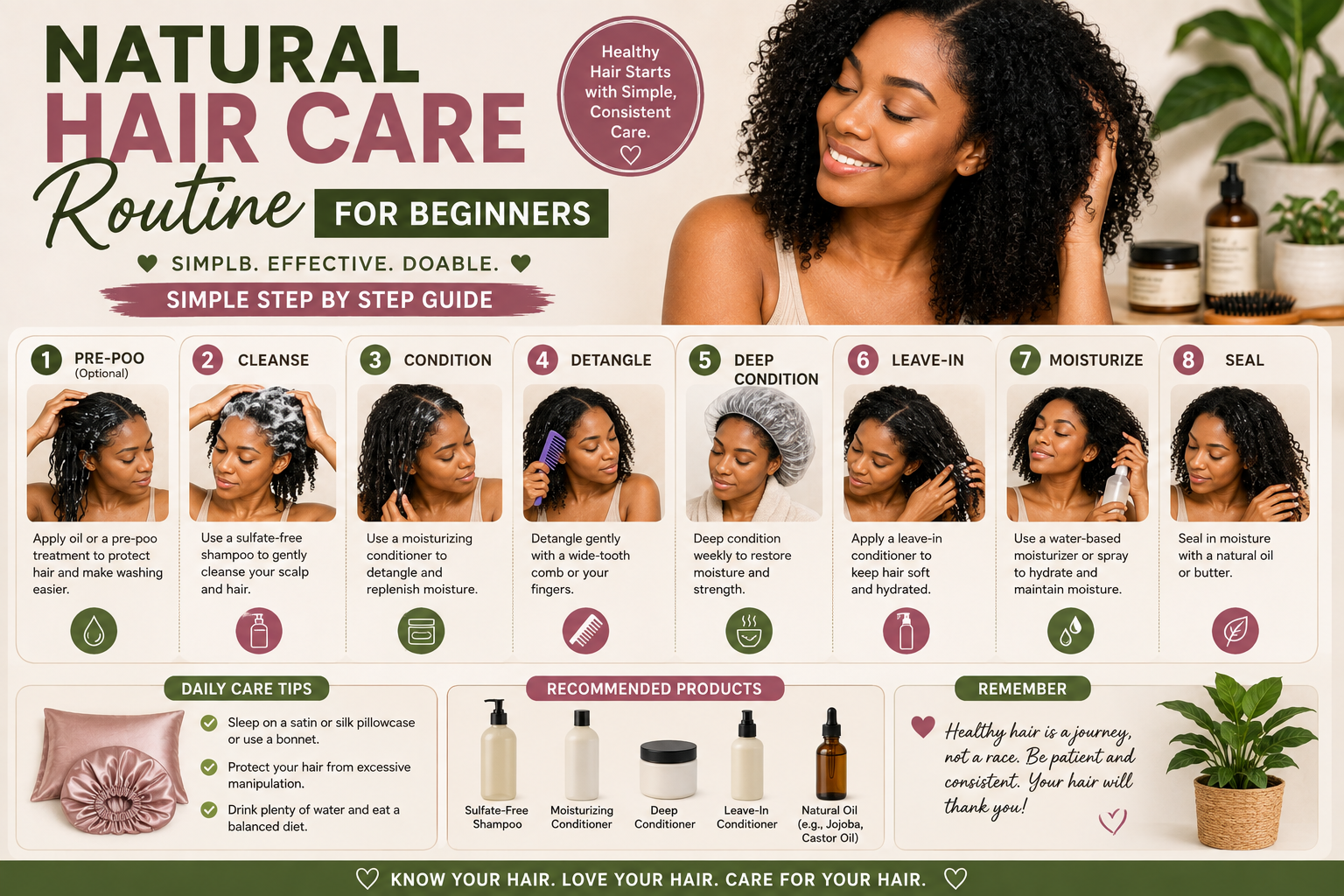
Natural Hair Care Routine for Beginners — Simple Step by Step Guide
Starting a natural hair journey is overwhelming in a way that nobody warns you about. There are hundreds of products, conflicting advice from every direction, and enough acronyms — LOC, LCO, TWA, BC — to make your head spin before you’ve even bought a shampoo.
I started my natural hair journey with no idea what I was doing and spent the first six months making expensive mistakes. This guide is what I wish someone had handed me on day one — a simple, honest routine that actually works for beginners.
Before You Buy Anything: Understand What Natural Hair Needs
Natural hair has one core need: moisture. Specifically, it needs water — because water is the only thing that actually hydrates hair — and it needs that water to stay in, which is where products come in.
The tight curl pattern of natural hair makes it hard for the oils your scalp produces to travel down the shaft. Straight hair gets coated in those oils automatically. Natural hair doesn’t. That’s why natural hair gets dry so much faster and why it needs more intentional care to stay moisturized.
Every step of a good natural hair routine either adds moisture, keeps moisture in, or protects against losing it. Once you understand that, the routine makes sense instead of feeling like a collection of random products.
The Basic Natural Hair Care Routine for Beginners
You don’t need ten products. You need four — and you need to use them consistently in the right order. Master these before adding anything else.
Step 1 — Shampoo (Once a Week)
Wash your scalp with a sulfate-free shampoo once a week. Sulfate shampoos clean effectively but strip the natural oils that natural hair already struggles to keep — switching to sulfate-free makes a noticeable difference in how dry your hair feels after washing.
Apply shampoo only to the scalp, not the length of your hair. Massage in with your fingertips — not your nails. The suds that run down the length of your hair as you rinse are enough to clean without scrubbing friction through it.
Work in sections if your hair is longer or thicker. Rinse thoroughly — shampoo left in the hair irritates the scalp.
Our guide to the best sulfate-free shampoos for natural hair covers specific recommendations at different price points.
Step 2 — Deep Condition (Every Wash Day)
This is the most important step and the one beginners are most likely to skip or rush. Don’t.
Apply your deep conditioner to damp hair immediately after rinsing the shampoo. Work through in sections from ends to roots. Cover with a shower cap and leave on for at least 20-30 minutes. Heat helps — sit under a dryer, use a heat cap, or even just sit in a warm bathroom. The heat opens the cuticle slightly and lets the conditioner actually penetrate instead of just sitting on the surface.
Rinse with cool water when done. Cool water closes the cuticle back down and seals in what the conditioner put in.
Use a deep conditioner with moisturizing ingredients like shea butter, honey, babassu oil, or aloe vera. See our deep conditioner recommendations for what actually works.
Step 3 — Detangle (While Rinsing Conditioner)
Detangle while your conditioner is still in — never on dry hair. The conditioner provides slip, which means your fingers or comb move through the hair instead of catching and pulling.
Always start from the ends and work upward toward the roots. Going root to tip forces knots down the shaft and causes unnecessary breakage. Work in sections. Hold the hair above the knot with one hand to protect the roots while you work through it with the other.
A wide-tooth comb or your fingers are the right tools. Fine-tooth combs and brushes are too aggressive for natural hair — especially when wet.
Step 4 — Moisturize and Seal (After Every Wash)
This is where you lock in moisture so your hair stays hydrated for days instead of hours. The method is called LOC — Liquid, Oil, Cream.
- Liquid (Leave-In Conditioner): Apply to soaking wet hair right after rinsing conditioner. Work through each section. This is your moisture step — the water in your hair plus the leave-in is what actually hydrates.
- Oil: Apply over the leave-in while hair is still damp. Oil slows down how fast moisture evaporates as your hair dries. Use a lightweight oil for fine or low-porosity hair (jojoba, argan) or a heavier oil for thicker or drier hair (castor oil).
- Cream: A butter or thick cream goes last to seal everything in. Shea butter, the TGIN Butter Cream, or any thick hair cream works. Focus on the ends.
See our full guide on how to moisturize natural hair for the LOC method explained in detail with product recommendations.
Between Wash Days
Natural hair doesn’t need to be washed every day — and it shouldn’t be. Once a week is the standard starting point. Between washes, you just need to maintain the moisture you put in on wash day.
Every 2-3 days, check your hair. If sections feel dry or rough, lightly mist with water or a water-based spray, apply a small amount of leave-in or oil to the dry sections, and you’re done. You don’t need to redo your entire routine — just refresh what needs it.
At night, cover your hair with a satin bonnet or sleep on a satin pillowcase. Cotton pulls moisture from natural hair while you sleep — this one change makes a visible difference in how your hair feels in the morning.
The Products You Actually Need as a Beginner
Keep it simple. Four products is enough to start:
- Sulfate-free shampoo — SheaMoisture Jamaican Black Castor Oil Shampoo is a reliable starting point. Available at most drugstores.
- Deep conditioner — Mielle Organics Babassu Oil & Mint Deep Conditioner works across most natural hair types and delivers real results from the first use.
- Leave-in conditioner — Kinky Curly Knot Today is lightweight and provides good detangling slip. Apply to soaking wet hair.
- Sealant — TGIN Butter Cream for 4A-4C hair, or jojoba oil for looser textures. This goes last, over the leave-in.
That’s it. Resist the urge to buy more products before you’ve given these four a proper chance. Most natural hair problems at the beginning aren’t product problems — they’re routine problems. Get the routine right first.
Common Beginner Mistakes to Avoid
Buying too many products at once. This is the most common beginner mistake. You end up with ten half-used bottles and no idea which product is helping or hurting. Start with four products, use them for at least six weeks, then evaluate.
Skipping deep conditioning. This feels optional until you see what consistent deep conditioning does to the texture and strength of your hair. It’s not optional. Every wash day, every time.
Detangling dry hair. Dry natural hair breaks when combed. Always detangle with conditioner in — on wash day in the shower — not dry.
Not sealing after moisture. Adding leave-in and then letting hair dry without a sealant means the moisture evaporates as it dries. Always apply oil or butter over your leave-in before your hair dries.
Washing too often. Natural hair doesn’t need daily or even every-other-day washing. Overwashing strips moisture faster than any product can replace it. Once a week is the right frequency for most people starting out.
Expecting overnight results. Natural hair changes slowly. Give any new routine at least six weeks before deciding whether it’s working. One wash day tells you nothing — a month of consistent routine tells you a lot.
Natural Hair Terms Every Beginner Should Know
Big Chop (BC): Cutting off all chemically relaxed or damaged hair to start fresh with fully natural hair.
Transitioning: Growing out natural hair while still having some relaxed or chemically processed hair at the ends — a slower alternative to the big chop.
Co-wash: Washing hair with conditioner instead of shampoo. Good for between regular wash days for very dry hair types — it cleanses gently without stripping.
Pre-poo: Applying an oil (usually coconut or olive oil) to dry hair before shampooing. It reduces breakage during the wash by protecting the hair from the swelling and friction that shampoo causes.
Porosity: How well your hair absorbs and holds moisture. Low porosity hair repels products; high porosity hair absorbs fast but loses moisture fast too. Knowing your porosity helps you choose the right products.
LOC method: Liquid, Oil, Cream — the moisture layering technique described above.
Protective style: A style that tucks the ends of your hair away — braids, twists, buns — to reduce manipulation and breakage.
How Long Before You See Results?
Real talk: six weeks minimum before you judge whether a routine is working. Natural hair responds to changes slowly. The improvements you want — less breakage, better moisture retention, softer texture — happen gradually over weeks, not after one wash day.
If your hair is transitioning from chemical relaxer, give it three to six months. Transitioning hair has two different textures and behaves differently than fully natural hair — it needs extra gentleness and patience during that period.
Frequently Asked Questions
How do I start a natural hair care routine from scratch?
Start with four products: sulfate-free shampoo, deep conditioner, leave-in conditioner, and a sealant (oil or butter). Use them every wash day in that order — shampoo, deep condition, apply leave-in on wet hair, seal with oil or butter. Refresh moisture between washes every 2-3 days and sleep on satin. Give it six weeks before evaluating.
How often should beginners wash natural hair?
Once a week is the right starting frequency for most natural hair types. Some people with very dry 4C hair do better every 10-14 days. Washing more often strips moisture. Between washes, co-washing or simply refreshing with water and leave-in is enough to keep hair clean and moisturized.
What products do beginners need for natural hair?
Four: sulfate-free shampoo, deep conditioner, leave-in conditioner, and a sealant. That covers every step of a basic natural hair routine. Don’t buy more until you’ve used those four consistently and understood how your hair responds to them.
How do I know my natural hair type?
Natural hair types go from 3A (loose waves) to 4C (tightest coils). Type 3 hair has visible curl definition. Type 4 hair coils tightly with less visible curl definition at 4B and 4C. Knowing your type helps but knowing your porosity matters more for choosing products. Most of the routines and products recommended here work across types 3C through 4C.
Why does my natural hair feel dry even after moisturizing?
Usually one of three things: applying products to dry hair instead of wet hair, not sealing after your leave-in (moisture evaporates without a sealant), or not deep conditioning regularly. Fix the order — always apply leave-in to wet hair, always seal immediately after — and add deep conditioning every single wash day. That combination resolves most persistent dryness within a few weeks.
Final Thoughts
A natural hair routine doesn’t need to be complicated to work. Four products, used consistently, in the right order, every wash day — that’s enough to see real improvement in how your natural hair looks and feels.
The two habits that matter most: deep condition every week without skipping, and seal moisture in after every wash. Everything else builds from there.
More from PickHonestly to help you build your routine:
- How to Moisturize Natural Hair — Complete LOC Method Guide
- Best Deep Conditioners for Natural Hair
- Best Leave-In Conditioners for Natural Hair
- Best Sulfate-Free Shampoos for Natural Hair
- Best Hair Oils for Natural Hair
- Best Products for 4C Natural Hair
Prices accurate as of publication. Verify current pricing before purchasing.