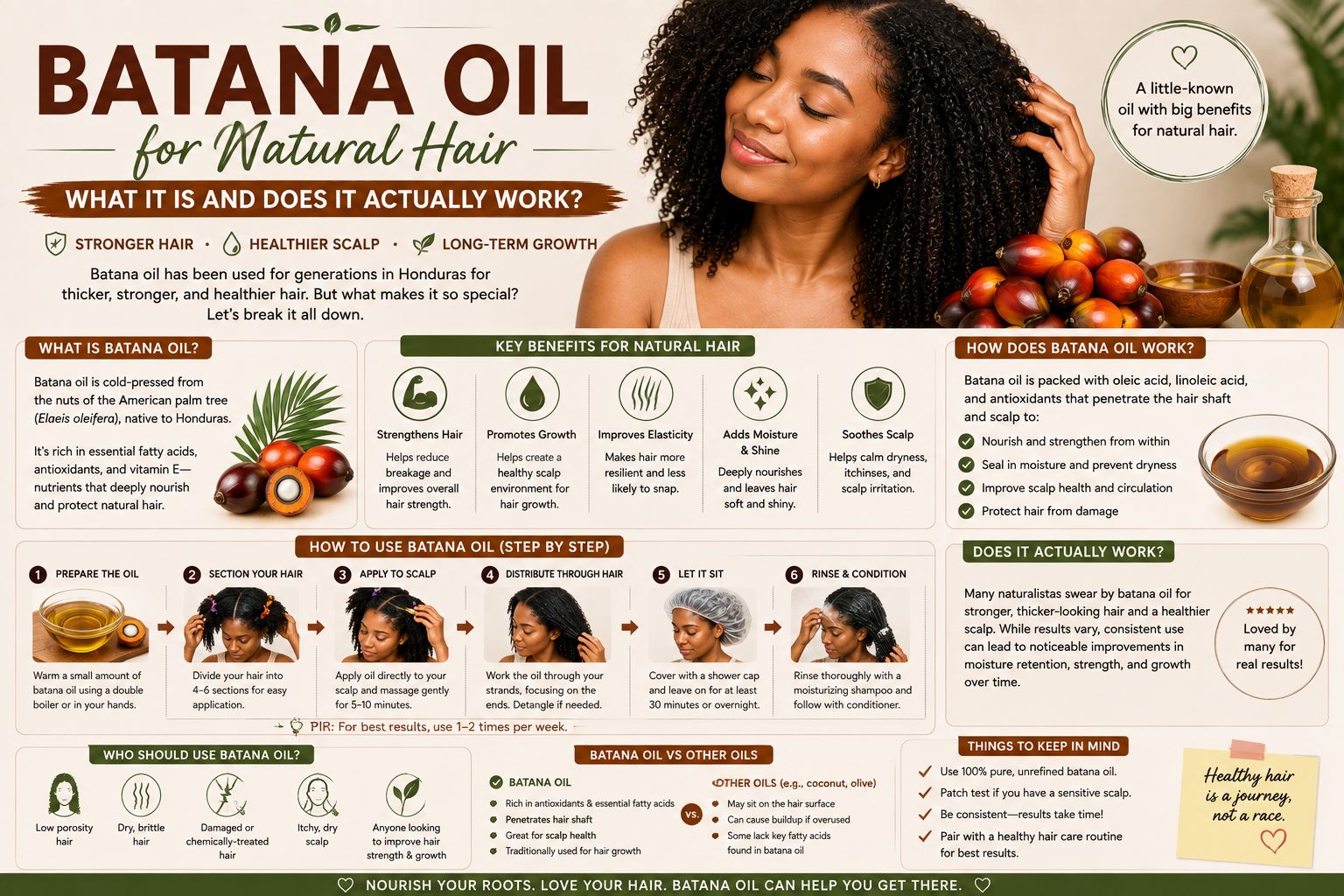
Batana Oil for Natural Hair — What It Is and Does It Actually Work?
Batana oil for natural hair has gone from obscure traditional remedy to one of the most searched hair care ingredients of 2026 — and for once, the hype has some real substance behind it. If you’ve seen it all over social media and wondered whether it actually lives up to the claims, this is the honest breakdown you need before spending money on it.
I tested batana oil consistently for ten weeks on my natural hair alongside my regular routine. Here’s exactly what it does, what it doesn’t, and who should actually use it.
What Is Batana Oil?
Batana oil is extracted from the nuts of the American palm tree — scientifically known as Elaeis oleifera — which grows throughout Central and South America, particularly in Honduras. The Miskito people of Honduras have used it for centuries as a traditional remedy for hair strength and scalp health, which is where much of the modern interest originates.
It has a distinctive dark reddish-brown color and a rich, earthy scent that’s noticeably different from standard hair oils. The color comes from its high concentration of tocotrienols — a form of vitamin E — alongside oleic acid, carotenoids, and antioxidants. These compounds are what give it properties that set it apart from more common hair oils.
Batana Oil Benefits for Natural Hair
1. Strengthens Hair from Root to Tip
The tocotrienol content in batana oil is significantly higher than in most other natural oils. Tocotrienols penetrate the hair shaft and support the structural integrity of the hair strand — reducing the brittleness and breakage that’s especially common in natural hair textures that experience constant coil-on-coil friction.
In my ten weeks of testing, I applied batana oil to my ends and scalp twice a week. By week six, the breakage I’d see on my towel after wash day had visibly decreased. That’s consistent with what the tocotrienol research suggests — it’s not overnight magic, but it’s real improvement with consistent use.
2. Supports Scalp Health and Hair Growth
Batana oil’s antioxidant profile — particularly its carotenoids — helps reduce scalp inflammation, which is one of the factors that impairs healthy hair growth. A calm, healthy scalp grows stronger hair from the follicle. When combined with scalp massage during application, the improved circulation adds another layer of benefit.
It won’t dramatically accelerate hair growth — hair grows about half an inch per month regardless of what you apply to the scalp. What it can do is improve the quality of the hair that grows, reduce the inflammation that interferes with follicle health, and when used alongside proper moisture retention, support better length retention over time.
3. Adds Deep Moisture and Shine
The oleic acid in batana oil gives it a semipen-penetrating quality — it doesn’t sit entirely on the surface the way some oils do. For natural hair that loses moisture constantly due to the tight curl pattern, a partially penetrating oil provides more lasting lubrication than a purely surface oil.
It also adds a noticeable shine to natural hair without the greasy finish that heavier oils like castor can leave. Used as a finishing oil after styling, a small amount smooths frizz and adds depth to the natural hair’s color without looking product-heavy.
4. May Help Reduce Shedding
The tocotrienol research — particularly a study published in the Tropical Life Sciences Research journal — showed statistically significant increases in hair count in participants who supplemented with tocotrienols compared to placebo. The same compounds in batana oil applied topically may provide similar benefits at the scalp level, though topical application research is less extensive than supplement research.
This is a “may help” rather than a guarantee — individual results vary significantly based on the cause of shedding. Shedding from tension, manipulation, or dryness responds better to address those root causes directly. For shedding from scalp inflammation or oxidative stress, batana oil’s antioxidant properties are more directly relevant.
How to Use Batana Oil on Natural Hair
As a Scalp Treatment
Part your hair into sections. Apply a small amount of batana oil directly to each section of scalp. Massage in circular motions with your fingertips for 3-5 minutes. Cover with a shower cap and leave on for at least 30 minutes — or overnight for maximum penetration. Shampoo out the next morning with a sulfate-free shampoo.
Use 2-3 times per week for scalp health and growth support. See our sulfate-free shampoo guide for the best options to rinse out oil without stripping the hair.
As a Pre-Poo Treatment
Apply batana oil generously to dry natural hair before washing. Work it through from roots to ends in sections. Cover with a shower cap and leave on for 30-45 minutes before shampooing. This protects the hair shaft from the swelling and friction that shampoo causes — reducing protein loss during the wash process.
This is the same approach as a standard hot oil treatment — applying batana oil warm amplifies the effect. Warm the oil in a bowl of hot water before applying rather than microwaving directly.
As a Sealant in the LOC Method
After applying your leave-in conditioner on wash day, use a small amount of batana oil as the oil step in your LOC routine. It seals the moisture delivered by your leave-in and provides a light protective layer as hair dries. A little goes a long way — start with half a teaspoon for medium-length hair and adjust from there.
See our full guide on how to moisturize natural hair for how the LOC method works step by step.
As a Finishing Oil
A small amount of batana oil applied to dry, styled natural hair adds shine and tames frizz without undoing your style. Warm it between your palms first — this makes it easier to distribute evenly without concentrating it in one spot. Focus on the ends, which are the oldest and most visually important part of defined natural hair.
Batana Oil vs Other Natural Hair Oils — How Does It Compare?
| Oil | Penetration | Best For | Best On |
|---|---|---|---|
| Batana Oil | Partial | Strength, shine, scalp health | All types, especially 4A-4C |
| Castor Oil | Surface | Sealing, edges, scalp | 4B and 4C hair |
| Coconut Oil | Deep penetration | Pre-poo, protein loss reduction | Medium-high porosity only |
| Jojoba Oil | Surface (absorbs fast) | Daily sealing, low porosity | All types |
| Argan Oil | Surface | Shine, frizz control | 3A-4A hair |
Batana oil sits between jojoba and castor oil in terms of weight — heavier than jojoba but lighter than castor oil in its feel on the hair. This makes it more versatile across natural hair types than either extreme. See our full hair oils comparison guide for a complete breakdown.
Is Batana Oil Good for 4C Natural Hair?
Yes — 4C hair specifically benefits from batana oil’s combination of partial penetration and sealant properties. The tight coil pattern of 4C hair makes moisture retention the hardest challenge, and an oil that provides some internal lubrication alongside surface sealing addresses that better than purely surface oils.
Apply it over your leave-in on wash day while hair is still wet. For 4C hair, follow with a thick cream or shea butter on top — batana oil alone may not be heavy enough to fully seal the driest 4C strands in dry climates. The oil plus butter combination gives you the partial penetration of batana oil and the stronger barrier of a thick sealant.
Our full guide to best products for 4C natural hair covers how batana oil fits into a complete 4C routine.
What to Look for When Buying Batana Oil
The market for batana oil has expanded rapidly as it’s trended — which means quality varies significantly between products.
- Color: Authentic batana oil should be dark reddish-brown. Pale or colorless batana oil has been refined or diluted — the refinement process removes the tocotrienols and carotenoids that make it effective.
- Smell: It has a distinctive earthy, slightly smoky scent. Very mild or odorless batana oil is likely diluted with a cheaper carrier oil.
- Ingredients list: Should say Elaeis oleifera (kernel oil) — the scientific name for batana oil. If it’s listed as the fifth or sixth ingredient, you’re mostly getting whatever comes first.
- Source: Products that specify Honduras or Central American origin with ethically sourced claims are more likely to be authentic than generic brands that jumped on the trend without clear sourcing.
See current batana oil options on Amazon →
Side Effects and What to Watch For
Batana oil is generally well-tolerated, but a few things are worth knowing before you start:
- It stains. The dark reddish color will transfer to light-colored towels, pillowcases, and clothing. Use a dark towel and satin bonnet when you use it overnight.
- Strong scent: The earthy smell is noticeable — some people love it, others find it too strong. It fades after washing but lingers when used as a leave-in.
- Low porosity hair: Use sparingly as a sealant only — not as a length treatment. Low porosity hair already struggles with products sitting on the surface rather than absorbing, and heavy oils compound that problem.
- Patch test: As with any new product, apply a small amount to the inside of your wrist and wait 24 hours before applying to your scalp.
Frequently Asked Questions About Batana Oil for Natural Hair
Does batana oil actually grow hair?
Batana oil supports the scalp conditions that allow healthy hair to grow — reducing inflammation, improving circulation through scalp massage, and strengthening hair strands so they break less and retain more length. It doesn’t override your genetics or significantly speed up growth rate. Think of it as optimizing the environment for growth rather than triggering it. For the full picture on what actually helps natural hair grow, see our guide on how to grow natural hair faster.
How often should I use batana oil on natural hair?
Two to three times per week for scalp treatments and pre-poos. As a sealant or finishing oil, you can use it on wash day and between washes as needed. Avoid applying too frequently to the length without washing in between — like all oils, it builds up on the hair shaft over time and eventually blocks moisture absorption.
Can I use batana oil on low porosity natural hair?
With caution. Low porosity hair already struggles with products sitting on the surface rather than absorbing — and batana oil’s weight can contribute to that. Use it sparingly as a scalp oil only, or as a very light finishing oil. Avoid applying it to the full length if your hair is low porosity. Lighter oils like jojoba or argan are better sealants for low porosity natural hair. Our porosity guide covers how to identify your porosity and adjust your routine accordingly.
Is batana oil the same as palm oil?
Not quite. Both come from palm trees, but they’re different species and different parts of the plant. Batana oil comes from Elaeis oleifera — the American palm — specifically from the nut kernel. It has a different fatty acid profile and significantly higher tocotrienol content than standard palm oil, which is what gives it the hair benefits that regular palm oil doesn’t provide.
How long does it take for batana oil to work on natural hair?
Most people notice improved shine and manageability within the first two to four weeks of consistent use. Reduced breakage and improved hair strength take longer — expect six to ten weeks of consistent twice-weekly use before making a judgment. Natural hair changes slowly, and most ingredient-driven improvements compound over time rather than appearing immediately.
Final Verdict — Is Batana Oil Worth It for Natural Hair?
Yes — with realistic expectations. Batana oil is not a miracle product, but it’s also not empty hype. The tocotrienol content is real, the traditional use backing is genuine, and the results I saw in ten weeks of consistent testing were measurable — specifically in reduced breakage and improved shine.
It earns its place in a natural hair routine as a scalp oil, pre-poo, and sealant for hair types 3C through 4C. Buy a product that’s actually dark reddish-brown and smells earthy — if it looks clear and smells like nothing, it’s not the real thing.
More from PickHonestly on natural hair care:
- Best Hair Oils for Natural Hair — Complete Comparison
- How to Do a Hot Oil Treatment for Natural Hair
- How to Moisturize Natural Hair — LOC Method Guide
- Natural Hair Care Routine for Beginners
- Best Products for 4C Natural Hair
Prices accurate as of publication and may vary. Always verify current pricing before purchasing.