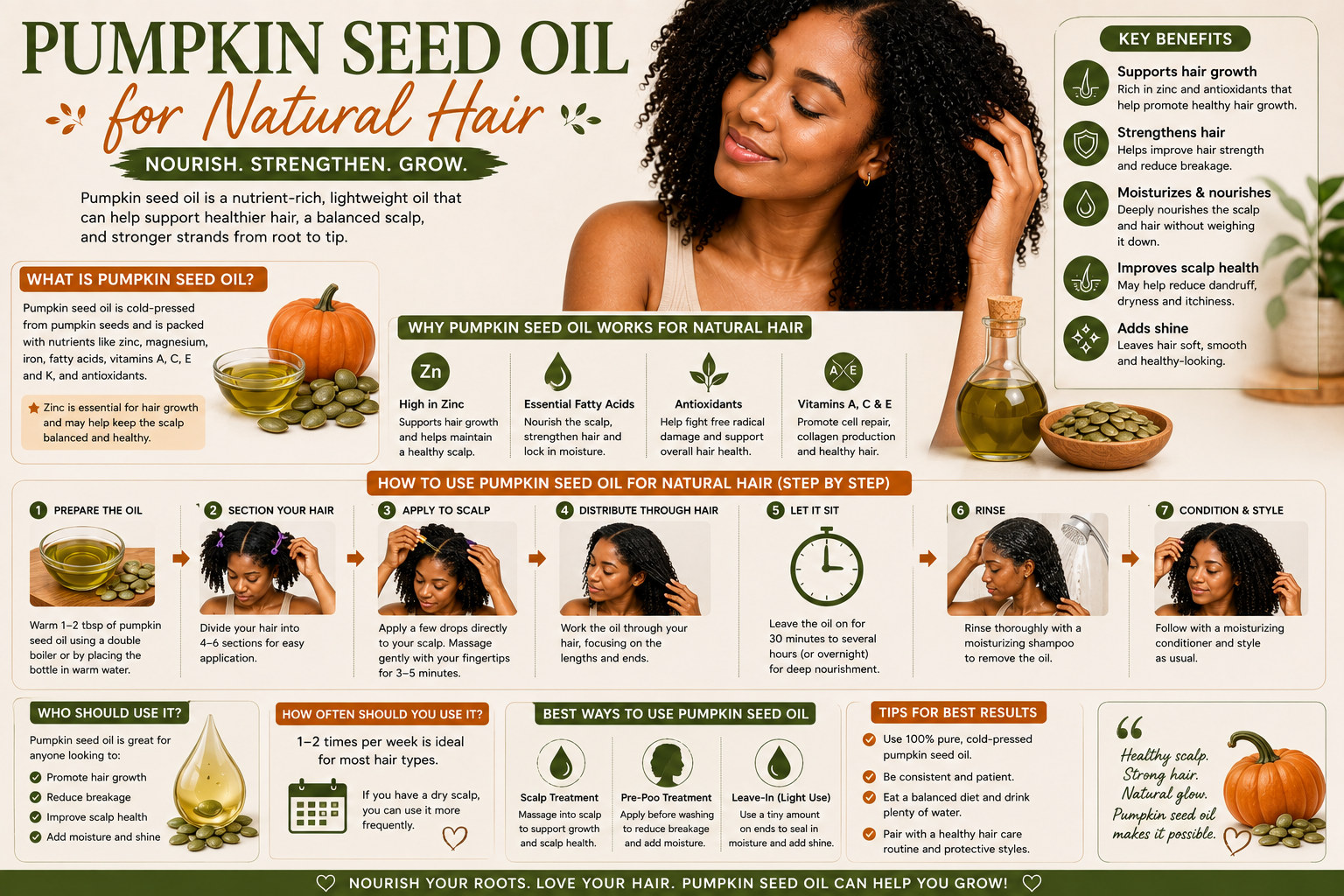
Pumpkin Seed Oil for Natural Hair — Benefits, Uses, and Honest Results
Pumpkin seed oil for natural hair is one of the fastest-rising ingredients in hair care right now — search interest has increased over 500% in the past year, and unlike most trends, this one has actual research behind it. If you’ve been seeing it everywhere and want an honest answer about whether it works before spending money on it, this guide covers everything you need to know.
I’ve been using pumpkin seed oil consistently for eight weeks alongside my regular natural hair routine. Here’s what the research says, what I actually experienced, and exactly how to use it on natural hair.
What Is Pumpkin Seed Oil?
Pumpkin seed oil is cold-pressed from the seeds of Cucurbita pepo — the common pumpkin. It has a rich dark green to amber color and a nutty, slightly earthy scent. The cold-pressing process preserves the nutrients that make it valuable for hair:
- Cucurbitin — an amino acid unique to pumpkin seeds that may block DHT, a hormone linked to hair thinning
- Zinc — supports healthy hair follicle function and reduces scalp inflammation
- Vitamin E (tocotrienols and tocopherols) — antioxidants that protect hair from oxidative damage
- Omega-6 and omega-9 fatty acids — condition and strengthen the hair shaft
- Beta-carotene — converts to vitamin A in the scalp, supporting cell turnover and follicle health
Pumpkin Seed Oil Benefits for Natural Hair
1. Supports Hair Growth and Reduces Shedding
The most studied benefit of pumpkin seed oil is its effect on hair loss. A randomized, double-blind, placebo-controlled trial published in Evidence-Based Complementary and Alternative Medicine found that men who took pumpkin seed oil supplements for 24 weeks experienced a 40% increase in hair count compared to placebo. The proposed mechanism is cucurbitin blocking the enzyme that converts testosterone to DHT — a hormone that miniaturizes hair follicles.
For natural hair specifically, this is most relevant for people experiencing thinning at the edges, temples, or crown — areas where tension from tight styles and DHT sensitivity intersect. Pumpkin seed oil applied topically to the scalp may provide some of the same DHT-blocking benefit as supplementation, though topical research is less extensive than the oral supplement studies.
2. Reduces Scalp Inflammation
The zinc content in pumpkin seed oil directly addresses scalp inflammation — one of the most underappreciated factors in natural hair health. An inflamed scalp produces weaker hair from the follicle and is more prone to flaking, itching, and accelerated shedding. Zinc helps regulate sebum production and calms the scalp environment, which supports healthier hair growth over time.
This is particularly relevant for natural hair because tight protective styles can restrict scalp circulation and trap product residue — both of which contribute to scalp inflammation. Massaging pumpkin seed oil into the scalp after protective style removal helps reset scalp health before the next install.
3. Strengthens the Hair Shaft
The combination of vitamin E and omega fatty acids in pumpkin seed oil provides two kinds of protection for natural hair strands. Vitamin E’s antioxidant properties neutralize free radical damage from UV exposure, heat, and environmental pollution — damage that weakens the protein bonds in the hair shaft over time. The omega fatty acids coat and partially penetrate the hair shaft, adding flexibility that reduces breakage during detangling.
For 4C natural hair specifically, where coil-on-coil friction causes constant micro-breakage, the added flexibility from fatty acids compounds over weeks of consistent use into real, measurable reduction in shedding on wash day.
4. Conditions and Adds Shine Without Heaviness
Pumpkin seed oil has a medium weight — heavier than argan oil, lighter than castor oil. It absorbs reasonably well across most natural hair types without leaving the heavy residue that thick oils like JBCO can. The result is conditioning and shine that feels incorporated into the hair rather than sitting on top of it.
As a finishing oil after styling, a small amount adds depth and shine to natural hair coils without weighing them down or making twists look greasy. For this purpose it works across 3C through 4C hair types without needing adjustment for different textures.
How to Use Pumpkin Seed Oil on Natural Hair
As a Scalp Treatment (Most Important Use)
This is where pumpkin seed oil delivers its most evidence-backed benefits. Part your hair into sections and apply pumpkin seed oil directly to the scalp using a dropper or your fingertips. Massage each section for 2-3 minutes using circular motions — the massage itself stimulates circulation and helps the oil reach the follicles.
Leave on for at least 30 minutes under a shower cap, or overnight for maximum penetration. Wash out in the morning with your sulfate-free shampoo. Use 2-3 times per week consistently — the DHT-blocking and anti-inflammatory benefits build over time and won’t show meaningful results in a single application.
For the best shampoo to rinse it out without stripping the scalp, see our sulfate-free shampoo guide.
As a Pre-Poo Before Washing
Apply pumpkin seed oil to dry natural hair 30-45 minutes before shampooing. Work through in sections from roots to ends. Cover with a shower cap. The oil forms a protective layer over the hair shaft that reduces the protein loss that shampoo causes — particularly useful for high porosity natural hair that loses structural integrity quickly during the wash process.
For a more intensive version, warm the oil first using the hot water method — place a small amount in a glass bowl inside a larger bowl of hot water for 2-3 minutes. Warm oil penetrates better than room-temperature oil. See our full hot oil treatment guide for the complete method.
As the Oil Step in the LOC Method
After applying your leave-in conditioner on wash day, use pumpkin seed oil as the “O” step in the LOC method — Liquid, Oil, Cream. Apply it over the leave-in while hair is still wet. It seals in the moisture from your leave-in as hair dries and adds the fatty acid conditioning layer that reduces friction between strands.
For 4B and 4C hair, follow with a heavier cream or shea butter over the pumpkin seed oil — it’s medium-weight and may not provide enough of a barrier on the driest natural hair textures on its own. For 3C and 4A hair, it works well as the final sealant step without needing a cream on top.
The full LOC method explained step by step is in our natural hair moisturizing guide.
As a Finishing Oil After Styling
Warm a small amount between your palms and apply lightly over dry, styled natural hair. Focus on the ends. It smooths frizz and adds shine without the heavy, greasy look that thicker oils can produce. Works well on twist-outs, wash-and-gos, and defined curl styles across most natural hair types.
Pumpkin Seed Oil vs Other Natural Hair Oils
| Oil | Weight | Key Benefit | Best Hair Type |
|---|---|---|---|
| Pumpkin Seed Oil | Medium | DHT blocking, scalp health, strength | All types, 3C–4C |
| Castor Oil | Very heavy | Sealing, edges | 4B and 4C |
| Jojoba Oil | Light | Daily sealing, low porosity | All types |
| Argan Oil | Light | Shine, frizz control | 3A–4A |
| Batana Oil | Medium-heavy | Strength, shine, antioxidant | 3C–4C |
| Coconut Oil | Medium | Penetration, pre-poo | Medium-high porosity |
Pumpkin seed oil’s combination of medium weight and specific DHT-blocking properties makes it different from any other oil on this list. No other common natural hair oil has the cucurbitin content that gives pumpkin seed oil its hair loss research backing. For scalp health and growth support, it’s a stronger choice than jojoba or argan. For pure sealing on very dry hair, castor oil still edges it out.
See our full hair oils guide for a complete comparison of which oil works best for which natural hair situation.
Is Pumpkin Seed Oil Good for 4C Natural Hair?
Yes — pumpkin seed oil works well on 4C natural hair with the right approach. Its medium weight means it absorbs better than heavy oils like castor but provides more conditioning than lightweight oils like argan. For 4C hair specifically:
- Use it as a scalp treatment 2-3 times per week for DHT-blocking and scalp health benefits
- Apply it over leave-in on wash day as the oil step in LOC — follow with a heavier butter or cream on top for maximum moisture sealing
- Use it as a pre-poo before wash day to protect the hair shaft during shampooing
The ends of 4C hair — the oldest and most fragile part — respond well to pumpkin seed oil’s fatty acid content. Regular application to the ends reduces the brittleness that causes single-strand knots and tip breakage on tight coil patterns.
For a complete 4C routine that incorporates oils correctly, see our guide on best products for 4C natural hair.
How to Choose a Good Pumpkin Seed Oil
As with batana oil, the pumpkin seed oil market has expanded rapidly with the trend — and not all products are equal:
- Color: Cold-pressed pumpkin seed oil should be dark green to amber. Clear or pale yellow pumpkin seed oil has been refined — the refining process removes the beneficial compounds that make it effective.
- First ingredient: Should list Cucurbita pepo (seed oil) as the first or primary ingredient. If it’s listed fifth or sixth, you’re mostly paying for carrier oil.
- Cold-pressed: Look for “cold-pressed” or “unrefined” on the label. Heat processing during extraction degrades the vitamin E and cucurbitin content.
- No added fragrance: Pure pumpkin seed oil has a mild nutty scent. Strong artificial fragrance is a sign the oil has been cut with other ingredients.
See cold-pressed pumpkin seed oil options on Amazon →
Frequently Asked Questions About Pumpkin Seed Oil for Natural Hair
Does pumpkin seed oil actually stop hair loss on natural hair?
The research on pumpkin seed oil and hair loss is promising — particularly one randomized controlled trial showing significant improvement in hair count over 24 weeks. The proposed mechanism is blocking DHT, a hormone that miniaturizes follicles and causes pattern thinning. For natural hair thinning specifically at the edges or crown, consistent topical use may support follicle health alongside addressing the tension and manipulation factors that are often the primary causes of natural hair loss. It’s not a guaranteed fix, but it’s one of the more evidence-backed natural ingredients for this concern.
How long does pumpkin seed oil take to work on natural hair?
Expect eight to twelve weeks of consistent use before assessing results. Scalp health improvements — less itching, less flaking — tend to show up within the first four weeks. Strength and shine improvements in the hair itself become noticeable around six weeks. Growth support, if it happens, takes longer because hair grows slowly — about half an inch per month regardless of what you apply. Consistency matters far more than frequency. Using it twice a week for ten weeks beats using it daily for two weeks and then stopping.
Can I mix pumpkin seed oil with other oils for natural hair?
Yes — mixing oils is common and often more effective than using one alone. A useful combination for scalp massage: pumpkin seed oil as the base with a few drops of rosemary essential oil (which has its own research backing for scalp circulation). Warm the mixture in a bowl of hot water before applying. For sealing on the hair length, mixing pumpkin seed oil with jojoba or argan creates a blend that’s lighter than pumpkin seed oil alone — better for fine or low-porosity natural hair.
Is pumpkin seed oil safe to use on color-treated natural hair?
Yes — pumpkin seed oil is gentle and doesn’t strip color. Its antioxidant properties (particularly vitamin E) actually help protect color-treated hair from some of the oxidative damage that makes color fade faster. Apply it as a scalp treatment and sealant as you would on unprocessed natural hair. Color-treated natural hair is higher porosity, which means pumpkin seed oil will absorb quickly — follow with a heavier sealant on top if your hair loses moisture fast.
Does pumpkin seed oil work for natural hair edges?
It’s worth trying consistently for thinning edges, particularly if the thinning has a hormonal or follicle-health component. Massage a small amount into the edge area daily for at least eight weeks. Combine this with reducing tension at the hairline — loose styles, no tight braids or ponytails at the edges — and the combination addresses both the mechanical and biological causes of edge thinning. See our natural hair growth guide for a full breakdown of what actually helps edges recover.
Final Verdict — Is Pumpkin Seed Oil Worth It for Natural Hair?
Yes — especially as a scalp oil. Pumpkin seed oil has more research backing than most trending hair ingredients, its nutrient profile addresses real natural hair concerns (scalp inflammation, DHT-related thinning, hair shaft strength), and it works across most natural hair types without being too heavy or too light.
The key is buying a genuine cold-pressed unrefined product — the dark green to amber color is the easiest quality indicator — and using it consistently as a scalp treatment two to three times per week. The benefits build over months, not days.
More from PickHonestly on natural hair care:
- Batana Oil for Natural Hair — What It Is and Does It Work
- Best Hair Oils for Natural Hair — Complete Comparison
- How to Do a Hot Oil Treatment for Natural Hair
- How to Grow Natural Hair Faster
- Natural Hair Porosity Test — What It Means for Your Routine
- Best Products for 4C Natural Hair
Prices accurate as of publication and may vary. Always verify current pricing before purchasing.