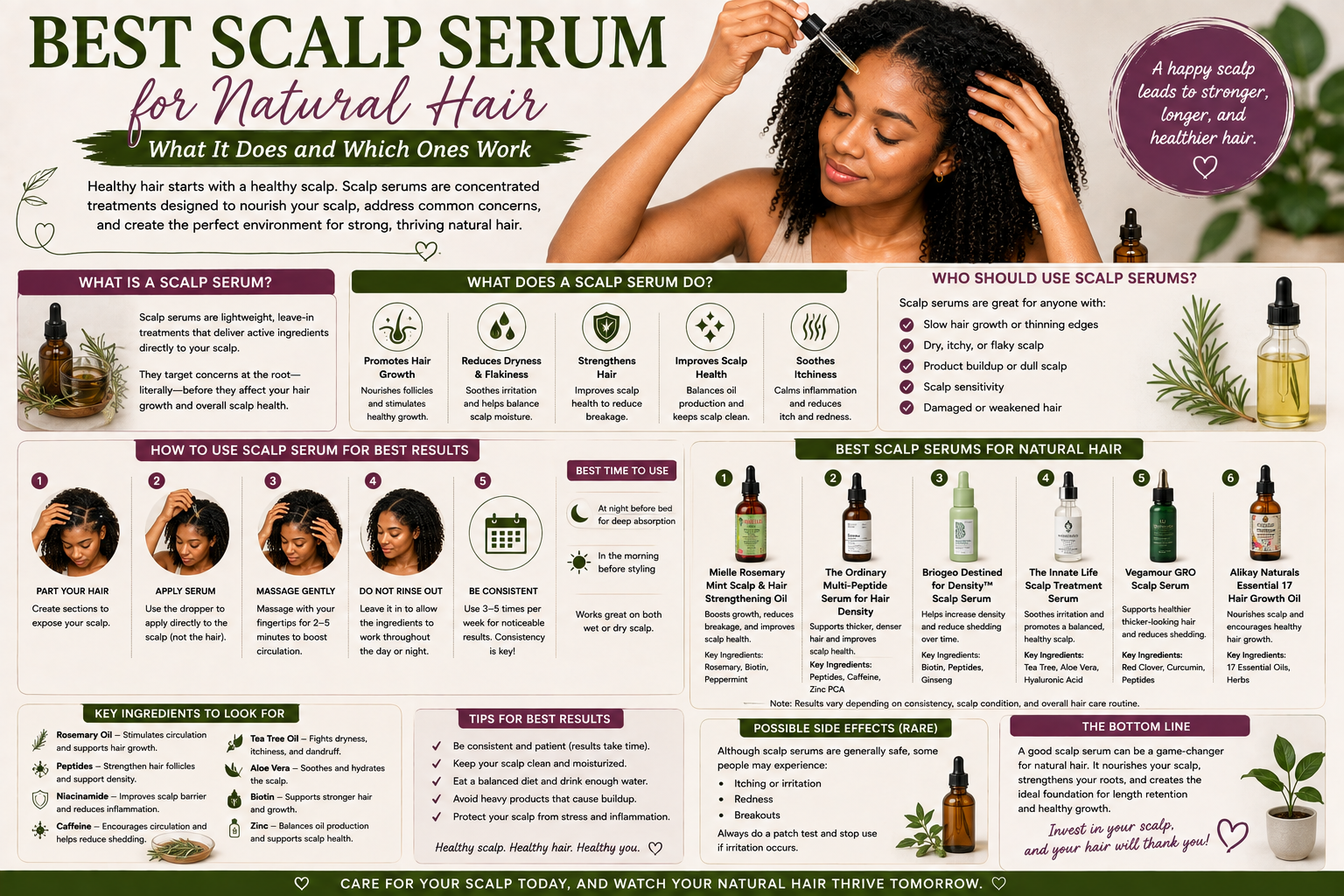
Best Scalp Serum for Natural Hair — What It Does and Which Ones Work
Using a scalp serum for natural hair has gone from niche salon treatment to one of the fastest-growing categories in hair care — and the shift makes sense. Most natural hair routines focus on the strand: conditioners, leave-ins, sealants. But the health of every strand starts at the scalp, and neglecting that foundation limits how well everything else works.
I added a scalp serum to my natural hair routine eleven weeks ago. Here’s what scalp serums actually do, which ones are worth using on natural hair, and exactly how to apply them for real results.
What Is a Scalp Serum and Why Does Natural Hair Need One?
A scalp serum is a concentrated, lightweight formula designed to be applied directly to the scalp — not the hair length. Unlike oils, which sit on the surface, and shampoos, which rinse off immediately, a scalp serum stays on the scalp and delivers active ingredients where they matter most: at the follicle level.
Natural hair needs scalp care for specific reasons that don’t apply in the same way to other hair types:
- Protective styles restrict scalp access. Braids, twists, and wigs make it harder to clean and treat the scalp regularly — leading to buildup, inflammation, and weakened follicles underneath
- The tight curl pattern makes product distribution harder. Oils and conditioners applied to natural hair often don’t reach the scalp effectively — a targeted scalp serum with a pointed applicator bottle solves this
- Tension from styling stresses follicles. Regular use of a scalp serum with anti-inflammatory ingredients addresses the inflammation that tension styling creates over time
- Hair growth starts at the scalp. The strongest length retention habits — deep conditioning, moisture sealing — don’t compensate for an unhealthy scalp environment producing weak hair from the root
Best Scalp Serums for Natural Hair in 2026
1. Mielle Organics Rosemary Mint Scalp & Hair Strengthening Oil — Best Overall
Focus keyword use: Best scalp serum for natural hair beginners and those focused on growth
Mielle’s Rosemary Mint formula is technically an oil, but its lightweight consistency and pointed applicator make it function exactly like a scalp serum — it delivers targeted active ingredients directly to the scalp with precision and absorbs without leaving heavy residue.
The rosemary oil content is what makes it stand out. A study published in Skinmed found rosemary oil comparable to minoxidil for hair count improvement over six months — and Mielle’s formula is pre-diluted in a jojoba and sweet almond oil carrier, making it safe for direct scalp application without mixing. The mint provides additional scalp stimulation through menthol’s vasodilating effect.
After eleven weeks of applying it to my scalp three times per week with a five-minute massage, I’ve seen the clearest improvement in edge density of anything I’ve tried. It won’t work overnight — this is a three-to-six month commitment — but the results are real and the mechanism is supported by actual research.
- ✅ Pre-diluted rosemary oil — safe for direct scalp application
- ✅ Pointed applicator for precise delivery through parts
- ✅ Lightweight — no heavy residue on scalp or hair
- ✅ Works through protective styles without taking them down
- ✅ Research-backed active ingredient
- ❌ Strong mint scent — not for everyone
- ❌ Results require consistent use over months, not weeks
Price: $10–$14
2. The Ordinary Multi-Peptide Serum for Hair Density — Best for Thinning Natural Hair
Best for: Natural hair experiencing thinning, density loss, or slow growth
The Ordinary’s hair serum uses a combination of peptides, REDENSYL, CAPIXYL, and Procyanidin B2 — a specific apple extract that has shown results in clinical trials for hair count improvement. It’s one of the most ingredient-transparent and evidence-backed options in this price range, and it’s become a go-to for people who want skincare-level ingredient research applied to their scalp.
The formula is water-based and completely weightless — it absorbs within minutes and leaves no trace on the hair. Apply it directly to the scalp with the dropper, massage in, and let it dry before applying any oils or creams over the top. It doesn’t interfere with any other products in a natural hair routine, which makes it easy to stack with your existing wash day process.
- ✅ Multiple evidence-backed active ingredients in one formula
- ✅ Completely weightless — no scalp buildup
- ✅ Transparent ingredient list with clinical references
- ✅ Fragrance-free — good for sensitive scalps
- ❌ No applicator — requires dropper application and finger distribution
- ❌ More expensive than oil-based scalp treatments
Price: $22–$28
3. Briogeo Scalp Revival Charcoal + Tea Tree Scalp Treatment — Best for Dry Itchy Scalp
Best for: Natural hair with persistent scalp itching, flaking, or buildup from protective styles
Activated charcoal draws out the product buildup, sebum, and residue that accumulates on the scalp — particularly relevant for natural hair in protective styles where the scalp goes longer between proper cleansing. Tea tree oil provides antimicrobial and anti-inflammatory action that calms itching and reduces the flaking that people often mistake for dandruff but is frequently just product buildup irritation.
Apply it to the scalp before shampooing — work it through the parts with your fingertips and leave it for five to ten minutes, then shampoo as normal. On natural hair in a protective style, use a pointed applicator bottle to deliver it through the parts without disturbing the style. After removing a long-term protective style, this is one of the most effective ways to reset the scalp before the next install.
- ✅ Charcoal removes deep scalp buildup that regular shampoo misses
- ✅ Tea tree calms itching and inflammation fast — often within one use
- ✅ Good for scalp reset after extended protective styles
- ✅ Works on all natural hair types
- ❌ Pre-shampoo use only — not a leave-in treatment
- ❌ More expensive than other options on this list
Price: $38–$42
4. Wild Growth Hair Oil — Best Budget Scalp Serum for Natural Hair
Best for: Natural hair on a tight budget that still wants real scalp benefits
Wild Growth has been a natural hair community staple for decades — long before scalp serums became a mainstream category. Its combination of olive oil, jojoba oil, and coconut oil with added vitamins and herbs delivers scalp conditioning and hair strengthening at a price that makes consistent use financially sustainable. It’s not a clinical-grade peptide serum, but it works as a foundational scalp treatment for natural hair that doesn’t need to address specific concerns like significant thinning.
Use it as your scalp oil two to three times per week, massaging in for three to five minutes per session. It has a distinctive scent that some people love and others find too strong — worth noting before committing to a bottle.
- ✅ Extremely affordable for regular use
- ✅ Established community track record across natural hair types
- ✅ Olive, jojoba, and coconut oil combination works for most 3C–4C textures
- ❌ Strong distinctive scent
- ❌ No clinical-grade actives for thinning or density concerns
Price: $8–$12
How to Use a Scalp Serum on Natural Hair — Step by Step
Step 1 — Part Your Hair in Sections
Divide your natural hair into four to eight sections and clip them out of the way as you work. Working section by section ensures complete scalp coverage — trying to apply a serum to all of your hair at once leads to the sides and back of the scalp getting significantly less product than the top.
Step 2 — Apply Directly to the Scalp
Use the applicator from your scalp serum — a pointed tip bottle, dropper, or nozzle — to apply the serum directly to the scalp in each part. Work methodically through each section. You don’t need to apply it to the hair length — scalp serums are designed for the scalp, not the strands.
Step 3 — Massage for 3–5 Minutes
After applying to each section, massage the scalp with your fingertips using circular motions. The massage is not just to distribute the product — it’s a meaningful part of the treatment. Scalp massage independently increases blood flow to the follicles and has its own evidence base for supporting hair density. Five minutes of consistent massage amplifies whatever active ingredients you’re applying.
Step 4 — Leave In or Rinse (Depending on the Product)
Leave-in scalp serums — like the Mielle Rosemary Mint oil and The Ordinary peptide serum — stay on the scalp and don’t need to be washed out. Apply them between wash days or after washing as part of your regular routine.
Pre-shampoo scalp treatments — like the Briogeo charcoal treatment — are applied before washing and rinsed out with your shampoo. Check the product instructions to confirm which category your scalp serum falls into.
Step 5 — Continue Your Regular Routine
After your leave-in scalp serum has absorbed (usually five to ten minutes), continue with the rest of your natural hair routine — leave-in conditioner, oil, and cream sealant as normal. Scalp serums don’t interfere with the LOC method or any other moisturizing technique. See our guide on how to moisturize natural hair for the full routine explained.
Scalp Serum vs Scalp Oil for Natural Hair — What’s the Difference?
| Scalp Serum | Scalp Oil | |
|---|---|---|
| Base | Water or silicone — absorbs quickly | Oil-based — sits longer on scalp |
| Active ingredients | Peptides, acids, clinical-grade actives | Plant oils, essential oils, vitamins |
| Absorption | Fast — minutes | Slower — may feel residue |
| Best for | Thinning, density, clinical concerns | Dryness, scalp health, general nourishment |
| Price range | $20–$45 typically | $8–$20 typically |
| Use frequency | Daily or every other day | 2-3 times per week |
The two categories work well together — a clinical scalp serum in the morning for active ingredients, a scalp oil massage two to three evenings per week for circulation and nourishment. For most natural hair needs, starting with a quality scalp oil like the Mielle Rosemary Mint covers the foundational benefits. Adding a peptide serum makes sense if you’re addressing specific concerns like density loss or slow growth.
For a full breakdown of which oils work best on natural hair scalps, see our complete hair oils guide.
Scalp Serum for Natural Hair by Concern
Best Scalp Serum for Natural Hair Growth
Mielle Rosemary Mint Oil or The Ordinary Multi-Peptide Serum — both address the follicle-level factors that support hair growth. Use consistently for a minimum of eight to twelve weeks before evaluating. For everything that affects natural hair length retention beyond scalp health, see our guide on how to grow natural hair faster.
Best Scalp Serum for Dry Natural Hair Scalp
Mielle Rosemary Mint Oil applied between washes as a leave-in scalp treatment, combined with regular scalp massage. If flaking and itching are persistent, the Briogeo charcoal treatment used monthly as a pre-shampoo reset addresses the buildup component that often underlies chronic dryness.
Best Scalp Serum for Natural Hair in Protective Styles
Any lightweight leave-in scalp treatment delivered through a pointed applicator bottle — the Mielle Rosemary Mint works well for this. Apply through the parts of braids or twists two to three times per week. This keeps the scalp from becoming inflamed or excessively oily under a long-term protective style without disturbing the install.
Best Scalp Serum for 4C Natural Hair
The same recommendations apply across natural hair types — scalp serums work on the scalp, not the hair shaft, so curl pattern affects application method more than product selection. For 4C hair specifically, a pointed applicator is essential for reaching all areas of the scalp without disturbing curl definition. See our 4C natural hair guide for how scalp care fits into a complete 4C routine.
Frequently Asked Questions About Scalp Serum for Natural Hair
How often should I use a scalp serum on natural hair?
Leave-in scalp serums: three to four times per week for active growth support, or daily if the formula is lightweight enough. Pre-shampoo scalp treatments: once a month as a reset, or before each wash day if scalp buildup is a persistent issue. The consistency of application matters more than any single session — weekly use for three months produces better results than daily use for three weeks followed by stopping.
Can I use a scalp serum on natural hair under a protective style?
Yes — this is one of the most useful applications. Use a lightweight serum in a pointed applicator bottle to reach the scalp through the parts of braids, twists, or locs. Apply two to three times per week to prevent the scalp from becoming inflamed or over-dry during a long protective style install. Avoid heavy oils that can cause buildup under styles — lightweight serums or diluted rosemary water work better for under-style scalp care.
Do scalp serums help with natural hair breakage?
Scalp serums address breakage indirectly — by improving the follicle environment, the hair that grows in is stronger at the root. They don’t directly treat breakage in existing hair strands. For breakage already happening in your current hair, the primary interventions are deep conditioning, proper moisture retention, and reducing manipulation. See our detangling guide and protein treatment guide for those concerns.
Can I use rosemary water as a scalp serum for natural hair?
Yes — homemade rosemary water functions as a DIY scalp serum and delivers the same active compound (rosmarinic acid) as commercial rosemary-based products. It’s a cost-effective alternative to commercial serums, especially for consistent daily or near-daily scalp treatment. See our full guide on rosemary water for natural hair for exactly how to make and use it.
Final Thoughts — Should You Add a Scalp Serum to Your Natural Hair Routine?
Yes — especially if you’re in protective styles regularly, experiencing edge thinning or slow growth, or noticing scalp itching and buildup. A scalp serum for natural hair addresses the root cause of hair health in a way that strand-focused products can’t. Every deep conditioner, leave-in, and sealant you apply works better when the scalp producing each strand is healthy.
Start with the Mielle Rosemary Mint Oil — it’s the most accessible entry point with real research backing, and the pointed applicator makes it practical for natural hair application. Use it three times per week with a five-minute scalp massage. Give it twelve weeks of consistency before judging whether it’s working.
More from PickHonestly on natural hair care:
- Rosemary Water for Natural Hair — How to Make It and Does It Work
- Best Hair Oils for Natural Hair — Complete Comparison
- How to Grow Natural Hair Faster — What Actually Works
- How to Do a Hot Oil Treatment for Natural Hair
- Best Products for 4C Natural Hair
- Natural Hair Care Routine for Beginners
Prices accurate as of publication and may vary. Always verify current pricing before purchasing.