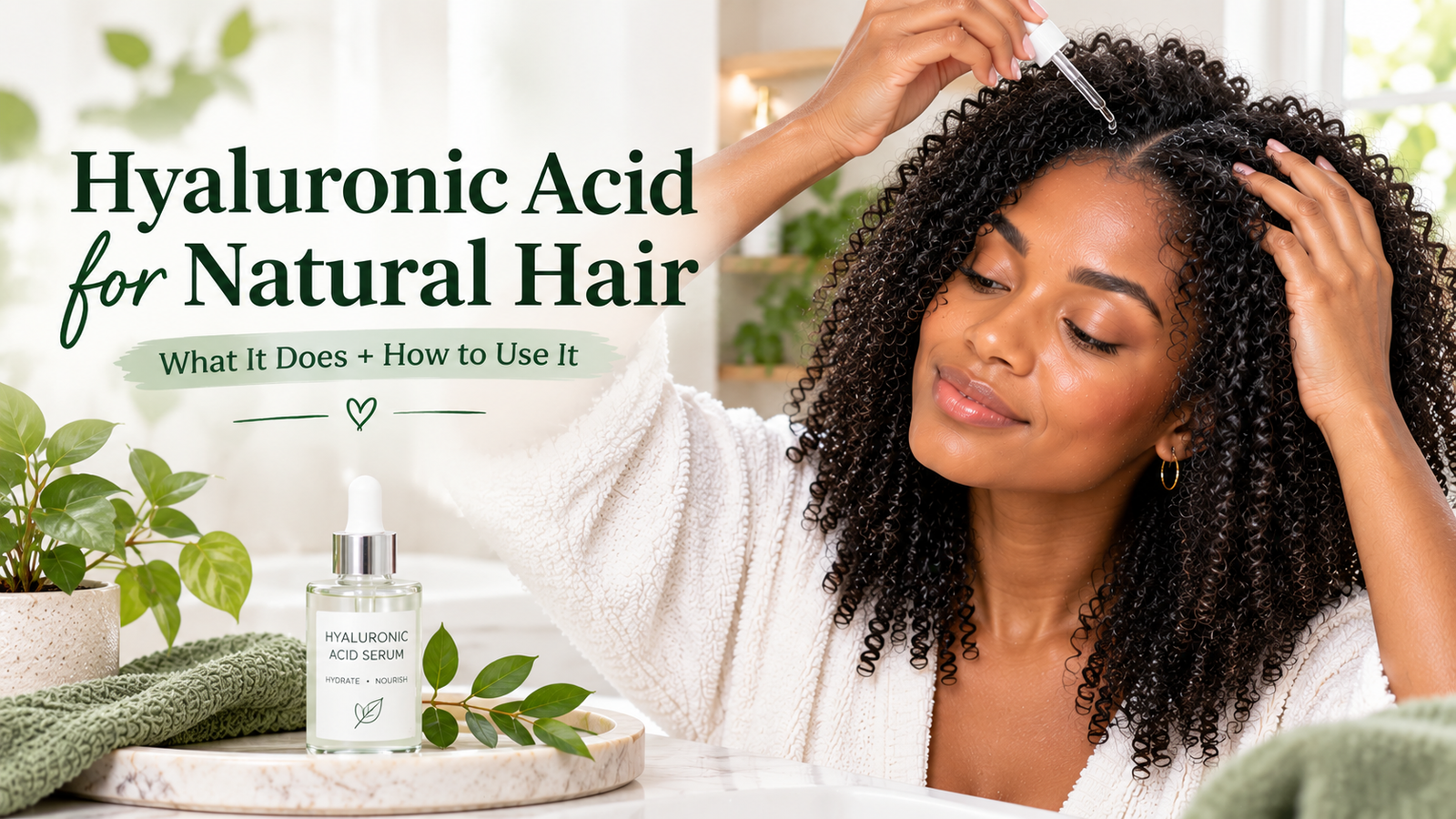
Hyaluronic Acid for Natural Hair — What It Does and How to Use It
Skincare’s most popular moisture ingredient has officially crossed over into hair care — and hyaluronic acid for natural hair makes more sense than most skincare-to-haircare crossovers. Hyaluronic acid doesn’t just sit on the surface. It binds water molecules and holds them against whatever it’s applied to — and for natural hair, which loses moisture constantly due to the tight curl pattern, that water-binding ability directly addresses the central challenge.
I’ve been adding a hyaluronic acid serum to my natural hair routine for eight weeks. Here’s the honest breakdown of what it does, where it fits in a natural hair routine, and which products are worth using.
What Is Hyaluronic Acid and What Does It Do for Natural Hair?
Hyaluronic acid (HA) is a naturally occurring polysaccharide — a sugar molecule — found in connective tissue throughout the body. It has an extraordinary ability to bind water: one gram of hyaluronic acid can hold up to six liters of water. In skincare, this property makes it one of the most effective humectants available. The same mechanism applies when it’s applied to the scalp and hair.
For natural hair specifically, hyaluronic acid works on two levels:
- On the scalp: It draws moisture from the environment into the scalp skin, supports the scalp barrier, and maintains the hydration level of the skin where hair follicles sit — creating a better environment for hair growth
- On the hair strand: It binds to the hair shaft’s surface and draws water molecules to it, reducing the moisture evaporation that happens constantly on natural hair — particularly on high-porosity strands where the cuticle doesn’t close tightly enough to hold moisture in
The molecular weight of hyaluronic acid determines where it works. High molecular weight HA stays on the surface — smoothing and adding slip. Low molecular weight HA penetrates the scalp skin more effectively — supporting barrier function and follicle hydration at a deeper level. Products that combine both provide the most comprehensive benefit.
Hyaluronic Acid Benefits for Natural Hair
1. Intense Moisture Without Heaviness
Natural hair needs moisture — not oil, not butter, not product. Water is what actually hydrates the hair shaft, and oil and cream seal that moisture in. Hyaluronic acid is a humectant — it actively attracts water and holds it against the hair. This makes it fundamentally different from oils and creams, which don’t add moisture; they seal it.
The result is intense hydration that feels lightweight. Hyaluronic acid in a leave-in conditioner or spray doesn’t weigh down coils the way heavy creams and butters can. For natural hair that needs moisture without the heaviness that causes definition loss, this is a meaningful advantage.
2. Reduces Frizz by Binding Surface Moisture
Frizz on natural hair happens when the hair shaft absorbs humidity unevenly — individual strands swell with moisture at different rates, causing the irregular texture we recognize as frizz. Hyaluronic acid applied to the hair surface creates a more even moisture distribution by attracting and holding water uniformly across the strand. The result is better frizz control in humid conditions — not from blocking humidity out, but from managing how the hair absorbs it.
3. Improves Scalp Hydration and Barrier Function
A chronically dry scalp — which is common in natural hair care where the scalp’s sebum struggles to travel down tight coils — benefits from hyaluronic acid’s water-binding effect directly at the skin level. Regular scalp application reduces transepidermal water loss from the scalp skin, supports the barrier that keeps scalp moisture in, and creates a more consistently hydrated environment at the follicle.
Combined with niacinamide (which builds ceramides) and rosemary oil (which stimulates circulation), hyaluronic acid completes a comprehensive scalp care approach that addresses hydration, barrier strength, and growth support simultaneously.
4. Adds Slip for Easier Detangling
Hyaluronic acid’s water-binding creates a slip on the hair surface that reduces friction during detangling. Applied on soaking wet hair before detangling — alone or mixed into a leave-in — it makes the wide-tooth comb move through natural hair with noticeably less resistance. This is particularly useful for 4B and 4C textures where detangling is the most breakage-prone part of wash day.
5. Extends Moisture Between Wash Days
The water-holding capacity of hyaluronic acid means that hair it’s applied to loses moisture more slowly between washes. Natural hair that usually starts feeling dry on day two holds moisture better into day three or four when hyaluronic acid is part of the moisture routine. For natural hair wearers who struggle to maintain moisture through the week, this extended retention is one of the most practically useful effects.
How to Use Hyaluronic Acid on Natural Hair
Method 1 — As a Pre-Leave-In Spray on Wet Hair (Most Effective)
Apply a hyaluronic acid serum or spray to soaking wet natural hair immediately after rinsing your conditioner. Section the hair and work it through evenly before applying your leave-in conditioner on top. The hyaluronic acid binds the water already in the wet hair to the strand — so as the hair dries, the moisture is held rather than evaporating.
This is the most effective use because hyaluronic acid needs water to work — applying it to wet hair gives it the water molecules it needs to bind immediately. Applied to dry hair, it pulls moisture from the air (which works in humid conditions but can backfire in dry climates, drawing moisture out of the hair instead).
Method 2 — Mixed Into Your Leave-In Conditioner
Add a few drops of a hyaluronic acid serum to your leave-in conditioner before applying. Mix in your palm, then apply to wet hair as normal. This combines the humectant properties of HA with the conditioning and slip of your leave-in in a single application step — practical for a routine that’s already multi-step.
For the best leave-ins to mix it with, see our leave-in conditioner guide for natural hair.
Method 3 — As a Between-Wash Moisture Refresher
Mix a few drops of hyaluronic acid serum into a spray bottle of water. Use it as your between-wash moisture spray on days two, three, and four. Lightly mist the driest sections of natural hair, follow with a small amount of your regular sealing oil or cream, and the HA holds the water from the spray against the hair as it dries.
This works particularly well in humid climates where there’s ambient moisture for the HA to attract. In very dry climates or in winter, use sparingly on dry hair — without adequate ambient humidity, HA can pull moisture from the hair shaft rather than from the air.
Method 4 — As a Scalp Treatment
Apply a hyaluronic acid serum directly to the scalp after washing — section the hair and apply to each part with a dropper or pointed applicator. Massage in gently. Leave in without rinsing. This delivers HA’s water-binding benefit directly to the scalp skin and follicle environment.
Stack it with a niacinamide serum on alternating days for a comprehensive scalp hydration and barrier-strengthening routine. See our guide on niacinamide for natural hair for how these two ingredients work together.
Method 5 — Mixed Into Deep Conditioner
Add a few drops of hyaluronic acid serum to your deep conditioner before applying on wash day. This adds humectant moisture-binding to the deep conditioning step — particularly effective when used with the steam method, where the open cuticle allows HA to reach deeper into the hair shaft. See our deep conditioner guide for the steam method explained fully.
Best Hyaluronic Acid Products for Natural Hair
The Inkey List Hyaluronic Acid Serum — Best Budget Option
A simple, affordable hyaluronic acid serum that contains both high and low molecular weight HA. Water-based, fragrance-free, and lightweight — works well mixed into a leave-in or applied directly to wet natural hair before styling. One of the most cost-effective ways to add HA to a natural hair routine.
Neutrogena Hydro Boost Water Gel — Best Accessible Option
Originally a facial moisturizer, this hyaluronic acid gel works exceptionally well on natural hair as a leave-in gel for wash-and-go styles. It provides slip, moisture, and light hold without the crunch of traditional gels. Works best on 3C and 4A hair as a styling product with moisture benefits.
Aunt Jackie’s Quench! Moisture Intensive Leave-In — Best Natural Hair Specific HA Product
One of the few natural hair products formulated specifically with hyaluronic acid as a key ingredient alongside shea butter and olive oil. Designed for natural hair from the ground up — better distribution on coily textures than repurposed facial serums.
Hyaluronic Acid vs Other Moisturizing Ingredients for Natural Hair
| Ingredient | Type | How It Works | Best For | Where to Apply |
|---|---|---|---|---|
| Hyaluronic Acid | Humectant | Binds water to hair/scalp | All types, especially high porosity | Wet hair, scalp |
| Glycerin | Humectant | Draws moisture from air | All types in humid climates | Leave-in, spray |
| Shea Butter | Emollient/Sealant | Seals moisture in | 4B and 4C hair | After leave-in |
| Aloe Vera | Humectant/Conditioner | Adds and holds moisture | All types | Leave-in, spray |
| Coconut Oil | Penetrating oil | Reduces protein loss | Medium-high porosity | Pre-poo |
Hyaluronic acid works best as part of the moisture step — alongside or before your leave-in conditioner — not as a replacement for sealing oils or butters. The complete LOC method (Liquid, Oil, Cream) still applies: HA enhances the liquid step, but the oil and cream steps are still needed to seal what HA attracts. See our guide on how to moisturize natural hair for how the full LOC method works.
Is Hyaluronic Acid Safe for Natural Hair?
Yes — hyaluronic acid is one of the gentlest and most universally tolerated ingredients in hair and skin care. A few notes for natural hair use:
- Apply to wet hair: In dry climates, HA applied to dry hair can pull moisture from the hair shaft rather than from the air — causing the hair to feel drier. Always apply to wet or damp hair so it has immediate water to bind to
- Not a sealant: HA attracts and holds water but doesn’t seal it in — always follow with an oil or cream on top
- Safe for color-treated natural hair: HA is gentle enough for color-treated hair and doesn’t affect color
- Safe for all porosity types: Works well across low, medium, and high porosity — adjust application timing (wet vs damp vs dry) based on porosity
Frequently Asked Questions About Hyaluronic Acid for Natural Hair
Does hyaluronic acid grow natural hair?
Hyaluronic acid doesn’t directly stimulate hair growth, but it supports the scalp conditions that allow healthy hair to grow — by maintaining scalp hydration, supporting the barrier function, and creating a consistently moisturized follicle environment. For the full picture on what actually supports natural hair growth, see our guide on how to grow natural hair faster.
Can I use hyaluronic acid on 4C natural hair?
Yes — 4C hair benefits significantly from hyaluronic acid because it struggles most with moisture retention. Apply a HA serum to soaking wet 4C hair immediately after rinsing conditioner, then follow with your leave-in, oil, and cream sealant as normal. The HA holds the water already in the wet hair as the strand dries, extending moisture retention into the week. For the complete 4C routine, see our guide on best products for 4C natural hair.
Can I use hyaluronic acid and glycerin together on natural hair?
Yes — both are humectants and work on similar mechanisms. Combining them in a leave-in or spray gives you slightly more moisture-binding capacity than either alone. In humid climates this works very well. In dry climates, be careful — both can draw moisture from the hair if ambient humidity is very low. Always seal with oil or butter over any humectant combination.
How often should I use hyaluronic acid on natural hair?
Every wash day as part of your wet hair routine — it can be applied as frequently as you refresh moisture between wash days. There’s no overuse concern with HA the way there is with protein treatments. Use it as a standard part of your leave-in application process on wet hair, and in your between-wash refresher spray as needed.
Is hyaluronic acid or aloe vera better for natural hair?
Both are effective humectants for natural hair — they work on similar mechanisms but with some differences. Aloe vera adds conditioning alongside moisture-binding, has a natural slip that helps with detangling, and is more accessible as a DIY ingredient. Hyaluronic acid has a stronger water-binding capacity per molecule and produces a lighter, less sticky feel on the hair. Many natural hair routines benefit from both — aloe vera in a leave-in spray and HA in a dedicated serum applied to wet hair before the leave-in.
Final Thoughts
Hyaluronic acid for natural hair is one of the more scientifically grounded additions you can make to a moisture routine — its water-binding mechanism directly addresses the core challenge of natural hair, and its lightweight profile means it adds moisture without the heaviness that can flatten curl definition.
Apply it to soaking wet hair before your leave-in on every wash day. Add it to your between-wash refresher spray. Give it six to eight weeks of consistent use before evaluating whether it’s making a difference to your hair’s moisture retention between wash days.
More from PickHonestly on natural hair moisture and scalp care:
- How to Moisturize Natural Hair — Complete LOC Method Guide
- Best Leave-In Conditioners for Natural Hair
- Niacinamide for Natural Hair — Scalp Barrier and Growth Support
- Best Scalp Serum for Natural Hair
- Best Deep Conditioners for Natural Hair
- Natural Hair Care Routine for Beginners
Prices accurate as of publication and may vary. Always verify current pricing before purchasing.