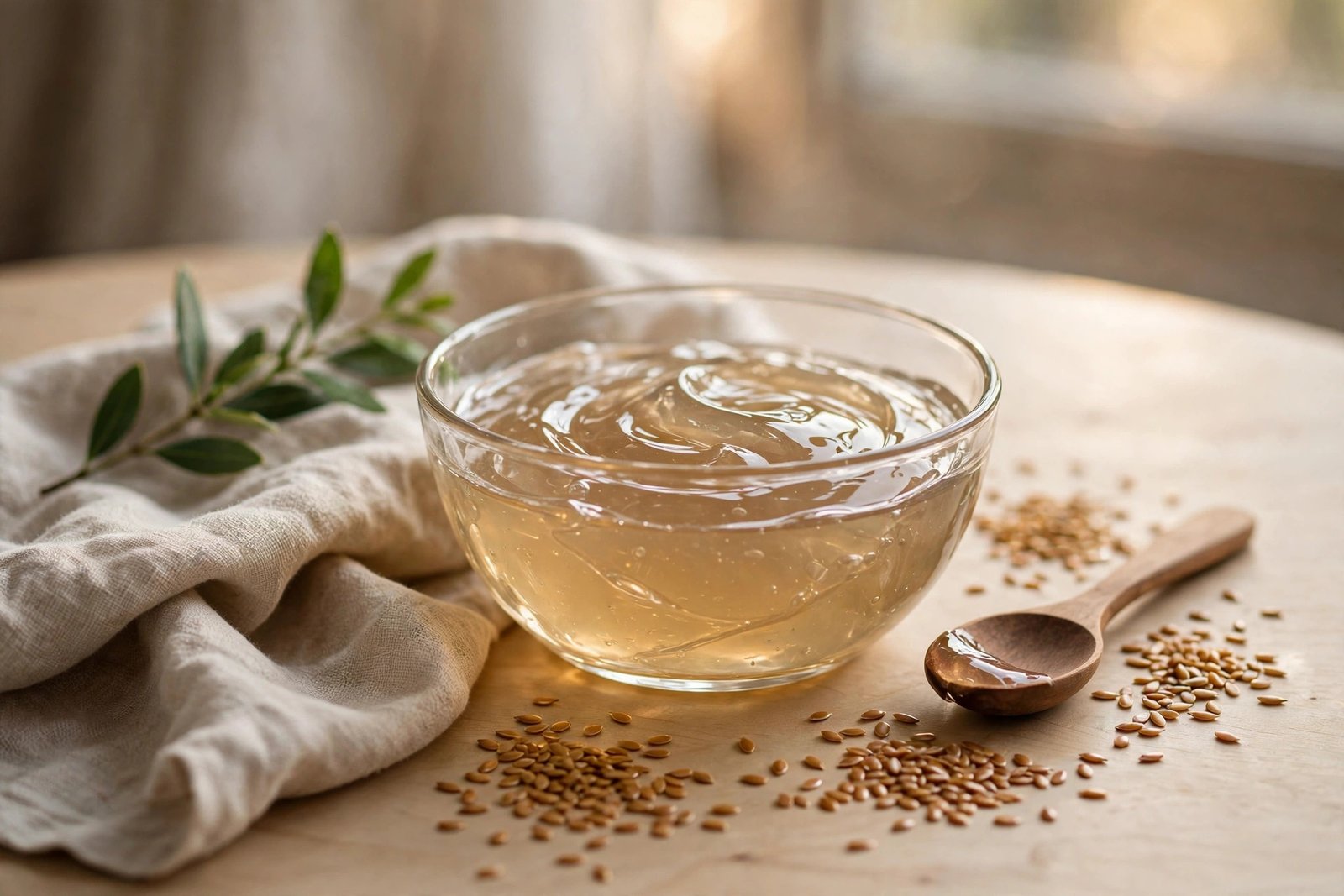
Flaxseed Gel for Low Porosity Hair: DIY Recipe, Benefits & How to Use
If you have low porosity hair, you already know the struggle: products sit on top of your strands instead of sinking in, and heavy gels leave your curls coated, flaky, or weighed down. Flaxseed gel for low porosity hair solves exactly this problem. It is a lightweight, water-based DIY gel made by boiling whole flaxseeds, and it defines curls without the buildup that low porosity hair is so prone to.
In this guide, you will learn what flaxseed gel is, why it works so well for low porosity hair, the exact DIY recipe, how to apply it for the best definition, how to store it safely, and the mistakes that cause flaking. Let us get into it.
What Is Flaxseed Gel?
Flaxseed gel is a natural styling gel made by simmering whole flaxseeds (Linum usitatissimum) in water. As the seeds heat, they release mucilage — a gel-like soluble fiber — that thickens the water into a smooth, slippery gel. Once strained, you are left with a clear, lightweight gel that can be used just like a commercial curl definer.
Unlike store-bought gels that rely on synthetic polymers, flaxseed gel contains only what you put in it: seeds, water, and any optional add-ins such as aloe vera or essential oils. It has been a staple in the natural hair community for years because it is cheap, customizable, and free from drying alcohols, silicones, and parabens.
Is Flaxseed Gel Good for Low Porosity Hair?
Yes — flaxseed gel is one of the best natural stylers for low porosity hair, and the reason comes down to how low porosity hair behaves. Low porosity hair has tightly packed cuticles, so it resists absorbing water and heavy products. Thick butters and rich creams tend to sit on the surface, causing buildup, while the hair underneath stays dry.
Flaxseed gel works differently. It is water-based and lightweight, so it does not fight your cuticles — it coats the strand with a thin, flexible film that locks in the water already on your hair. That film-forming action gives you curl definition and frizz control without the heavy residue that makes low porosity hair look dull and feel coated.
The key is application: flaxseed gel performs best on clean, damp hair with minimal layering underneath. If you pile it over a heavy leave-in, a thick cream, and an oil, even a light gel can feel heavy. Keep the routine simple and let the gel do the work.
7 Benefits of Flaxseed Gel for Low Porosity Hair
1. Lightweight moisture without buildup
The number one complaint among people with low porosity hair is product buildup. Because flaxseed gel is mostly water plus plant mucilage, it rinses out cleanly and does not accumulate on the strand the way waxes and heavy butters do. Your hair stays bouncy instead of getting that coated, straw-like feeling.
2. Defined curls and coils
The mucilage in flaxseeds forms a soft cast around each curl as it dries, encouraging clumping and definition. Once the cast is fully dry, you scrunch it out to reveal soft, defined curls — no crunch left behind when you use the right amount.
3. Frizz control
That same film-forming layer smooths the cuticle and seals in moisture, which keeps humidity from puffing your hair up. It will not give you the helmet-head hold of a strong synthetic gel, but for everyday frizz control it is remarkably effective.
4. Rich in omega-3 fatty acids
Flaxseeds are one of the richest plant sources of alpha-linolenic acid (ALA), an omega-3 fatty acid. Healthline notes that flaxseed oil is high in omega-3s. Note that most of the seed’s oil stays locked inside the seed when you make gel — the gel itself is mainly water and mucilage — but it still forms a protective, conditioning film on the hair shaft.
5. Gentle on the scalp
Flaxseed oil has been studied for its effects on skin: a 12-week randomized trial published on PubMed found that flaxseed oil supplementation improved skin hydration and barrier function while reducing sensitivity. That research is about oral supplementation and skin — not gel on scalps — but keeping heavy, pore-clogging pomades off the scalp and using a lightweight gel is simply a gentler way to style.
6. Supports length retention
Flaxseed gel does not magically make hair grow faster — no topical product does. What it does is reduce breakage by keeping hair moisturized and minimizing friction between strands. Less breakage means you retain more of the length you grow.
7. Fully customizable and inexpensive
A bag of whole flaxseeds costs very little and makes dozens of batches. You control every ingredient, which matters if your scalp reacts to fragrances or preservatives in commercial products. Add aloe vera for extra slip, a drop of rosemary essential oil for scent, or keep it plain — it is your formula.
DIY Flaxseed Gel Recipe for Low Porosity Hair
This is the classic recipe, slightly adjusted for low porosity hair: a thinner consistency works better than a thick jelly, because it spreads easily and does not pile up on the strand.
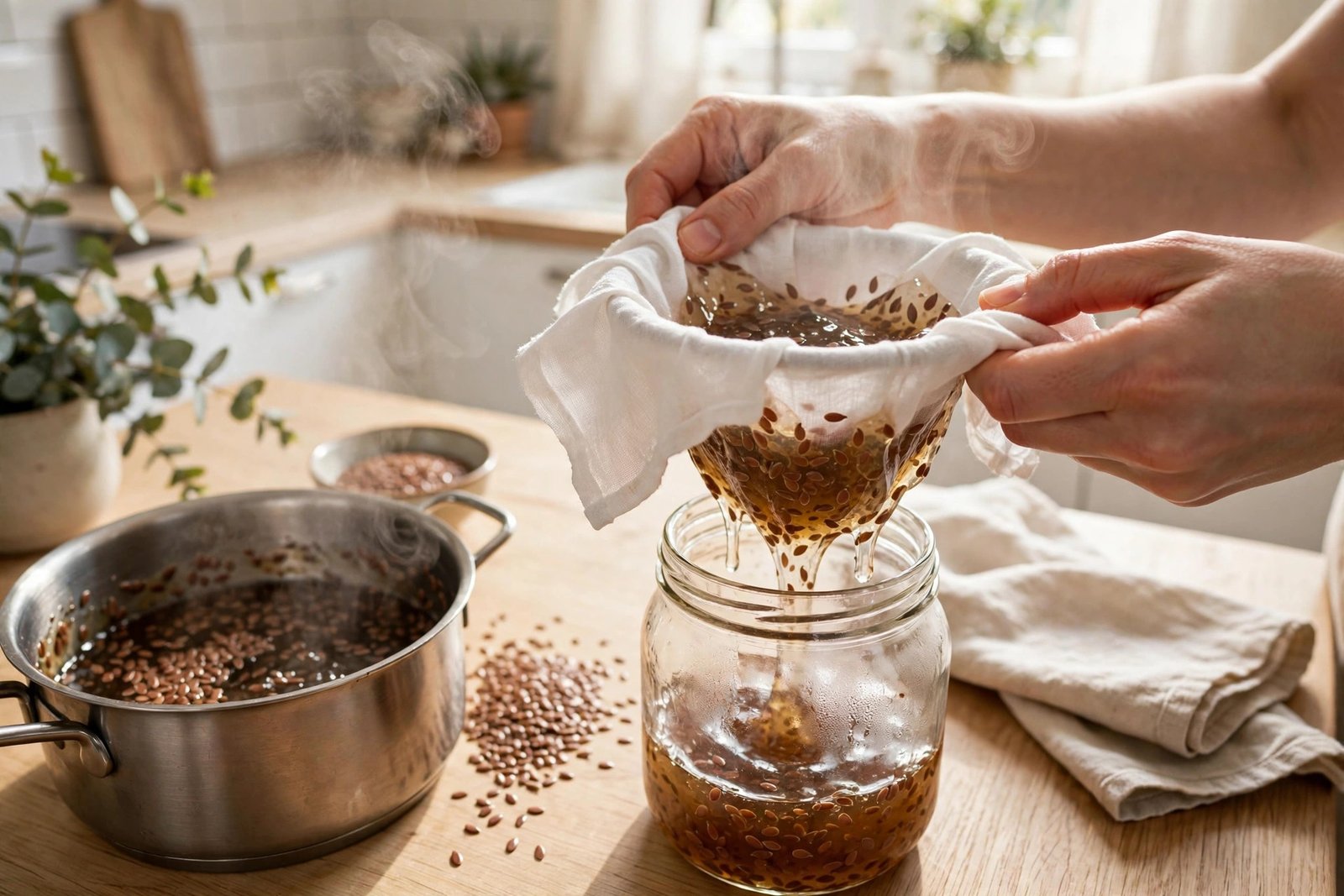
Ingredients and equipment
- 1/4 cup whole flaxseeds (golden or brown; do not use ground flaxseed)
- 2 cups water (use a little extra water for a thinner, low-porosity-friendly gel)
- 1 tablespoon aloe vera gel (optional, adds slip)
- 3–5 drops rosemary or lavender essential oil (optional, for scent and scalp benefits)
- Small saucepan, fine-mesh strainer or muslin cloth, glass jar with lid
Step-by-step instructions
- Combine seeds and water. Add 1/4 cup whole flaxseeds and 2 cups of water to a small saucepan. Stir once to distribute the seeds.
- Bring to a gentle boil. Place over medium heat and bring to a boil, stirring occasionally so the seeds do not stick to the bottom.
- Simmer until it thickens. Reduce to a simmer and cook for 7–10 minutes, stirring often. You are looking for a consistency like egg whites — it should coat the back of a spoon and drip in a thin stream. For low porosity hair, strain on the thinner side; the gel thickens as it cools.
- Strain immediately. Pour the hot mixture through a fine-mesh strainer or muslin cloth into a glass jar. Do this while it is hot — once it cools, straining becomes nearly impossible. Press gently with a spoon to extract the gel.
- Cool, then customize. Let the gel cool to room temperature, then stir in the aloe vera gel and essential oil if using.
- Store it right. Seal the jar and refrigerate. See the storage section below for shelf life.
Yield: about 1 to 1½ cups of gel — enough for several wash days depending on your hair length and density.
As a wash-and-go styler
- Start with freshly washed, clean hair. If you use a leave-in, keep it very light — a watery leave-in or just plain water works best under flaxseed gel for low porosity hair.
- Keep your hair soaking wet. Work in 4–6 sections so the product distributes evenly.
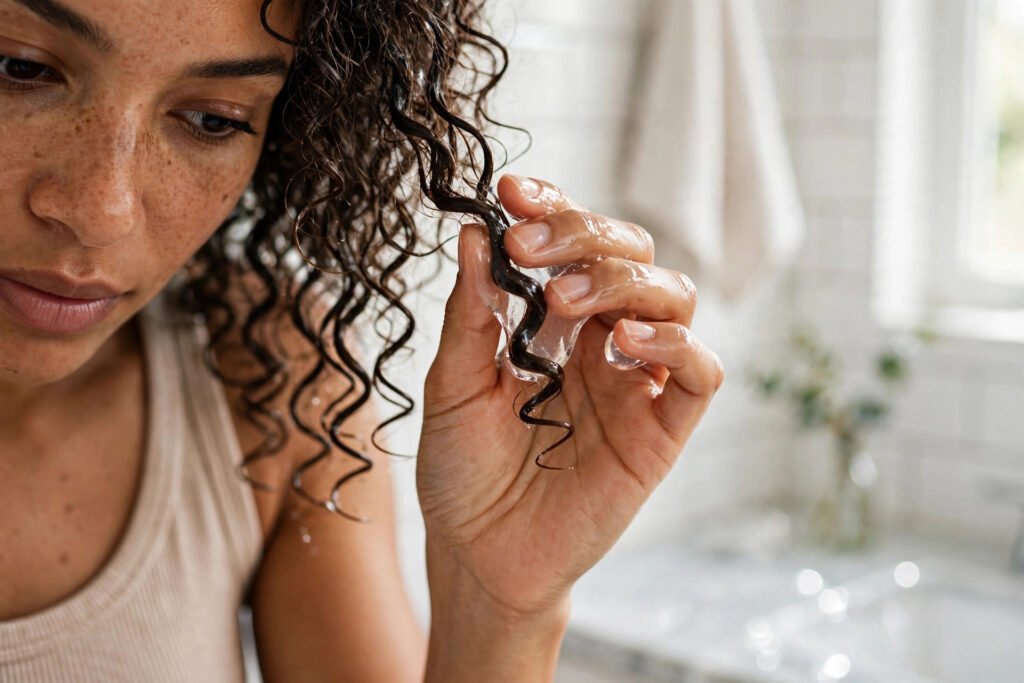
- Smooth a coin-sized amount of gel per section from roots to ends using praying hands, then rake or shingle to encourage curl clumps.
- Do not touch your hair while it dries. Air-dry or diffuse until it is completely dry.
- Scrunch out the crunch. Once fully dry, scrunch upward with clean hands (or a drop of light oil on your palms) to break the cast and reveal soft definition.
As a pre-poo treatment
Flaxseed gel also works as a pre-shampoo treatment: apply it generously to dry hair 20–30 minutes before washing. The mucilage softens the strands and helps the shampoo glide through with less tangling, which means less breakage on wash day — a big win for fragile low porosity curls.
Application tips for low porosity hair
- Less is more. Start with less gel than you think you need. White flakes or a coated feeling almost always means too much product, not a bad recipe.
- Apply to very wet hair. Water is part of the styling process — it helps the gel spread thinly instead of sitting in globs.
- Simplify your stack. Gel + water + (optionally) a light leave-in is enough. Skip the heavy cream under it.
- Refresh with water, not more gel. On day 2 or 3, mist with water and smooth — adding fresh gel over dry gel causes flaking.
How to Store Homemade Flaxseed Gel (and How Long It Lasts)
Because homemade flaxseed gel contains no synthetic preservatives, it is perishable. Stored in a sealed jar in the refrigerator, it lasts 1 to 2 weeks. Make small batches you can finish in that window.
Signs your gel has gone bad: a sour or off smell, visible mold, or a change in texture. When in doubt, throw it out and make a fresh batch — it only takes 15 minutes. Adding a few drops of vitamin E oil or rosemary essential oil may extend freshness slightly, but refrigeration is what matters most. Never store it at room temperature for more than a day.
5 Common Mistakes to Avoid
- Boiling it too long. Overcooked gel turns thick and gloopy, which is exactly what low porosity hair cannot handle. Pull it off the heat at the egg-white stage.
- Straining it cold. Always strain while hot. Cold gel will not pass through the cloth, and you will lose half your batch.
- Using ground flaxseed. Ground seeds turn to mush and cannot be strained out. Whole seeds only.
- Layering over heavy products. Flaxseed gel on top of a thick butter or heavy cream is a recipe for buildup and flakes on low porosity hair.
- Breaking the cast too early. Scrunching before the hair is 100% dry creates frizz. Patience is part of the technique.
Flaxseed Gel vs. Commercial Styling Gels
| Feature | Homemade Flaxseed Gel | Commercial Gel |
|---|---|---|
| Ingredients | 2–4 natural ingredients, fully known | Often 15+ ingredients, including synthetic polymers and preservatives |
| Buildup risk on low porosity hair | Low — rinses out cleanly | Medium to high depending on formula |
| Hold | Light to medium, soft finish | Light to extra-strong, can feel crunchy |
| Cost per batch | Very low | Moderate |
| Shelf life | 1–2 weeks refrigerated | 12+ months |
| Customization | Fully adjustable thickness and add-ins | Fixed formula |
Neither option is universally better — it depends on your priorities. If you want maximum hold for a sleek style, a commercial gel may win. If you want a clean, lightweight styler you fully control, flaxseed gel is hard to beat, especially for low porosity hair that punishes heavy formulas.
Frequently Asked Questions
Can I use flaxseed gel on low porosity hair every day?
You can, but daily reapplication is unnecessary and can cause buildup. It is better to style once on wash day and refresh with water on the following days. If your hair feels coated, clarify and start fresh.
Does flaxseed gel help hair grow faster?
No topical product speeds up the biological rate of hair growth. Flaxseed gel helps with length retention by moisturizing the strand and reducing breakage, so you keep more of the hair you grow.
Why is my flaxseed gel flaking?
Flaking is almost always caused by using too much gel, applying it over heavy products, or reapplying gel onto dry hair. Use a thinner layer on very wet hair over a minimal base, and refresh with water only.
Can I add oils to my flaxseed gel?
Yes, but keep it light for low porosity hair — a few drops of lightweight hair oils such as grapeseed or sweet almond oil per batch is plenty. Heavy oils like castor oil can make the gel feel greasy and defeat the purpose of a lightweight styler.
Is flaxseed gel good for straight or wavy low porosity hair?
Yes. Wavy and straight low porosity hair also benefits from the lightweight film, though you may want an even thinner consistency and a smaller amount to avoid weighing the hair down.
Final Thoughts
Flaxseed gel for low porosity hair is one of those rare DIY treatments that is genuinely better suited to the hair type than many commercial alternatives. It is lightweight, defines without buildup, costs almost nothing, and you know exactly what is in it. The recipe takes 15 minutes, the technique takes one or two wash days to dial in, and the payoff is soft, defined hair that is not weighed down.
Start with a thin batch, apply it to soaking wet hair over a minimal routine, and give your curls time to dry completely before scrunching. Pair it with the right staples from our guide to natural hair care products to keep the rest of your routine buildup-free too. If you have been fighting buildup from heavy stylers, this simple seed gel might be the reset your low porosity hair has been waiting for.
Disclaimer: This article is for informational purposes only and is not medical advice. If you have a scalp condition or experience irritation, discontinue use and consult a dermatologist. Always do a patch test before trying a new DIY treatment.