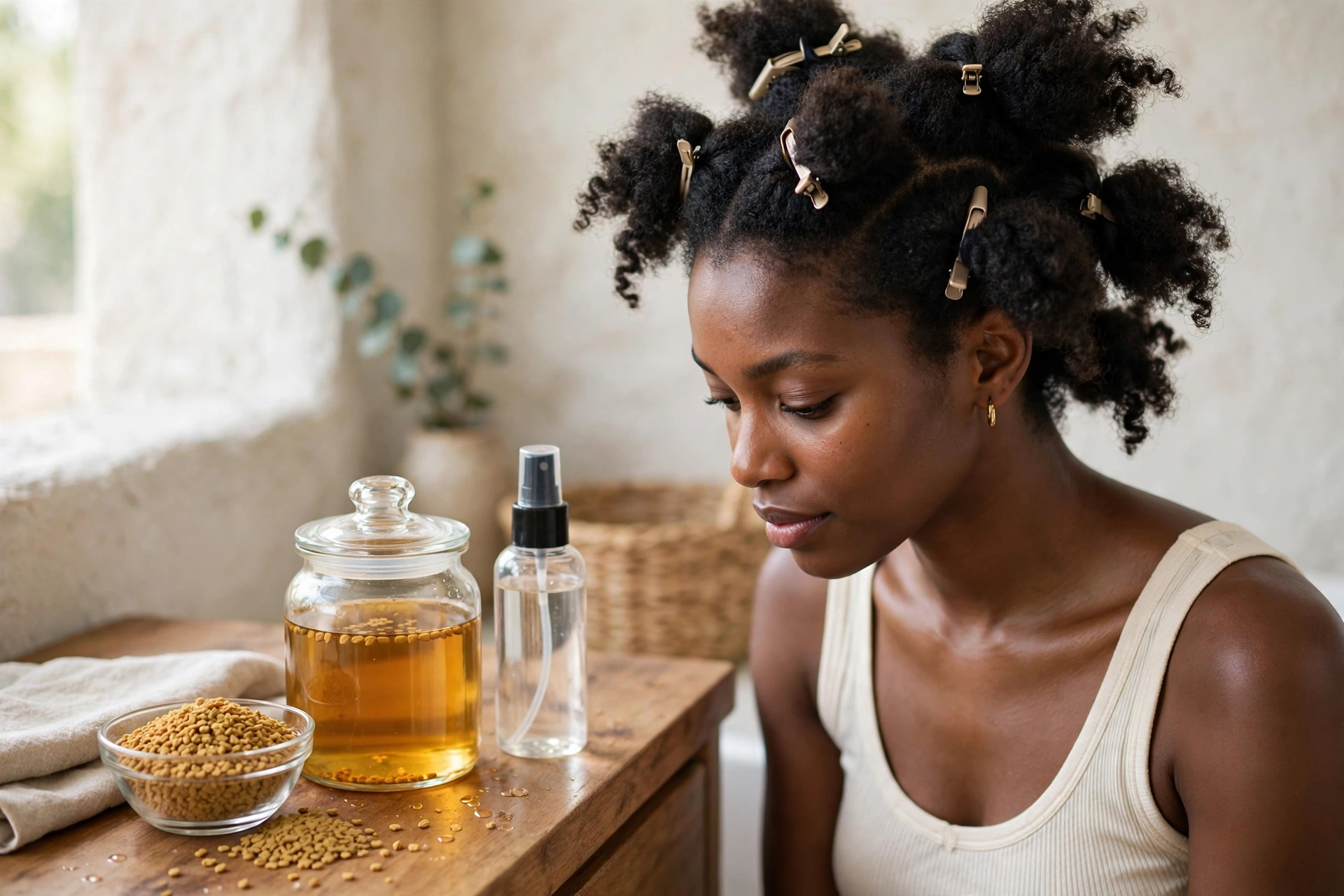
Fenugreek for Natural Hair: The Slip Is Real, the Regrowth Claims Are Not
 Maya Thompson
📅 November 4, 2026
⏱ 20 min read
Fenugreek for natural hair smells like maple syrup, and that is the least of its problems. The bigger problem is the promise attached to it: that a bowl of soaked seeds will regrow hair, reverse thinning, or replace a dermatologist. It will not do any of those things. What it can do, used properly, is more modest and more useful — it gives dense, coily hair slip, it coats the strand so detangling causes less breakage, and it calms a dry, flaky scalp for some people. That is worth having, as long as you buy it for what it is and not for what the videos claim.
This guide is written for coily and tightly curled hair specifically, because almost every fenugreek article online is written for straight or wavy hair and then copied across. On straight hair, a bit of grit rinses out easily and a heavy paste is a minor inconvenience. On 4c coils, grit hides in the bends of the strand, a heavy paste can sit on the scalp for days, and a protein-heavy treatment can turn soft hair stiff. The method below is built around those differences, not around a generic recipe.
The short verdict, before the detail: fenugreek is a conditioning and breakage-reduction aid, not a growth treatment. If your goal is fewer snapped strands on wash day, softer detangling, and a scalp that feels less tight, it is worth a careful trial. If your goal is regrowing a bald patch, filling in thinning edges, or treating sudden shedding, skip the seeds and see a dermatologist first — a home remedy that delays a diagnosis can cost you hair that a treatment might have saved.
First, what fenugreek is actually doing to your hair
Fenugreek seeds (Trigonella foenum-graecum) are mostly interesting for two physical properties, not for any magic nutrient that travels into the follicle and switches growth on. The first is mucilage, the slippery gel that soaked seeds release. That gel is the reason a fenugreek paste feels so slick between your fingers, and it is the reason detangling after a fenugreek treatment often feels easier: the gel coats the strand, lowers friction, and lets a wide-tooth comb pass through with less snagging. The second is protein. Fenugreek seeds are protein-rich, and that protein temporarily coats and fills rough spots on the cuticle, which can make damaged-feeling hair feel stronger and smoother for a wash or two. Both effects are real, and both are temporary. They wash out. They do not rebuild the hair shaft from the inside, and they do not change your growth cycle.
That distinction matters because the evidence most often quoted for fenugreek does not test what people are actually doing at home. The best-known human trial, published in 2006, tested an oral fenugreek-containing supplement — capsules swallowed daily for six months, combined with other micronutrients — in people with mild to moderate hair loss, and reported favourable effects on hair loss and growth compared with placebo. That is a supplement study, not a paste study. It says nothing reliable about rubbing a homemade mask on your scalp for 45 minutes, and it certainly does not mean a mask will reproduce a six-month capsule result. Treat anyone who quotes that trial as proof that a fenugreek rinse grows hair with the scepticism it deserves.
The animal evidence is even further from your bathroom. One study that gets shared a lot tested fenugreek leaf extracts — leaves, not seeds, in alcohol and petroleum-ether solvents — on mice with induced hair loss, and found faster hair coverage than in untreated mice. Mice are not people, leaf extract in a lab solvent is not a seed paste, and a shaved mouse back is not a human scalp with years of styling history. It is interesting as a reason to keep researching the plant. It is not a reason to promise yourself regrowth.
There is also a confusion worth clearing up before you buy anything: fenugreek is not rosemary, and the famous rosemary trial is not fenugreek evidence. A 2015 trial compared rosemary oil with minoxidil 2% for pattern hair loss and found similar improvements after six months. That trial tested rosemary oil, a different plant, in a different form, for a specific type of hair loss. Borrowing its result to sell fenugreek water is the kind of quiet switch that makes a weak claim look scientific. Judge fenugreek on fenugreek evidence, which is thin, traditional, and mostly about conditioning — and on your own wash-day results, measured honestly.
So what should you actually expect? Over four to six consistent uses, the honest wins are: less breakage while detangling, hair that feels softer and more manageable after rinsing, and for some people, less scalp flaking and itching. What you should not expect: new hair where follicles have closed, a changed hairline, thicker strands that stay thicker after you stop, or a cure for shedding caused by hormones, illness, medication, or severe scalp disease. If you are shedding in clumps, losing hair in patches, or seeing a widening part, that is a medical question first, and the American Academy of Dermatology’s healthy hair tips make the same point from the other side: gentle handling protects the hair you have, but it does not diagnose why hair is leaving.
Fenugreek for natural hair: paste, water, or oil?
Most recipes present one method as “the” method. In practice the three forms do different jobs, and picking the wrong one is how most fenugreek trials fail on coily hair. Paste is the strongest and the messiest. Water — a strained tea or rinse — is the lightest and the easiest to rinse out. Oil, made by infusing seeds in a carrier oil, is the gentlest on the scalp but the weakest as a slip treatment. None of them is universally best; the right one depends on what your hair needs this week.
Choose the paste when your main problem is breakage during detangling and your hair can handle protein. The thick gel gives the most slip and the most coating, which is exactly what a tangle-prone head needs. The price is grit: unless the paste is blended completely smooth, tiny seed particles lodge in coils and keep shedding onto your clothes for days, and the paste is heavy enough to leave low-porosity hair feeling coated and limp. If you have fine strands or low-porosity hair, paste is the form most likely to backfire, and the water version below is the safer first trial.
Choose the water when you want a light treatment, when your hair is low-porosity, or when you have tried paste before and spent the next wash day picking bits out of your twists. Fenugreek water gives you much of the slip with almost none of the residue, because the seeds are strained out entirely. It will not coat as heavily as paste, so it will not rescue a severely tangled head on its own — but it also will not leave your scalp feeling filmed over, and it rinses clean in one pass. For a first-ever fenugreek trial on natural hair, water is the sensible default.
Choose the oil when your scalp, not your lengths, is the complaint — dryness, tightness, or flaking — and when you already oil your scalp as part of your routine. Infusing seeds in warm coconut or castor oil gives a light scalp massage oil that carries a little of the seed’s conditioning character without any grit at all. Be honest about its limits, though: an infused oil is mostly carrier oil, and most of the benefit you feel will be the oil and the massage, not the fenugreek. If someone tells you a fenugreek oil regrew their edges, the likelier explanations are the massage, the reduced tension styling that came with the new routine, or time — not the seeds in the bottle.
One more distinction that saves confusion: fenugreek powder and whole seeds are not interchangeable in practice. Powder blends into a smoother paste faster and leaves less grit, which matters enormously on coils. Whole seeds need a full overnight soak and a powerful blender to get anywhere near smooth, and even then you should strain the mixture through a fine cloth if you plan to leave anything in. If your blender is weak, buy powder, or use the water method and skip paste entirely. A gritty paste is not a stronger treatment; it is a treatment you cannot rinse out.

A fenugreek wash day that works on coils
The order matters as much as the recipe. Fenugreek goes on before your deep conditioner, not instead of it, and it comes off completely before you style. Here is the sequence that avoids the two classic failures — grit left in the hair, and a scalp filmed over with paste for a week.
Step 1: Soak, then blend until it is genuinely smooth
For paste, soak 3 tablespoons of fenugreek seeds or powder in just enough warm water to cover them, overnight or for at least 8 hours. In the morning, blend with a little of the soaking water until the mixture is completely smooth — run it between your fingers; if you feel grain, keep blending or strain it through a fine cloth or old stocking. For water, simmer 2 tablespoons of seeds in 2 cups of water for 10 to 15 minutes, cool completely, and strain through a fine cloth. The water should be golden and clear, not cloudy with particles.
Step 2: Patch test, even if you have used fenugreek in food
Eating fenugreek in cooking is not the same as leaving a concentrated paste on your scalp. Dab a little of your prepared mixture behind your ear or on a small section of scalp, leave it for 30 minutes, rinse, and wait 24 hours. Redness, itching, or burning means stop — do not push through it hoping your scalp will “get used to it.” This matters doubly if you are allergic to peanuts, chickpeas, or other legumes, because fenugreek is a legume and cross-reactivity is a real, if uncommon, risk.
Step 3: Apply in sections, scalp first only if that is the goal
Work in 4 to 6 sections, the way you would for any wash-day treatment, and apply with your fingers, not by dumping the bowl over your head. If breakage is the goal, focus on the lengths and ends, where the coating helps most, and keep the scalp application light. If scalp dryness is the goal, massage a thin layer into the scalp with your fingertips for 2 to 3 minutes and leave the lengths mostly alone. Covering the whole head thickly with paste “for maximum benefit” is how you end up with residue and a coated scalp; targeted application is both more effective and easier to rinse.
Step 4: Leave it 30 to 45 minutes, not overnight
Cover with a shower cap to keep the treatment damp, and set a timer. Longer is not stronger here: paste left for hours dries on the strand, hardens, and becomes dramatically harder to rinse out of coils, and an over-long protein-heavy treatment is one of the fastest routes to stiff, straw-like hair. Overnight fenugreek is a social-media dare, not a better method. Rinse while it is still damp and slick.
Step 5: Rinse in sections, then shampoo gently
This is the step straight-hair guides skip, and it is the step that decides whether you love or hate fenugreek. Rinse one section at a time under running water, finger-detangling as you go, and check each section for grit before moving on. Then shampoo once with a gentle shampoo — you need the surfactant to lift the remaining film and particles, and a co-wash alone often will not clear a paste. If you used the water version, a thorough rinse may be enough, but a light shampoo still leaves the scalp cleaner. For a fuller picture of how washing frequency interacts with treatments like this, see how often to wash natural hair.
Step 6: Deep condition after, then seal as usual
Fenugreek is not a deep conditioner, even though it feels slippery. Follow it with your regular deep conditioner, because the protein coating can leave hair feeling strong but not necessarily moisturised, and the rinse can strip a little of your usual slip. After rinsing the conditioner, apply your leave-in and seal with your usual oil or butter. If your hair feels stiff after the whole sequence, that is information, not failure — it usually means protein overload or too-frequent use, and the fix is to space treatments further apart, not to add more protein. The diagnostic detail for that stiff, snapping feeling is covered in protein treatment for natural hair, and it is worth reading before you repeat a fenugreek mask weekly out of habit.

Where fenugreek backfires on natural hair
Most fenugreek failures are predictable, which means most of them are avoidable. The first is protein overload, and it is the one people misread most. Hair that feels stiff, straw-like, and snaps when stretched, after a fenugreek run, is not “detoxing” and does not need another protein mask to fix it. It needs moisture and a break from protein, including fenugreek, until the stretch and softness return. This is especially likely if you are already using protein treatments, protein-rich leave-ins, or frequent egg or mayonnaise masks alongside fenugreek — the total protein load is what counts, not any single product. Low-porosity hair is the most vulnerable here, because the coating sits on the surface rather than absorbing, so the stiff feeling arrives faster and lingers longer.
The second failure is residue, and it is a coils-specific problem. Seed particles that would rinse straight out of straight hair wedge into the bends of a coil and into the base of twists, then flake onto shoulders for days and irritate the scalp underneath a protective style. If you have ever found grit in your hair three days after a “natural” treatment, you have met this problem. The fixes are unglamorous: blend smoother, strain through cloth, prefer water over paste, rinse in sections, and shampoo after. A treatment you cannot fully remove is not a treatment; it is buildup with good intentions.
The third is the smell, and it deserves more honesty than it usually gets. Fenugreek’s maple-syrup scent is strong, it clings to hair and pillowcases, and for some people it survives two or three washes. If you dislike the smell, no amount of benefit will make the treatment sustainable, and pretending otherwise just means you will quit after two uses and blame yourself. A rinse with diluted apple cider vinegar after shampooing, or following with a fragranced leave-in, takes the edge off for most people, but if the scent genuinely bothers you, that is a legitimate reason to choose a different ingredient. Sustainability beats intensity: a treatment you actually repeat is worth more than a stronger one you abandon.
Then there are the people who should skip fenugreek or check first. Anyone with a peanut or chickpea allergy should patch test with particular care or avoid it, given the legume connection. Anyone who is pregnant should be cautious about fenugreek supplements — the caution in the literature is about concentrated oral use, not a rinse you wash off, but supplements are a different exposure from a topical mask, and a supplement decision belongs with a clinician, not a hair blog. Anyone with a scalp condition that is worsening, with sudden patchy loss, or with shedding that is clearly different from normal daily loss, should get a diagnosis before adding any new scalp treatment; layering a home remedy over an undiagnosed condition wastes the window in which treatment works best. And if you are trying to tell whether you are losing hair or breaking it — a distinction that changes everything about what helps — hair shedding vs breakage walks through the strand test that settles it.
Two smaller cautions round this out. First, colour: there are scattered reports of a slight warm tint on very light or bleached hair from repeated fenugreek use. It is not a dye, and on dark natural hair it is a non-issue, but if your hair is bleached blonde, strand-test first and do not leave paste on for hours. Second, fenugreek is not a moisturiser on its own. The gel feels wet and slippery, which tricks people into thinking their hair is hydrated, but mucilage coats rather than penetrates, and hair can feel coated yet dry underneath. If your hair is genuinely dry, the fix is water, a proper conditioner, and sealing — how to care for high porosity natural hair covers the sealing side in detail — with fenugreek as an optional extra, not a replacement. Healthline’s guide to home remedies for dry hair makes the same underlying point: most dry-hair fixes work by reducing damage and sealing moisture in, not by any single ingredient.
How often to use it, and how to judge it honestly
Start once every two weeks, not daily and not even weekly. That sounds cautious, but it is the only schedule that lets you actually tell whether fenugreek is helping. Use it on a wash day, note three things before you start — how much breakage you see while detangling, how your scalp feels, and how your hair feels on day three after wash day — and compare the same three things after four uses, roughly two months in. If detangling breakage is visibly down, your scalp feels calmer, and day-three hair still feels soft, the treatment is earning its place. If nothing has changed after four careful uses, it is not going to change on the fifth, and your wash-day time is better spent elsewhere.
From that baseline, adjust by porosity and by feel, not by a fixed rule. Low-porosity hair that feels coated or limp should drop to once a month or switch permanently to the water version. High-porosity hair that drinks up treatments and still feels rough may tolerate weekly use, but only if the hair stays soft and stretchy between treatments — stiffness is the signal to back off, whatever the calendar says. Fine strands should stay on the lighter end of every range: less paste, shorter leave-in time, water preferred. Thick, dense hair can handle the full paste, provided the rinse is thorough. And never stack fenugreek on the same wash day as a strong protein treatment. Two protein-heavy steps in one wash day is the most common route to the stiff-hair complaint, and it is entirely avoidable by alternating weeks.
Judge growth claims by the right measure, too. Fenugreek does not make hair grow faster from the follicle in any demonstrated way, so measuring length month to month will mostly measure your normal growth plus how much breakage you prevented — which is still a real win, because length retention is how most natural hair actually gets longer. The honest metric is breakage: fewer snapped pieces in the comb and the shower drain, fewer short broken bits on your shoulders, and ends that survive to the next trim. If you want a number, count the broken pieces in your detangling session before your first fenugreek use and again after your fourth. It is unglamorous, and it is the only number that means anything here. A review of hair cosmetics in the International Journal of Trichology, via PubMed Central, reaches a compatible conclusion from the science side: cosmetic treatments help mainly by reducing friction, protecting the cuticle, and limiting breakage — which is exactly the lane fenugreek belongs in. Read it as a review of hair cosmetics in the International Journal of Trichology if you want the mechanism behind the marketing.
Storing it without growing something else in the jar
Fresh fenugreek preparations are food, in the spoilage sense, and they should be treated that way. A strained water kept in a clean, closed bottle in the fridge lasts about five to seven days; a paste lasts less, two to three days at most, and only refrigerated. Discard either one the moment it smells sour rather than mapley, turns darker, or develops any film or mould — and never try to rescue it by boiling it again. Do not keep a batch at room temperature “for the week,” do not top up an old bottle with a fresh batch, and do not freeze paste expecting it to keep its gel texture; freezing and thawing breaks the mucilage structure that made it useful in the first place. Small, fresh batches are slightly more work and dramatically less risky than one big jar nursed along for a month. Make what you will use in the next wash day or two, and make it again next time.
That rule also answers the “can I buy it ready-made” question. Bottled fenugreek waters and oils from reputable sellers are fine, and they solve the spoilage problem with preservatives — but read the ingredient list before paying a premium. Many “fenugreek” sprays are mostly water, fragrance, and a token amount of extract, and a bottle that lists fenugreek extract near the end of a long list is not the same product as the fresh preparation described above. If you buy ready-made, you are paying for convenience and shelf life, not for a stronger formula, and you should judge it by the same breakage test as the homemade version.
Frequently Asked Questions
Can fenugreek regrow hair on bald spots?
No, not on any evidence that applies to a home treatment. No topical fenugreek preparation has been shown to reactivate closed follicles or regrow hair on a genuinely bald area. The human trial most often quoted tested an oral supplement, not a paste, and the animal study tested leaf extracts on mice. If you have a bald patch, especially one that appeared suddenly, see a dermatologist — that presentation needs a diagnosis, not a seed mask.
How often should I use fenugreek on natural hair?
Start once every two weeks and judge after four uses. Low-porosity or fine hair often does better at once a month or with the strained water instead of paste. Weekly use is reasonable only for high-porosity, thick hair that stays soft between treatments. Stiffness, dryness, or increased snapping after a treatment means you are using it too often or layering it with too much other protein — space it out before adding anything else.
Can I leave fenugreek on my hair overnight?
You can, in the sense that nothing stops you, but it is a bad idea on coily hair. Paste dries, hardens, and becomes much harder to rinse out of coils, and the extra hours add protein exposure without adding benefit. Thirty to 45 minutes under a shower cap, while the treatment is still damp and slick, is the effective window. If you want an overnight treatment, use a plain oil or a proper deep conditioner instead.
Does fenugreek help with dandruff?
It can help some people, and the mechanism is plausible: the gel soothes a dry, tight scalp, and fenugreek has mild antifungal and anti-inflammatory properties that may calm flaking. But flaking has many causes — dry scalp, seborrhoeic dermatitis, product buildup, and scalp psoriasis can look similar and need different treatment — and fenugreek will not fix the ones that need medication. If flaking persists, worsens, or comes with redness, scaling patches, or hair loss, get it diagnosed rather than cycling through home remedies.
Disclaimer: This article is for general hair-care information only and is not medical advice. Fenugreek can irritate sensitive scalps and may affect people with legume allergies; patch test before full use, and talk to a dermatologist about sudden, patchy, or heavy hair loss, persistent scalp problems, or before taking fenugreek supplements, especially during pregnancy or alongside medication.
