
Hair Shedding vs Breakage: How to Tell Which One Is Happening to You
 Maya Thompson
📅 October 25, 2026
⏱ 12 min read
Count the hair in your shower drain on wash day and you will almost always scare yourself. That is not a joke about vanity — it is arithmetic. If you shed the normal 50 to 100 hairs a day and you only fully detangle once a week, a single wash day can legitimately hand you 350 to 700 hairs, all at once, all looking like a crisis. The pile is not the problem. The question the pile cannot answer on its own is the one that actually matters: are those hairs falling out, or snapping off?
Shedding and breakage look almost identical in a drain and mean completely different things. Shedding starts at the root: a finished hair releases from its follicle, and the fix — if one is needed at all — lives in your body, your stress, your health. Breakage happens mid-shaft: a living hair snaps under force, and the fix lives in your hands, your tools, your routine. Treat one like the other and you will waste months: protein masks will not stop stress shedding, and iron supplements will not stop a flat iron from snapping your ends. This guid to hair shedding vs breakagee shows you how to tell them apart in about five minutes, how to measure what is really happening over a month, and what to do about whichever pile is bigger.
The 5-Second Bulb Test (and Its Three Caveats)
Pick up a single fallen hair and look at the end that came from your scalp, in good light, against a dark towel. A shed hair carries a small pale bulb at its root end — the club-shaped tip of a hair that finished its growth cycle and let go on schedule. The strand will be roughly as long as the rest of your hair. A broken hair has no bulb. It is a fragment, shorter than your hair, and at least one end looks frayed, split, or bluntly cut off.
That is the whole test, and it works — with three caveats the short versions of this advice usually skip. First, the bulb is small, roughly twice the width of the strand, not a visible white ball. If you are hunting for something dramatic, you will misread half your shed hairs as breakage. Second, the length comparison only works against your hair length. If you wear a tapered cut or short coils, a shed hair is short too — judge it by the bulb, not the length. Third, a hair you yanked out by force can also carry a bulb, because you pulled a living hair out by its root. The test reads hairs that came out on their own, during washing or gentle detangling, not hairs from a tug-of-war with a knot. If you are unsure about a single strand, you are not doing it wrong; sort a handful instead of agonizing over one. The pattern across twenty strands beats any single strand.
Why Wash Day Lies to You
Natural hair has a special talent for making normal shedding look catastrophic: it traps shed hairs. On straight hair, a shed strand slides out and lands on a pillow or a shirt the same day. In coils, curls, and braids, a shed strand stays tangled in place until wash day or takedown day sets it free. So the hairball you see is not one day of shedding. It is every day since your last thorough detangle, arriving together.
This is also why protective styles produce the most frightening takedown piles. Two weeks of braids can hold two weeks of shed hair — 700 to 1,400 strands by the normal daily rate — and all of it appears in a single evening. That pile is not evidence that the style damaged your hair. It is evidence that the style did its job of keeping shed hair out of your way until you took it down. The way to judge a style is not the size of the takedown pile but what is in it: full-length hairs with bulbs are the style working as expected, while a large share of short, bulb-less fragments points to tension or friction damage from the style itself.
The Wash-Day Count: Measuring Instead of Guessing
One wash day tells you almost nothing. Four wash days, counted the same way, tell you nearly everything. Here is the method:
Step 1: Collect everything, once
On wash day, gather the hair from your detangling session and your shower drain into one pile. Do not add hair from your pillow or brush during the week — you are measuring one wash day, not your whole life.
Step 2: Sort into two piles
Spread the hair on a dark towel and sort it by the bulb test: full-length hairs with a small pale bulb go in the shed pile; short fragments with no bulb go in the breakage pile. You do not need to sort every strand — sort a representative handful of about fifty and estimate the ratio.
Step 3: Divide by the days since your last detangle
Take your shed-pile estimate and divide it by the number of days since you last fully detangled. If you collected roughly 400 shed hairs after seven days, that is about 57 a day — squarely inside the normal 50-to-100 range, however alarming the pile looked. If you collected 400 shed hairs after two days, that is 200 a day, and something deserves attention. The same division applies to breakage: a handful of fragments after a week of rough handling is a different story from a handful of fragments after a gentle week.
Step 4: Repeat for a month and watch the trend
Write down two numbers each wash day — shed estimate and breakage estimate — and nothing else. After four wash days you will see which pile is consistently bigger, whether either is growing, and whether a change you made (a new detangling method, a break from heat) actually moved the numbers. A single dramatic wash day after a stressful month is noise. A rising breakage pile across four gentle wash days is a signal.

Hair Shedding vs Breakage at a Glance
| Clue | Shedding | Breakage |
|---|---|---|
| Where it starts | At the root — the whole hair releases from the follicle | Mid-shaft — the hair snaps along its length |
| Root end | Small pale bulb | No bulb; end looks frayed, split, or blunt |
| Length | Full length, close to the rest of your hair | Short fragments of varying lengths |
| What you notice | Thinner ponytail, wider part, hair on pillow and clothes | Uneven lengths, frizz, flyaways, split ends, stalled length |
| Main drivers | Hair cycle, stress, illness, hormones, medication, nutrition | Heat, tension, rough detangling, dryness, chemical damage |
| What fixes it | Time plus addressing the trigger; a doctor if it persists | Gentler handling, less heat and tension, trims, moisture |
Where Breakage Clusters Tells You the Cause
Breakage is rarely random. Where the fragments come from narrows the culprit faster than any product swap:
The crown and hairline. Short, frizzy bits standing up around the crown and edges usually mean tension or heat: tight ponytails and braids, edge control applied daily with a hard brush, or a flat iron that passes over the same section twice. If the hairline itself is thinning with tiny broken hairs rather than a receding pattern of full-length loss, suspect traction first — the fix is looser styles and a break from tension, not a growth serum.
The ends. Fragments from the last inch or two, plus visible splits, mean old damage working its way up: ends that have survived a year of styling, sun, and friction. No conditioner repairs a split end — a trim removes it before the split travels upward and snaps the strand higher. If your length has been stuck at the same point for months while your roots keep growing, ends breakage is the usual thief.
The nape and underneath layers. Breakage concentrated at the nape often means friction: shirt collars, coat collars, and cotton pillowcases rubbing the same spot all day and night. A satin scarf or pillowcase and keeping the nape moisturized do more here than any treatment mask.
All over, evenly. Diffuse breakage with no hot spot usually means a routine-wide problem: dry detangling, a brush that is too fine-toothed for your curl pattern, or a protein-moisture imbalance that has left the hair either stiff or mushy. If you have not already ruled that out, our protein treatment diagnostic guide walks through the test that separates the two.
When Shedding Is a Body Signal, Not a Hair Problem
Most shedding needs no intervention at all — it is the hair cycle doing its job. But a sudden, heavy wave of full-length, bulb-tipped hairs is often the echo of something that happened two to four months earlier. That lag is the single most useful fact about shedding, and the one most articles bury: after a shock to the system, affected follicles shift into their resting phase together, sit there for weeks, and only then release. The trigger is almost never the thing that happened last week.
When you see a shedding wave, look back two to four months for illness (especially with a high fever), surgery, childbirth, major emotional stress, rapid weight loss, or a medication change. Postpartum shedding is the most common version of this pattern, typically starting a few months after delivery and settling on its own. Dermatologists call this pattern telogen effluvium, and the American Academy of Dermatology’s Hair Loss Resource Center is the clearest plain-language starting point for its causes. One honest boundary: no shampoo, oil, or scalp massage shortens a shedding wave that is driven by the hair cycle. What helps is identifying and addressing the trigger, eating adequately (crash diets are a known trigger), and giving the cycle time to reset — usually within six to nine months.
See a dermatologist sooner rather than later if any of these apply: shedding that stays heavy past six months, a visibly widening part or shrinking ponytail, bald patches, a sore, inflamed, or flaking scalp, or shedding paired with other symptoms such as fatigue, unexplained weight change, or irregular periods. Patchy loss and scalp pain are not “just shedding” and should not wait out a watch-and-see month. A dermatologist can also rule out the scarring conditions that matter most for natural hair, which need treatment, not patience.
You Found Both Piles — What to Fix First
Almost everyone finds both piles, and that is normal. The question is which pile is bigger and which fix comes first. The order matters: fix breakage first. Breakage is the pile you control directly, and it responds within weeks to gentler handling. Shedding driven by the hair cycle takes months to settle no matter what you do, so chasing it with product changes only adds variables while you wait.
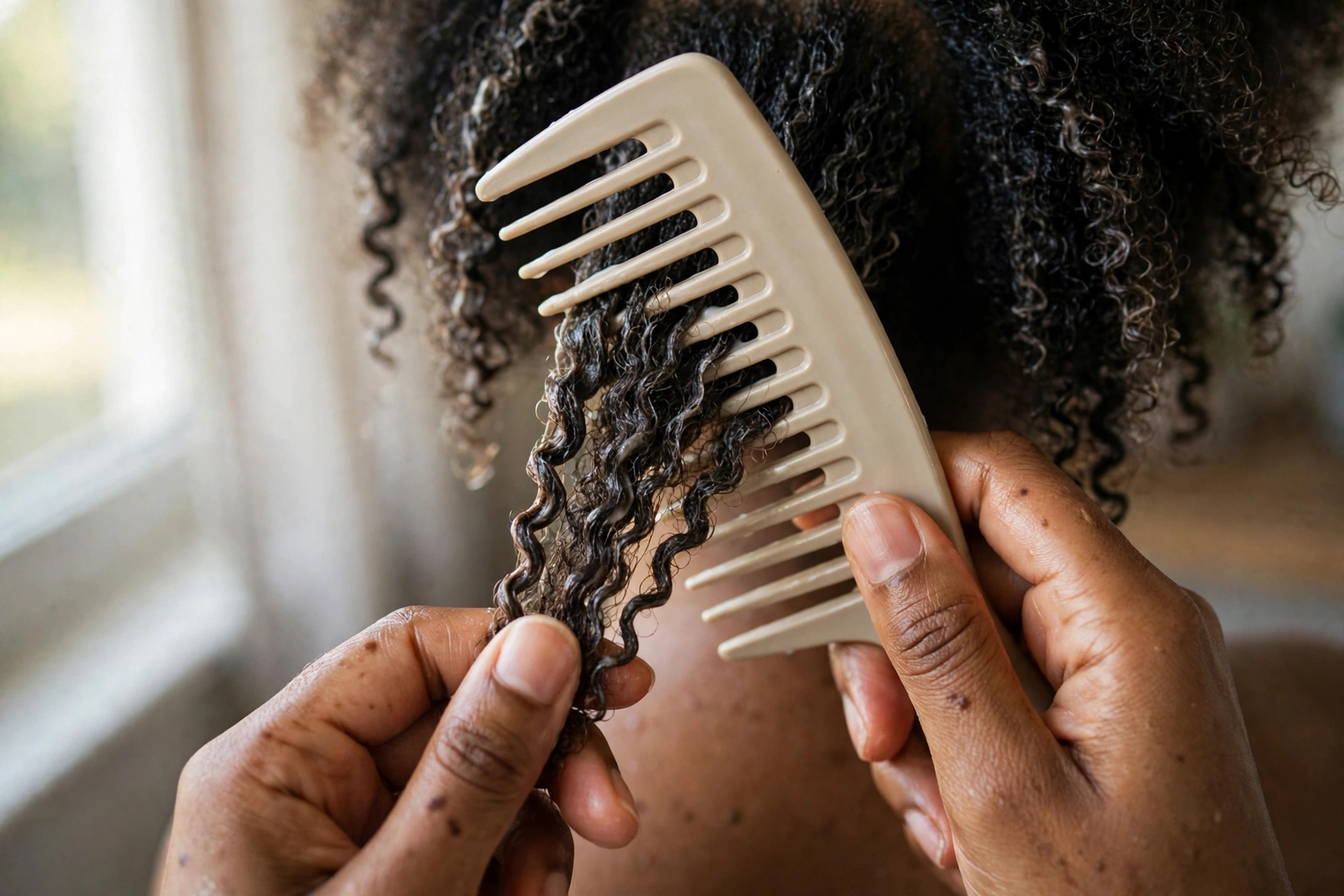
If breakage dominates: detangle only on wet, conditioned hair with fingers or a wide-tooth comb, working from the ends upward; pause heat styling for a month; trim split ends; sleep on satin; and loosen any style that pulls. Our detangling guide covers the technique in full, and our 4c breakage guide goes deeper on the tightest curl patterns, where every bend in the strand is a weak point.
If shedding dominates: do the timeline exercise above, keep the wash-day count going, and resist the urge to overhaul your product shelf — a dozen simultaneous changes make it impossible to tell what helped. Protective styles are fine during a shedding wave, but keep them loose and time-limited; a style that adds tension to a scalp already shedding heavily is the one change that can turn a temporary wave into lasting edge loss. Our protective styles guide covers safe tension and takedown.
What not to do either way: do not stop washing to “save” hair. Skipping washes lets shed hair accumulate further, lets buildup irritate the scalp, and makes the next detangle rougher — which creates the very breakage you were trying to avoid. Gentle, regular washing is part of the fix for both piles.
Frequently Asked Questions
Is it normal to lose a lot of hair on wash day?
Yes, if you do not detangle daily. Normal shedding runs about 50 to 100 hairs a day, so a week between full detangles can legitimately produce several hundred shed hairs in one wash. Judge the wash-day pile by the bulb test and the per-day division, not by its size.
Can breakage cause hair loss?
Breakage does not remove follicles, so it does not cause true hair loss — but severe, ongoing breakage thins the hair visibly and stalls length, which looks and feels like hair loss. The follicles keep producing hair; the hair just does not survive long enough to show it.
Does shedding mean my hair is unhealthy?
Not on its own. Shedding is a normal phase of the hair cycle, and healthy heads of hair shed every day. Shedding becomes a concern when the amount jumps suddenly, stays high for months, or comes with thinning, patches, or scalp symptoms.
How long does it take for breakage to improve?
Most people see fewer fragments within four to eight weeks of gentler handling, because new growth is no longer being snapped off at the same rate. Existing damage does not heal — damaged lengths must be trimmed away gradually as healthy hair replaces them.
Should I take biotin for shedding or breakage?
Biotin helps only if you are actually deficient, which is uncommon. For breakage, handling changes beat supplements. For heavy or persistent shedding, a doctor can check for the deficiencies and conditions that actually drive it — guessing with a supplement bottle delays that check. A review of hair cosmetics in the International Journal of Trichology makes the same broader point: hair shaft health is mostly about what the hair is exposed to, not what you swallow.
Disclaimer: This article is for general information only and is not medical advice. Heavy, persistent, patchy, or painful shedding deserves a dermatologist’s assessment, not a product recommendation. The American Academy of Dermatology’s healthy hair tips are a good companion read for the day-to-day habits that keep breakage down.
