Aloe Vera Gel for Your Scalp: Benefits, How to Use It & What It Can’t Do
 Maya Thompson
📅 October 18, 2026
⏱ 14 min read
In 1999, dermatologists in Israel ran a small double-blind trial: adults with seborrheic dermatitis applied either a 30% aloe vera emulsion or an identical placebo cream, twice a day, for four to six weeks. More than six in ten of the aloe group reported their scaling and itching had improved, versus one in four on placebo. It is one of the only real clinical trials ever run on aloe vera for a scalp condition — and almost nobody writing about “aloe for dandruff” online mentions how small, how old, or how specific it was. That gap, between what was actually studied and what the internet claims, is exactly what this guide is about.
If you have natural hair, an itchy, flaky scalp is a particular kind of misery: scratching is harder under twists and braids, medicated shampoos can leave your lengths parched, and most scalp advice online is written for straight hair that gets washed daily. Aloe vera gel for scalp use sits right in the middle of this debate — a genuinely promising natural option for mild flaking and itch, surrounded by exaggerated claims it was never shown to earn. Here is what the evidence supports, what it doesn’t, how to use it properly on coily and curly hair, and when a dermatologist is the right answer instead.
What aloe vera gel actually does on a scalp
Aloe vera gel for scalp care is not a shampoo and not a moisturizer in the usual sense. What it is, physically, is a water-based gel that dries into a thin, breathable film. That film is why it behaves the way it does: it holds water against the skin for a while, cools as it evaporates, and rinses out cleanly without the greasy residue that heavy oils leave behind — a real advantage on a scalp that is already flaky, since the yeast linked to dandruff feeds on oil.
Three mechanisms matter, and they are all modest rather than miraculous. First, cooling and hydration: the gel’s high water content plus its film-forming habit soothes the tight, irritated feeling of an inflamed scalp. Second, gentle cleansing: Healthline’s review of aloe vera for hair notes that aloe strips excess sebum and product residue from the hair shaft without the harshness of sulfates, which is one reason people with itchy scalps often feel relief after an aloe treatment. Third, anti-inflammatory activity: the fatty acids and plant sterols in the inner gel have documented anti-inflammatory effects in lab models, which is the plausible mechanism behind the 1999 trial’s results.
What the gel does not do on a scalp is equally worth stating. It is not antimicrobial in any clinically meaningful sense when applied as a kitchen gel — lab studies on aloe extracts and Malassezia yeasts exist, but they were done in petri dishes with concentrated extracts, not on anyone’s head. It does not dissolve buildup the way a clarifying shampoo does. And despite what a hundred blog posts claim, there is no evidence it increases blood circulation to the follicles in any way that changes hair growth. Keep those boundaries clear and aloe becomes a genuinely useful tool; blur them and you end up disappointed.
The one clinical trial worth knowing
The study that anchors this entire topic deserves a close, honest look. In the 1999 trial, published in the Journal of Dermatological Treatment, adults with seborrheic dermatitis — the clinical name for the condition behind persistent dandruff — were randomly assigned to a 30% crude aloe vera emulsion or a placebo cream, applied twice daily for four to six weeks. PeaceHealth’s summary of the 1999 double-blind trial reports the headline numbers: 62% of the aloe group reported improvements in scaling and itching, compared with 25% of the placebo group, and dermatologists’ ratings agreed the aloe group improved more.
Now the caveats, because they change how much weight this carries. The trial was small — a few dozen patients — and it has never been replicated at a larger scale. The treatment was a formulated 30% crude aloe emulsion, not the pure kitchen gel or store-bought bottle you’d buy today; you cannot map those results one-to-one onto scooping gel from a leaf. The patients had seborrheic dermatitis, a diagnosed inflammatory condition, not ordinary dry-scalp flaking — the two can look similar but behave differently. And it was 1999: no follow-up work of this quality on aloe and dandruff has appeared since.
So where does that leave us? With one small, old, reasonably well-designed trial suggesting topical aloe can calm the scaling and itching of mild seborrheic dermatitis — plus a long tradition of use and a strong safety profile. That is a fair basis for trying aloe on a mildly flaky, itchy scalp. It is not a basis for treating severe scalp disease, and it is certainly not a basis for the “regrows hair” claims that circulate on social media. Anyone telling you the evidence is stronger than this is selling something.
What aloe vera gel can’t do for your scalp
Clearing the myths first makes the real uses more credible, not less. Aloe vera gel for scalp application will not regrow hair on thinning edges or bald patches — no study has shown any regrowth effect, and temporary shedding from poor scalp health is a different problem from permanent follicle loss. It will not cure scalp psoriasis, eczema, or severe seborrheic dermatitis; those are medical conditions that need a dermatologist’s diagnosis and treatment, and waiting too long on DIY remedies can let them worsen. It will not replace a medicated dandruff shampoo when flakes keep coming back week after week — for that, dermatologists recommend starting with an over-the-counter shampoo containing zinc pyrithione, ketoconazole, selenium sulfide, or a similar proven active. If you want that route explained properly, the American Academy of Dermatology’s dandruff treatment guidance is the honest baseline, including their advice to match shampoo frequency to curly and coily hair (about once a week, applied to the scalp rather than the lengths, since the actives can dry natural hair).
There is also one interaction worth knowing: aloe can increase how much topical medication the skin absorbs, so if you are using a prescription scalp treatment — a steroid solution, for instance — don’t layer aloe over it without asking the prescribing doctor. Patch-test first, always: a dab on the inside of your wrist, watched for a couple of hours, before the gel goes anywhere near your hairline.

Fresh leaf or store-bought gel? The purity check
For scalp use, what is in the gel matters more than it does for lengths, because the scalp is skin — and broken, scratched scalp skin at that. Fresh leaf gel is the purest option, but only if you handle the aloin problem. The yellow sap (aloin) that sits just under the leaf’s green skin is a known irritant; it must be drained completely by standing the cut leaf upright for 10–15 minutes, then rinsed away, before you scoop the clear inner gel. Skip that step and you can turn a soothing treatment into an itchy one. (If you want the full extraction walkthrough, it lives in our guide to aloe vera gel for natural hair; this article won’t repeat it here.)
Store-bought gel is fine — often more practical — if you read the label like a skeptic. Look for: aloe barbadensis as the first ingredient, no added alcohol (it dries and stings irritated skin), no fragrance or artificial color (green dye is a red flag; real gel is clear), and no menthol or “cooling” additives marketed for sunburn gels. A short ingredient list beats a long one. And be honest about freshness: blended fresh gel lasts about a week in the fridge; a bottle that has sat open in a hot bathroom for months has lost most of whatever was useful in it.

How to use aloe vera gel on natural hair
Application is where most online advice fails natural hair, because it assumes you can just smear gel on your head. On dense, coily hair the gel has to reach the scalp — and then it has to come back out without leaving your lengths a tangled film. Here is the method that actually works:
1. Start with sectioned, damp hair
Work on clean or freshly rinsed hair, divided into 4–6 sections with clips. Dampen the scalp with a spray bottle — aloe spreads much more evenly on a damp scalp, and you’ll use half as much product. If your hair is in twists or braids, apply along the exposed parts and the hairline; don’t try to force gel through a full install.
2. Apply to the scalp, not the hair
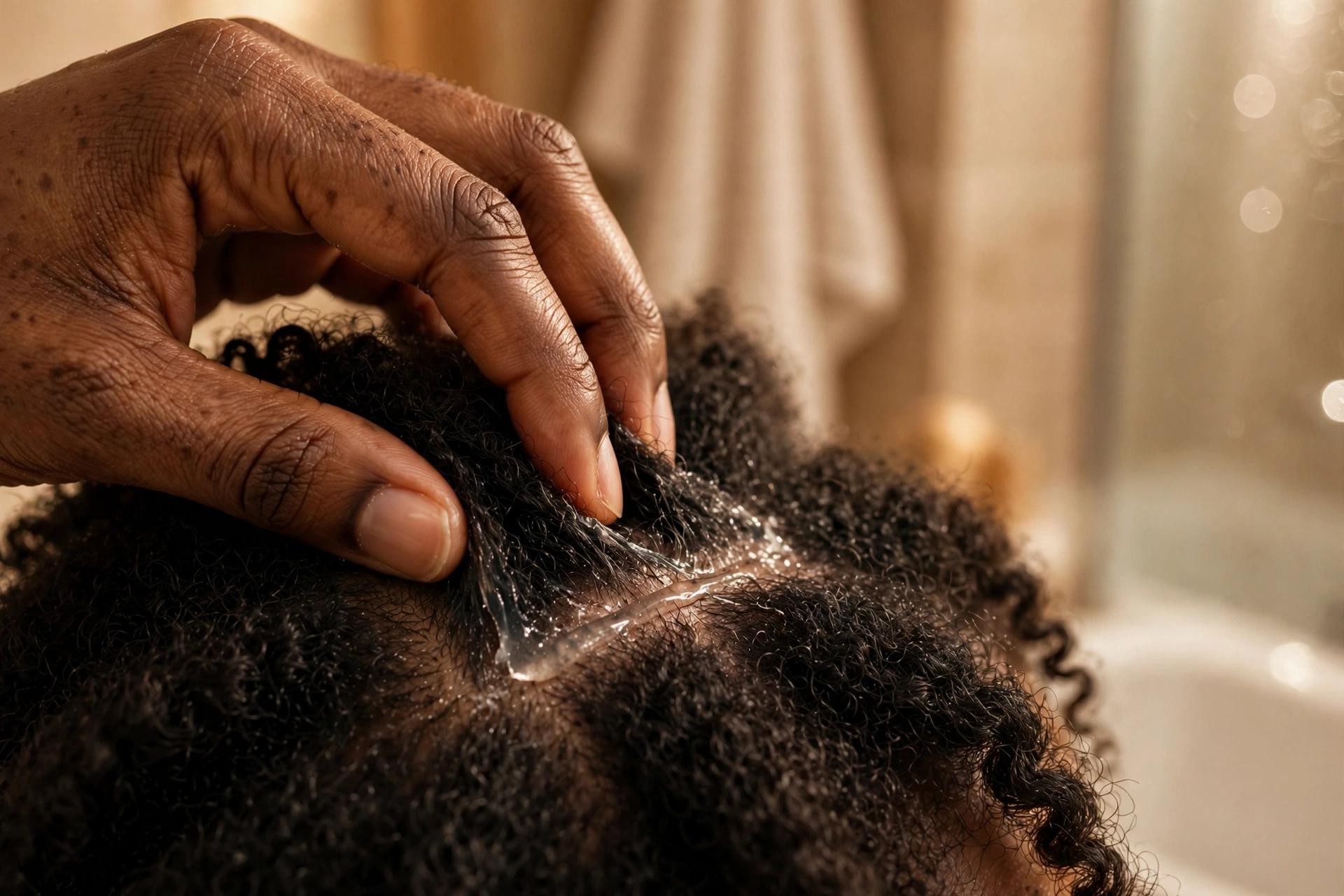
With fingertips (never nails), massage a thin layer of gel directly onto the scalp in each section, using gentle circular motions. The massage itself matters — it loosens flakes mechanically. Keep the gel off the lengths as much as you can: aloe’s film is fine on skin but can leave low-porosity hair feeling coated and stiff. If you’re unsure about your porosity, run through our porosity test first — low-porosity scalps do best with thinner applications.
3. Let it sit 30–60 minutes
Cover with a shower cap to keep the gel from drying out. Thirty minutes is enough for mild itch; an hour is the sensible maximum for a first few sessions. Overnight sits are popular online, but they buy you little extra benefit while raising the odds of a dried, flaky film that is annoying to rinse — save the overnight idea for deep conditioners, not scalp gels.
4. Rinse thoroughly, then condition the lengths
Rinse with lukewarm water, working section by section, and use a gentle sulfate-free shampoo if any film remains — residue left on the scalp can flake and mimic the dandruff you were trying to fix. Follow with your normal conditioner on the lengths only. This order (scalp treatment, rinse, then moisture for the hair) keeps the two jobs from interfering.
How often, by scalp type
Mild itch or seasonal flaking: once a week, on wash day, for 3–4 weeks, then reassess. Recurring dandruff alongside flakes: twice a week max, and if there’s no clear improvement after a month, switch to a medicated approach rather than doubling down — our ketoconazole shampoo guide explains how naturals can use medicated shampoos without wrecking their moisture balance. Oily, irritated scalp with redness: aloe can soothe, but persistent redness or greasy yellowish scales are seborrheic dermatitis territory and deserve a dermatologist, not a kitchen remedy.
Aloe vs the other scalp options, honestly compared
Aloe is one tool on a shelf of options. Here’s how it stacks up, so you can pick the right one instead of the trendiest:
| Option | Best for | Honest limitation |
|---|---|---|
| Aloe vera gel (scalp) | Mild itch, light flaking, soothing an irritated scalp between washes | Thin evidence base (one small 1999 trial); won’t touch persistent dandruff alone |
| Medicated dandruff shampoo (zinc pyrithione, ketoconazole) | Recurring dandruff that keeps coming back | Can dry natural hair lengths; use on the scalp only, about weekly for coily hair |
| Tea tree oil shampoo (5%) | Mild seborrheic-type flaking; a middle step before medicated shampoo | Can irritate sensitive scalps undiluted; weaker evidence than medicated actives |
| Apple cider vinegar rinse (diluted) | Clarifying residue and hard-water film that looks like flakes | No solid evidence against dandruff itself; can sting broken skin — see our apple cider vinegar rinse guide for the safe dilution |
The pattern across the row: match the tool to the severity. Light and occasional belongs to aloe; stubborn and recurring belongs to medicated shampoo; buildup masquerading as flakes belongs to clarifying. Using aloe for a job that needs ketoconazole is how people conclude “natural remedies don’t work” — the remedy was fine, the diagnosis was wrong.
When to stop the DIY and see a dermatologist
Aloe is a home remedy, and home remedies have a jurisdiction. Book a dermatologist — a board-certified one — if any of these show up: thick, greasy, yellowish scales; red, inflamed, or painful patches; sores, oozing, or crusting; hair loss in patches or widening parts; itching so intense it disrupts sleep; or anything that hasn’t improved after a month of sensible home care. Scalp psoriasis and severe seborrheic dermatitis can look like “bad dandruff” to the untrained eye, and both have effective prescription treatments that no gel can substitute. There is no prize for suffering through a treatable condition.
Frequently Asked Questions
Can I leave aloe vera gel on my scalp overnight?
You can, but there’s little reason to. The useful contact time is 30–60 minutes under a shower cap; beyond that the gel dries into a film that adds no further benefit and can flake off looking exactly like dandruff. Overnight sits also keep a damp scalp warm for hours, which isn’t ideal if a yeast imbalance is part of your problem. Rinse it out before bed.
How often should I use aloe vera gel on my scalp?
For mild itch or seasonal flaking, once a week on wash day for three to four weeks, then reassess. Twice weekly is the sensible ceiling for recurring dandruff — and if a month of that hasn’t clearly helped, that’s your signal to move to a medicated shampoo or a dermatologist rather than increasing frequency.
Is aloe better for dandruff or for dry scalp?
It’s better for itch and mild inflammatory flaking — the dandruff end of the spectrum — because its real strengths are cooling, hydration, and anti-inflammatory activity. For a purely dry, tight scalp with no flakes, it helps as a hydrating layer, but a light oil or leave-in applied to a damp scalp afterward usually does more for lasting comfort.
Can aloe vera grow my edges back?
No study has shown that aloe vera regrows hair, on edges or anywhere else. What it can do is improve the scalp environment — less itching means less scratching, and less scratching means less breakage around fragile edges. That’s a real benefit, but it’s breakage prevention, not regrowth. Edges lost to traction or scarring need a different plan entirely.
Fresh aloe or store-bought gel for scalp use?
Fresh is purest but demands the aloin-draining step — skip it and the yellow sap can irritate the very scalp you’re trying to soothe. Store-bought is more practical; just insist on a short ingredient list with no alcohol, fragrance, or dyes, and aloe barbadensis as the first ingredient. Either way, patch-test before the first full application.
Can I mix aloe vera gel with oil for my scalp?
You can, but think about why. Oil adds slip and seals in the gel’s hydration, which some people like as a pre-poo scalp treatment. The trade-off: heavy oils feed Malassezia, the yeast behind dandruff, so if flakes are your problem, keep oils light and minimal on the scalp — or skip the oil and let the gel work alone.
Does aloe vera help scalp psoriasis?
There is some preliminary evidence for aloe in psoriasis generally, but scalp psoriasis is a distinct, often stubborn condition, and kitchen gel is not its treatment. If your plaques are thick, silvery, or extend past the hairline onto the forehead or neck, see a dermatologist — effective prescription options exist, and delaying them lets the condition entrench.
Will aloe vera gel dry out my natural hair?
On the scalp, no — it’s hydrating. On the lengths, it can leave low-porosity hair feeling coated or stiff because of the film it forms as it dries. That’s why this guide keeps the gel on the scalp and the conditioner on the lengths. If gel does get on your hair, a thorough rinse plus your normal conditioner sorts it out.
Disclaimer: This article is for informational purposes only and is not medical advice. Scalp conditions that persist, worsen, or involve pain, sores, or hair loss should be evaluated by a board-certified dermatologist. If you are pregnant, nursing, or using prescription scalp treatments, check with your doctor before adding new topical remedies.
