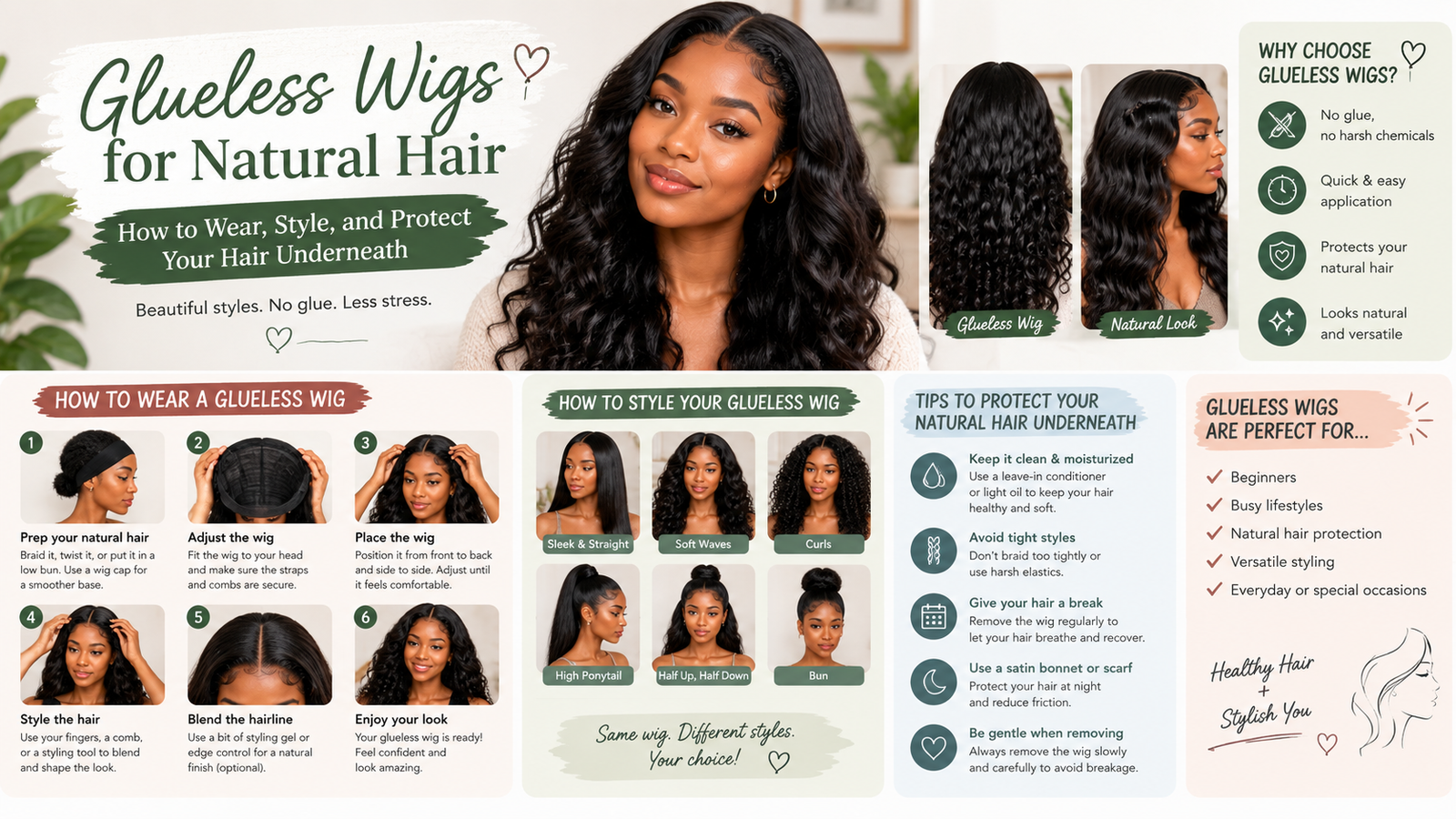
Glueless Wigs for Natural Hair — How to Wear, Style, and Protect Your Hair Underneath
If you’re wearing glueless wigs for natural hair, you already know the appeal — no adhesive, no scalp damage, no hour-long installation. But glueless wigs can still cause breakage, edge loss, and scalp issues when worn incorrectly. Most of the problems people attribute to wigs are actually problems with how the hair underneath is cared for and how the wig is secured.
This guide covers everything you need to know about wearing glueless wigs safely over natural hair — from prepping your hair underneath to maintaining your edges and scalp during extended wear.
What Are Glueless Wigs and Why Are They Better for Natural Hair?
Glueless wigs are wigs designed to be secured without lace glue or adhesive tape. They stay in place using one or more of the following:
- Adjustable elastic bands inside the wig cap
- Combs at the front, back, and sides that grip the hair or wig cap underneath
- Drawstring closures at the nape
- Wig grips or non-slip bands worn underneath
For natural hair specifically, glueless installation matters for several reasons. Lace glue and adhesive tape applied repeatedly to the hairline cause chemical irritation to the scalp and mechanical damage to the edges — two of the leading causes of traction alopecia at the hairline in wig wearers. Glueless wigs eliminate that chemical contact entirely.
They also install faster — the learning curve on a well-designed glueless wig is significantly shorter than glued installation — and they can be removed easily at the end of the day, which allows for better scalp care between wears.
How to Prepare Natural Hair for a Glueless Wig
Step 1 — Moisturize and Seal Your Natural Hair First
Natural hair underneath a wig loses moisture faster than hair that’s left out — it’s covered for hours with limited airflow. Before installing any wig, apply your full moisture routine: leave-in conditioner, oil, and cream sealant in the LOC method. Well-moisturized hair underneath a wig stays healthier during extended wear than dry hair.
See our guide on how to moisturize natural hair for the complete LOC method before wig installation.
Step 2 — Choose the Right Protective Style Underneath
How you style your natural hair under the wig matters. The goal is a flat, even base that protects the hair without creating tension:
- Flat twists: The most popular option — lay natural hair flat against the scalp in twists that run front to back or in cornrow patterns. Low tension, even distribution, and the twist-out result when you remove the wig is a bonus.
- Cornrows: Neat, flat cornrows give a smooth base and work well for longer wear periods. Make sure they’re not too tight — the wig adds compression on top, which means tension from tight cornrows compounds.
- Banding method: Stretch natural hair with hair ties spaced along the length without heat, then pin flat. Good for length retention.
- Compression cap: For very short natural hair, a wig cap alone over moisturized natural hair works.
Step 3 — Protect Your Edges Specifically
The hairline is the most vulnerable area during wig wear. Before putting on your wig:
- Apply a small amount of a lightweight oil or scalp serum to the edges — Mielle Rosemary Mint oil works well for this
- Lay edges with an edge control that doesn’t contain alcohol, which dries out the hairline
- Avoid pulling the wig too far forward onto the natural hairline — the wig’s lace front should sit at the hairline, not pulling the hairline forward
For consistent scalp and edge care during extended wig wear, see our guide on scalp serums for natural hair.
How to Secure a Glueless Wig on Natural Hair
Option 1 — Wig Grip Band (Most Recommended)
A wig grip is a velvet or silicone headband worn underneath the wig that grips both your head and the inside of the wig cap without any adhesive. It distributes the hold evenly around the perimeter rather than concentrating tension at the combs or elastic band. For natural hair, this is the most scalp-friendly method because it creates no point-source tension on any specific area of the hairline.
Wear the wig grip over your wig cap and under the wig. Adjust the wig until it sits naturally at your hairline, then press the inside of the wig perimeter against the grip to hold it in place. Most wig grips hold securely enough for a full day without any additional securing.
Option 2 — Elastic Band Method
Most glueless wigs have an adjustable elastic band inside the cap. Tighten it to fit your head securely, then use the attached combs to grip your wig cap or braids underneath. The comb at the nape holds the back; the combs at the temples hold the sides.
Don’t overtighten the combs — they should grip without pulling. Tension from overtightened combs at the temples is a direct cause of hairline breakage in wig wearers.
Option 3 — Wig Cap Plus Combs
A dome cap over your flat-twisted or cornrowed natural hair gives the wig combs something to grip without directly pulling on individual hair strands. This creates a buffer layer that reduces the mechanical stress of the combs on your natural hair.
How to Care for Natural Hair Underneath a Glueless Wig
Daily Scalp Care During Wear
Even with a wig on, your scalp needs daily attention. Use a pointed applicator bottle to apply a lightweight scalp oil — rosemary mint oil or diluted rosemary water — through the parts of your cornrows or flat twists underneath the wig. This maintains scalp health and circulation during extended wear without requiring you to remove the wig daily.
See our guide on rosemary water for natural hair for an inexpensive DIY option that works well for under-wig scalp care.
How Often to Remove the Wig and Wash
Remove the glueless wig and wash your natural hair every one to two weeks. This is non-negotiable — product buildup, sweat, and sebum accumulate under the wig and create scalp conditions that weaken follicles if left unaddressed for longer.
When you remove the wig for wash day:
- Gently remove the wig and wig cap
- Take down your flat twists or cornrows carefully — don’t rush
- Deep condition immediately — hair that’s been compressed under a wig needs intensive moisture restoration
- After washing and deep conditioning, re-moisturize fully before re-installing
For the best deep conditioners to use on wash day between wig installs, see our deep conditioner guide.
What to Do If Your Scalp Itches Under the Wig
Scalp itching under a wig usually indicates one of three things: buildup from sweat and product, fungal overgrowth, or dryness. Address them in that order:
- Buildup: Use a clarifying or ketoconazole shampoo on your next wash day. See our ketoconazole shampoo guide for the right approach to scalp reset after wig wear.
- Dryness: Apply a light scalp oil through the parts more frequently — daily if needed
- Fungal overgrowth: Tea tree oil diluted in a carrier oil applied to the scalp, or a ketoconazole shampoo treatment on wash day
How to Protect Natural Hair Edges While Wearing Glueless Wigs
Edge loss is the most common complaint from regular wig wearers — and it’s almost always preventable with the right habits:
- Never pull the wig too tight: The wig should sit at your natural hairline with slight give — you should be able to slide a finger underneath the perimeter without significant tension
- Take the wig off at night: Sleeping in a wig adds hours of friction and compression to the hairline every day. Remove it, apply a scalp oil to the edges, and sleep with a satin bonnet
- Vary your wig’s position slightly: Don’t put every wig on in exactly the same position — slight variation prevents pressure concentration at the same hairline points every time
- Massage your edges when the wig is off: Apply a scalp serum or oil and massage the hairline for two to three minutes when the wig comes off — this restores circulation to the compressed area
- Don’t wear the same wig daily: Rotating between two or three wigs reduces cumulative tension on the hairline
For ongoing edge growth support, our natural hair growth guide covers the full picture of what supports hairline recovery.
Glueless Wig Styles That Work Best Over Natural Hair
HD Lace Glueless Wigs
HD lace is thinner and more transparent than standard lace, which means it sits flatter against the scalp and requires less melting with heat or adhesive to look natural. For natural hair wearers who want a realistic-looking hairline without any adhesive, HD lace glueless wigs are the current standard.
Wear-and-Go Glueless Wigs
Pre-cut lace wigs designed for immediate wear without any customization — the lace is pre-trimmed, the knots are pre-bleached, and the wig can be on your head within minutes of unboxing. These work particularly well for natural hair wearers who want a protective style they can install and remove quickly.
U-Part and V-Part Wigs
U-part wigs leave a section of your natural hair out at the top to blend with the wig, eliminating the need for any lace frontal at all. V-part wigs do the same with a smaller parting section. Both styles are completely glueless and work well for natural hair that’s long enough to blend with the wig’s perimeter.
Frequently Asked Questions About Glueless Wigs for Natural Hair
Do glueless wigs damage natural hair?
Not inherently — but incorrect installation and neglect of the hair underneath can cause significant damage. The main risk factors are: tension from overtightened combs or elastic bands, buildup from not washing the natural hair underneath regularly enough, and edge loss from wearing wigs to sleep. Follow the scalp care and installation protocols in this guide and glueless wigs are one of the most protective styles available for natural hair.
How long can I keep a glueless wig on natural hair?
Daily wear with nightly removal is ideal — this gives your scalp access to air and allows you to apply scalp treatments. If you’re keeping the wig installed for multiple days, remove it and wash your natural hair every seven to ten days maximum. Longer than two weeks without washing underneath leads to significant buildup and scalp issues regardless of how well you maintained scalp oil between washes.
What is the best way to lay a glueless wig on natural hair without glue?
A wig grip band is the most effective no-adhesive method — it holds securely, distributes tension evenly, and doesn’t put point-source pressure on the hairline the way combs can. Combine with the wig’s built-in elastic band tightened to a comfortable (not tight) fit. For extra security, use Got2b Gel along the hairline without going into the actual hairline — apply it just to the inside of the wig’s lace, not your scalp or edges.
How do I keep my natural hair moisturized under a glueless wig?
Moisturize thoroughly before installation using the LOC method. Between wash days, use a pointed applicator bottle to apply a lightweight scalp oil or diluted rosemary water through the parts of your cornrows or flat twists underneath. Avoid applying heavy products that can’t breathe under the wig — they accumulate and cause buildup. Wash and re-moisturize every one to two weeks.
Can glueless wigs cause edge loss on natural hair?
Yes — if worn incorrectly. The primary causes of edge loss from glueless wigs are overtightened combs at the temples, wearing wigs to sleep (creating hours of friction and pressure at the hairline), and not massaging the edges when the wig comes off. Follow the edge protection steps in this guide and rotate wigs so the same pressure points aren’t stressed daily. For edges already thinning, consistent scalp oil massage and the guidance in our natural hair growth guide covers recovery.
Final Thoughts
Glueless wigs for natural hair are one of the better protective style options available — they eliminate the chemical damage of adhesive, install quickly, and can be removed at the end of each day for proper scalp care. The key is maintaining the natural hair underneath with the same consistency you’d apply to any protective style: moisture before installation, scalp care during wear, and thorough wash and deep conditioning every one to two weeks when the wig comes off.
The wig protects the length. Your routine protects the health. You need both.
More from PickHonestly on natural hair care:
- How to Grow Natural Hair Faster — What Actually Works
- Best Scalp Serum for Natural Hair
- Rosemary Water for Natural Hair
- How to Moisturize Natural Hair — Complete Guide
- Best Deep Conditioners for Natural Hair
- Natural Hair Care Routine for Beginners
Prices accurate as of publication and may vary. Always verify current pricing before purchasing.