Hard Water Hair Damage: 9 Signs, What It Really Does, and How to Fix It
What Is Hard Water, Exactly?
Hard water is simply water with a high concentration of dissolved minerals — mainly calcium and magnesium. As groundwater moves through soil and rock, it picks up these minerals. The U.S. Geological Survey defines water hardness as the amount of dissolved calcium and magnesium, measured in milligrams per liter (mg/L) as calcium carbonate:
| Classification | Hardness (mg/L) |
|---|---|
| Soft | 0–60 |
| Moderately hard | 61–120 |
| Hard | 121–180 |
| Very hard | Over 180 |
Hard water is not a health hazard — the minerals are safe to drink, and the WHO notes they can even contribute to dietary calcium and magnesium. But what is harmless in a glass can be a real nuisance on your head. Every wash deposits a microscopic mineral film on each hair shaft, and over weeks and months, that film changes how your hair looks, feels, and behaves.
What Hard Water Actually Does to Your Hair
To understand the damage, picture a single hair strand. Its outer layer, the cuticle, is made of overlapping scales — like roof shingles. Healthy cuticles lie flat and reflect light (that’s shine). Here’s what mineral deposits do at the strand level:
- They form a film that blocks moisture. Calcium and magnesium bind to the hair’s surface proteins, creating a barrier that stops water and conditioner from penetrating. Your hair can be soaking wet and still feel dry.
- They roughen the cuticle. Mineral crystals lift and dull the cuticle scales, so hair loses shine, feels rough, and tangles more easily.
- They react with shampoo to form soap scum. As the USGS explains, hard-water minerals react with soap to form an insoluble residue. On hair, that means shampoo lathers poorly, rinses incompletely, and leaves buildup behind.
- They accelerate color fade. The mineral film oxidizes and dulls dye molecules, so color-treated hair loses vibrancy faster.
- They make products underperform. That expensive conditioner isn’t failing you — it’s sitting on top of a mineral layer instead of reaching your hair.
Who suffers most? Curly and coily hair (already drier and more porous — not sure of your porosity? Find out here), color-treated or bleached hair (raised cuticles grab more minerals), fine hair (buildup weighs it down fast), and anyone with heat or chemical damage.
9 Signs Your Hair Is Damaged by Hard Water
Hard water damage is often misdiagnosed as “dry hair” or “bad products.” Look for this pattern:
- Hair feels dry and straw-like even right after conditioning. The classic sign — moisture can’t get past the mineral film.
- Shampoo barely lathers, no matter how much you use. You need more product to get fewer suds.
- Hair looks dull and lifeless, with no shine even when freshly washed.
- Frizz and tangling increase after every wash, especially at the ends.
- Color fades unusually fast — your dye looks brassy or washed out within weeks.
- Ends feel rough and brittle, and breakage increases around the mid-lengths.
- Scalp feels tight, itchy, or flaky, with buildup that doesn’t respond to regular shampooing.
- Hair feels coated or “waxy” and gets weighed down quickly after washing.
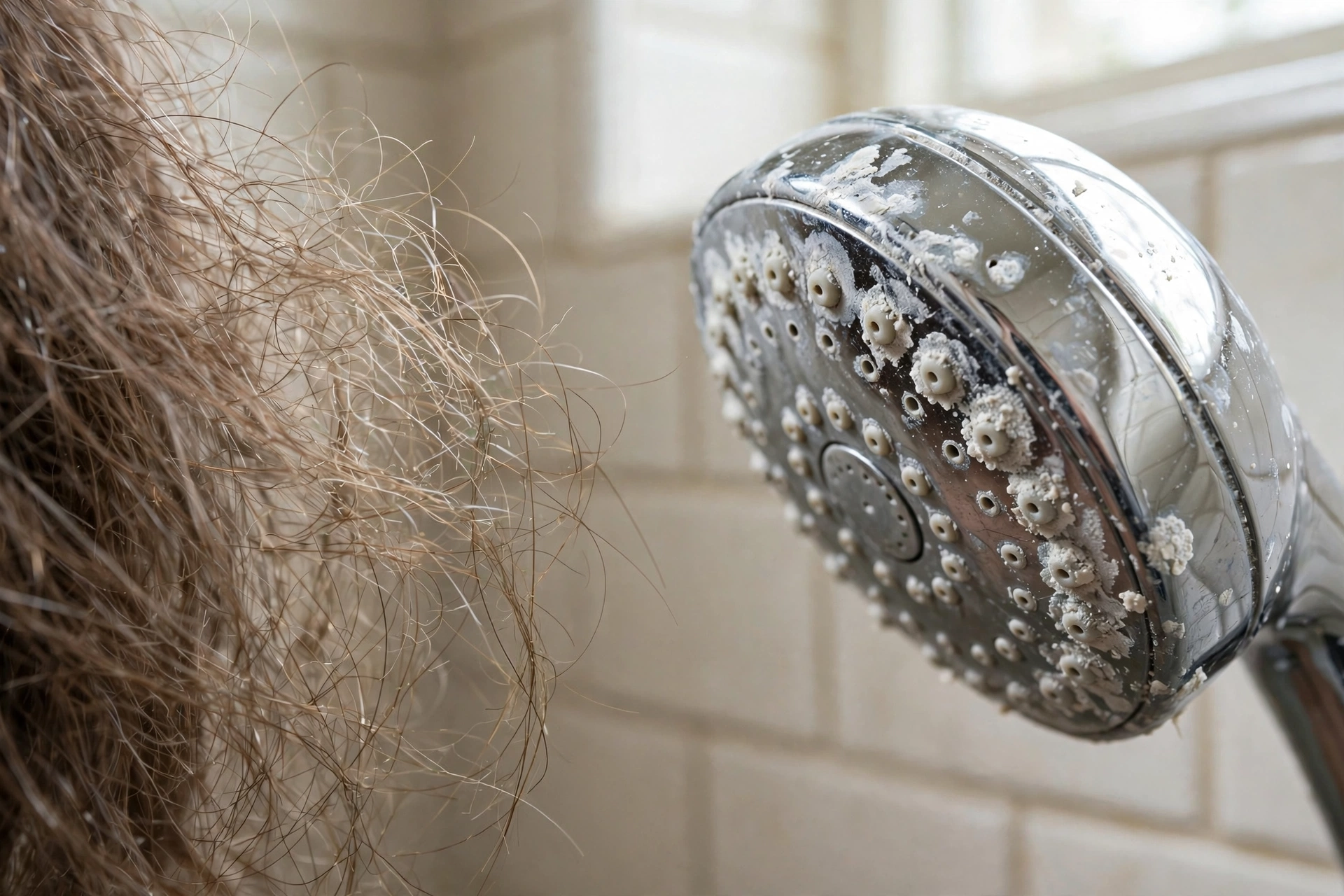
- White, chalky deposits on your showerhead or faucets — if your fixtures have limescale, your hair has it too.
If three or more of these sound familiar, your water is a prime suspect — not your shampoo.
Does Hard Water Cause Hair Loss? The Honest Answer
This is where many articles overclaim, so let’s be precise. There is no strong scientific evidence that hard water makes hair fall out from the follicle or causes true hair loss conditions. What hard water does cause is breakage: mineral-weakened strands snap at the mid-lengths and ends, which can make hair look thinner and create the impression of shedding.
That distinction matters for treatment. If you’re seeing short broken pieces (with no bulb at the end), that’s breakage — and fixing your water plus a chelating routine should help. If you’re seeing full-length shed hairs with bulbs, or widening part lines and bald patches, that’s a shedding or follicle issue — see a dermatologist, because no shower filter will fix it. Don’t let a water-softener salesman diagnose your hair loss.
How to Confirm Your Water Is the Problem
Before spending money on fixes, verify. Four practical tests:
- The soap test (free): fill a clear bottle one-third with tap water, add a few drops of pure liquid soap (not detergent), and shake. Soft water produces lots of fluffy suds; hard water gives cloudy water with little lather.
- The limescale check (free): white, crusty deposits on showerheads, faucets, or kettles mean hard water.
- A TDS meter (~$10–15): measures total dissolved solids in ppm. It doesn’t isolate calcium/magnesium, but a high reading plus hair symptoms is telling.
- Your municipal water report: most water utilities publish annual quality reports with hardness figures. Search “[your city] water quality report hardness.”
What Actually Fixes Hard Water Hair Damage (Ranked)
Not all solutions are equal. Here they are in order of effectiveness:
1. Chelating shampoo — the single most effective step
A chelating shampoo contains ingredients (typically EDTA or citric acid) that chemically bind to calcium, magnesium, iron, and copper and rinse them away. This is the only wash-day product that actually removes mineral deposits rather than just cleaning around them. Use it every 1–2 weeks — more often if your water is very hard — and always follow with a deep conditioner, since chelating shampoos are strong cleansers. This one step resolves most hard-water hair complaints.
2. A true water softener — the real long-term fix
Whole-house ion-exchange softeners swap calcium and magnesium ions for sodium ions before water reaches your shower. They are the only “filter” that actually removes hardness. The catch: cost and installation (typically hundreds to low thousands of dollars), which makes this a homeowner-level investment, not a renter’s quick fix.
3. Final rinse with distilled or bottled water
Cheap and surprisingly effective: after your normal wash, do a final rinse with a jug of distilled water. It won’t remove existing buildup, but it prevents a fresh mineral deposit on every wash. Many people in very hard-water areas swear by this as a daily habit.
4. Acidic rinses (ACV or citric acid)
An apple cider vinegar rinse (about 1 tablespoon per cup of water) or a weak citric acid rinse mildly dissolves mineral residue and smooths the cuticle by lowering pH. The evidence is mostly anecdotal, but the chemistry is plausible and the cost is negligible. Use once a week at most — overdoing acids can dry hair.
The Shower Filter Myth (Read This Before You Buy)
Here is the uncomfortable truth most “hard water” articles skip: standard shower filters do not remove calcium and magnesium. Most showerhead filters use activated carbon or KDF media, which reduce chlorine and some heavy metals — worthwhile for chlorine-sensitive scalps, but they leave water hardness essentially unchanged. Removing dissolved calcium and magnesium requires ion exchange or reverse osmosis, which standard $30 shower filters don’t do.
Some shower softeners with salt-based ion-exchange cartridges do exist and can genuinely reduce hardness — but they are bulkier, need regular cartridge replacement, and cost far more than typical filters. When shopping, check the specs: if it doesn’t explicitly claim ion-exchange softening with a rated grain capacity, assume it won’t fix hard water. Don’t pay a hardness price for a chlorine solution.
Chelating vs. Clarifying Shampoo: What’s the Difference?
These terms get mixed up constantly, even by brands. They do different jobs:
| Chelating shampoo | Clarifying shampoo | |
|---|---|---|
| Removes | Mineral deposits (calcium, magnesium, iron, copper, chlorine) | Product buildup (silicones, oils, styling residue) |
| Key ingredients | EDTA, citric acid, phytic acid | Stronger surfactants (olefin sulfonate, SLS) |
| Use when | Hard water symptoms: dullness, poor lather, stiffness | Hair feels coated, heavy, or “producty” |
| Frequency | Every 1–2 weeks | Every 2–4 weeks (or as needed) |
| Follow with | Deep conditioner (non-negotiable) | Regular conditioner |
If you have hard water, you need the chelating column. A clarifying shampoo alone won’t dissolve mineral deposits.
A Hard Water Hair Routine That Works
Put it together into a simple routine (for the full fundamentals, see how to take care of your hair):
- Weekly or biweekly: wash with a chelating shampoo, then deep-condition for 10–20 minutes. This is your reset wash.
- Regular wash days: use a gentle, pH-balanced shampoo; consider a final distilled-water rinse.
- After every wash: apply leave-in conditioner to damp hair, focusing on mid-lengths and ends where mineral damage concentrates.
- Monthly: check your showerhead for limescale — if buildup is returning fast, your water is very hard and the chelating wash matters even more.
- Ongoing: reduce heat styling while your hair recovers; mineral-weakened hair breaks more easily under heat. For extra moisture on wash days, a DIY treatment like our flaxseed gel for low porosity hair can help restore softness without heavy silicones that add to buildup.
If you’re new to ingredient-led hair care, start at the PickHonestly homepage for more honest guides.
Hard Water vs. Chlorine vs. Product Buildup: Don’t Confuse Them
Three different problems get blamed on each other constantly, so here’s the quick separation:
- Hard water = dissolved calcium and magnesium. Leaves hair stiff, dull, and rough; shampoo won’t lather. Fixed with chelating shampoo or softening.
- Chlorine = disinfectant in tap and pool water. Dries hair and fades color, but doesn’t leave the chalky mineral film. Reduced by standard shower filters and vitamin C treatments.
- Product buildup = silicones, waxes, and heavy oils accumulating from your own routine. Makes hair coated and limp. Fixed with clarifying shampoo.
Many people have two or even all three at once — for example, hard tap water plus heavy silicone serums. That’s why a single “miracle” product rarely fixes everything: match the fix to the actual problem, and when in doubt, the chelating wash is the best diagnostic tool you own. If your hair transforms after one chelating wash, minerals were the culprit.
Frequently Asked Questions
Can hard water damage be reversed?
Yes — mineral buildup is one of the most reversible hair problems. One or two chelating washes usually restore softness and shine noticeably. The damage isn’t “reversed” at a structural level so much as the deposits are removed; severely weakened ends may still need a trim.
Is hard water bad for curly hair specifically?
Curly and coily hair shows hard water damage first and worst, because it’s naturally drier and its raised cuticle grabs more minerals. If you have curls and hard water, the chelating shampoo step is close to essential.
Will boiling water remove hardness?
Boiling removes temporary hardness (bicarbonates) as scale, but not permanent hardness (sulfates/chlorides of calcium and magnesium). It’s impractical for hair washing anyway — stick with chelating shampoo.
Does hard water affect everyone in the house equally?
No. Fine, porous, color-treated, or damaged hair shows symptoms fastest. Someone with coarse, virgin, low-porosity hair may barely notice the same water.
Are water softeners safe for hair?
Yes. Ion-exchange softeners replace calcium/magnesium with small amounts of sodium, which doesn’t deposit on hair the same way. Softened water typically leaves hair feeling softer and needing less shampoo.
Can I just use a clarifying shampoo instead of chelating?
For mineral deposits, no — clarifying shampoos remove product buildup, not bonded minerals. Check the ingredient list for EDTA or citric acid high up if you want true chelating action.
How do I know if my shower filter is actually softening water?
Test it: run the soap-shake test on filtered vs. unfiltered water from the same shower. If both behave the same (cloudy, little lather), your filter isn’t softening — it’s likely only reducing chlorine. A $10 TDS meter before and after the filter tells the same story in numbers.
Should I wash my hair less often in hard water areas?
Not necessarily — less washing means fewer mineral deposits, but it also means more scalp buildup. A better strategy is washing as often as your scalp needs, but making one wash per week a chelating reset wash. That gives you the best of both.
The Bottom Line
Hard water damage is common, misdiagnosed, and very fixable. Confirm your water with a simple test, make a chelating shampoo your regular reset wash, and don’t waste money on a standard shower filter expecting it to soften water — the chemistry doesn’t work that way. Your hair (and your shampoo budget) will thank you.
Disclaimer: This article is for informational purposes only and is not medical advice. If you are experiencing significant shedding, widening part lines, or bald patches, consult a board-certified dermatologist to rule out medical causes of hair loss.