Hibiscus Powder for Hair: How to Buy It, Use It Right, and What It Actually Does
 Maya Thompson
📅 October 22, 2026
⏱ 14 min read
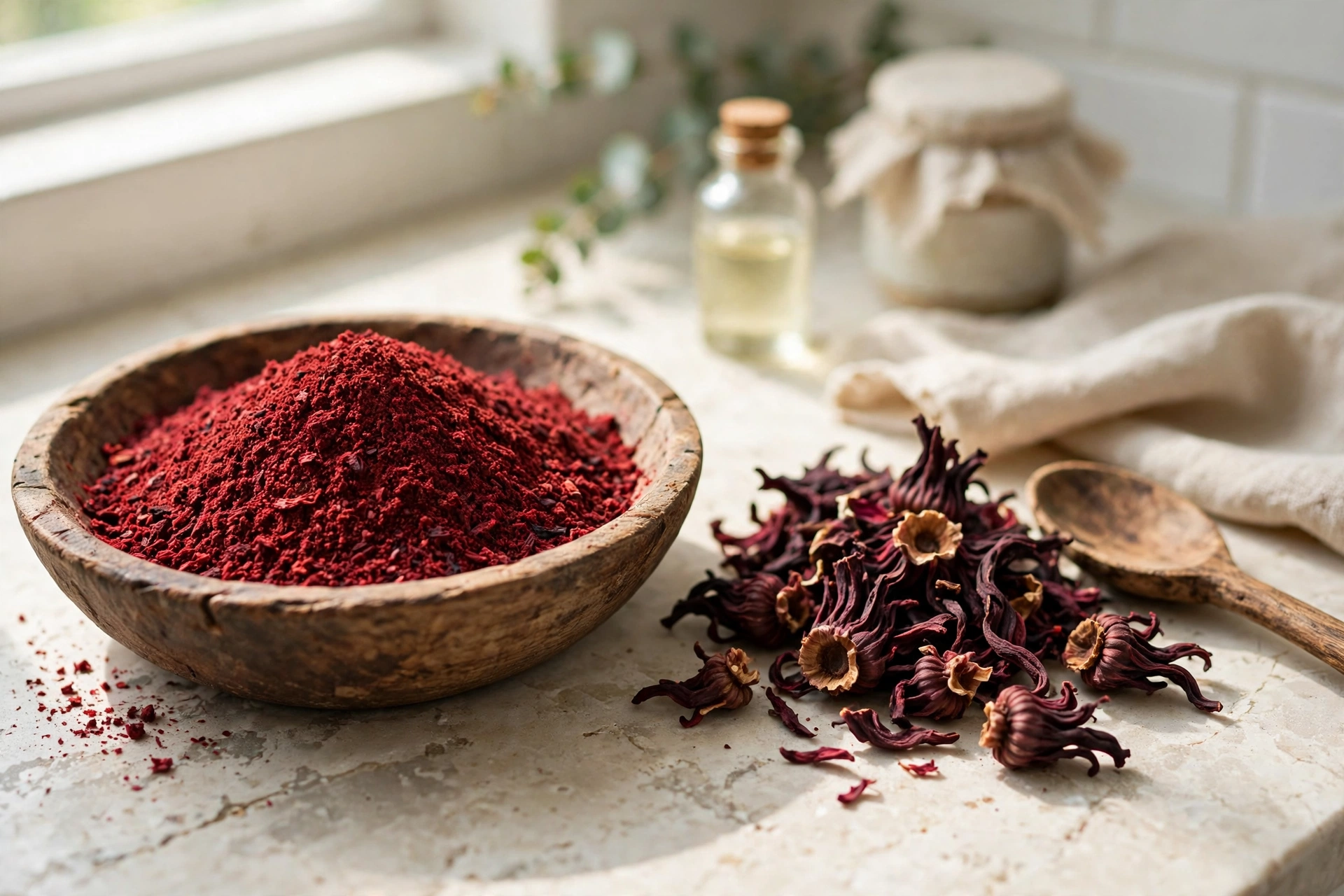
Two pouches of hibiscus powder for hair can sit side by side on a shelf, look identical through the packaging, cost roughly the same — and be two completely different products. One is finely ground petals of Hibiscus rosa-sinensis, the flower Ayurvedic tradition actually used for hair. The other is a coarser powder, possibly a different hibiscus species altogether, sometimes stretched with filler or brightened with added color. The label will not always tell you which is which.
This is the article nobody writes about hibiscus powder. The internet is full of benefit lists — growth, shine, dandruff, greying, the usual copy-pasted parade — but almost nobody teaches you how to buy the real thing, how to tell it from the fake, how to store it, or how to use it without ending up with gritty residue in your coils for a week. This guide covers all of that, plus the five ways to actually use the powder, safety cautions the product pages skip, and an honest look at what the evidence really says. If you want the full research deep-dive — every study, the benefit-by-benefit honesty ratings, and the recipes for fresh flowers and tea — that lives in our full evidence breakdown of hibiscus for natural hair, and this guide is its practical companion.
First, the species problem: not all “hibiscus powder” is the same plant
Here is the single most useful thing you can learn about buying hibiscus powder. The hibiscus used in Ayurvedic hair tradition — known in India as gudhal or jaswand — is Hibiscus rosa-sinensis, the big red ornamental flower. The hibiscus in your grocery store tea aisle is usually Hibiscus sabdariffa, also called roselle, grown for its tart calyces for teas, jams, and food coloring.
Some sellers use sabdariffa in their hair powder, or mix the two, without saying so. Sabdariffa is not dangerous in a hair mask, but it is not the plant behind the hair-growth studies, and the traditional recipes were built around rosa-sinensis. A serious seller names the species on the label. If the label just says “hibiscus powder” with no species, you are guessing.
There is a second split worth knowing: leaf powder vs flower (petal) powder. The one solid published study on hibiscus and hair growth — a 2003 rat study in the Journal of Ethnopharmacology — actually found the leaf extract more potent than the flower extract. Yet nearly every powder on the market is flower-only, because petals are what consumers expect. Leaf-flower blends exist; on their own, flowers are the standard. Just know that when someone claims their powder is “more potent,” there is no evidence the flower powder they are selling beats any other flower powder.
How to buy hibiscus powder for hair that is actually good
Run every pouch through this checklist before it goes in your cart:
| Check | What you want | Red flag |
|---|---|---|
| Species | Hibiscus rosa-sinensis named on the label | Just “hibiscus powder,” or sabdariffa with no explanation |
| Ingredient list | One ingredient: 100% hibiscus (petal or flower) powder | Extra ingredients, “fragrance,” added color, undisclosed blends |
| Grind | Fine, sifted powder that dissolves into a smooth paste | Coarse, gritty grind that leaves bits in your hair for days |
| Color | Deep red to dark maroon — fresh, potent pigment | Brownish, dull, or faded — a stale-powder signal |
| Smell | Mildly earthy-floral, like dried flowers | Perfumed, chemical, or completely odorless |
| Source honesty | Seller states origin and harvest/batch info | Vague “premium quality” claims with zero specifics |
A practical test when you open the pouch: put a teaspoon in a glass of water. Good powder blooms into a rich red liquid quickly and settles into a fine sediment. Coarse or stale powder leaves floating grit and a weak, brownish tint. That water test predicts exactly what will happen on your scalp.
Storing hibiscus powder so it stays potent
Hibiscus powder’s active compounds — anthocyanins, the pigments behind the red color — degrade with heat, light, and moisture. Treat it like a spice, not like flour:
- Airtight container, away from the original paper pouch once opened. Glass jars with a good seal beat zip bags.
- Cool, dark cupboard. Not above the stove, not on a sunny bathroom shelf.
- Shelf life is roughly 12 months from a fresh batch. It will not become dangerous after that, just weaker and duller.
- Staleness signs: color shifts from deep red toward brown, the smell fades, and pastes stain less. If your mask suddenly leaves almost no color, the powder is spent, not your technique.
- Keep it dry. Damp powder clumps, and clumps invite mold — throw out any batch that smells musty.
What hibiscus powder can and can’t do (the honest version)
Let us keep this tight, because the full evidence breakdown already exists. Here is the tiered reality:
Supported by real research (animal, not human): the 2003 Journal of Ethnopharmacology rat study showed hibiscus leaf and flower extracts increased hair length and shifted follicles from resting to growth phase over 30 days. That is genuine, published evidence — on shaved rats, using solvent extracts, not on humans rubbing powder paste into their scalps. There are zero published human clinical trials on hibiscus for hair growth. Any site that implies otherwise is selling, not informing.
Plausible, traditional, but unproven: the mild cleansing action (hibiscus contains natural saponins, gentle cleansing compounds), the conditioning slip from its mucilage (the same gel-like substance that makes okra slippery), and scalp exfoliation from its natural fruit acids. These have a sensible mechanism and centuries of traditional use behind them, but no clinical trials measuring them.
Overclaimed: “works like minoxidil,” “blocks DHT,” “stimulates keratin production,” “prevents greying.” You will read these on every product page. They are marketing sentences with no human evidence attached. Hibiscus does not re-pigment grey hair — it can tint it reddish, which is a different thing entirely (more on that below).
How to use hibiscus powder: the 5 methods that actually work
These are powder-specific methods — things you cannot do well with fresh flowers or tea bags. Ratios below assume shoulder-length hair; halve for short hair, double for very long or thick hair.
Method 1: The hibiscus powder wash (a standalone gentle cleanser)
This is the most underused method and my favorite discovery from old Ayurvedic blogs. Hibiscus powder’s saponins give it mild cleansing power, so it can function as a low-poo wash on its own — no shampoo needed that day.
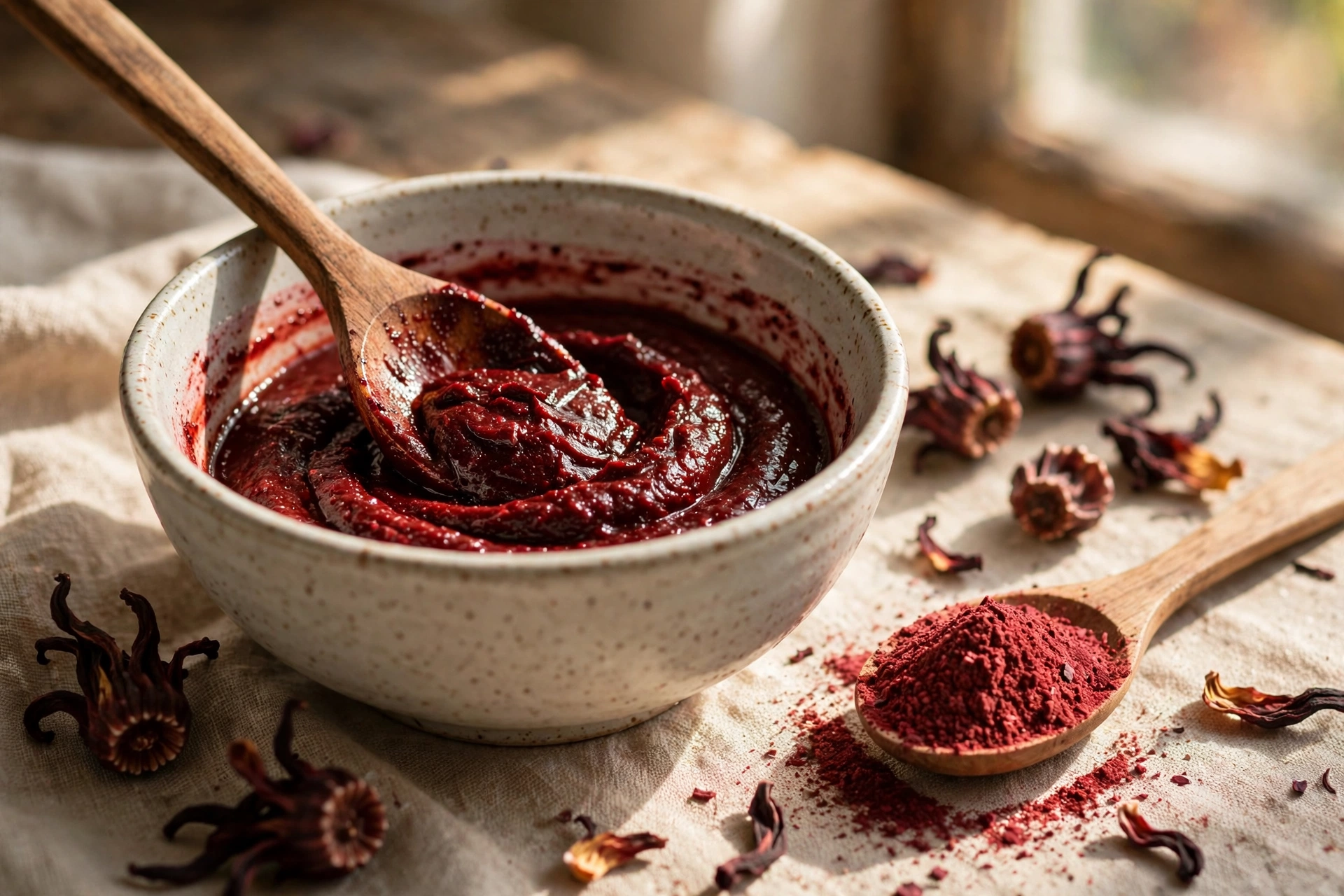
Mix 2–3 tablespoons of powder with warm water into a thin, pourable paste. Apply to a wet scalp, massage with your fingertips for 3–5 minutes — this is doing the cleansing — then rinse very thoroughly. Because it is mildly astringent, always follow with conditioner or a good deep conditioner for 4c hair. Best for: oily scalps and fine hair, once a week. Dry, coily hair should treat this as an occasional clarifier, not a weekly routine, because the mild dryness adds up.
Method 2: The hibiscus-ACV finishing rinse
Steep 1 tablespoon of powder in 2 cups of hot (not boiling) water for 15 minutes, strain through muslin or a fine sieve — no one wants petals in their coils — then stir in 1 tablespoon of apple cider vinegar. After your normal wash and condition, pour it over your hair, leave 2–3 minutes, and rinse lightly. The fruit acids plus vinegar smooth the cuticle, which reads as shine, and the light hibiscus stain adds a warm glow on dark hair. Use every 1–2 weeks.
Method 3: Hibiscus overnight oil
Warm 100 ml of a carrier oil (coconut for most, something lighter if you are low-porosity — see which carrier oil suits your hair), stir in 2 tablespoons of powder, keep on the lowest heat for 5–10 minutes without frying it, then cool and strain twice through muslin. The result is a deep-red infused oil for scalp massages and pre-poo treatments. Stored in a dark bottle, it keeps about 3 months. Apply 1–2 times a week, 30 minutes before washing — or overnight if your hair drinks it up.
Method 4: The four-herb wash blend (hibiscus + amla + fenugreek + shikakai)
This is the classic Indian herbal wash, and nobody online gives you the actual ratios, so here they are. For one wash on medium-length hair:
| Powder | Amount | Its job in the blend |
|---|---|---|
| Hibiscus | 2 tbsp | Slip, conditioning, red tint |
| Amla | 2 tbsp | Vitamin C, scalp tone, volume |
| Fenugreek (methi) | 1 tbsp | Mucilage slip, softness |
| Shikakai | 1 tbsp | The real cleanser of the group |
Mix with warm water to a yogurt consistency, apply to wet scalp and hair, massage 5 minutes, rinse thoroughly, condition after. Adjust the blend to your hair: oily scalps can bump shikakai to 2 tablespoons; dry 4c hair should drop shikakai to a teaspoon and add a tablespoon of plain yogurt or aloe gel to the paste for extra slip. Take the porosity test if you are unsure which camp you fall into — it changes everything about frequency.
Method 5: Hibiscus as a tint — red tones and grey blending
Hibiscus powder is a genuine, if subtle, natural colorant. On dark hair it deposits a warm red sheen visible in sunlight; on blonde, light brown, or grey hair it can tint noticeably pinkish-red, lasting through a few washes.
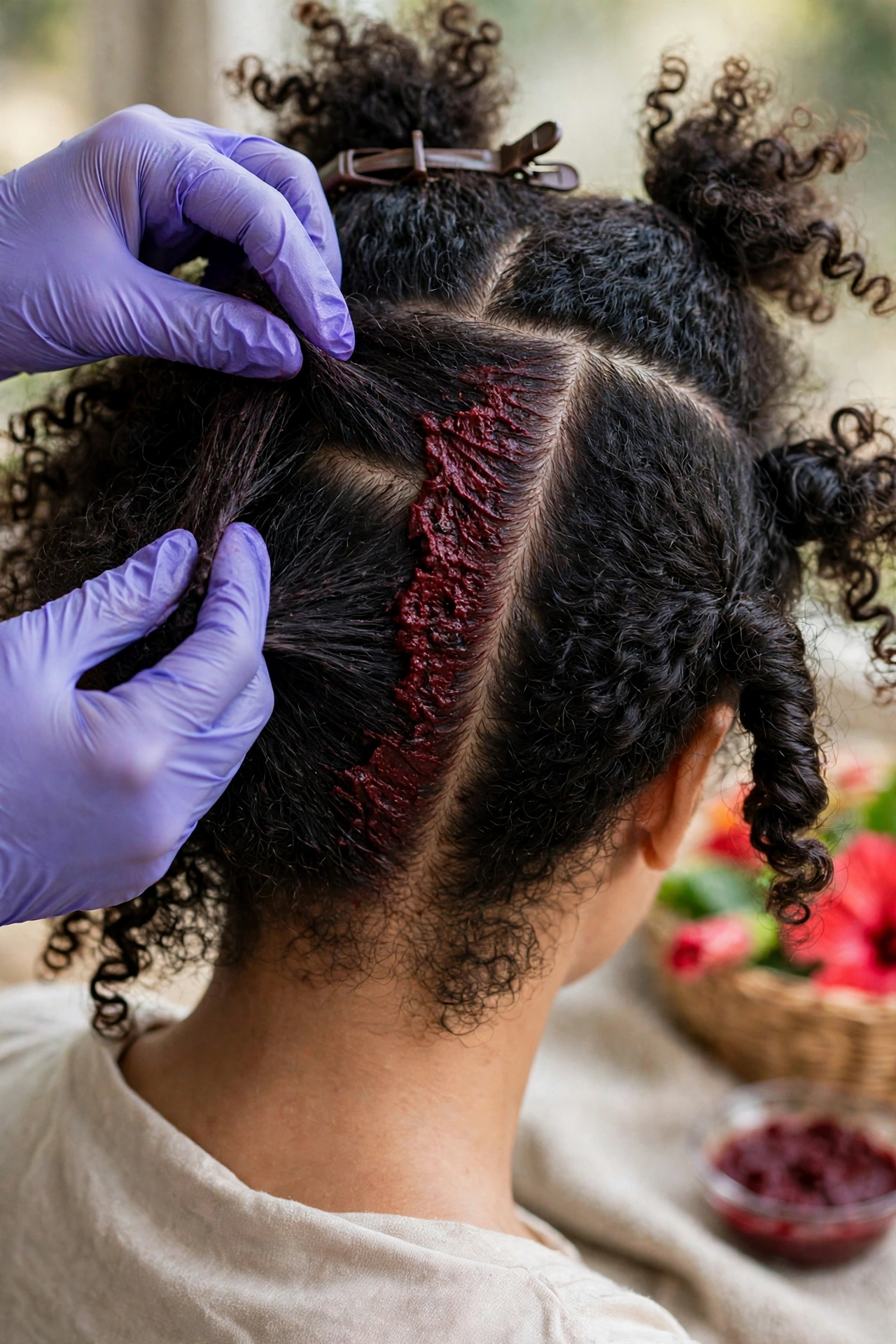
For a tint treatment: mix 4 tablespoons of powder with warm water into a thick paste, apply to clean damp hair in sections, wrap in cling film, leave 1–2 hours, then rinse. For grey blending, mix 2 parts henna to 1 part hibiscus — the hibiscus deepens henna’s red and softens its orange edge. Two honest caveats: it will not cover grey the way dye does, and light-haired users must strand-test first, because that pink tint is a surprise you want on a hidden section, not your whole head.
How often to use it: a frequency table by hair type
| Hair type | Mask / paste | Powder wash | Rinse or oil |
|---|---|---|---|
| Oily scalp, fine hair | Every 2 weeks | Weekly | Rinse weekly |
| Normal, wavy to curly (3a–3c) | Weekly or every 10 days | Every 2 weeks | Oil 1–2x/week |
| Dry, coily (4a–4c) | Every 1–2 weeks, always followed by deep conditioning | Monthly, as a clarifier | Oil 1–2x/week |
| Tint maintenance | Every 2–3 weeks, or as the red tone fades | ||
The overuse signal is dryness: hibiscus is mildly astringent, and using it too often — especially the powder wash on already-dry hair — leaves hair feeling rough rather than conditioned. If that happens, cut back frequency and always pair the treatment with a moisturizing conditioner. More is not better here.
When hibiscus powder goes wrong: the safety section sellers skip
Breathing in the dust. Fine hibiscus powder goes airborne the moment you scoop it. One European seller actually warns about this; the “100% natural and safe” blogs never do. Mix your pastes in a ventilated spot and consider a simple dust mask if you are sensitive — inhaling fine plant dust irritates airways regardless of how natural it is.
Staining everything. The same anthocyanins that tint your hair will tint your towels, your grout, and your favorite white shirt. Wear dark clothes, use dark towels, and rinse the shower immediately after. The stain on skin fades in a day; on fabric, often never.
Color-treated hair. If your hair is dyed — especially blonde, highlighted, or fashion colors — hibiscus can shift the tone. It will not strip dye, but a red-pink cast over blonde highlights is a real possibility. Strand-test, wait 48 hours, then decide.
Patch-test the paste. Hibiscus is gentle, but plant allergies are individual. A dab behind the ear 24 hours before a full application costs you nothing.
Pregnancy. Hibiscus tea is flagged in pregnancy for its traditional use as an emmenagogue; a scalp mask is not the same as drinking it, but there is no safety data for topical use in pregnancy either. Ask your doctor — that is the honest answer, and any site that gives you a firmer one is guessing.
And if you are dealing with actual dandruff rather than simple dryness — flakes plus itching and redness — see the American Academy of Dermatology’s dandruff treatment guidance rather than hoping a powder mask resolves a medical scalp condition. Hibiscus can be part of a routine; it is not a treatment for seborrheic dermatitis. (For general hibiscus safety and benefits beyond hair — where the human research actually exists, mostly around hibiscus tea — Healthline’s overview of hibiscus is a solid read.)
Frequently Asked Questions
Does hibiscus powder actually grow hair?
There is no published human trial showing hibiscus grows hair. The credible evidence is one 2003 animal study where hibiscus extracts increased hair growth in rats. Everything else — including every “regrows hair” product claim — is marketing built on that single animal finding plus tradition.
Will hibiscus powder darken or stain my hair?
It adds a warm red tint rather than darkening. On dark hair the effect is a subtle sheen in sunlight; on blonde, grey, or highlighted hair it can show as a pinkish-red tint lasting several washes. Strand-test first if your hair is light.
Leaf powder or flower powder — which is better?
The one animal study found leaf extract more potent than flower extract, but virtually all commercial powder is flower-based, and there is no human comparison. If you find a leaf-flower blend from a reputable seller, it is worth trying; do not pay a premium for “leaf is stronger” claims aimed at your wallet.
Can I use hibiscus powder on color-treated hair?
You can, but expect a possible tone shift — especially on blonde or fashion colors. It will not damage the dye or strip color, but strand-test and wait 48 hours before a full application.
How often should I use hibiscus powder?
Most hair types do well with a mask every 1–2 weeks. Oily scalps can use the powder wash weekly; dry 4c hair should keep it to every 1–2 weeks with deep conditioning after. Daily use is overkill — the mild astringency dries hair out with overuse.
Powder vs fresh flowers — which is better?
Powder wins on convenience, shelf life, and consistent potency; fresh flowers win on purity if you grow hibiscus yourself. For pastes and washes, quality powder is the practical choice. Our main hibiscus guide compares all three forms in detail.
Can I mix hibiscus powder with amla, yogurt, or coconut oil?
Yes to all three. Amla and hibiscus are the classic Ayurvedic pairing; yogurt adds slip and mild protein for dry hair; coconut oil carries it as a pre-poo. Avoid mixing it with commercial conditioners — you cannot predict the chemistry, and it wastes both products.
Does hibiscus powder help dandruff?
Its fruit acids give it mild exfoliating action, which can help with simple flaking, but there is no evidence it treats dandruff as a condition. Persistent dandruff with itching or redness needs a proper anti-dandruff approach — see a dermatologist if it does not clear.
How do I store hibiscus powder, and how long does it last?
Airtight container, cool dark cupboard, about 12 months. Brownish color, faded smell, and weak staining mean it has gone stale. Keep it dry — damp, musty-smelling powder goes in the bin.
Is hibiscus powder safe in pregnancy?
There is no safety data for topical hibiscus use in pregnancy. A scalp mask is not the same as drinking hibiscus tea, but the honest answer is: ask your doctor.
The bottom line
Hibiscus powder for hair earns its place in a natural hair routine — not because of the growth miracles on the packaging, but because it is a genuinely useful multi-tasker: a mild cleanser, a conditioning paste, a scalp exfoliant, and a natural tint, all from one cheap pouch. The trick is buying the real thing — Hibiscus rosa-sinensis, fine grind, deep red, one ingredient — storing it properly, and using it at a frequency your hair type can handle. Do that, keep your expectations where the evidence is, and it will not disappoint you. And when a seller tells you it works like minoxidil, you now know enough to smile and keep scrolling.
Disclaimer: This article is for informational purposes only and is not medical advice. The hair-growth evidence discussed comes from animal studies; no human clinical trials exist for hibiscus and hair. Patch-test new ingredients, and consult a dermatologist for persistent scalp conditions or a doctor if you are pregnant.
