Best Deep Conditioner for 4C Hair: 8 Honest Picks + Complete 4C Deep Conditioning Guide (2026)
Deep conditioning is the single most important wash-day step for 4C hair — and also the step where most people waste money. Walk into any beauty supply store and you will find dozens of jars promising “intense repair,” “miracle moisture,” and “salon results,” yet most of them were not designed with tightly coiled hair in mind. Some sit on top of 4C strands without ever penetrating. Others deliver moisture but zero strength. A few are genuinely excellent — for the right hair, at the right time, in the right amount.
This guide is a research-based roundup of the best deep conditioner options for 4C hair, built from reviewer reports from people who actually have 4C hair, ingredient analysis, and what the ranking guides got right and wrong. You will also find the parts the top-ranking articles skip: how to tell whether your hair needs moisture or protein, a step-by-step deep conditioning method for dense coils, how often to do it by porosity, the mistakes that undo your results, and what no deep conditioner can do — said plainly.
If you are still building your wash-day lineup, start with our complete guide to 4C hair products for the big picture, and see our best rinse-out conditioners for 4C hair for what to use after the mask comes out.
Quick Comparison: The 8 Best Deep Conditioners for 4C Hair
| Product | Type | Price | Best For | Porosity Match |
|---|---|---|---|---|
| SheaMoisture Manuka Honey & Mafura Oil Intensive Hydration Masque | Moisture | $12–14 | Overall best for dry 4C hair | All, especially high |
| TGIN Honey Miracle Hair Mask | Moisture | $15–18 | High-porosity rescue sessions | High porosity |
| Mielle Babassu Oil & Mint Deep Conditioner | Balanced | $10–13 | Weekly safe choice, unsure what you need | All |
| Camille Rose Algae Renew Deep Conditioning Mask | Light moisture | $18–22 | Low-porosity 4C that rejects heavy masks | Low to normal |
| Briogeo Don’t Despair, Repair! Deep Conditioning Mask | Protein + moisture | $36–40 | Heat or chemical damage | All (use sparingly) |
| As I Am Hydration Elation Intensive Conditioner | Moisture | $11–14 | Extreme dryness, winter wash days | Normal to high |
| Aunt Jackie’s Fix My Hair Intensive Repair Conditioning Masque | Protein | $8–10 | Budget strengthening, breakage | All (protein cycles) |
| SheaMoisture Raw Shea Butter Deep Treatment Masque | Moisture | $11–13 | Budget pick for thick, coarse 4C | Normal to high |
A note on honesty: we did not lock ourselves in a lab and “test 20 masks.” Nobody outside a cosmetics lab can run a controlled trial on hair products at home. These picks come from ingredient-label analysis and — more importantly — consistent reports from reviewers with 4C hair across hundreds of reviews: what kept working after months, what caused buildup, what flaked, what actually softened dense coils. Where a product has a real downside, you will read it here.
Moisture or Protein? Figure Out What Your 4C Hair Needs First
Buying a deep conditioner before answering this question is how money gets wasted. Hair is built from keratin protein, and healthy hair keeps protein (strength) and moisture (elasticity) in balance. The American Academy of Dermatology’s guidance on caring for Black hair emphasizes gentle handling and adequate conditioning — and choosing the right kind of conditioner starts with reading your hair’s signals.
Signs your 4C hair needs moisture
- Hair feels dry, rough, or straw-like even right after conditioning
- Strands snap quickly when gently stretched, with little bounce-back
- Frizz and puffiness return within hours of styling
- Coils look dull and feel stiff rather than soft and pliable
What to do: use a moisture-focused mask (most of this list). Hold off on protein until flexibility returns.
Signs your 4C hair needs protein
- Hair feels mushy, gummy, or overly soft when wet
- Strands stretch far without snapping back
- Coils look limp with weak definition; breakage at the mid-shaft
- Recent color, relaxer, texturizer, or frequent heat styling
What to do: use a protein or protein-plus-moisture mask, then follow with a light moisture conditioner so you do not overcorrect. Our guide to protein treatments for natural hair covers the stronger options in detail.
If you are unsure, start with a balanced formula like the Mielle Babassu below — it is the safest weekly default. And if you do not know your porosity yet, take our natural hair porosity test first; it changes everything about how you deep condition.
The 8 Best Deep Conditioners for 4C Hair (2026)
1. SheaMoisture Manuka Honey & Mafura Oil Intensive Hydration Masque — Best Overall
Type: Moisture | Price: ~$12–14 for 12 oz | Key ingredients: manuka honey, mafura oil, shea butter
Manuka honey is a humectant — it draws moisture toward the hair — while mafura oil and shea butter seal it in. This is the mask that reviewers with 4C hair mention most consistently for turning crunchy, dehydrated wash-day hair soft for several days, not just a few hours. The texture is thick but workable, so it spreads through dense coils without the tugging thinner conditioners cause.
Honest limitation: this is a pure moisture treatment with no meaningful protein. If your hair is mushy and over-moisturized, this will not fix it. Reviewers with fine strands also note it can feel heavy if you use too much — a little goes further than you think.
Best for: dry, dehydrated 4C hair of any porosity; protein-sensitive hair. Skip if: you need strengthening — pair a protein treatment first, then use this for moisture.
2. TGIN Honey Miracle Hair Mask — Best for High-Porosity 4C Hair
Type: Moisture | Price: ~$15–18 for 12 oz | Key ingredients: raw honey, olive oil, jojoba oil
Raw honey and olive oil are one of the oldest pairings in textured-hair care, and reviewers with high-porosity 4C hair consistently call this the mask that “melts tangles.” It clumps coils on contact, rinses clean without the coated feeling cheaper masks leave, and the softness lasts for days — a common complaint about other masks is that the softness vanishes by morning.
Honest limitation: the honey base can feel slightly tacky if you rush the rinse; spend a full two to three minutes rinsing. It is rich enough that low-porosity hair may prefer it every other week rather than weekly.
Best for: high-porosity, dry, brittle 4C hair; monthly “rescue” sessions after inconsistent routines. Skip if: your hair is fine and low-porosity and you deep condition weekly — it may be too much of a good thing.
3. Mielle Babassu Oil & Mint Deep Conditioner — Best Balanced Weekly Pick
Type: Balanced moisture + light protein | Price: ~$10–13 for 8 oz | Key ingredients: babassu oil, amino acids, peppermint
Babassu oil penetrates the hair shaft similarly to coconut oil but with less of the protein-mimicking behavior that makes some protein-sensitive hair feel stiff. Combined with amino acids (the building blocks of keratin), this sits in the middle: enough moisture for regular use, enough strengthening to maintain elasticity. Reviewers who are not sure whether their hair needs moisture or protein use this as the safe default — and it rarely disappoints.
Honest limitation: because it is balanced, it is not the strongest at either job. For extreme dryness, a dedicated moisture mask wins; for real damage, a dedicated protein treatment wins. The mint tingle is pleasant for most but can irritate a sensitive scalp.
Best for: weekly deep conditioning when you are unsure what your hair needs; all porosity levels. Skip if: you are dealing with a crisis (severe dryness or real damage) — go dedicated, not balanced.
4. Camille Rose Algae Renew Deep Conditioning Mask — Best Lightweight Option for Low-Porosity 4C
Type: Light moisture | Price: ~$18–22 for 8 oz | Key ingredients: blue-green algae, mango butter, aloe vera, jojoba oil
Low-porosity 4C hair rejects thick, heavy masks — they sit on the surface and rinse off having done nothing. This algae-based formula is the answer reviewers with low-porosity hair keep returning to: blue-green algae delivers vitamins, minerals, and amino acids without the heaviness of traditional butters, while mango butter and aloe provide moisture that actually absorbs. It also rinses cleanly enough for shorter 4C styles.
Honest limitation: if your 4C hair is extremely thick, coarse, and high-porosity, this may feel too light as your primary mask — use it on lighter weeks and a richer mask for heavy sessions. The price per ounce is on the higher side.
Best for: low-porosity 4C hair; anyone whose hair “hates” thick masks; shorter styles. Skip if: you need maximum richness for very coarse, dry, high-porosity hair.
5. Briogeo Don’t Despair, Repair! Deep Conditioning Mask — Best for Damaged 4C Hair
Type: Protein + moisture | Price: ~$36–40 for 8 oz | Key ingredients: keratin protein, biotin, rosehip oil, algae extract
This is the premium pick, and the only one on this list aimed squarely at damage: relaxers, texturizers, color, or heat styling that has left 4C hair limp, mushy, or breaking at the mid-shaft. The keratin and biotin rebuild strength while the oils keep the formula from turning hair stiff — a real risk with protein-heavy products. Reviewers transitioning from relaxers report it restoring elasticity over a few sessions.
Honest limitation: the price is steep, and for healthy natural 4C hair it is simply unnecessary — using it “just because” risks protein overload, which makes hair stiff and brittle. This is a repair tool, not a weekly habit; every 3–6 weeks is plenty for most.
Best for: chemically treated or heat-damaged 4C hair; transitioning hair. Skip if: your natural 4C hair is healthy — you need moisture, not a $40 repair mask.
6. As I Am Hydration Elation Intensive Conditioner — Best for Extreme Dryness
Type: Moisture | Price: ~$11–14 | Key ingredients: sugar beet extract, phytosterols, green tea extract
Formulated for hair that regular conditioners cannot fix. Sugar beet extract is a natural humectant; phytosterols are plant-derived lipids that mimic the lipids in healthy hair. Reviewers in dry winter climates call this their cold-weather rescue: applied thick and left under a heat cap for 30 minutes, it rehydrates hair that central heating has turned to straw.
Honest limitation: it works best with heat — without a cap or steamer, results are merely good rather than great. The formula is rich, so fine low-porosity hair should use it sparingly.
Best for: extremely dry 4C hair, winter wash days, dry climates. Skip if: you never use heat with your treatments — you will not get the full benefit.
7. Aunt Jackie’s Fix My Hair Intensive Repair Conditioning Masque — Best Budget Protein
Type: Protein | Price: ~$8–10 | Key ingredients: hydrolyzed keratin and conditioning agents
The most affordable way to give 4C hair real strengthening. Reviewers with breakage-prone hair use this on protein weeks and report less mid-shaft snapping without the stiffness some protein treatments cause. At this price, there is no excuse for skipping the protein side of the balance.
Honest limitation: this is a light-to-medium protein treatment, not a salon-grade reconstructor — severely damaged hair may need something stronger (see Briogeo above or our protein treatment guide). Always follow with moisture; protein without it is how stiffness happens.
Best for: breakage-prone 4C hair on a budget; alternating protein weeks. Skip if: your hair is already protein-sensitive or stiff — you need moisture, not this.
8. SheaMoisture Raw Shea Butter Deep Treatment Masque — Best Budget Moisture for Thick 4C
Type: Moisture | Price: ~$11–13 for 12 oz | Key ingredients: raw shea butter, argan oil, sea kelp
Thick, rich, and unapologetically heavy — which is exactly what very coarse, dense 4C hair needs. Reviewers with thick textures praise how it coats every coil and delivers lasting softness at a drugstore-friendly price. If the Manuka Honey masque is the refined pick, this is the workhorse.
Honest limitation: it is heavy. Fine or low-porosity 4C hair will likely find it too much and end up with buildup. The richness that thick hair loves is the same richness that weighs down finer strands.
Best for: thick, coarse 4C hair on a budget. Skip if: your hair is fine or low-porosity — choose the Camille Rose or Mielle instead.
How to Deep Condition 4C Hair: The Right Method
A great mask applied badly gives mediocre results. Dense 4C coils need a method, not just a product:
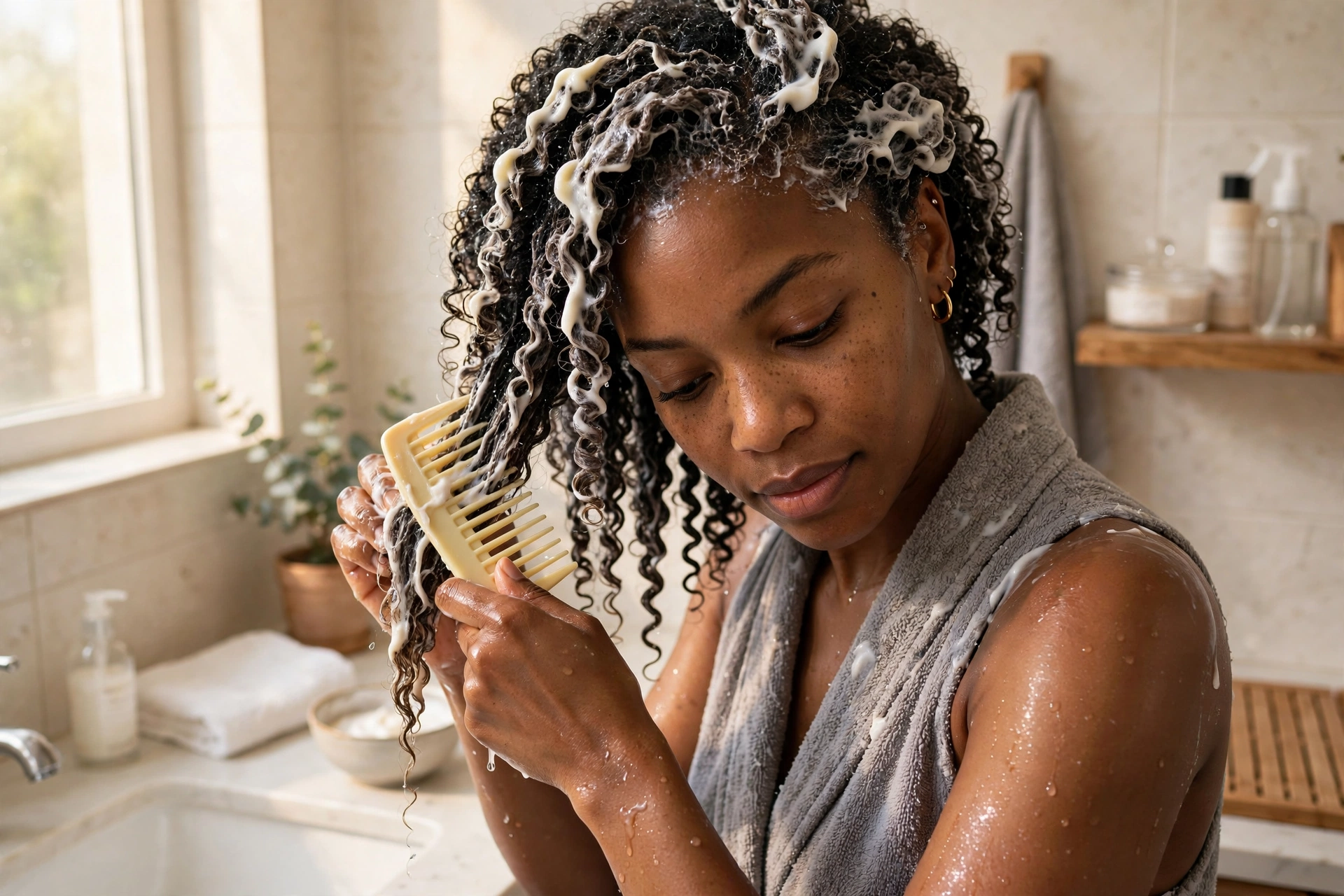
- Start with clean, damp hair. Deep conditioner cannot penetrate through a layer of gel, oil, and product buildup. Shampoo first with a sulfate-free shampoo; if you have heavy buildup, clarify before the mask. This is the step most people skip — and the reason most “this mask did nothing” complaints exist.
- Section your hair into 4–6 parts. Working in sections is non-negotiable for 4C hair. It guarantees every coil gets product and turns detangling from a battle into a process.
- Apply generously from mid-shaft to ends. The ends are the oldest, driest part of your hair and need the most product. Use a lighter hand near the roots, where buildup causes flakes and itch.
- Detangle with the mask in. This is the secret the ranking articles barely mention: a deep conditioner with good slip is also your detangling session. Work through each section with your fingers first, then a wide-tooth comb, starting from the ends. Our guide to detangling 4C hair without breakage covers the technique in full.
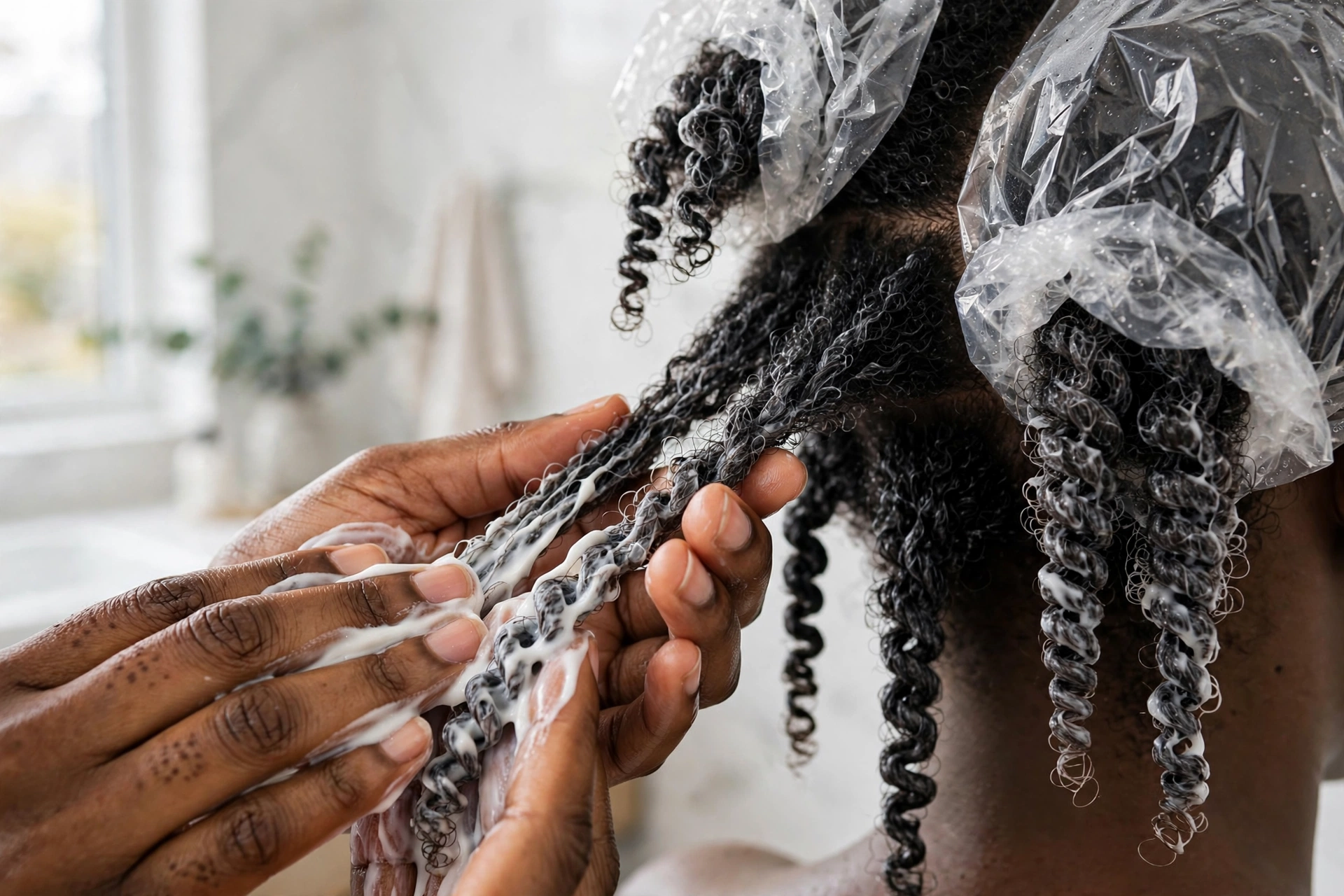
- Add heat — it matters more than the brand. Cover with a plastic cap (a shower cap works) and add gentle heat for 15–20 minutes: a hooded dryer on low, a heat cap, or even a warm towel. Heat gently lifts the cuticle so moisture can enter — this makes a bigger difference than upgrading to a pricier mask, especially for low-porosity hair. Healthline’s guide to low porosity hair care explains how steamers, heat caps, and hooded dryers help treatments penetrate resistant cuticles. No heat source? A plastic cap alone still traps body heat and helps.
- Rinse thoroughly with cool to lukewarm water. Two to three full minutes. Residue left behind becomes buildup, itch, and flakes by mid-week — particularly with honey-based masks.
- Follow with a leave-in. Deep conditioning opens the door; a leave-in keeps it open. Apply your leave-in to damp hair right after rinsing, then seal with an oil or cream if your routine calls for it. See our rinse-out conditioner picks for what pairs well after masking.
For a broader routine framework, our best deep conditioners for natural hair roundup covers how masking fits alongside the rest of wash day.
How Often Should You Deep Condition 4C Hair?
There is no single right answer — it depends on your hair’s condition. Use this as a starting point and adjust by how your hair feels:
| Your situation | How often | What type |
|---|---|---|
| Healthy natural 4C, normal porosity | Every 1–2 weeks | Moisture mask; protein every 6–8 weeks |
| Low-porosity 4C | Every 1–2 weeks with heat | Lightweight moisture; skip heavy butters |
| High-porosity 4C | Weekly | Rich moisture; protein every 4–6 weeks |
| Color-treated or relaxed 4C | Weekly | Moisture weekly; protein every 3–4 weeks |
| Heat-damaged 4C | Weekly with a heat cap | Protein + moisture; protein every 2–3 weeks until recovered |
| 4C hair in locs | Every 2–3 weeks | Light, thoroughly-rinsed moisture (avoid heavy residue) |
| Dry winter / dry climate | Weekly | Extra-rich moisture mask with heat |
The honest test: if your hair feels great for days after masking, your schedule is right. If it is dry again by day two, mask more often or switch to a richer formula. If it feels coated, limp, or mushy, you are overdoing it — or using the wrong type.
DIY Deep Conditioner for 4C Hair (When You Want to Go Natural)
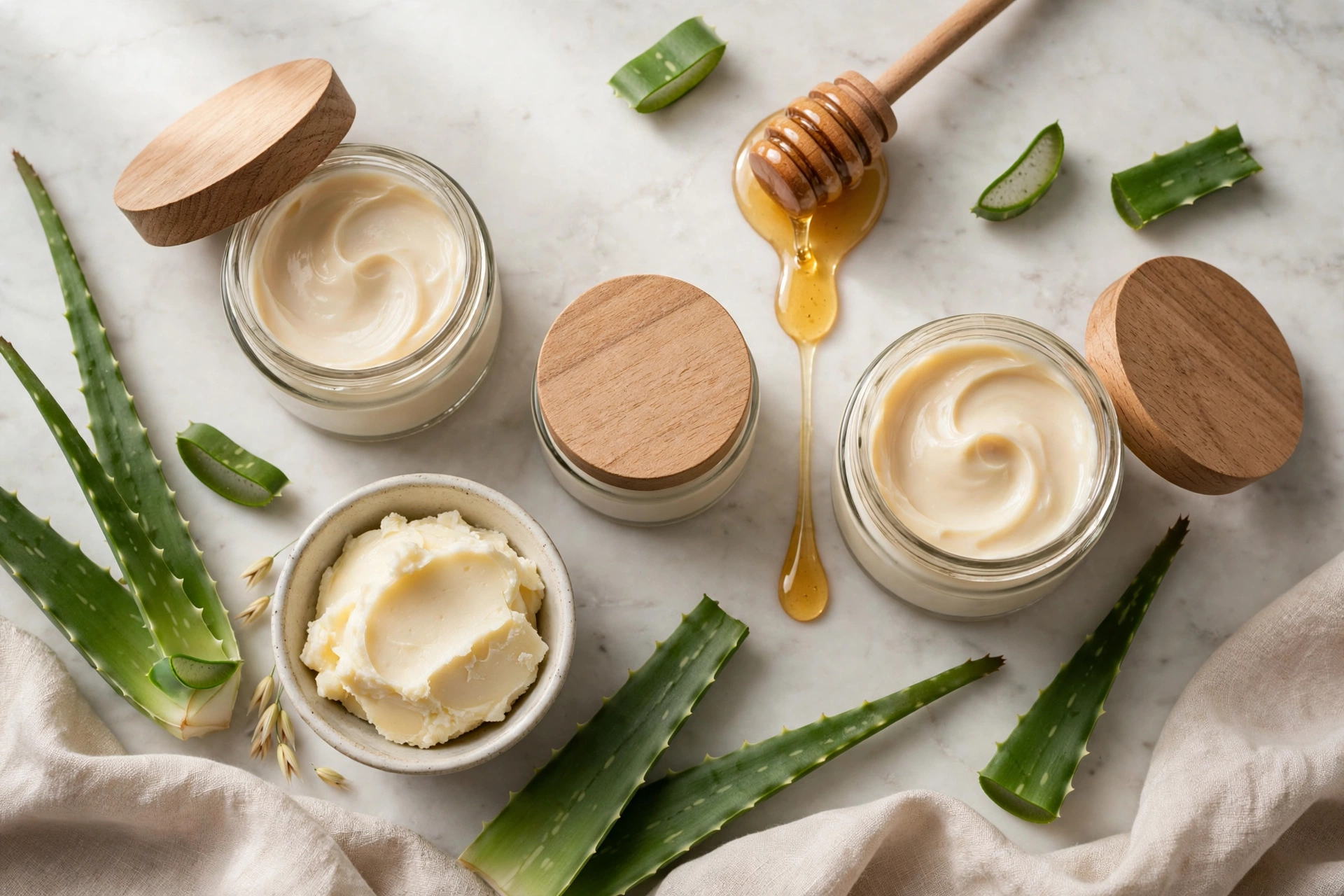
Prefer to mix your own? This simple recipe covers the basics — a humectant, a penetrating oil, and a rich butter:
- ½ ripe avocado, mashed completely smooth (lumps are the enemy — they get stuck in coils)
- 2 tablespoons raw honey
- 2 tablespoons olive oil or melted shea butter
- Optional: 1 tablespoon aloe vera gel for extra slip
Blend until completely smooth, apply to clean damp hair in sections, cover with a cap for 20–30 minutes, and rinse very thoroughly. Use it fresh the same day — homemade mixes have no preservatives.
The honest caveat: DIY masks are pleasant and moisturizing, but they cannot match commercial formulas for consistency, preservation, or targeted ingredients like hydrolyzed proteins (whose molecules are small enough to actually reinforce the hair shaft). Think of DIY as a nice supplement, not a replacement — especially if your hair needs protein.
7 Mistakes That Ruin Your Deep Conditioning Results
- Masking dirty hair. Product buildup blocks absorption. Shampoo first, always.
- Skipping sections. Applying one glob to unsectioned 4C hair means the canopy gets everything and the underneath gets nothing.
- Leaving it on for hours “for extra moisture.” After 30–45 minutes with heat, you have gotten nearly all the benefit. Overnight masking mostly risks hygral fatigue (repeated swelling and shrinking that weakens hair) and scalp irritation — not deeper conditioning.
- Using protein every week. Protein is medicine, not food. Weekly protein on healthy hair leads to stiffness and breakage — the opposite of what you wanted.
- Applying heavily to the scalp. Deep conditioners are for the hair shaft, especially the ends. Scalp application causes buildup, itch, and flakes.
- Rinsing too fast. A 30-second rinse leaves residue. Give it minutes, not seconds.
- Skipping the leave-in after. The mask’s job ends at the rinse. Without a leave-in to hold the moisture in, much of the benefit evaporates within a day.
What Deep Conditioners Honestly Can’t Do
No ranking article wants to print this section, but it is the most useful one here:
- They cannot repair split ends. Once a strand splits, no mask fuses it back. Trimming is the only fix; conditioning only prevents the next split.
- They cannot permanently change your porosity. Low-porosity hair stays low-porosity. Masks manage it; they do not transform it.
- They cannot make hair grow faster. Growth happens at the scalp. What deep conditioning does is reduce breakage, so you retain more length — which looks like faster growth but is not the same thing.
- They cannot undo chemical damage alone. Relaxer or bleach damage needs consistent protein-moisture cycling and trims over months, not one miracle mask.
- More expensive does not mean more effective. Several $10–$14 masks on this list outperform $40 ones for plain moisture needs. Pay for the right type, not the price tag.
A peer-reviewed review of hair cosmetics in the International Journal of Trichology is worth a look if you want the science behind what conditioning agents actually do to the hair shaft — and their limits.
Frequently Asked Questions
Can I use a regular conditioner as a deep conditioner?
To a point. Leaving a rinse-out conditioner on longer with a cap gives you a light treatment, but deep conditioners and masks contain higher concentrations of conditioning agents, butters, and oils designed for extended contact. For 4C hair — which needs the most intensive conditioning of any texture — a dedicated mask is worth it.
Should I deep condition on dry or wet hair?
On clean, damp hair. Water helps the product distribute and the cuticle is already slightly raised from washing, which improves absorption. Masking dry, dirty hair is one of the most common reasons people conclude “deep conditioning doesn’t work for me.”
Is heat really necessary when deep conditioning 4C hair?
Not strictly — but it is the highest-impact upgrade you can make, especially for low-porosity hair. Fifteen minutes under a $15 heat cap routinely beats switching to a pricier mask. At minimum, use a plastic shower cap to trap your body heat.
Can I deep condition 4C hair every week?
Yes, if you are using a moisture mask and your hair likes it. Weekly deep conditioning is standard for high-porosity and very dry 4C hair. Just keep protein treatments on their own slower schedule, and watch for signs of over-conditioning (mushy, limp hair).
Why does my hair feel dry again a day after deep conditioning?
Three usual suspects: you masked over buildup (shampoo first), you skipped heat (especially with low-porosity hair), or you did not follow with a leave-in to seal the moisture in. Fix those before blaming the product.
Do I need a different deep conditioner in winter?
Often, yes. Cold air and indoor heating pull moisture out of 4C hair aggressively. Many people switch to their richest mask (like the As I Am or SheaMoisture Manuka Honey above) and add a heat cap for winter wash days, then return to lighter options in humid months.
Are these deep conditioners safe for kids’ 4C hair?
Most moisture masks on this list use gentle, well-established ingredients, but children’s scalps are more sensitive — skip anything with strong fragrance or tingling agents (like heavy mint), patch-test first, and keep it simple. When in doubt, ask your pediatrician or dermatologist.
Can deep conditioning help with 4C breakage?
It helps prevent it, which is the part that matters. Breakage in 4C hair is overwhelmingly a moisture-elasticity problem: dry coils snap where moisturized coils stretch. Consistent deep conditioning plus gentle detangling (see our detangling guide) addresses the two biggest breakage drivers. If breakage is severe and sudden, see a dermatologist — it can have medical causes.
The Final Verdict
For most 4C hair, the SheaMoisture Manuka Honey & Mafura Oil Masque is the best starting point: affordable, widely available, and consistently praised by reviewers with 4C hair for lasting moisture. If your hair is high-porosity and chronically dry, the TGIN Honey Miracle is the rescue pick. If you never know what your hair needs week to week, the Mielle Babassu is the safe balanced default. And if your hair is damaged, stop buying moisture masks and get the protein your hair is actually asking for.
But here is the honest bottom line the ranking sites will not give you: the mask matters less than the method. Clean hair, sections, detangling with the product in, heat, a thorough rinse, and a leave-in afterward — do that consistently with any decent mask on this list and your 4C hair will change. Skip the method and even the best mask on earth will disappoint you.
Disclaimer: This article is for informational purposes only and is based on ingredient analysis and aggregated reviewer reports, not clinical testing. Everyone’s hair responds differently — patch-test new products, and consult a dermatologist or trichologist for persistent hair loss, scalp pain, or sudden breakage.