Humectants for Natural Hair: Which One Actually Works for You?
 Maya Thompson
📅 October 23, 2026
⏱ 15 min read
Humectants are moisture magnets: molecules that grab water and hold it against your hair. Glycerin, honey, aloe vera, and hyaluronic acid all work this way. They are some of the most useful ingredients in natural hair care — and some of the most weather-dependent. Use them with the air on your side and they’re brilliant. Use them against it and the same molecule dries your hair out. This guide covers the mechanism honestly, puts the four main natural humectants head to head, and gives you the climate rules nobody teaches: what to use, when to skip it, and what to layer on top. No hype, no lab-coat cosplay, no fake testing claims — just what the chemistry and experienced reviewers consistently report.
What a Humectant Actually Does — and Why Weather Decides Everything
A humectant is a water-loving molecule. Its structure carries groups that form hydrogen bonds with water, so it pulls moisture toward itself and holds it there — this is the mechanism dermatology reviews describe for glycerin and its cousins, and the same chemistry applies on hair. But here is the part that changes everything: a humectant doesn’t create moisture. It moves moisture along a gradient, from wherever water is plentiful to wherever it isn’t.
On a humid day, the air holds more water than your hair does, so a humectant pulls moisture from the air into your hair. On a dry day — heated indoor air in winter, desert climates, a high-altitude hotel room — the situation flips. Now your hair holds more water than the air, and the same humectant sitting on your strands can pull moisture out of your hair and into the air. Dermatology sources say the same thing about skin: humectants draw from the environment in humidity and can have a drying effect when the air is dry (see dermatology literature). Your hair is no exception.
So the honest rule of thumb: humectants perform best in moderate humidity, roughly the middle band of most weather apps, and become unreliable at both extremes. In very dry air, always pair a humectant with a sealant on top — an oil or butter that physically blocks evaporation — or skip the humectant-heavy product that day. In very humid air, humectants keep working, but high-porosity hair can absorb so much water it swells, frizzes, and stretches past its happy place (more on the protein-balance fix later). The weather app on your phone is genuinely one of the best humectant guides you’ll find, and a later section of this article turns it into a decision chart.
Humectant vs Emollient vs Occlusive: The Three Jobs Nobody Explains for Hair
Most “humectant” articles stop at “moisture magnets” and move on. But half the confusion around these ingredients comes from mixing up three different jobs your hair products do:
Humectants attract and hold water. Glycerin, honey, aloe vera, hyaluronic acid, panthenol, sorbitol, propylene glycol, sodium PCA. They bring moisture to the hair.
Emollients fill in the rough, lifted edges of the cuticle so the strand feels smooth. Many plant oils and fatty alcohols do this job — they make hair feel soft and slippery, but they don’t add water.
Occlusives (sealants) form a film that physically blocks water from escaping. Heavy butters and waxes live here — shea butter, beeswax, mineral oil. They lock in whatever moisture is already there, but they contribute no water of their own.
This is worth nailing down because a surprisingly common mistake — you’ll see it in roundup articles and on ingredient graphics — is listing shea butter, coconut oil, or beeswax as “humectants.” They are not. They are occlusives, and calling them humectants teaches the wrong layering logic. The correct order for hair is fixed and simple: humectant first (water’s entrance), emollient second (smooth the surface), occlusive last (lock the door). That’s the entire logic of the LOC and LCO methods, by the way — liquid (water + humectant), oil/cream, seal — and understanding why the order matters lets you improvise instead of memorizing acronyms.
A quick diagnostic, because your hair will tell you which job is missing: hair that feels tight and straw-like right after wetting is thirsty — it needs the humectant step. Hair that’s hydrated but rough and snaggy needs an emollient. Hair that feels good at noon and crispy by evening needs an occlusive to hold what you gave it. Porosity changes which of these you lean on hardest, and we’ll get to that in the decision chart.
The Four Humectants for Natural Hair, Head to Head
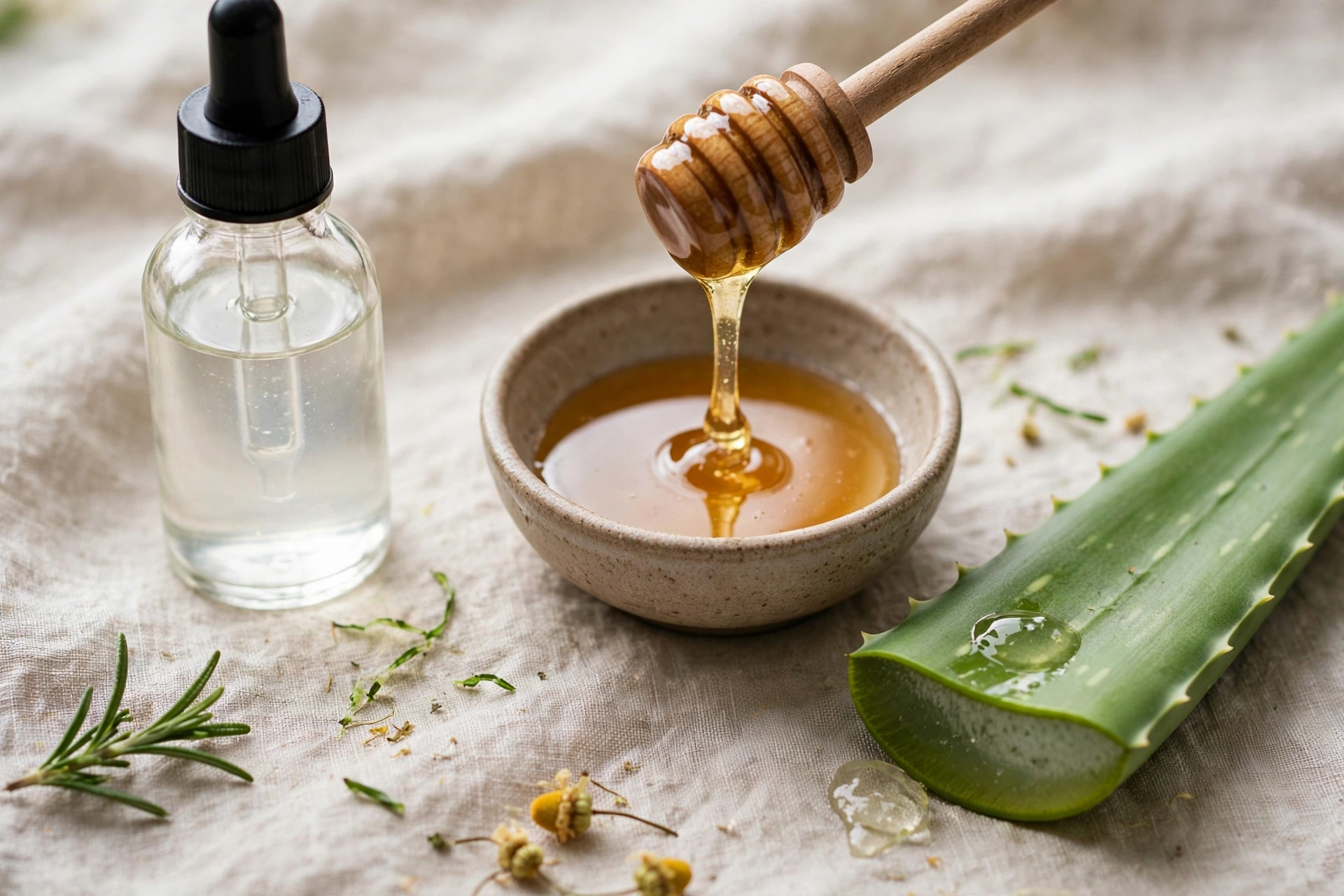
These are the four humectants that dominate natural-hair routines. Each has a real strength and a real failure mode, and the honest reviews from people with natural hair are remarkably consistent about what those are.
| Humectant | Strength | Stickiness / buildup risk | Best porosity | Best climate | Main watch-out |
|---|---|---|---|---|---|
| Glycerin | Strongest of the four, cheapest | High if used undiluted or in dry air | All, with care on low porosity | Humid to moderate | Sticky film on low-porosity hair; can backfire in dry air |
| Honey | Moderate humectant + mild antibacterial reputation | Medium — must be dissolved, never used straight | Medium to high | Moderate | Attracts frizz in very humid air; hard to rinse if overused |
| Aloe vera | Gentle humectant + scalp-soothing | Low | All — friendliest to low porosity | All climates | Store-bought gels often contain more additives than aloe |
| Hyaluronic acid | Exceptional water-holding capacity per gram | Low | All, best with damp hair + sealant | Moderate to humid | Most expensive; useless on dry hair without sealing |
Glycerin: the workhorse that punishes sloppy use
Glycerin (listed as glycerin or glycerol) is the most effective and cheapest humectant in the group, which is why it shows up everywhere — and why it also generates the most complaints. Used right, it’s superb. The rule experienced users converge on: always dilute, always on damp hair, always sealed. A commonly cited DIY ratio is roughly four parts water to one part vegetable glycerin in a spray bottle, applied to damp — not dry — hair, then sealed with an oil or butter. At that dilution it behaves. Used straight from the bottle, it can feel tacky for hours.
The low-porosity failure mode is specific and worth describing plainly: on tightly closed cuticles, undiluted glycerin doesn’t penetrate — it sits on the surface as a sticky film that can leave a whitish residue as it dries and attracts lint and dust. If that has happened to you, the fix is dilution, not abandonment. Glycerin on damp low-porosity hair, in moderate humidity, sealed afterward, works fine.
One label distinction worth knowing: glycerin has a synthetic cousin, propylene glycol, which you’ll see in the same ingredient lists. Both are humectants. Propylene glycol is a thinner liquid that some people find less sticky, but it’s also the one more likely to irritate sensitive scalps — if a product with it itches or stings, glycerin-based formulas are usually the safer swap. The gentler plant-derived alternative you’ll see marketed now is propanediol (often from corn), which behaves similarly to propylene glycol with a better tolerance reputation.
Honey: the humectant you have to dissolve
Honey is a legitimate humectant — WebMD’s humectant ingredient lists include it alongside glycerin and hyaluronic acid — and it carries a mild antibacterial reputation that makes it popular in scalp masks. The mistake is treating it like a leave-in. Straight honey on hair is a sticky situation in the literal sense: hard to distribute, hard to rinse, and in very humid weather it can keep pulling moisture until frizz takes over.
Used as a wash-out ingredient, it’s excellent. The practical formula people keep returning to: one to two tablespoons of raw honey dissolved in warm water, or mixed into a deep conditioner as a boost, left on for 15–30 minutes and rinsed thoroughly. Dissolving matters — undissolved honey clumps and never rinses clean. Think of honey as a treatment ingredient, not a styling one.
Aloe vera: the gentle one
Aloe is the mildest humectant of the four and the friendliest to low-porosity hair, because it absorbs without the tacky residue glycerin can leave. It’s also the one most often ruined by the product it’s sold in: many “aloe gels” are mostly water, thickeners, preservatives, and dye with aloe far down the ingredient list. If you want the humectant effect, look for aloe barbadensis leaf juice in the first few ingredients — or use fresh leaf, where the gel is unambiguously the main event. For the full breakdown of fresh leaf versus store-bought, including purity red flags, our aloe vera gel guide covers it in detail.
Hyaluronic acid: the expensive overachiever
Hyaluronic acid can hold an enormous amount of water relative to its weight, which is why it’s the star of expensive serums. On hair, though, its power comes with a strict condition: it must be applied to damp hair and sealed. On dry hair in dry air, a hyaluronic acid serum has nothing to pull from except your strands — the backfire scenario, at premium prices. It’s the best choice when you want maximum hydration with minimum weight and residue, and the worst value when used carelessly. Our hyaluronic acid deep dive covers the molecular-weight details and the humid-climate nuances if you want to go further.

Your Weather App Is a Humectant Guide
Here is the decision chart the top-ranking articles gesture at but never quite deliver. Check your phone’s humidity reading, find your row, and adjust:
| Humidity | What the air is doing | Humectant strategy |
|---|---|---|
| Below ~30% | Dry air; humectants can pull moisture out of hair | Skip humectant-heavy leave-ins, or use them only under a real sealant (butter/oil). Anti-humectant styling products earn their keep here. |
| ~30–60% | The sweet spot | Humectants at full strength. Glycerin mists, honey masks, aloe — everything works as intended. This is humectant season. |
| Above ~60–70% | Air is wetter than your hair | Humectants keep pulling moisture in. Low-porosity hair usually loves this. High-porosity hair may swell, frizz, and lose definition — ease off humectants, lean on protein and sealants. |
Now cross that with porosity, because the same humidity hits different hair differently:
- Low porosity + dry air: the hardest combination. Humectants sit on the surface, so dilute well, apply to damp hair, and always seal. This is where the “glycerin ruined my hair” stories come from.
- Low porosity + humid air: the easiest win. Moisture is abundant and your cuticles let it in slowly — humectants shine here with minimal effort.
- High porosity + dry air: humectants help, but sealants matter more. Your cuticles leak; a humectant without an occlusive on top is water poured into a sieve.
- High porosity + humid air: the frizz danger zone. Too much humectant plus abundant moisture can over-soften hair into mushiness — cut back humectants, bring protein forward.
Seasonal swaps follow naturally. A winter routine in a heated home leans on cream leave-ins, heavier sealants, and humectants used sparingly under occlusion. A summer routine in humidity leans on lighter humectant layers, more frequent clarifying, and protein treatments to balance the moisture load. Nobody needs to buy a “summer line” and a “winter line” — you need the same ingredients in different proportions, and now you know the dial to turn. Our moisturizing guide lays out the full routine framework these swaps slot into.
The Protein Balance Nobody Connects to Humectants
Here is the downstream consequence of getting the climate chart wrong: hair that is over-moisturized. When high humidity plus generous humectant use pushes too much water into the strand, hair becomes overly soft, stretchy, and limp — it loses its spring and breaks from being too elastic rather than too dry. Stylists call the chronic version hygral fatigue: repeated swelling and contracting of the hair shaft as it takes up and loses water, which stresses the cuticle over time.
The fix is not to fear moisture — it’s balance. Protein treatments give the strand structure that excessive moisture softens away. If your hair feels mushy when wet and stretches like gum before snapping, that’s a protein call, not a moisture call. If it snaps immediately with no stretch, that’s a moisture call. The humectant-heavy summer routine and the protein treatment exist in a seesaw relationship: when one side of the year pushes moisture up, protein comes up to meet it.
Reading a Label: The Humectant INCI Names
Marketing names lie; ingredient lists don’t. When you’re deciding whether a product is actually humectant-powered, scan the first five to eight ingredients for these names — position matters, since anything past the midpoint of a long list is present in trace amounts:
- Glycerin / glycerol — the classic; strong humectant, low cost
- Honey / honey extract / mel — genuine humectant; best in rinse-out formulas
- Aloe barbadensis leaf juice — gentle humectant; watch how far down the list it sits
- Sodium hyaluronate / hyaluronic acid — the premium humectant
- Panthenol (pro-vitamin B5) — mild humectant plus a smoothing reputation
- Sorbitol — sugar-alcohol humectant, gentle and effective
- Propylene glycol / propanediol / butylene glycol — synthetic humectants; effective, occasionally irritating for sensitive scalps
- Sodium PCA — part of skin’s natural moisturizing factor; mild humectant
- Urea — strong humectant at low concentrations; in hair products usually a supporting player
And the counter-list — ingredients routinely mislabeled as humectants that are actually occlusives or emollients: shea butter, cocoa butter, coconut oil, castor oil, beeswax, mineral oil, petrolatum, dimethicone. These are fine ingredients; they’re just doing a different job. A product built entirely on this list with no humectant in sight is a sealant, not a moisturizer, no matter what the front label claims.
Frequently Asked Questions
Is shea butter a humectant?
No — and this is the single most common mislabeling in natural-hair content. Shea butter is an occlusive: it seals in moisture that’s already there but adds no water itself. It’s excellent as the last step of a routine (the “lock the door” layer), but if your hair is dry underneath it, shea butter alone won’t fix that. You need the humectant step first.
Can I use glycerin on dry hair, or does it have to be damp?
Damp, always. Glycerin needs a water source to do its job — on damp hair it pulls from the water you just applied plus the air. On dry hair in dry air, its only water source is your strands. The 30-second version: mist with water first, apply the glycerin product, seal with oil. Dry-hair glycerin application is where most “glycerin dried out my hair” stories start.
Do humectants cause buildup on natural hair?
True humectants rinse out with water — they don’t accumulate the way silicones or heavy waxes do. What people call “glycerin buildup” is usually one of three things: undiluted glycerin left as a sticky film, a product whose other ingredients (waxes, butters) built up while the humectant took the blame, or hard-water minerals interacting with product residue. If your hair feels coated, clarify and dilute — don’t fear the humectant itself.
Is honey too sticky to use on hair?
Straight, yes — which is why nobody with sense uses it straight. Dissolved in warm water or mixed into a conditioner, honey distributes evenly and rinses clean. The stickiness complaint almost always traces back to skipping the dissolving step or using too much. One to two tablespoons per treatment is plenty.
Are humectants good for low-porosity hair?
Yes, with technique. Low-porosity hair’s closed cuticles resist absorption, so the rules are: dilute (especially glycerin), apply to damp hair, and consider lighter humectants like aloe first. In humid weather, low-porosity hair and humectants are a genuinely great pairing. The failures come from undiluted products on dry hair, not from humectants as a category.
Should I skip humectants in winter?
Not necessarily — but change how you use them. In heated, dry indoor air, either skip humectant-heavy leave-ins or use them strictly under a sealant. Many people switch to “anti-humectant” stylers in the driest months, which is just marketing-speak for formulas that favor occlusives. Come spring, the humectants come back out.
Can humectants help with hair loss or thinning?
No, and be skeptical of any product implying otherwise. Humectants manage moisture — they make existing hair softer, more elastic, and less breakage-prone, which can make hair look fuller. But moisture is not regrowth. Thinning and shedding are medical or hormonal territory; a humectant serum is not a treatment for them.
The Bottom Line
Humectants are simple molecules with one weather-dependent job: move water along the gradient. In moderate to humid air, glycerin, honey, aloe, and hyaluronic acid are among the best tools natural hair has. In dry air, they need a sealant bodyguard or a day off. Learn the three roles — humectant attracts, emollient smooths, occlusive locks — read the ingredient list instead of the front label, and let your weather app set the proportions. Do that and you’ll never again wonder why the same product is a miracle in August and a disappointment in January. For dermatologist-vetted hair-care fundamentals, the AAD’s healthy hair tips are a solid baseline.
Disclaimer: This article covers cosmetic hair care, not medical advice. Humectants manage moisture; they don’t treat hair loss, scalp disorders, or allergies. Patch-test new products, and see a dermatologist for persistent scalp or shedding issues.
