
Winter Natural Hair Care: The Cold-Weather Routine That Actually Protects Coils
 Maya Thompson
📅 October 27, 2026
⏱ 16 min read
The first real cold morning of the year is a hair test you did not sign up for. You step outside, the wind catches the hair you left loose, and by lunchtime your coils feel like they belong to someone else: drier, stiffer, and already catching on your coat collar. Nothing about your products changed. The air did, and that is the whole story of winter natural hair care.
Most winter hair advice is written for straight hair and then pasted onto everyone else. It tells you to deep condition more and wear a hat, and stops there. That is not enough for coils, because coils start winter at a disadvantage: the bends in each strand slow down your scalp’s natural oils on their way to the ends, so your ends are already the driest part of your hair before the cold even arrives. Winter does not create a new problem. It takes the existing one — dryness at the ends — and makes it worse from three directions at once: cold air outside, heated air inside, and the wool, scarves, and coat collars rubbing against your hair all day.
This guide is built around that reality. It is not a longer version of your summer routine. It is a short list of switches: what to keep, what to change, and what to stop until spring.
Why winter hits coils harder than straight hair
Three things happen at once in winter, and each one lands harder on textured hair.
First, cold air holds very little moisture, and heated indoor air is often drier still. Hair loses water to dry air the same way skin does, and once that water is gone, elasticity goes with it. Dry hair does not stretch and spring back; it snaps. A published review of hair cosmetics in the International Journal of Trichology notes that African hair typically has a thinner cuticle layer than Asian or Caucasian hair, which leaves it more prone to breakage — and winter weathering, friction, and repeated drying all chip away at that already-thin protective layer. You can read the review itself here: published review of hair cosmetics in the International Journal of Trichology.
Second, your scalp’s oils have further to travel on a coily strand than on a straight one, because every bend slows them down. In summer, humidity and sweat mask that gap. In winter, there is nothing masking it, so your ends can be parched while your roots feel fine. That is why “my hair is dry” in winter usually means “my ends are dry” — and why treating the whole head the same way wastes product on roots that do not need it.
Third, winter adds friction that summer does not. Wool beanies, chunky scarves, coat collars, and even the headrest of a car seat rub against your hair for hours. Friction lifts the cuticle, roughens the surface, and turns single strands into tangles that snap during detangling. A lot of winter breakage is blamed on the cold when the real culprit is the hat.
The winter switch list: keep, change, stop
Before buying anything new, run your current routine through this table. Most people only need to change three or four things, not start over.
| Keep doing | Change for winter | Stop until spring |
|---|---|---|
| Regular washing on your normal schedule | Switch to a richer deep conditioner, weekly | Going outside with soaking-wet hair in freezing weather |
| Sealing with an oil or butter after moisturising | Seal ends first, then work upward — ends get priority | Heavy glycerin-first products in very dry air (see below) |
| Protective styles you already like | Shorten how long each install stays in | Leaving a style in “one more week” because it still looks fine |
| Gentle detangling on damp, conditioned hair | Detangle less often, in larger sections | Dry detangling, and detangling just to restyle for the day |
| Covering your hair outdoors | Line every hat and hood with satin or silk | Raw wool directly against your hair, all day, every day |
The pattern in that table is the pattern of the whole season: winter rewards you for doing less to your hair, less often, with more protection in between.
The humectant trap nobody warns you about
Here is the winter advice that most articles get backwards. All year, you have been told that humectants — ingredients like glycerin and honey that attract water — are your friends. In humid summer air, they are: they pull moisture from the air into your hair. But a humectant does not know where the water is supposed to come from. In very dry winter air, there is little moisture in the air to pull, so a glycerin-heavy product sitting on your hair can end up drawing moisture out of the hair shaft itself toward the drier air. Your hair can feel soft on the surface while the inside gets drier — the worst kind of false comfort, because you keep reapplying the thing that is making it worse.
This is not settled, laboratory-proven science for every head of hair, and honest writers should say so. It is a well-reasoned mechanism that many experienced natural-hair writers and stylists report in practice, and it matches the basic physics of how humectants behave. The practical rule is simple and low-risk: in the driest weeks of winter, check where glycerin sits on the ingredient list. If it is second or third, and your hair feels drier the more you use the product, park that product until the humidity rises and switch to a cream whose first ingredients are water, a butter, or an oil. If you want the full picture on how humectants behave in different conditions, our guide to humectants for natural hair breaks down glycerin, honey, aloe, and hyaluronic acid one by one.
One related winter trap: do not confuse “heavier” with “more moisturising.” A thick butter seals moisture in, but it cannot add moisture that was never there. Butter on dry hair just gives you greasy dry hair. Water or a water-based leave-in first, then the butter to seal it — that order matters more in winter than in any other season.
Your winter wash day, adjusted
You do not need a new wash day. You need your wash day with four adjustments: warmer (not hot) water, a longer deep-conditioning step, ends-first sealing, and hair that is actually dry before you leave the house.
Step 1: Wash with lukewarm water, and shampoo the scalp only
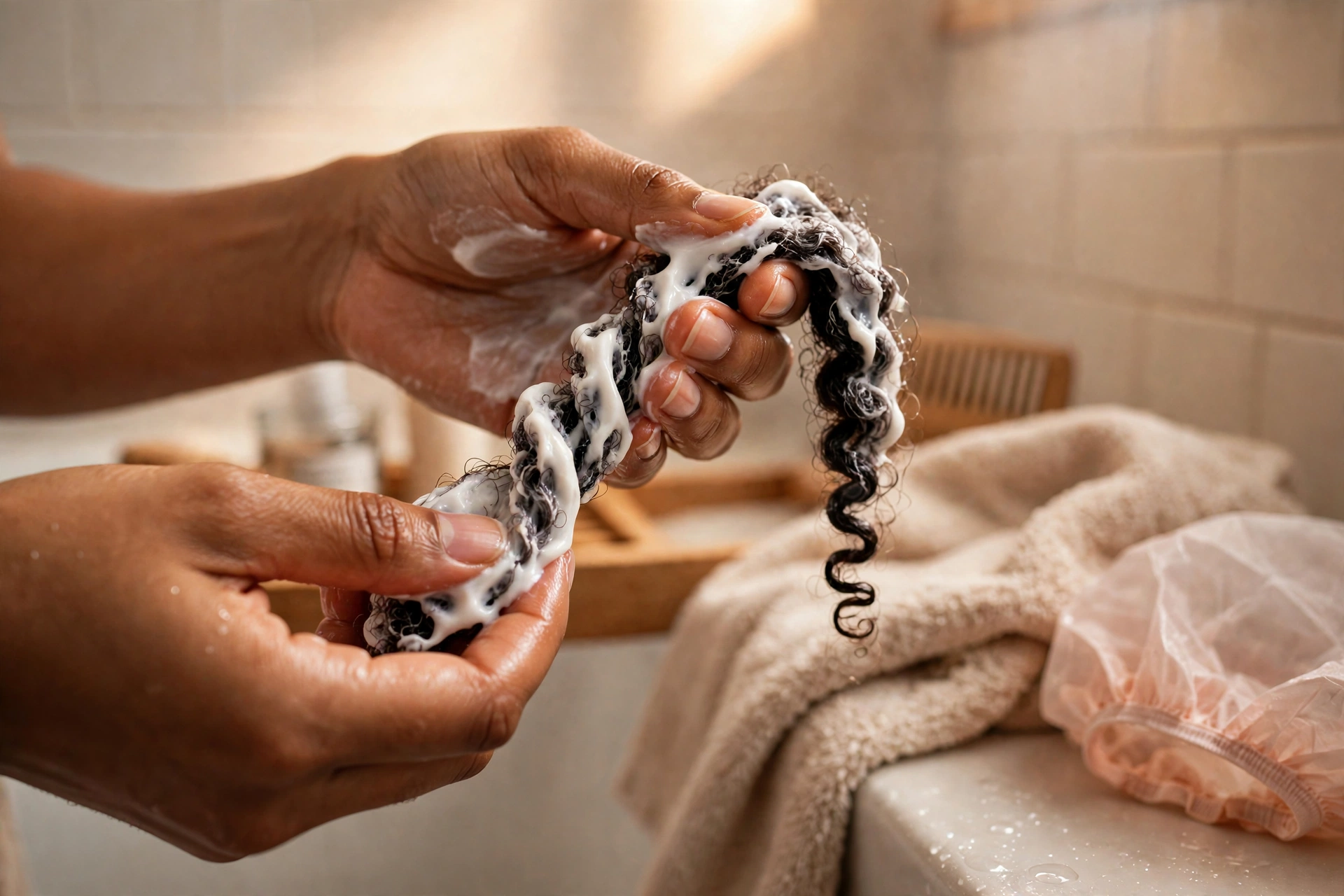
Hot water feels wonderful in January and strips your hair relentlessly. Lukewarm water cleans just as well without lifting the cuticle as aggressively. Work the shampoo into your scalp with your fingertips, let the suds run down the lengths as you rinse, and do not pile your lengths on top of your head and scrub them — that is friction you do not need. If you have been stretching washes with co-washing, winter is the season to be honest about whether it is still working; a scalp under a hat all day can build up faster than a scalp in summer air. Our guide to co-washing natural hair has a reset schedule for exactly this situation.
Step 2: Deep condition weekly, with heat, and give it the full time
This is the one step worth upgrading. In summer, a quick conditioner may be enough. In winter, a weekly deep conditioner — left on for 20 to 30 minutes under a shower cap, with a warm towel or a hooded dryer if you have one — is the difference between ends that survive February and ends that do not. Apply it from the ends upward, because the ends are the oldest, driest, and most weathered part of every strand. Rinse with cool water to help the cuticle lie flat again.
Step 3: Layer moisture in the right order while hair is still damp
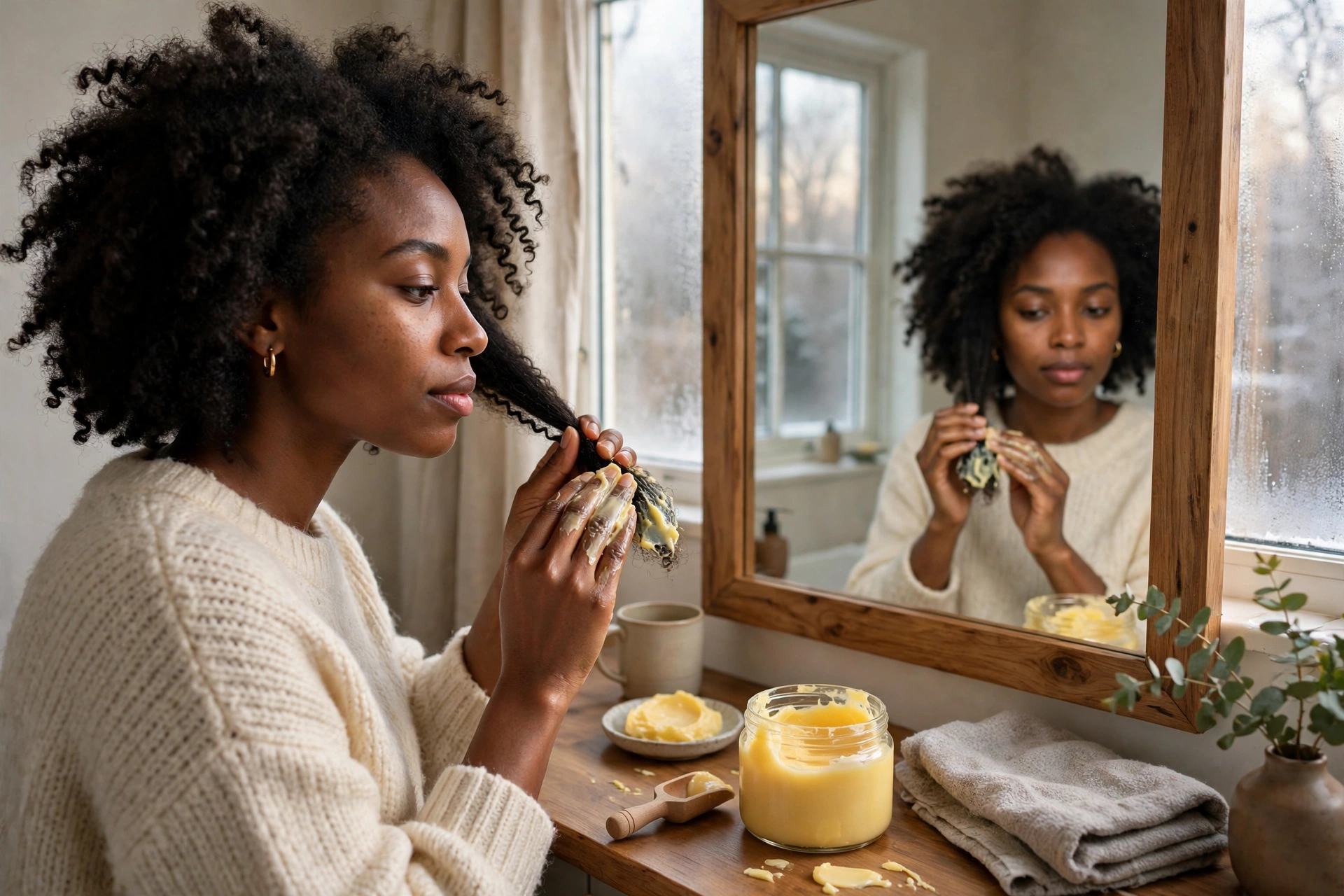
On damp hair, apply a water-based leave-in first, then a cream, then a butter or oil to seal — the LOC or LCO order, whichever your hair prefers. In winter, use slightly more cream on the last two inches of every section than you think you need, and slightly less on the roots. Roots under a hat warm and can look greasy fast; ends in the wind cannot get enough.
Step 4: Dry your hair before you go outside
This is the rule people skip because it is inconvenient, and it matters most on the coldest days. Soaking-wet hair taken out into freezing air goes stiff and rigid, and stiff hair snaps far more easily than flexible hair when it catches on a scarf or a coat zip. If you wash in the morning, dry to at least 80 percent before leaving — diffuse on low heat if you must, or wash the night before and sleep in a protective style. The American Academy of Dermatology’s healthy hair tips make the same underlying point in general terms: gentle handling and less heat and friction are what keep hair intact, and winter is when handling gets roughest.
Step 5: Trim on schedule, even though growth feels slower
Winter is when people skip trims because they are “trying to grow it out.” Split ends do not heal, and a split left alone travels upward through the winter, so you lose more length in spring than a small trim would have cost you now. A dusting every 8 to 12 weeks — just the very ends — is enough. If your ends feel rough no matter how much you moisturise, that roughness is damage, not dryness, and no product will fix it.
Between wash days: hats, scarves, and static
Your hair spends more time under cover in winter than in any other season, so what it touches matters as much as what you put on it. Wool is warm and it is also a friction machine: its rough fibres catch on the cuticle and, over a full day, create the tangles that become breakage at detangling time.
The fix is cheap and it works immediately. Line your winter hats with satin or silk — a satin-lined beanie, or a satin scarf worn under a regular hat, or your satin bonnet underneath a looser beanie. The point is that nothing rough touches your hair directly. The same logic applies at night, only more so, because winter bedding is heavier and you move against it for hours: a satin bonnet or pillowcase is not a luxury in winter, it is the other half of your daytime protection. Our guide to silk for natural hair explains which option suits which sleep style.
For static — the flyaways that stand up the moment you take a hat off — the cause is the same dryness as everything else in this article: dry hair holds an electrical charge because there is no moisture layer to discharge it. A tiny amount of leave-in smoothed over the surface, or a drop of oil rubbed between your palms and pressed over the canopy, discharges it in seconds. What does not help is brushing dry hair to “smooth” it, which just creates more charge and more friction. If your hair is crackling, it is asking for moisture, not for a brush.
One more between-wash-day habit worth building: a midweek moisture refresh, but a small one. A light mist of water mixed with a little leave-in, smoothed over the ends and sealed with a drop of oil, beats a heavy reapplication of cream that just sits on top of three-day-old product. Refresh the ends, not the whole head, and never refresh with a glycerin-heavy spray in the driest weeks — the humectant trap applies to refreshers too.
Protective styles in winter: the three mistakes
Winter is protective-style season for good reason: braids, twists, and buns keep your ends tucked away from wind, wool, and handling. But protective styles only protect you if the installation and the maintenance are right, and winter exposes three mistakes that summer forgives.
Mistake one: too much tension. A style installed tightly at the hairline in December hurts more in January, because cold, dry skin is less forgiving and because you are less likely to take a style down early once it is hidden under hats. Tension at the edges is how people lose their hairline over a winter, a few strands at a time. If it hurts, it is too tight, full stop — no style is worth an edge.
Mistake two: leaving it in too long. A style that still looks neat at week six can be matted underneath, especially at the nape where hats and scarves rub. Four to six weeks is a sensible ceiling for most braided styles in winter, and the moment you feel matting or see buildup you cannot rinse out, it is time, however good it still looks from the front.
Mistake three: forgetting the hair underneath. Hair in a protective style still needs moisture and a clean scalp. A light scalp oil or a diluted leave-in misted along the parts once or twice a week, plus a gentle scalp wash if the style allows it, keeps the foundation healthy. “Protective” describes what the style does for your ends, not a promise that the hair underneath looks after itself. For the full rundown of styles that actually protect versus styles that just look protective, see our guide to protective styles for natural hair.
Winter scalp: dry, flaky, or something more
Almost everyone gets a drier scalp in winter. Heated indoor air dries scalp skin the same way it dries the skin on your hands, and a hat worn all day traps warmth and sweat against that dry skin. The result is usually simple dryness: small, dry, white flakes and an itchy feeling that improves when you moisturise your scalp lightly and wash regularly.
But not every winter flake is simple dryness, and treating the wrong one wastes weeks. Dandruff flakes tend to be larger, slightly yellowish or oily, and they come with an oily or irritated scalp rather than a dry one. A related condition, seborrheic dermatitis, causes red, irritated patches with greasy-looking scales, often along the hairline, behind the ears, and in the eyebrows as well as the scalp. If your flakes are greasy, if the skin underneath is red or sore, or if the problem keeps coming back no matter what you change, that is worth a dermatologist’s look rather than another product swap. The American Academy of Dermatology’s overview of seborrheic dermatitis describes what it looks like and how it is usually treated.
A practical winter scalp rule: wash your scalp when it needs washing, not on a fixed calendar. Some people need to wash more often in winter because of hats and sweat; some need to wash less because their scalp is dry and irritated. Let the scalp decide, and judge by how it feels two days after washing, not by how it feels on wash day itself.
Four winter myths that cost you length
Myth 1: “Winter means you should stop washing your hair.” Stretching washes does reduce manipulation, which is good. But stretching them until your scalp is itchy and coated is not protection, it is buildup, and buildup under a hat is an itch-and-scratch cycle that damages the scalp. Wash when your scalp asks, even if that is more often than the internet told you.
Myth 2: “Oil alone moisturises hair.” Oil seals; it does not hydrate. A head full of oil on dry hair is still dry hair, just shinier. If your winter routine is oil, oil, and more oil, and your hair still feels like straw, the missing step is water-based moisture underneath the oil, not a different oil.
Myth 3: “Heat is always bad, so air-dry no matter what.” Heat used badly is bad. But going out into freezing weather with wet hair is worse, and a diffuser on low heat with a heat protectant is a reasonable trade. Winter is about choosing the smaller damage, not pretending you can choose none.
Myth 4: “If it worked in summer, it works in winter — just use more of it.” Using more of a summer product in winter often means more humectant in dry air, more weight on roots under a hat, and more buildup on a scalp that is already covered all day. Winter usually needs different products, not more of the same ones.
Frequently Asked Questions
How often should I wash natural hair in winter?
As often as your scalp needs, which for most people is once a week, sometimes every 10 days. Judge by your scalp two days after washing; itchy, coated, or sore means wash sooner; dry and tight means you can stretch a little longer, or switch to a gentler cleanser. There is no universal winter wash schedule, only your scalp’s feedback.
Can I still co-wash in winter?
Yes, but watch the buildup. A scalp under hats and scarves all day can accumulate product and sweat faster than in summer, so many people find they need a real shampoo more often in winter even if co-washing worked all summer. If your scalp starts itching or your roots feel coated, that is your signal to shampoo and reset.
Is it really bad to go outside with wet hair in winter?
Yes, on genuinely freezing days. Wet hair goes stiff in the cold, and stiff hair snaps more easily when it catches on scarves, zips, and coat collars. Dry your hair to at least 80 percent before going out, or wash the night before and sleep in a protective style.
Should I use glycerin in winter?
Use it with care in the driest weeks. In humid air glycerin draws moisture into your hair, but in very dry winter air there is little moisture to draw, and a glycerin-heavy product can leave hair drier over time. If a glycerin-first product seems to make your hair drier the more you use it, park it until spring and switch to a cream based on water, butter, or oil.
What is the single best winter protective style?
The one that is not too tight, does not stay in too long, and lets you still moisturise your scalp. Flat twists and loose braids under a satin-lined hat suit most people; the specific style matters less than the tension, the duration, and the maintenance underneath it.
Disclaimer: This article is general hair-care information, not medical advice. If you have persistent scalp redness, soreness, patchy hair loss, or flakes that do not improve with basic care, see a dermatologist — some scalp conditions need treatment, not a new product.
