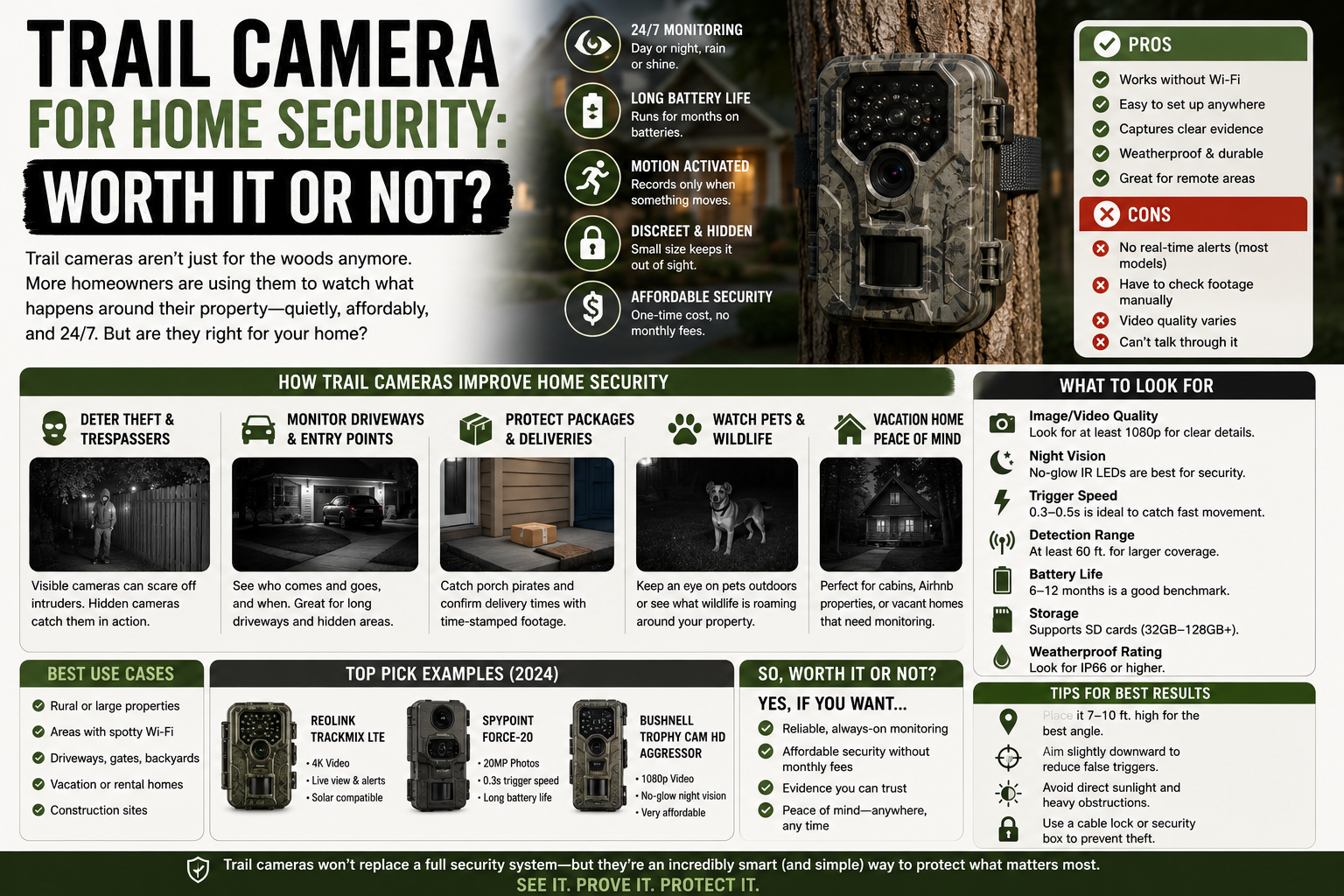
Trail Camera for Home Security: Worth It or Not?
What Makes a Trail Camera Different From a Regular Security Camera
Regular security cameras plug into power and usually need Wi-Fi running to them directly. A trail camera runs on batteries and often has its own cellular connection built right in, no home network required at all. Reolink’s own guide on this exact comparison lays out the core difference clearly: trail cameras were built for hunters tracking wildlife, but the same motion-and-heat detection works just as well on a person walking up your driveway.
No Wiring, No Power Bill Increase
Since it’s battery-powered, a trail camera can go basically anywhere. Tree branch, shed roof, fence post, spots a wired camera could never reach without an electrician involved. That alone makes it worth considering for anyone with a large property or a detached structure sitting away from the house.
The Detection Method Works Differently Too
Most trail cameras use a passive infrared sensor, PIR for short, which reacts to heat and movement together rather than constant video recording. That’s actually a battery-saving feature, not a downside, since it only fires when something’s actually there instead of recording hours of empty yard.
Where a Trail Camera for Home Security Actually Shines
Large properties, rural land, cabins, hunting leases, anywhere a normal CCTV system would need trenching cable through half an acre just to reach. One review site’s breakdown of top security trail cameras makes this point directly: trail cameras cover ground a traditional system simply can’t, for a fraction of the installation cost.
Night Vision Without Tipping Off Whoever’s There
Look for a camera using true no-glow infrared, sometimes listed as 940nm, rather than a low-glow red flash. The no-glow version stays completely invisible in the dark, which matters if you don’t want to alert someone that they’ve been caught on camera.
Remote Alerts From Places With No Wi-Fi
GardePro’s rundown of current trail camera tech points out that most modern units connect over cellular data instead of home Wi-Fi, meaning they still send alerts to your phone even from a cabin or a back lot with zero internet access nearby.
Where It Falls Short Compared to a Real Security System
Honestly, this is the part worth being upfront about. Most trail cameras trigger on motion rather than recording continuously, so there’s a small delay, usually under a second, but a delay nonetheless, between something happening and the camera actually catching it.
Not Built for Constant Live Monitoring
Eufy’s take on using a trail camera for security notes that most units capture short bursts of photos or clips when triggered, not the always-on live video feed you’d get from a dedicated security camera watching a front door.
Ongoing Costs People Forget to Budget For
Cellular trail cameras usually need a data plan, on top of the camera itself. Some brands now offer pay-as-you-go options for seasonal use, which helps, but it’s still a recurring cost worth factoring in before buying, not an afterthought once the bill shows up.
Picking the Right Trail Camera for Home Security
Full HD resolution is worth prioritizing if you actually want usable footage rather than a grainy image you can’t identify anything from. One buyer’s guide covering models tested specifically for security use recommends checking battery life and total cost of ownership together, since a cheap camera that burns through batteries fast ends up costing more over a year than a pricier, more efficient one.
Solar Options Worth Considering
A solar-equipped trail camera cuts out battery changes almost entirely, which matters a lot if the camera’s mounted somewhere hard to reach. Worth the extra cost if you’re placing it somewhere you don’t want to visit every few weeks just to swap batteries.
Common Mistakes People Make
- Choosing a white-flash camera for security use, which lights up the whole scene and tips off whoever’s there.
- Ignoring the data plan cost until the first bill arrives, then being surprised by it.
- Mounting it too low or at the wrong angle, which is a mistake carried over from wildlife photography habits that don’t apply the same way to security use.
Worth saying plainly: a trail camera works best as one layer of a security setup, not a total replacement for a proper wired system covering your front door and main entry points.
If You’re Building Out a Full Camera Setup
Traffic and monitoring cameras cover different ground entirely, but the underlying idea, wide coverage without needing someone watching constantly, comes up a lot in this space. Our piece on Florida’s live traffic camera system and our breakdown of how sewer inspection cameras work both cover cameras solving a similar “see what’s happening somewhere I can’t stand and watch” problem, just in very different settings.
If you’re newer to cameras generally and want a broader starting point, our guide on picking a first camera is worth a look too, even though it’s aimed more at photography than security specifically.
Quick Questions People Ask
Can a trail camera actually work as a security camera?
Yes, for a lot of use cases, especially large properties or spots without easy access to power or Wi-Fi. It’s less suited for constant live monitoring of something like a front door.
Do trail cameras need Wi-Fi to send alerts?
No, most modern units use cellular data instead, which is actually a bigger advantage for security use since it works in areas without home internet access.
What’s the difference between white flash and no-glow trail cameras?
White flash lights up the entire scene visibly. No-glow infrared, usually 940nm, stays invisible in the dark, which matters more for security than for wildlife photography.
Are there ongoing costs with a cellular trail camera?
Yes, typically a data plan on top of the camera cost. Some brands offer pay-as-you-go options that help if you only need coverage part of the year.
Should I get a solar trail camera for security use?
Worth it if the camera’s mounted somewhere hard to reach, since it cuts down on battery changes. For an easily accessible spot, it’s a nice-to-have rather than essential.
Bottom Line on a Trail Camera for Home Security
A trail camera for home security works genuinely well for large or hard-to-wire properties, as one part of a broader setup rather than a full replacement for a dedicated security system. Check the flash type, budget for data costs, and match the camera to the actual ground you need covered.