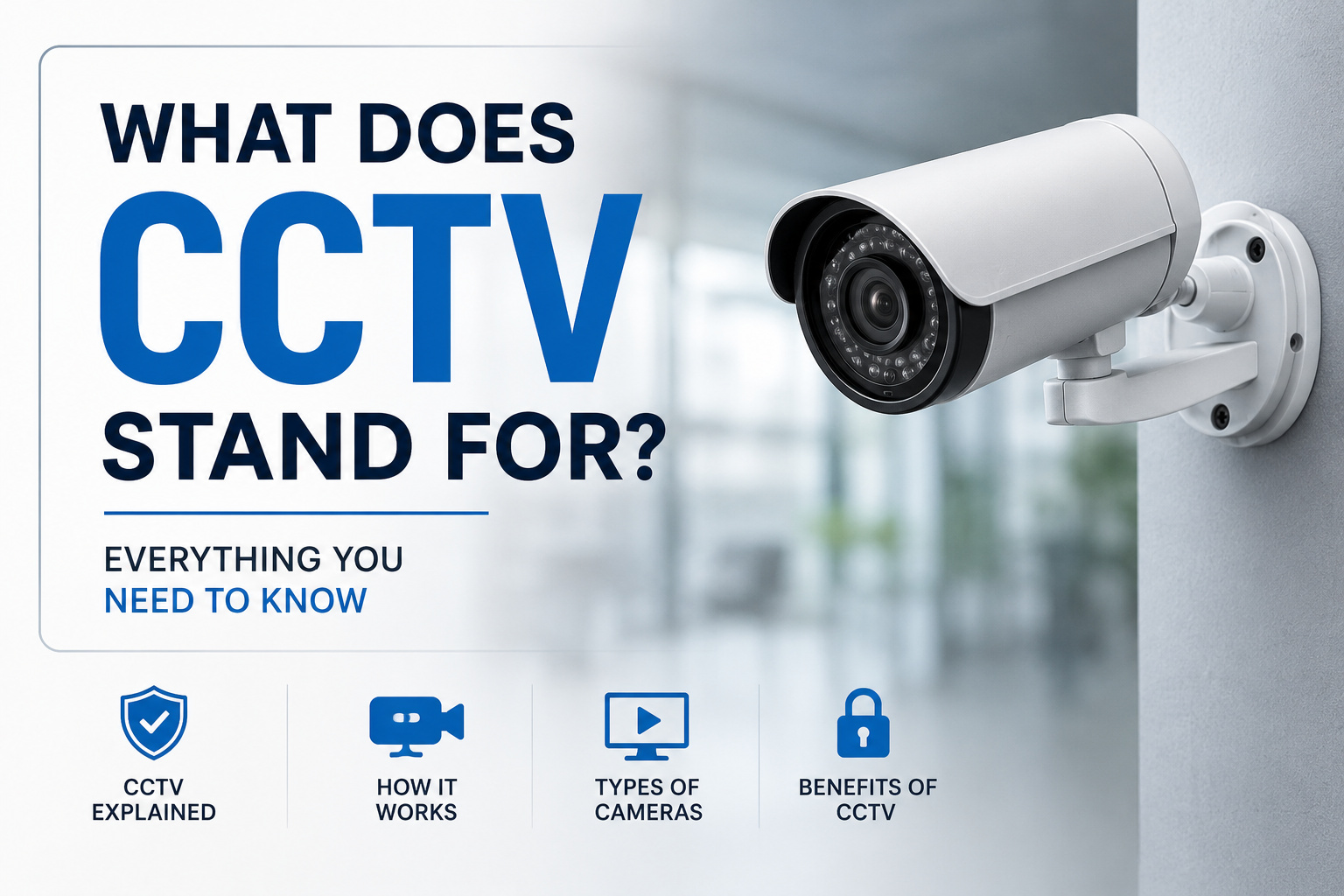
What Does CCTV Stand For? Everything You Need to Know
So what does CCTV stand for, exactly? Short answer: Closed-Circuit Television. Long answer takes a bit more explaining, and it’s actually a pretty interesting story once you dig into it.
What Does CCTV Stand For?
CCTV stands for Closed-Circuit Television. The word “closed-circuit” is the important part here. Regular TV broadcasts get sent out publicly, anyone with an antenna or a cable box can pick up the signal. A CCTV system doesn’t do that. Its video feed stays private, closed off, going only to a specific set of monitors or a recording device, not out into the world.
What Does CCTV Stand For in Everyday Use?
“Closed” means the signal isn’t shared publicly. “Circuit” refers to the private loop the video travels through, from camera to screen or storage. “Television” is really just the old-school word for a video display, left over from when this technology first started, decades before smartphones or streaming existed.
What Is CCTV, Beyond What Does CCTV Stand For?
At its core, CCTV is a system of cameras connected to a private display or storage setup, used mainly for monitoring a specific space. Not broadcast, not public, just a closed loop watching over one location. This is the simplest way to answer what does CCTV stand for once you move past the acronym itself.
Define CCTV in Plain Terms
Think of it like a security guard who never blinks. The camera watches constantly, records what it sees, and either someone reviews that footage later or a system flags something worth looking at right away.
CCTV Acronym Explained
People often assume CCTV is some fancy modern term, but it’s actually been around since the 1940s. The acronym itself hasn’t changed at all, even though the technology behind it has changed completely, from old tape recordings to today’s digital, AI-assisted systems.
What a CCTV Camera Actually Looks Like
CCTV cameras come in a handful of common shapes, each built for a different job. Some are small and dome-shaped, mounted flush against a ceiling. Others are longer and cylindrical, mounted visibly on an outdoor wall. The shape isn’t just style, it actually changes how and where a camera works best, more on that a bit further down.
Now That You Know What CCTV Stands For, How Does It Work?
A CCTV camera captures video continuously or on motion, then sends that footage through a private connection, either a physical cable or a closed wireless link, to a recording device or a live monitor. No public network involved at any point in that chain.
Older CCTV systems recorded straight to tape, which had to be manually swapped and stored. Modern systems record digitally instead, usually to a DVR or NVR, a small hard drive-based box that stores days, weeks, or months of footage depending on how much storage it has.
CCTV Footage Meaning
CCTV footage just means the actual recorded video a camera captured, whether that’s a live feed being watched in real time or older recordings pulled up after the fact to review something that already happened.
What Is CCTV Footage Used For?
Mostly two things: catching something as it happens, or reviewing something after the fact. A store owner checking footage after a theft, or a security guard watching a live feed during a night shift, both count as using CCTV footage, just at different points in time.
History of CCTV
CCTV’s story starts earlier than most people expect, and it wasn’t originally built for catching shoplifters. Deep Sentinel’s history of surveillance cameras traces an early concept back to 1927, when Soviet inventor Leon Theremin, the same person who invented the theremin musical instrument, built a system to monitor the Moscow Kremlin’s courtyard.
The First CCTV Camera
The system most historians credit as the actual first true CCTV setup came in 1942, built by German engineer Walter Bruch. Vector Security’s breakdown of CCTV’s evolution explains it was used to monitor V-2 rocket launches from a safe distance during World War II, letting military personnel watch dangerous launches without standing anywhere near them.
From Wartime Tool to Everyday Technology
By 1949, the American company Vericon released the first commercially available CCTV systems. Backstreet Surveillance’s industry history notes CCTV even played a role in the Apollo moon missions, with footage from the spacecraft transmitted back to Earth as a closed-circuit signal before being broadcast publicly. CCTV spread into everyday shops and banks through the 1970s, and kept evolving from there, tape to digital, analog to AI-assisted detection today.
How CCTV Recording and Storage Actually Works Today
Modern systems mostly fall into two camps: DVR-based and NVR-based. A DVR, short for digital video recorder, works with older analog cameras, converting their signal into digital footage on the way in. An NVR, or network video recorder, handles footage that’s already digital, coming straight off IP cameras connected over a network.
How Long Does CCTV Footage Actually Get Kept?
This varies a lot by business and by law. Some shops keep footage for just a week or two before it gets overwritten automatically. Banks and larger commercial properties often keep recordings for 30 to 90 days, sometimes longer, depending on local regulations and how much storage the system has available.
Cloud-Based CCTV Is Changing the Old Model
Traditional CCTV kept everything local, on a physical DVR or NVR sitting in a back room somewhere. Newer systems increasingly back footage up to the cloud too, which adds convenience, remote access from a phone, easier sharing with police if needed, but also means thinking harder about who else might access that footage down the line.
Is CCTV Legal Everywhere?
Generally, yes, for monitoring your own property. Rules get stricter around audio recording specifically, and around pointing a camera into a neighbor’s private space, like directly into their windows. Public-facing CCTV, the kind run by cities or businesses watching sidewalks and parking lots, usually falls under a different, more relaxed set of rules than a camera aimed at someone’s private backyard.
A Quick Word on Privacy Expectations
Most places draw a legal line around “reasonable expectation of privacy.” A camera watching your own front porch is normally fine. One angled specifically to look through a neighbor’s bathroom window is a very different, and often illegal, situation. Worth knowing before mounting anything, not after.
Types of CCTV Cameras
Modern CCTV systems mostly rely on a handful of camera shapes, and each one solves a slightly different problem. Reolink’s guide comparing bullet, dome, and PTZ cameras breaks this down clearly, and honestly, once you know the shapes, spotting which type is watching you gets a lot easier.
Dome Cameras
Small, rounded, usually mounted on a ceiling. The tinted dome cover makes it hard to tell which direction the lens is actually pointing, which works as its own kind of deterrent since nobody’s sure exactly what it’s watching.
Bullet Cameras
Longer and cylindrical, easy to spot from a distance. Mammoth Security’s comparison of camera types notes bullet cameras tend to cover longer, straighter distances well, making them a common pick for watching a fence line, driveway, or parking lot edge.
PTZ Cameras
Short for pan-tilt-zoom, these cameras can physically move and zoom in on command, giving a security operator live control over exactly what the camera focuses on, rather than staying locked on one fixed angle like a dome or bullet camera does.
CCTV vs Security Camera: What’s Actually Different
Here’s where a lot of people get confused, understandably. Technically, every security camera that keeps its footage private, not broadcast publicly, counts as a CCTV camera. “CCTV” and “security camera” get used almost interchangeably today, even though CCTV is really the broader technical term.
Where the Terms Actually Diverge
The real difference shows up more in how people use the words casually. “CCTV” tends to describe older, wired, often business-installed systems, banks, shops, parking garages. “Security camera” leans more toward newer, often wireless, home-focused setups people install themselves. Under the hood, though, they’re doing the same basic job.
If you’re weighing a specific home security option instead of a traditional wired CCTV setup, our piece on eufy’s no-subscription security camera lineup covers one of the more popular modern alternatives worth comparing against a classic CCTV install.
Common Uses of CCTV
Retail stores use it to deter theft and review incidents after the fact. Office buildings use it for both security and tracking who comes and goes. Traffic authorities use camera systems built on the same closed-circuit principle to monitor roads and intersections in real time.
Beyond Traditional Security
CCTV-style monitoring isn’t limited to catching crime either. Our piece on Florida’s live traffic camera system shows how the same closed-circuit idea gets used for something as ordinary as checking road conditions before a drive, not just security. And sometimes it captures something nobody expected at all, like the traffic camera that caught a tornado crossing a Florida intersection.
Specialized CCTV Use Cases
Not every camera under this umbrella is watching for crime. Our breakdown of sewer inspection cameras shows a completely different, non-security use of the same basic closed-circuit concept, just aimed underground instead of at a parking lot. Rural properties often lean on a different tool entirely for coverage, which our guide on using a trail camera for home security covers in more depth.
Common Mistakes People Make Understanding CCTV
- Assuming CCTV footage is always monitored live by a person, when most systems actually just record and get reviewed later if something happens.
- Thinking CCTV and security cameras are two completely different technologies, when they’re really the same closed-circuit concept under two different common names.
- Believing older CCTV systems have been fully replaced. Plenty of businesses still run traditional wired CCTV setups alongside newer wireless options.
Worth saying plainly: understanding what does CCTV stand for makes the rest of the technology a lot less confusing, since nearly every camera type built for monitoring traces back to this same basic closed-circuit idea.
If You’re Curious About Camera Gear Beyond Security
Not every camera on this site is about surveillance. If you’re newer to photography specifically, our guide on picking a first camera is a good starting point, and our piece on the Canon ER-L1 camera strap covers a small but genuinely useful accessory decision for anyone shooting with a newer mirrorless body.
FAQs
What does CCTV stand for?
CCTV stands for Closed-Circuit Television. It means the video signal stays private, sent only to a specific monitor or recording device rather than broadcast publicly.
What is the difference between CCTV and a security camera?
Technically, almost none. Every security camera keeping its footage private counts as CCTV. The terms just get used differently in casual conversation, with CCTV leaning toward older, wired, commercial setups.
Who invented the first CCTV camera?
German engineer Walter Bruch is widely credited with building the first true CCTV system in 1942, used to monitor V-2 rocket launches during World War II.
What does CCTV footage actually mean?
It refers to the recorded or live video captured by a CCTV camera, used either to watch something happening in real time or to review an incident after it occurred.
What are the main types of CCTV cameras?
Dome, bullet, and PTZ are the three most common types. Dome cameras are discreet and ceiling-mounted, bullet cameras cover long straight distances, and PTZ cameras can pan, tilt, and zoom on command.
Conclusion: What Does CCTV Stand For, One More Time
So, what does CCTV stand for? Closed-Circuit Television, a private video system that’s been around since the 1940s and quietly evolved into nearly every modern security camera you walk past today. Once you know the history and the basic types, the whole topic stops feeling technical and starts feeling pretty straightforward.