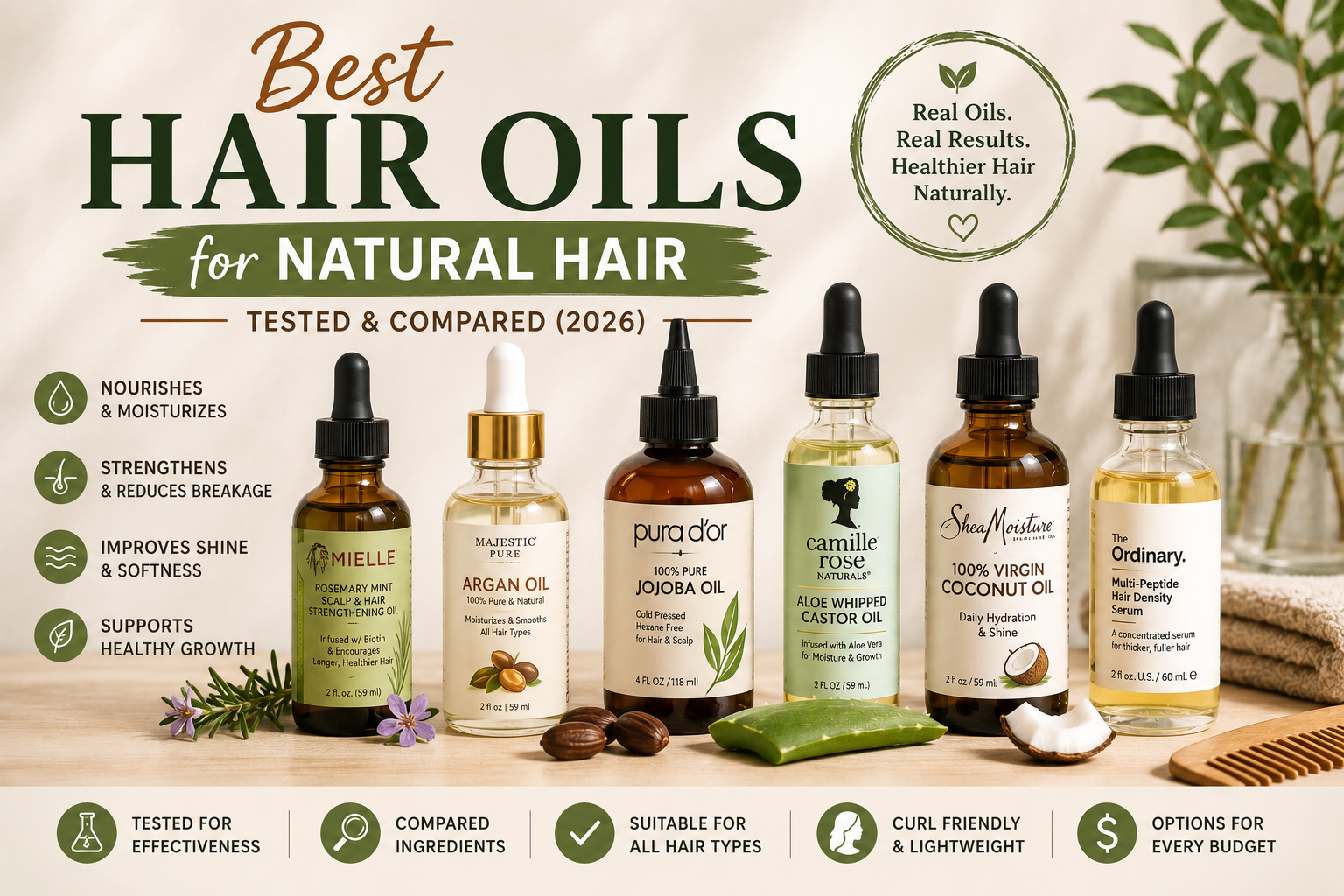
Best Hair Oils for Natural Hair — Tested & Compared (2026)
Hair oil is one of the most misunderstood products in natural hair care. People pour castor oil onto dry hair expecting it to add moisture. They apply coconut oil to every texture expecting the same result. Then they wonder why their hair still feels dry or why products are building up instead of absorbing.
Oil doesn’t moisturize hair. Water does. What oil does — when used correctly — is slow down how fast that moisture leaves. That’s a different job, and understanding it changes which oils you reach for and how you use them.
Here’s what I’ve found actually works after testing a wide range of oils on natural hair over several years.
How Hair Oil Works on Natural Hair
Natural hair loses moisture constantly — through evaporation, friction against clothing and pillowcases, and the simple fact that the tight curl pattern makes it hard for scalp oils to travel down the shaft. Water-based products (leave-ins, aloe vera, water sprays) replace that moisture. Oils seal it in.
Apply oil to dry hair and you’re sealing in dryness. Apply oil over a water-based product — while hair is still damp — and you’re sealing in moisture. The order is what makes oil useful or useless.
Beyond sealing, some oils penetrate the hair shaft — coconut oil and olive oil are the most studied examples. Penetrating oils add some lubrication from inside, which reduces friction and breakage during detangling. Most oils, though, are surface oils that work by coating the outside of the hair shaft rather than entering it.
Best Hair Oils for Natural Hair
1. Jamaican Black Castor Oil — Best for Scalp Health and Edges
Best for: Scalp massage, edge growth, and sealing ends on 4B and 4C hair
Jamaican black castor oil is thick — noticeably thicker than regular castor oil, which is already heavy. That thickness is what makes it work well as a sealant on the driest natural hair textures. It creates a barrier that slows moisture loss effectively, which is exactly what 4B and 4C hair needs.
On the scalp, it’s one of the most popular oils in the natural hair community for a reason. Massaged into the scalp consistently — three to four times per week — it stimulates circulation and many people report improved edge density and reduced thinning over several months of use. It won’t regrow hair that’s stopped growing due to scarring, but for edges that are thin from tension or breakage, it supports recovery.
One important note: it’s too heavy for fine or low-porosity hair. If products tend to sit on top of your hair rather than absorbing, skip this one or use it only on the ends and scalp — not the length.
- ✅ Excellent sealant for very dry 4B and 4C hair
- ✅ Supports edge growth and scalp health with regular massage
- ✅ Thick barrier protects ends from moisture loss
- ❌ Too heavy for fine or low-porosity natural hair
- ❌ Can cause buildup if applied to the length too frequently
Price: $10–$15
2. Jojoba Oil — Best Everyday Oil for Natural Hair
Best for: Daily sealing, scalp balance, and low-porosity natural hair
Jojoba oil is technically a liquid wax, not an oil — and that distinction matters. Its molecular structure is closer to the sebum your scalp produces than any other oil. That means it absorbs well across most hair types, including low-porosity hair that tends to repel heavier oils.
It’s lightweight enough to use daily without buildup, which makes it ideal for the sealing step of the LOC method when you’re refreshing hair between washes. A small amount distributed through damp hair after your leave-in keeps moisture locked in without making hair feel coated or greasy.
It also works well as a carrier oil for essential oils — rosemary oil for scalp massage, for example, needs to be diluted before applying directly to the scalp. Jojoba is one of the better carrier options because it absorbs cleanly and doesn’t leave residue.
- ✅ Lightweight — works across most natural hair types including low porosity
- ✅ Absorbs cleanly without buildup
- ✅ Good carrier oil for essential oils like rosemary
- ✅ Mimics scalp sebum — supports scalp balance
- ❌ Not heavy enough to seal very dry 4C hair on its own — layer with a butter for extra protection
Price: $10–$18 depending on size
Best for: Scalp stimulation, hair growth support, and edge care
Rosemary oil has more research behind it for hair growth than almost any other natural ingredient. A study comparing rosemary oil to minoxidil — a common hair loss treatment — found comparable results in hair count after six months. It works by increasing blood flow to the scalp follicles.
Mielle’s version is pre-diluted in a carrier oil blend with mint — you can apply it directly to the scalp without the irritation that undiluted rosemary oil can cause. Massage it into the scalp two to three times per week, focusing on the edges and any areas where the hair feels thinner or less dense.
It’s also light enough to use on the hair length as a finishing oil after styling — a small amount smooths frizz and adds shine without making natural hair look greasy.
- ✅ Rosemary oil has real research backing for scalp health and growth
- ✅ Pre-diluted — safe to apply directly to scalp without irritation
- ✅ Lightweight enough for daily use on hair length
- ✅ Good for edges and thinner areas
- ❌ Strong mint scent — not for everyone
- ❌ Not heavy enough as a sealant for very dry 4C hair
Price: $10–$14
4. Argan Oil — Best Finishing Oil for Natural Hair
Best for: Adding shine, taming frizz, and sealing on 3A to 4A hair
Argan oil is lightweight, absorbs relatively quickly, and adds a shine to natural hair that heavier oils can’t replicate without making hair look greasy. For looser natural hair textures — 3A through 4A — it works well as the oil step in the LOC method and as a finishing oil after styling.
It contains vitamin E and fatty acids that support hair health over time with consistent use. On very dry 4B and 4C hair it’s usually not heavy enough on its own — it absorbs too quickly to provide lasting moisture protection. Layering it under shea butter works better for those textures.
- ✅ Lightweight and absorbs quickly
- ✅ Adds shine without greasiness
- ✅ Works well on 3A through 4A natural hair
- ✅ Vitamin E supports long-term hair health
- ❌ Not heavy enough for 4B and 4C hair on its own
- ❌ More expensive than other options per ounce
Price: $12–$20 depending on size and brand
5. Coconut Oil — Best Penetrating Oil (for the Right Hair Types)
Best for: Pre-poo treatments and sealing on medium to high porosity natural hair
Coconut oil is one of the few oils that actually penetrates the hair shaft rather than just coating the outside. Studies have shown it reduces protein loss during washing when applied before shampooing — a technique called pre-pooing. Apply coconut oil to dry hair 30 minutes before washing, then shampoo as normal. It reduces the swelling and friction that cause breakage during the wash process.
The important caveat: coconut oil doesn’t work well for everyone. For low-porosity hair or hair that’s protein-sensitive, it can cause buildup and make hair feel stiff and brittle over time. If you try it and your hair feels harder and drier after a few uses, stop — your hair is protein-sensitive and coconut oil’s protein-like properties are causing that reaction.
- ✅ One of the few oils that penetrates the hair shaft
- ✅ Reduces protein loss during washing as a pre-poo
- ✅ Works well for medium to high porosity natural hair
- ❌ Causes buildup and stiffness on low-porosity or protein-sensitive hair
- ❌ Solidifies in cold temperatures — needs warming before use
Price: $8–$14
How to Choose the Right Oil for Your Natural Hair
The right oil depends on your hair’s porosity more than its curl pattern.
Low porosity natural hair (products sit on top, water beads on surface):
- Use lightweight oils that absorb easily — jojoba, argan, grapeseed
- Avoid heavy oils on the length — castor oil and coconut oil will coat the surface without absorbing and eventually block moisture
- Apply oils to hair that’s still warm from the shower — the slight heat helps the cuticle accept the oil
High porosity natural hair (absorbs products fast but loses moisture fast):
- Use heavier sealants — castor oil, olive oil, or a thick butter over a lighter oil
- Seal immediately after leave-in before hair starts to dry
- Layer oils under butters for maximum moisture protection
Not sure about your porosity? Our complete natural hair care guide covers the simple at-home porosity test and what to do with the results.
How to Use Hair Oil in Your Natural Hair Routine
Where oil fits in your routine matters as much as which oil you use:
- Pre-poo (before washing): Apply coconut oil or olive oil to dry hair 30-60 minutes before shampooing. This reduces protein loss and breakage during the wash process.
- After leave-in (LOC method): Apply oil over your leave-in conditioner while hair is still damp. This seals in the moisture from your leave-in as hair dries.
- Scalp massage: Apply jojoba or Mielle Rosemary Mint oil to the scalp 2-3 times per week. Massage for 3-5 minutes to stimulate circulation.
- Finishing oil: A small amount of argan oil or jojoba on dry styled hair adds shine and smooths frizz without undoing your style.
For the full routine context, our guide on how to moisturize natural hair walks through exactly where oils fit in the LOC method step by step.
Frequently Asked Questions
Which oil is best for natural hair growth?
Rosemary oil has the most research behind it for supporting scalp health and hair growth — it increases blood flow to follicles and has shown results comparable to some hair loss treatments in studies. Mielle’s Rosemary Mint oil is pre-diluted and easy to use directly on the scalp. Jamaican black castor oil is popular for edge growth through scalp massage. No oil dramatically speeds up growth rate — hair grows about half an inch per month regardless — but these support the scalp environment where growth happens.
Can I apply hair oil to dry natural hair?
You can, but it’s less effective than applying over damp hair. Oil seals in moisture. On dry hair, there’s no moisture to seal in — the oil just coats the surface temporarily. For between-wash refreshing, lightly mist your hair with water first, then apply your oil. That small amount of water makes the oil significantly more effective.
How often should I oil my natural hair?
On wash day as part of the LOC method — every wash, every time. For scalp massage with rosemary or castor oil, two to three times per week is a reasonable frequency. For refreshing between washes, when hair feels dry — usually every 2-3 days. There’s no benefit to oiling more frequently than your hair actually needs it; over-oiling causes buildup that eventually blocks moisture.
Is coconut oil good for all natural hair types?
No — and this is one of the most common mistakes in natural hair care. Coconut oil works well for medium to high porosity natural hair. For low-porosity hair or protein-sensitive hair, it causes buildup and stiffness over time. If you use coconut oil and your hair starts feeling hard, dry, or crunchy after a few uses, stop and try a lighter oil like jojoba instead.
What’s the difference between hair oil and hair serum?
Hair serums are usually silicone-based — they coat the hair shaft with a smooth layer that reduces frizz and adds shine. They work on the surface. Natural oils can either coat the surface (most oils) or partially penetrate the shaft (coconut, olive). Serums give immediate shine results but build up over time and require regular clarifying to remove. Natural oils build up less aggressively but still need occasional clarifying to keep the hair absorbing moisture effectively.
Final Thoughts
Hair oil is a tool — a useful one when used correctly and a source of frustration when used wrong. Apply it over moisture, not instead of it. Match the weight of the oil to your hair’s porosity. Use it consistently as part of a routine that also includes proper cleansing and deep conditioning.
If you’re just starting out, jojoba oil is the most versatile option — it works across most natural hair types, absorbs without leaving residue, and is light enough for daily use. Add rosemary oil to your scalp massage routine for long-term scalp health. From there, experiment with heavier oils as your hair’s needs become clearer.
More from PickHonestly on natural hair:
- How to Grow Natural Hair Faster — What Actually Works
- Best Leave-In Conditioners for Natural Hair
- Best Deep Conditioners for Natural Hair
- How to Moisturize Natural Hair — Complete Guide
- Best Products for 4C Natural Hair
Prices accurate as of publication. Verify current pricing before purchasing.