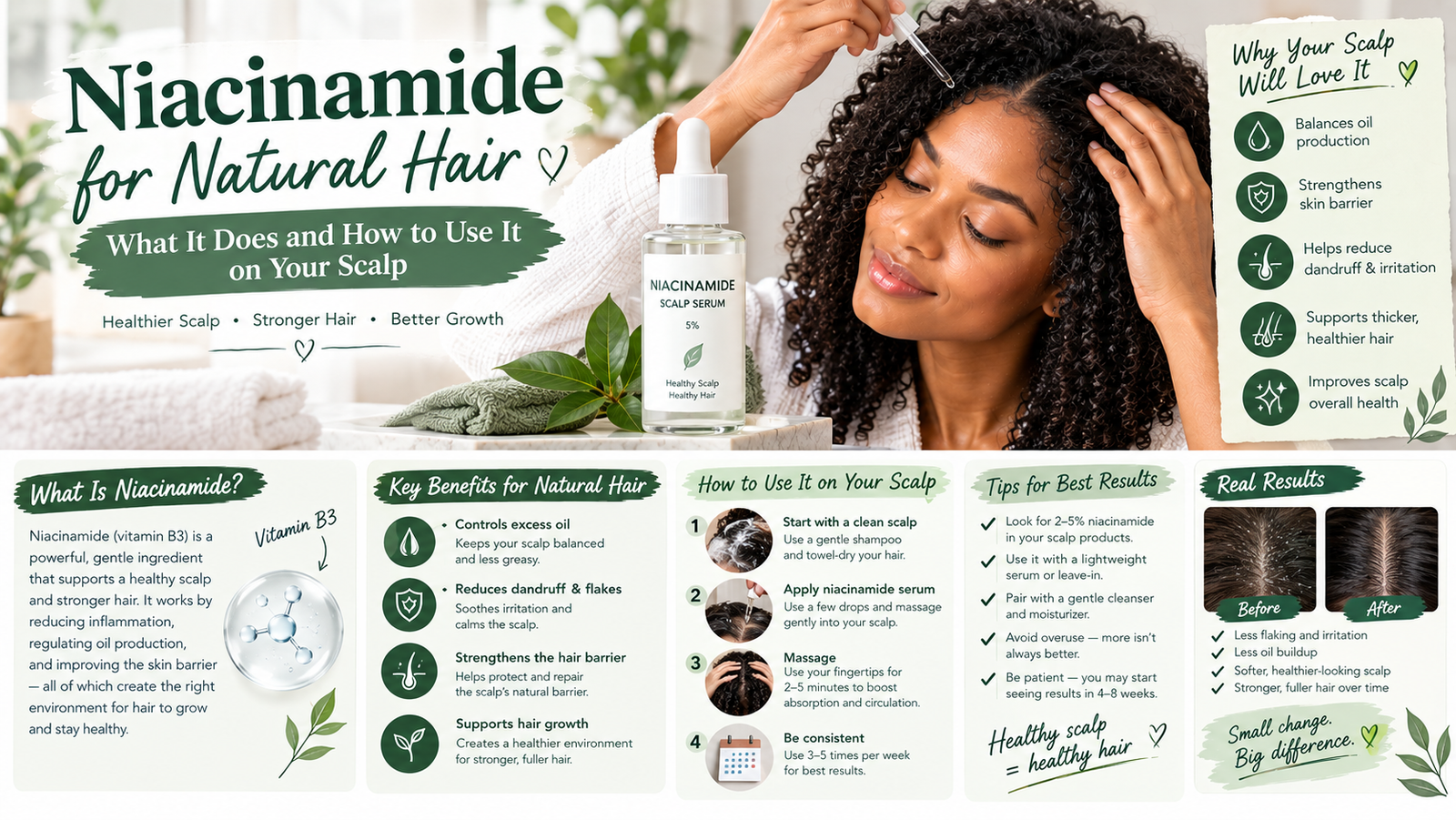
Niacinamide for Natural Hair — What It Does and How to Use It on Your Scalp
Skincare ingredients are crossing over into hair care in a serious way in 2026 — and niacinamide for natural hair is one of the most interesting transitions. Niacinamide has been a staple in facial skincare for years, backed by extensive research for its effects on the skin barrier, inflammation, and cell turnover. The same mechanisms that make it effective on skin apply directly to the scalp — which is, after all, skin.
I started applying a niacinamide serum to my scalp seven weeks ago. Here’s the honest breakdown of what it does, what the research says, and how to use it correctly on natural hair without interfering with your existing routine.
What Is Niacinamide and What Does It Do for Natural Hair?
Niacinamide is a form of vitamin B3 — a water-soluble vitamin that the body uses in hundreds of metabolic processes. Applied topically to the scalp, it works on several mechanisms simultaneously:
- Strengthens the scalp barrier: Niacinamide increases ceramide synthesis in the scalp — ceramides are the lipids that hold scalp skin cells together and prevent moisture loss. A stronger scalp barrier means less transepidermal water loss, less chronic dryness, and a healthier environment for hair follicles
- Reduces scalp inflammation: It has well-documented anti-inflammatory properties that calm the chronic low-level inflammation that weakens hair follicles over time
- Regulates sebum production: It helps balance how much oil the scalp produces — reducing excess oil without drying out the scalp, which makes it useful for both oily and dry scalp types
- Supports keratin production: Niacinamide is involved in the synthesis of keratin — the structural protein that hair is primarily made of. Adequate niacinamide availability supports stronger hair strand production from the follicle
- Improves blood circulation: Like niacin (a related form of vitamin B3), niacinamide in higher concentrations can increase blood flow to the scalp, supporting nutrient delivery to active follicles
Niacinamide Benefits for Natural Hair Specifically
1. Calms Chronic Scalp Inflammation
Scalp inflammation is one of the most underaddressed issues in natural hair care. It doesn’t always present as obvious redness or flaking — it often shows up as persistent mild itching, tenderness at the hairline, or a scalp that never quite feels comfortable. Over time, chronic inflammation weakens the follicle environment and produces thinner, weaker hair at the root.
For natural hair wearers specifically, the sources of scalp inflammation are numerous: tight protective styles that restrict circulation, product buildup from the multiple layers used in natural hair routines, and friction from styles that pull at the hairline. Niacinamide applied consistently to the scalp provides anti-inflammatory support at the cellular level — calming this chronic state that other products don’t specifically address.
2. Strengthens the Scalp Barrier for Better Moisture Retention
The scalp’s barrier function affects how well the skin beneath the hair retains moisture — and a compromised scalp barrier contributes to the chronic dryness that is the central challenge of natural hair care. When the scalp loses moisture rapidly through a weakened barrier, it affects the condition of the follicle environment and the initial moisture content of new hair growth.
Niacinamide’s ceramide-boosting effect directly strengthens this barrier. Used consistently over six to eight weeks, it measurably improves the scalp’s ability to hold moisture — which shows up as less chronic dryness and itching between wash days.
3. Balances Scalp Sebum Without Over-Drying
Natural hair routines typically involve a range of oils and butters applied to the scalp. Over time, combined with the scalp’s own sebum production, this can lead to buildup that blocks follicles. For scalps that overproduce oil between wash days, niacinamide helps regulate sebum production without the drying effect of astringents or harsh cleansers.
For scalps that underproduce oil and tend toward chronic dryness, niacinamide strengthens the barrier that keeps existing scalp moisture in — producing a similar balancing effect from the opposite direction.
4. Supports Stronger Hair Growth From the Follicle
The keratin synthesis support that niacinamide provides at the follicle level means that the hair growing from a niacinamide-supported scalp has the building blocks for better structural strength from the root. This kind of root-level strength improvement doesn’t show up in existing hair — it takes new growth cycles to see its effect, which means results require consistent use over three to six months rather than weeks.
How to Use Niacinamide on Natural Hair and Scalp
Method 1 — Dedicated Scalp Serum (Most Effective)
Apply a niacinamide-containing scalp serum directly to the scalp in parted sections. A concentration of 2–5% niacinamide is the effective and well-tolerated range for scalp application — high enough to deliver the barrier and anti-inflammatory benefits without the flushing or irritation that higher concentrations can cause on sensitive skin.
Apply to a clean, dry or slightly damp scalp after washing. Massage in with fingertips for two to three minutes per application — the massage adds circulation benefits to the active ingredient delivery. Leave in without rinsing. Apply three to four times per week consistently.
For a complete overview of scalp serum application technique, see our guide on scalp serums for natural hair.
Method 2 — Mixed Into Your Deep Conditioner
Add a few drops of a niacinamide serum or a small amount of a niacinamide powder to your deep conditioner before applying on wash day. This delivers niacinamide to both the scalp and the hair shaft during the deep conditioning step — a practical way to incorporate it without adding an entirely separate product step to your routine.
Use a 2–5% niacinamide serum — three to five drops per application of deep conditioner is sufficient. Don’t overdo the concentration: at high percentages, niacinamide can react with other ingredients and potentially cause irritation. For the best deep conditioners to mix it with, see our deep conditioner guide for natural hair.
Method 3 — In Your Leave-In Conditioner or Water Spray
Add a small amount of a water-based niacinamide serum to your leave-in conditioner or to the water spray you use between wash days. This provides ongoing low-dose niacinamide delivery to the scalp between washes without requiring an additional application step.
Keep the concentration low for this method — one to two drops per application. More than that risks buildup and potential irritation with frequent between-wash use.
Method 4 — As Part of a Monthly Head Spa Session
Include a niacinamide scalp treatment as one step in a monthly head spa session — applied after scalp exfoliation and before the deep conditioning step. The clean, exfoliated scalp absorbs active ingredients more effectively than a scalp with product buildup, making a head spa session the highest-absorption opportunity for any scalp treatment. See our guide on head spa for natural hair for the complete session protocol.
Best Niacinamide Products for Natural Hair
The Ordinary Niacinamide 10% + Zinc 1% — Best Budget Scalp Serum
The most widely available and affordable option — a high-concentration niacinamide serum that costs under $10. The 10% concentration is high for scalp use — dilute it slightly with water or mix one drop into your regular scalp oil before applying. The zinc adds sebum-regulating and antimicrobial benefit. Widely available at most pharmacies and online.
Briogeo Scalp Revival Charcoal + Tea Tree Scalp Treatment — Best for Buildup + Niacinamide Combined
Contains niacinamide alongside charcoal and tea tree for a comprehensive scalp treatment that addresses buildup, inflammation, and barrier health simultaneously. The most practical option for natural hair that needs multiple scalp concerns addressed in one product.
Inkey List Niacinamide Serum — Best Lightweight Option for Under Wig Use
A lightweight 10% niacinamide serum with hyaluronic acid that absorbs quickly without residue — ideal for scalp application under wigs or braids where heavier products would cause buildup. Apply through the parts of a protective style with a pointed applicator bottle.
Niacinamide vs Other Scalp Treatments — How It Compares
| Treatment | Primary Benefit | Best For | How Often |
|---|---|---|---|
| Niacinamide | Barrier strength, inflammation, sebum balance | Chronic scalp inflammation, dryness, weak hair at root | 3–4x per week |
| Rosemary Oil | DHT blocking, circulation stimulation | Thinning, edge recovery, growth support | 2–3x per week |
| Ketoconazole Shampoo | Antifungal, dandruff control | Seborrheic dermatitis, persistent dandruff | 1–2x per week max |
| Salicylic Acid | Exfoliation, buildup removal | Scalp buildup, blocked follicles | 1x per week |
| Pumpkin Seed Oil | DHT blocking, zinc, antioxidants | Thinning, scalp health support | 2–3x per week |
Niacinamide and rosemary oil complement each other well — rosemary addresses circulation and DHT blocking while niacinamide addresses the barrier and inflammation. Used together on different days, they cover more of the scalp health spectrum than either alone. For the full rosemary research and how to use it, see our guide on rosemary water for natural hair.
Is Niacinamide Safe for Natural Hair?
Yes — niacinamide is one of the best-tolerated active ingredients in both skincare and scalp care. A few things to note for natural hair use:
- Concentration matters: 2–5% is well-tolerated for scalp use. The 10% serums commonly sold for facial use work on the scalp but may cause mild flushing or tingling in some people — dilute slightly if that happens
- Don’t mix with vitamin C: Niacinamide and high-concentration vitamin C serums applied together can cause a reaction that temporarily yellows the skin. Keep them in separate steps or on separate days
- Patch test first: Apply to a small scalp area and wait 24 hours before using across the full scalp
- Works on color-treated natural hair: Niacinamide is safe for color-treated hair — its barrier-strengthening effect can actually help color-treated scalps that tend toward irritation and sensitivity
Frequently Asked Questions About Niacinamide for Natural Hair
Does niacinamide grow natural hair?
Niacinamide supports the scalp environment that allows healthy hair to grow — by reducing inflammation, strengthening the scalp barrier, and supporting keratin production. It doesn’t directly trigger hair growth but improves the conditions under which stronger, healthier hair grows. Results in hair quality show up over three to six months of consistent use. For the full picture on what supports natural hair growth, see our guide on how to grow natural hair faster.
How long does it take for niacinamide to work on natural hair?
Scalp comfort improvements — less itching, reduced dryness, better oil balance — typically show within two to four weeks of consistent use. Improvements in the quality and strength of new hair growth take longer, because hair grows slowly — expect three to six months of consistent application before evaluating growth-related results. Consistency matters far more than frequency — three applications per week maintained for months outperforms daily use for three weeks then stopping.
Can I use niacinamide on natural hair in protective styles?
Yes — a lightweight niacinamide serum applied through the parts of braids or twists with a pointed applicator bottle is one of the most practical between-style scalp treatments for natural hair. It absorbs quickly without residue, doesn’t cause buildup under styles, and provides consistent scalp barrier and anti-inflammatory support during extended protective style wear. See our guide on protective styling for natural hair for more on scalp care during protective styles.
What percentage of niacinamide should I use on my scalp?
2–5% is the recommended range for scalp use — enough to deliver the barrier, anti-inflammatory, and sebum-regulating benefits without the irritation risk of higher concentrations. If you’re using a 10% facial niacinamide serum on your scalp, dilute it with a carrier like water or your regular scalp oil to bring the effective concentration down to the 5% range. This applies particularly to sensitive scalps or first-time users.
Can I use niacinamide and rosemary oil together on natural hair?
Yes — they work on different mechanisms and complement each other well. Apply niacinamide to a clean scalp and let it absorb for five to ten minutes, then follow with your rosemary oil scalp massage. Alternatively, use niacinamide on alternating days from your rosemary oil treatment. The combination covers inflammation and barrier health (niacinamide) alongside DHT blocking and circulation stimulation (rosemary) — a more comprehensive scalp health approach than either provides alone.
Final Thoughts
Niacinamide for natural hair is one of the more scientifically grounded additions you can make to a scalp care routine — its mechanisms are well understood, its tolerance profile is excellent, and its benefits address real issues that natural hair routines typically underserve: scalp barrier health, chronic inflammation, and sebum balance.
Add it as a leave-in scalp serum three times per week after washing and between wash days. Start with a 2–5% concentration and give it eight weeks of consistent use before evaluating the results. The improvements in scalp comfort come first — the effects on hair quality follow over months.
More from PickHonestly on natural hair scalp care:
- Best Scalp Serum for Natural Hair
- Rosemary Water for Natural Hair — How to Make It and Use It
- Ketoconazole Shampoo for Natural Hair
- Head Spa for Natural Hair — How to Do It at Home
- How to Grow Natural Hair Faster
- Natural Hair Care Routine for Beginners
This article is for informational purposes only and is not a substitute for professional dermatological advice. Consult a dermatologist for persistent or severe scalp conditions.