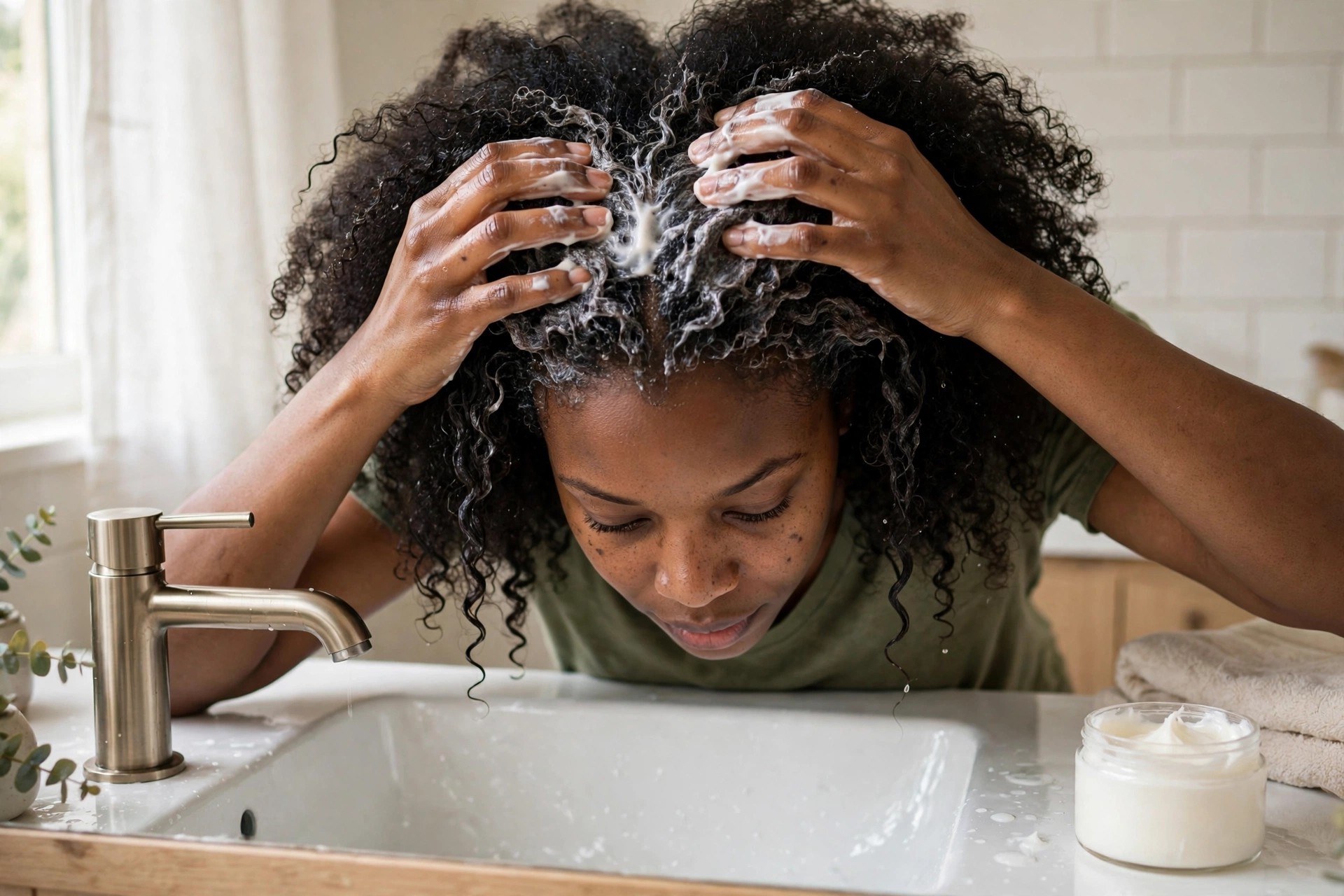
Co-Washing Natural Hair: When It Helps, When It Hurts, and How to Do It Right
 Maya Thompson
📅 October 26, 2026
⏱ 14 min read
Ask ten people with natural hair about co-washing natural hair and you will get two confident, opposite answers. One camp treats it as the gentlest wash day there is: no sulfates, no stripped curls, no straw-dry ends. The other camp treats it as a slow-motion scalp disaster: layer after layer of conditioner with nothing ever truly cleaning anything. Both camps are describing something real. They are just describing different heads of hair, different products, and different schedules — and that is exactly where most co-washing advice falls down. It sells a single verdict for a technique that only works as part of a routine.
The honest verdict is less catchy and far more useful: co-washing is a good tool and a bad replacement. Used between shampoos, with the right product and a regular reset, it can keep dry, coily hair moisturized through the week without the damage of daily shampooing. Used instead of shampoo, indefinitely, it eventually does what its critics say — it coats the hair and scalp in residue that water alone cannot shift. This guide draws that line properly: what co-washing actually cleans, who it genuinely suits, the exact way to do it, the schedule that keeps it working, and the warning signs that mean it is time to shampoo.
What Co-Washing Actually Cleans — and What It Cannot
Co-washing means washing with conditioner instead of shampoo. The name comes from conditioner washing, and it grew out of the Curly Girl Method, which argued that harsh detergents do more damage to curly and coily hair than they are worth. That starting point is sound. Tight curl patterns make it hard for the scalp’s natural oil, sebum, to travel down the hair shaft the way it glides down straight hair, so the lengths of natural hair are often under-oiled even when the scalp is producing plenty. Shampooing every day strips what little oil reaches the lengths, and the ends pay for it.
But gentler and cleaning are not the same thing, and this is where the product you choose matters more than the technique’s reputation. A true cleansing conditioner contains mild cleansing agents — often cocamidopropyl betaine or similar gentle surfactants — that lift light dirt, sweat, and some product residue while depositing moisture. A regular rinse-out conditioner mostly does the opposite job: it coats the hair shaft to smooth it, reduce friction, and make detangling easier. The published review of hair cosmetics in the International Journal of Trichology describes exactly this coating action — conditioners are surface modifiers, designed to change how the fiber feels, not to remove what sits on it. Rubbing a regular conditioner into your scalp and calling it a wash gives you the feeling of clean hair without much of the cleaning.
So the first honest distinction: a cleansing conditioner co-wash does some real, light cleaning. A regular-conditioner co-wash mostly redistributes what is already there. Neither one removes heavy buildup — non-water-soluble silicones, thick butters layered over a week, hard-water mineral deposits, or a fortnight of gel and edge control. That job still belongs to shampoo, which is why every sustainable co-wash routine in this guide includes one. If a routine has no shampoo anywhere in it, it is not a wash routine. It is a coating routine with a wash-day costume on.
Who Co-Washing Natural Hair Suits — and Who Should Skip It
Whether co-washing helps you depends less on your curl pattern alone than on the combination of your hair, your scalp, and your week. Use this table as the decision, not a quiz result: if two or more rows in the skip or limit column apply to you, co-washing should be an occasional tool, not your default wash.
| Situation | Co-washing usually helps | Skip it or keep it rare |
|---|---|---|
| Hair texture | Thick, coarse, tightly coiled (type 4) hair that dries out fast between washes | Fine or wavy hair that goes limp and greasy quickly — conditioner weight flattens it |
| Porosity | High-porosity hair that loses moisture within a day or two of washing | Low-porosity hair that already resists absorbing product — layers sit on top and build up (see our porosity test if you are unsure) |
| Scalp | A healthy, non-itchy scalp with normal oil production | An oily scalp, dandruff, or seborrheic dermatitis — residue feeds the very yeast involved, and the American Academy of Dermatology’s overview of seborrheic dermatitis is worth reading before you commit to any no-shampoo routine |
| Styling load | Light routines: a leave-in and an oil, refreshed midweek | Heavy gel, wax, edge control, or daily restyling — co-washing cannot lift that load |
| Week | A midweek refresh between shampoos, or a second wash after swimming or a sweaty workout | As the only wash for months on end, with no clarifying reset anywhere |
| Color or chemicals | Color-treated hair, where gentler midweek washing helps color last longer | Weak, over-processed, or thinning hair — extra softening from constant conditioning can make fragile strands feel weaker, not stronger |
Two groups deserve a special note. First, people who work out daily or live in hot, humid weather often assume sweat means they should shampoo daily, and co-washing looks like the compromise. It can be — a light midweek co-wash after a sweaty session beats a harsh daily shampoo — but sweat plus conditioner residue on a hot scalp is also the fastest route to itching, so the reset shampoo matters even more for this group, not less. Second, anyone whose scalp is already itchy, flaky, or sore should not start co-washing to fix it. A troubled scalp needs proper cleansing and, if it does not settle, a dermatologist — not another layer of conditioner.
How to Co-Wash Natural Hair Properly
Most co-wash failures are technique failures, not product failures. Rushing it, using too little product on the scalp, or leaving residue behind turns a gentle wash into a buildup session. Done slowly, in sections, it works.
Step 1: Soak the hair completely, then section it
Stand under warm water until every section is fully wet — co-washing dry or half-damp hair just smears conditioner over dry strands. Divide the hair into four to six sections and clip them up. Sectioning is not fussiness; it is the difference between actually reaching your scalp and conditioning only the top layer while the underneath stays dirty.
Step 2: First pass — scalp only, with your fingertips, for a full minute
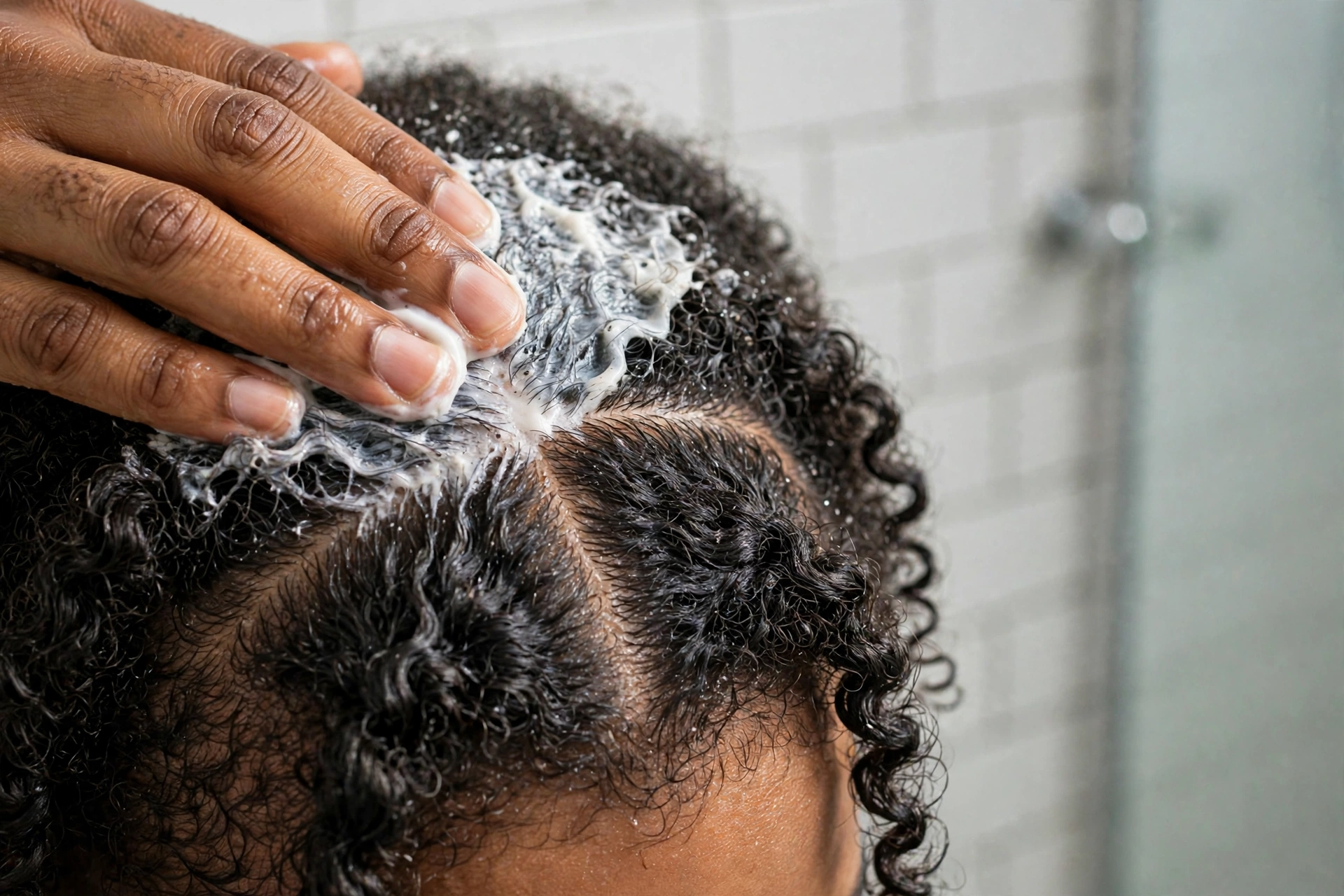
Apply the cleansing conditioner directly to the scalp in one section at a time and massage with the pads of your fingers — never your nails — for 60 to 90 seconds per section. This friction is doing the cleaning work that shampoo’s detergents would otherwise do, so it cannot be a ten-second token rub. You will not get lather like shampoo, and that is normal. No lather does not mean no cleaning, but it also does not prove cleaning happened — the massage time is the honest measure.
Step 3: Second pass — work it through the lengths
Once the scalp is massaged, smooth the remaining conditioner down the lengths of each section and finger-detangle gently, working from the ends upward. This is the point where co-washing earns its reputation: detangling on conditioner-slippery, wet hair causes far less breakage than detangling dry or shampoo-stripped hair. Our guide to detangling without breakage covers the same principle in detail.
Step 4: Let it sit, then rinse until the water runs clear
Leave the conditioner on for three to five minutes, then rinse thoroughly — longer than feels necessary. Run your fingers through each section under the water until the hair feels clean but slippery, not coated or squeaky. A coated, filmy feeling after rinsing is residue, not moisture: rinse more, and next time use less product on the lengths. A squeaky feeling means you have stripped the hair, which co-washing should not do — if that happens, your cleansing conditioner may be harsher than advertised, or you scrubbed too hard.
Step 5: Follow with a leave-in, not a second full conditioner
Some older guides tell you to condition again after the co-wash. For most people that is one layer too many and the single most common cause of the weighed-down, greasy feeling people blame on co-washing itself. Rinse out the co-wash, then apply a light leave-in and seal only if your hair needs it. If your hair still feels dry after that, the answer is a deep conditioner once a week, not a second conditioner on co-wash day.
Reading the Label: Cleansing Conditioner vs Regular Conditioner
The product shelf is where co-washing quietly goes wrong, because bottles rarely say do not use this as a wash. Three label checks separate a real co-wash product from an ordinary conditioner wearing the job title.
First, look for a mild surfactant in the ingredient list: cocamidopropyl betaine is the common one, sometimes alongside gentle cleansers like cocamidopropyl hydroxysultaine. If the ingredient list is only oils, butters, and conditioning agents with no cleanser at all, it is a conditioner, not a wash — fine for conditioning, wrong for co-washing. Second, check the silicones. Non-water-soluble silicones such as dimethicone and amodimethicone build up under co-washing because nothing in the routine removes them; water-soluble ones (anything with PEG- in front of the silicone name) rinse out more easily. A co-wash product heavy in dimethicone is a buildup machine with a friendly label. Third, beware of weight. Thick butters and heavy oils suit coarse, high-porosity hair but sit on fine or low-porosity hair like a coat. For those hair types, a lighter cleansing conditioner used less often beats a rich one used daily — every time.
Price is not a reliable guide here. Several affordable cleansing conditioners use exactly the same mild surfactants as expensive ones, and several expensive co-wash creams are repackaged regular conditioners. Read the ingredient list, not the front of the bottle, and ignore any product that promises growth, repair, or detox in the same breath. Co-washing moisturizes and lightly cleanses. It does not grow hair, repair split ends, or detox a scalp, and a product claiming otherwise is selling you a story, not a wash.
The Reset Schedule That Keeps Co-Washing Working
A co-wash routine without a shampoo reset is a countdown to buildup, so build the reset in from day one instead of adding it after problems appear. This four-week pattern suits most thick, coily hair; adjust the shampoo frequency up if your scalp is oily or your styling load is heavy, and down if your hair is very dry and your routine is light.
Week pattern: co-wash midweek (for example Wednesday) between shampoo washes, shampoo properly once a week with a gentle sulfate-free shampoo, and use a clarifying shampoo once every three to four weeks — or sooner if the buildup signs below appear. Our shampoo guide for 4c hair covers how to pick a gentle shampoo that resets without stripping. Deep-condition once a week on shampoo day, not on co-wash day, so the deep treatment lands on genuinely clean hair.
Think of it as a ratio, not a rule: for most people, one shampoo wash for every one or two co-washes keeps the balance. Two co-washes a week with no shampoo for a month does not. If you co-wash more often than that — after daily workouts, say — shorten the clarifying interval to every two weeks. The clarifying wash is not a punishment for co-washing. It is part of co-washing, the same way rinsing a sponge is part of using it.
Hard water changes the arithmetic too. Mineral deposits from hard water coat the hair in a way co-washing cannot remove, so if your water is hard, the clarifying wash matters even more — our guide to hard-water hair damage explains how to tell whether your water is part of the problem. And if you wear protective styles, co-washing has a different role again: a diluted cleansing conditioner applied along the parts with a nozzle bottle, massaged gently and rinsed carefully, can refresh the scalp between installs — but braids and twists trap residue more than loose hair does, so keep the product light, rinse longer, and never co-wash a style you cannot rinse properly. Our protective styles guide covers the broader care routine around this.

Buildup or Dryness? How to Tell Which Problem You Have
The cruelest co-wash trap is that buildup and dryness feel similar at first — both make hair dull, limp, and hard to style — and the fixes are opposites. Adding more conditioner to buildup makes it worse; clarifying dry hair makes it worse. Use this diagnostic before you change anything.
Signs it is buildup: hair that feels coated or waxy even right after washing; roots that look greasy within a day while the ends feel fine; curls losing definition and clumping into stringy sections; an itchy scalp or small bumps along the hairline; products that used to absorb now sitting on the surface. The test: after your next wash, press a section of damp hair between your fingers. If it feels slippery-filmy rather than soft, that film is residue.
Signs it is genuine dryness: hair that feels rough and straw-like when wet, not coated; ends that snap easily when gently pulled; frizz that appears immediately after drying rather than building over days; a scalp that feels tight but not itchy or bumpy. Dry hair absorbs product hungrily; buildup hair repels it.
The fix for buildup: one clarifying shampoo wash, followed by a normal conditioner — not a deep protein treatment, which adds another layer to coated hair. If one clarifying wash does not clear it, wait a few days and clarify once more rather than scrubbing repeatedly in one session. The fix for dryness: a deep conditioner on shampoo day, a leave-in after every wash, and sealing the ends — not more co-washing, which only helps if the dryness came from over-shampooing in the first place. If neither fix works within two wash cycles, stop guessing: something else is going on, and that is the point at which a dermatologist earns their fee. The American Academy of Dermatology’s healthy hair tips are a good baseline for what normal, healthy hair care looks like — if your routine already matches them and your hair still struggles, get professional eyes on it.
Frequently Asked Questions
Can I co-wash every day?
You can, but most hair does not need it and buildup arrives faster. Daily co-washing suits a narrow case: very thick, coarse, high-porosity hair in a hot climate or after daily workouts, with a weekly shampoo and a fortnightly clarifying wash. For everyone else, every three to five days is plenty, and daily washing of any kind — even gentle washing — keeps hair wet longer, which weakens it over time.
Can I use my regular conditioner to co-wash?
Occasionally, in a pinch, yes — but not as a routine. Regular conditioner lacks the mild surfactants that do the actual cleansing, so regular-conditioner co-washing mostly coats rather than cleans. If you co-wash more than once a week, use a product actually made for it, and check the label for a gentle cleanser and no heavy silicones.
Will co-washing make my hair grow faster?
No — and be suspicious of any product or guide that says so. Co-washing can help length retention, which is different: by reducing breakage from harsh washing and dry detangling, more of the hair you grow stays on your head. Growth itself happens at the follicle, and no wash method changes that rate. Retention is still a real win, but it is not growth, and honest guides should say which one they mean.
Why is my hair still dry after co-washing?
Three usual causes, in order: you are co-washing with a product too light for your hair, so it never delivered enough moisture; you have buildup blocking moisture from getting in, so the hair is coated rather than hydrated; or you are skipping the leave-in and seal after rinsing, so whatever moisture the co-wash delivered evaporates. Work through them in that order before buying a new product.
Should I stop co-washing if my scalp itches?
Yes — pause it and shampoo properly. An itchy scalp on a co-wash routine is the earliest warning sign of buildup or scalp irritation, and pushing through it is how a mild problem becomes a dermatitis flare. If the itching clears after a shampoo and clarifying reset, you can return to co-washing with a lighter product and a shorter reset interval. If it does not clear within a week or two, or you see redness, scaling, or hair loss, see a dermatologist rather than trying another product.
Disclaimer: This article is general hair-care information, not medical advice. Scalp conditions, unusual shedding, or hair loss should be checked by a dermatologist, especially if symptoms persist, worsen, or include redness, pain, or patchy loss.
