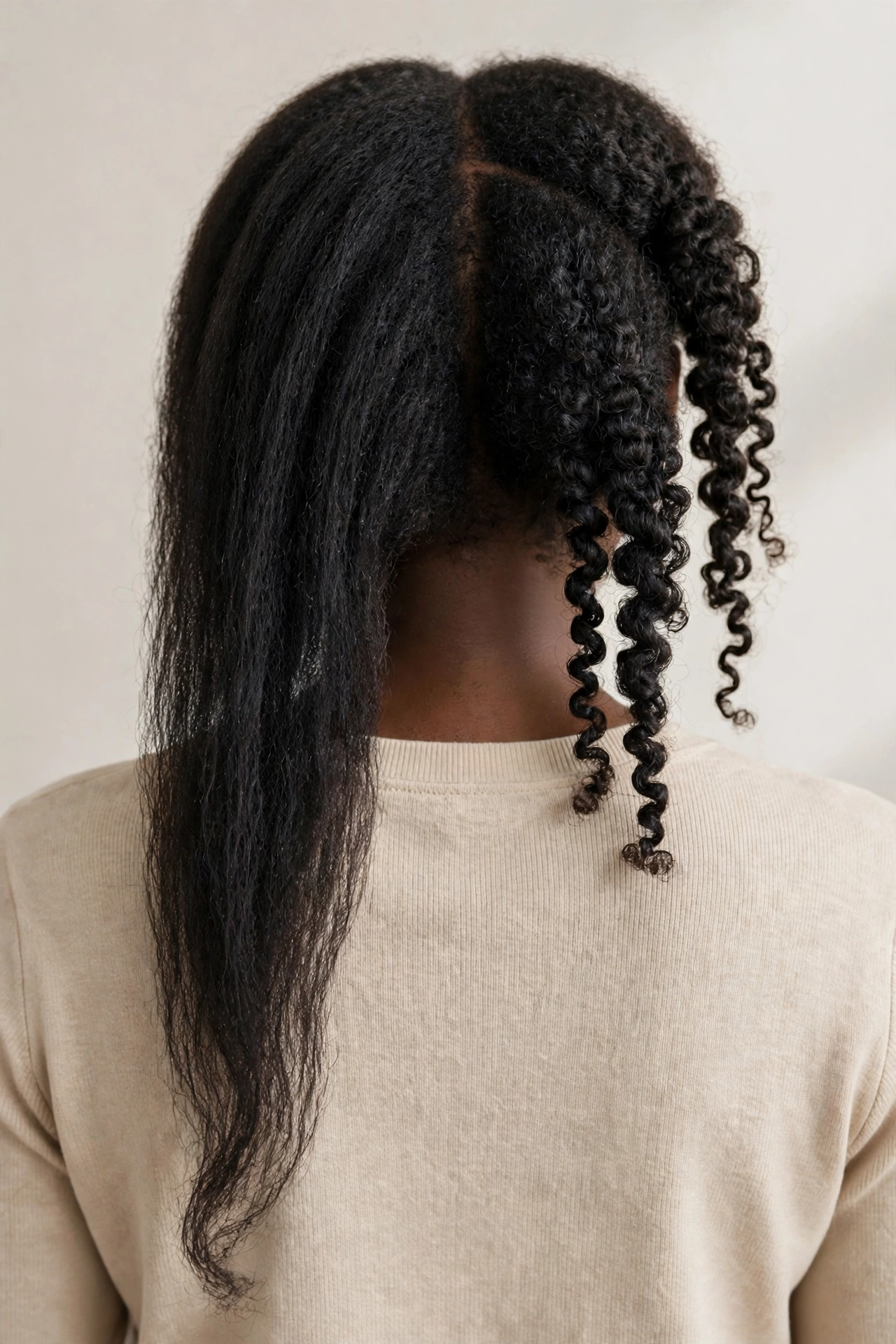
Natural Hair Shrinkage: Why Your Hair Looks Shorter — and How to Stretch It Safely
 Maya Thompson
📅 October 31, 2026
⏱ 18 min read
You wash your hair, detangle it carefully, and watch it hang several inches longer while it is wet. By the time it dries, half that length seems to have vanished. Nothing broke. Nothing fell out. The hair is still there — it has just folded itself back up, coil by coil, into a much shorter shape. That disappearing act is natural hair shrinkage, and it is one of the most misunderstood things about curly and coily hair.
Most articles about it jump straight to a list of stretching tricks. That skips the two questions that actually decide whether any trick will work for you: how much of your length is really being hidden, and what kind of result do you want — a length check, an easier detangling session, or a style that lasts three days? Answer those first, and the methods below stop being a random list and start being choices.
Measure your own shrinkage before you try to fix it
Guessing your shrinkage from a mirror is unreliable, because different sections of one head shrink by different amounts. The nape almost always shrinks more than the crown, and the front often behaves differently from the back. A five-minute measurement gives you a baseline that every later experiment can be judged against.
On freshly washed, soaking-wet hair, pick three sections: one at the crown, one at the nape, and one at the front hairline. Gently pull one strand (or a small section) straight down until it stops stretching on its own — do not yank it — and note where it reaches against your body: chin, collarbone, shoulder, armpit. Let go, let it dry completely untouched, and note where the same section ends up dry. The difference between the two points is your shrinkage for that section.
To turn it into a number, measure a single strand wet-stretched and dry with a soft tape measure, then use this: (wet length minus dry length) divided by wet length, times 100. A strand that stretches to 20 centimetres wet and dries at 8 centimetres has shrunk by 60 percent. Writers and stylists commonly quote figures of roughly 30 to 75 percent for type 4 hair, but those are broad reported ranges, not measurements of your head — which is exactly why your own three-section check matters more than any number in an article, including this one.
Repeat the check after any new stretching method. If banding takes your nape section from 60 percent shrinkage to 25 percent, that method works for you. If a product claims to “fight shrinkage” but your numbers do not move, the product is doing something else — probably adding moisture or hold — and you can stop paying for a promise it never kept.
Why coils spring back: it is geometry, not failure
Hair shape is set by the follicle it grows from and by the bonds inside the shaft. Curly and coily follicles are curved rather than straight, and the hair shaft itself is elliptical rather than round, with its structural proteins distributed unevenly around the fibre. That asymmetry is what makes the strand bend into a curl or coil in the first place.
The second part of the mechanism is water. Inside the hair shaft, keratin proteins are held together by strong disulfide bonds, which set the permanent shape, and by much weaker hydrogen bonds, which break when hair gets wet and reform as it dries. Wet hair can be pulled straight because those weak bonds are temporarily undone; as it dries, they reform and pull the strand back toward its coiled shape. That is why shrinkage is fully reversible with water, and why a stretched style collapses in humidity: moisture in the air is quietly redoing the same bonds.
There is an important consequence that most shrinkage articles bury or skip. Because the strand returns to its shape instead of staying stretched, shrinkage is a sign of elasticity — the hair can stretch and rebound without breaking. It is not evidence that your hair is unhealthy, damaged, or “not growing.” If your hair stretches when wet and springs back when dry, the system is working as designed. Stretching is therefore a styling choice, not a repair.
One more piece of honesty about the science: coily hair does break more easily during grooming, but the reason is mechanical, not a built-in defect. A 2005 microscopy study comparing hair from Black African, Caucasian, and Asian volunteers found no abnormality in the distribution of cystine-rich proteins in African hair; the authors concluded that the structural damage observed was consistent with physical trauma from grooming rather than an inherent weakness. A later clinical review put it more plainly for everyday care: knot formation from intertwined fibres makes combing difficult and predisposes the hair to breakage during normal grooming. In other words, the danger in stretching is not the stretch itself — it is rough handling while the hair is at its most fragile. That distinction shapes every safety rule below.
Shrinkage is not the same as three other problems
People blame shrinkage for things it did not cause, and then treat the wrong problem. Before you stretch anything, check which of these you actually have.
| What you see | Likely cause | Quick test |
|---|---|---|
| Hair looks much shorter dry than wet, but stretches back out when wet | Normal shrinkage | Wet a section: it lengthens immediately |
| Short pieces on your clothes, sink, or comb, with no bulb at the end | Breakage | Look at the ends of shed pieces: broken pieces have no root bulb |
| Full-length strands with a small white bulb, mostly in the shower drain | Normal shedding | The bulb means the strand completed its growth cycle |
| Stretched length itself getting shorter month by month | Length loss: breakage outpacing growth | Compare monthly stretched measurements, not dry appearance |
If your stretched length is shrinking over months, stretching techniques will not solve it — you are losing length to breakage, and the fix is gentler handling, not a better banding method. Our guide to hair shedding vs breakage walks through that diagnosis in full. If only the dry length bothers you, you have a shrinkage question, and the rest of this article is for you.
The honest comparison: seven ways to stretch, side by side
Every competitor list names the same methods. Almost none of them compare the methods against each other, so readers pick at random and blame themselves when a method does not suit their hair or their schedule. Here is the comparison those lists skip.
| Method | Stretch level | Time | Skill needed | Main risk | Best for |
|---|---|---|---|---|---|
| Banding | High | Overnight or until fully dry | Low | Dents at band points; tension at the root if bands are tight | Length checks, prepping for styles, all type 4 hair |
| African threading | Highest (heat-free) | Overnight; slower to install | Medium | Too-tight wrapping; thread snagging on removal | Maximum stretch without heat |
| Twist-out / braid-out | Medium | Overnight | Low | Frizz if unravelled while damp | Defined, stretched styles with wave or curl pattern |
| Roller / flexi-rod set | Medium-high | Until fully dry (hours) | Medium | Uneven stretch if sections vary in size | Smooth, elongated curls |
| Tension blowout | High | 30–60 minutes | Medium-high | Heat damage if heat is high or hair is dry | Fastest stretch; fluffy volume |
| Bantu knots | Medium | Overnight | Low-medium | Knots left too long tangle at the base | Stretch plus bouncy curl definition |
| Pineapple / overnight preservation | Preserves, does not create | Minutes | Low | Almost none if kept loose | Keeping a stretched style alive for days |
Two rules apply to every row of that table. First, stretch damp hair, never dry hair and never soaking-wet hair: damp strands dry into the elongated position, while dry strands just get pulled without setting, and soaking hair takes so long to dry that the underneath layers stay damp and spring back first. Second, never remove any method before the hair is completely dry — not “mostly dry,” completely. Taking bands out early is the single most common reason a stretch “did not work.”
Banding: the best starting point, done gently
Banding is the method to try first because it needs no skill, no heat, and no special tools beyond soft, snag-free bands. Work on damp, detangled, moisturised hair. Divide it into sections — smaller sections stretch more — and place bands along each section from root to tip, spaced evenly. Closer bands mean more stretch; wider spacing means less. The bands should hold the hair, not strangle it: if your scalp feels pulled or you see the skin dimpling at the root, the band is too tight, and tightness at the root is exactly how a harmless stretch becomes a tension problem.
Leave the bands in until the hair is fully dry, ideally overnight, then remove them gently, sliding rather than pulling. Expect small dents where each band sat; they soften as you style. Banding is also the most honest length check available: it shows your stretched length without heat, without chemicals, and without pretending the result is permanent.

African threading: the strongest heat-free stretch, with one warning
Threading wraps thread around damp sections from root to tip, holding them straight as they dry. It gives the most dramatic heat-free stretch of any method here, and it has a long history as a traditional technique rather than a new trend. Its weakness is installation time and removal care: wrapping too tightly, or yanking thread off dry hair, can snap strands and irritate the scalp. Wrap firmly but not painfully, keep sections small enough that the thread can hold them straight, and unwind patiently. If threading feels like a chore, that is useful information — banding gives most of the same result for a fraction of the effort, and a method you will actually repeat beats a stronger method you use once.
Twist-outs, braid-outs, rollers, and Bantu knots: stretch with a style attached
These four are worth grouping together because they do two jobs at once: they stretch the hair and they set a pattern. Bigger twists and braids give more stretch and looser waves; smaller ones give more definition and less length. Roller sets give the smoothest, most elongated curl but demand the most even sectioning — uneven sections are why one side comes out stretched and the other does not. Bantu knots give stretch plus springy curl, but do not leave them in for days hoping for extra stretch; knots left too long tangle at the base and cost more breakage than the stretch was worth. In all four, the same rule decides success: unravel only when fully dry, and separate the sections with oiled fingers rather than a comb if you want to keep frizz down.
Tension blowout: the fast option, with real heat rules
A tension blowout — holding each section taut while drying it on low heat — is the fastest way to stretch, and it is the method most likely to cause damage when done carelessly. The safe version has four non-negotiable parts: start with hair that is already mostly air-dried, use a heat protectant, use the lowest heat setting that gets the job done, and keep the dryer moving instead of parking it on one section. The American Academy of Dermatology warns that styles that pull can lead to hair loss, and that warning applies to heat-plus-tension just as much as to tight braids: tension is tension, whatever tool creates it. If your hair is already heat-damaged, colour-treated, or breaking easily, skip the blowout until the breakage is under control — stretching damaged hair faster is not a shortcut, it is a second problem.
Pick a method by your hair type and your goal
There is no single best method, but there are bad matches. Looser curls (3C, 4A) usually need less force: a twist-out or braid-out often gives all the stretch they need, and heavy banding can leave dents that take longer to fall out. Tighter coils (4B, 4C) usually need more structure: banding or threading, in smaller sections, because a loose twist on 4C hair can dry into a shrunken twist rather than a stretched one. If your goal is a length check, banding wins — it is the most repeatable, so month-to-month comparisons mean something. If your goal is a style you will wear, pick the method whose finished pattern you actually like; a braid-out you love beats a threading result you immediately restyle. If your goal is easier detangling before braids or a protective style, banding or threading the night before wash day’s end gives you stretched, separated sections to work with — and our protective styles guide explains why starting from stretched hair makes installs gentler on the edges.
The stretch-day sequence that actually works
Methods fail more often from sequence than from technique. This order is the one that makes every method above work better.
Step 1: Detangle before you stretch, not during
Stretching tangled hair locks the tangles into their stretched position. Detangle on damp, conditioned hair with fingers or a wide-tooth comb, working from ends to roots, before any band, thread, or twist goes in.
Step 2: Moisturise lightly, then seal only if your hair needs it
Apply a leave-in to damp hair. A light oil or cream on top can slow moisture loss while the hair dries, but heavy butters are not a shrinkage cure: they weigh the hair down while wet and then trap buildup, which makes the next wash day harder. Use the lightest layer that keeps your hair soft while it dries.
Step 3: Section smaller than you think you need
Big sections dry unevenly — dry outside, damp inside — and the damp core springs back overnight. Smaller sections take longer to install and dry far more evenly, which is why the nape, the section people rush most, is also the section that disappoints most.
Step 4: Dry completely before you touch it
Air-dry fully, or diffuse on low heat if you must speed things up. Test the thickest section, usually at the nape, before removing anything: if it feels even slightly cool or damp, it is not done.
Step 5: Take it down gently and leave it alone
Remove bands, thread, or twists slowly, separate with oiled fingers, and resist restyling with a comb. Every extra manipulation after takedown trades stretch for frizz.
Why stretched hair collapses by noon — and how to slow it
Four culprits account for most collapses. Humidity is the first: moisture in the air breaks and reforms those weak hydrogen bonds, so a stretched style in a humid climate will always have a shorter life than the same style in dry air. A light sealing layer helps, but no product makes hair humidity-proof, and any product claiming otherwise is selling weather control it cannot deliver. The second culprit is a damp core, covered above: if the inside of a section was still damp at takedown, it finishes drying in its shrunken shape. The third is product weight: heavy creams and butters pull stretched curls down unevenly and invite buildup, which is why a stretched style can look greasy and flat by afternoon. The fourth is touching: hands, scarves, and high collars push sections back toward their coil, especially at the nape.
Overnight preservation is where most stretched styles are actually saved or lost. A loose pineapple — gathered high and loosely, never pulled tight — plus a satin bonnet or scarf reduces friction and moisture loss while you sleep. Our guide to silk for natural hair explains why satin and silk beat cotton here: cotton absorbs moisture from the hair and drags at the cuticle. Re-band or re-twist only the sections that collapsed, rather than redoing the whole head, and your stretch can realistically last two to four days depending on humidity and how much you handle it.

When not to stretch
Stretching is safe for healthy hair done gently. It is the wrong move in a few specific situations, and naming them is more useful than another list of tips. Do not stretch hair that is actively breaking in large amounts — fix the breakage first. Do not stretch with tight tension if your edges are already thinning; tension on already-stressed follicles is how temporary thinning becomes lasting loss, and our edges regrowth guide explains the difference between breakage you can recover from and follicle loss you may not. Do not stretch on a tender, irritated, or freshly scratched scalp, and do not stretch immediately after a relaxer touch-up or colour service, when the shaft is at its most fragile. And do not stretch a child’s hair with adult-level tension or overnight methods that pull: children’s follicles and scalps are more vulnerable, and a style is never worth that trade.
Troubleshooting: the five complaints that come up most
Bands keep slipping off. Your hair was probably too dry or too smooth when you started. Band on damp, lightly moisturised hair, and use fabric-covered bands that grip without snagging. Rubber bands and thin elastics cut into the shaft and snap strands on removal — throw them out for this purpose.
The nape never stretches as much as the top. Normal, and fixable: the nape is denser and curls tighter, so it needs smaller sections and more drying time than the crown. Section the nape separately and check it last before takedown.
One side is longer than the other. Uneven section sizes, not uneven hair. Keep sections roughly the same size on both sides, and install in the same order so drying time is even.
The stretch looks great, then turns into a frizz halo. You probably separated the sections too aggressively or with a comb, or you unravelled while still damp. Next time, separate only when fully dry, with oiled fingers, and stop at “good enough” — every extra separation adds frizz.
Knots appeared after banding or threading. Small sections were skipped during detangling, or bands were left in for days. Stretching is an overnight method, not a week-long install; take it down once dry, detangle gently, and restyle.
Frequently Asked Questions
Can natural hair shrinkage be stopped permanently?
No. Temporary stretching changes how the strands are arranged while they dry; water, washing, and humidity let them contract again. Only chemical straightening permanently changes treated hair, and excessive heat can damage the curl pattern permanently — both are very different from a braid-out or banding, and neither is a shrinkage “cure” worth the cost.
Does stretching damage natural hair?
Gentle stretching on damp, detangled hair does not. Damage comes from the extras: tight tension at the root, pulling dry hair, rough removal, and high heat. If a method hurts your scalp, it is too tight, whatever the tutorial said.
Why does the back of my hair shrink more than the front?
The nape is usually denser with a tighter curl pattern than the crown or front, so it coils more compactly and takes longer to dry. Smaller sections and a final dryness check at the nape close most of that gap.
Can a product stop shrinkage?
No product stops the coil from springing back — that is set by the follicle and the bonds in the shaft. Products can help indirectly: a good leave-in makes detangling gentler, and a light sealant slows moisture loss so a stretched style lasts longer. Judge a product by your own shrinkage measurements, not by its label.
How often can I stretch my hair?
As often as you wash and restyle, provided each stretch is gentle and the hair is fully dry before takedown. If you notice more breakage, more knots, or a sore scalp, that is your signal to stretch less often or more loosely — not to buy a stronger product.
The honest bottom line
Shrinkage is not a flaw in your hair, and it is not a problem you solve once and forget. It is the visible proof that your coils are elastic and alive. Measure it, pick a stretching method that matches your hair type and your actual goal, stretch damp hair gently, dry it completely, and protect it overnight. Do that, and you get the length you already have — on the days you want it — without trading your curl pattern for it.
Disclaimer: This article is for general information only and is not medical advice. If you notice patchy hair loss, a sore or inflamed scalp, or shedding that suddenly increases, see a dermatologist rather than trying a new styling method.
Further reading from research and dermatology sources: the clinical review of hair breakage in patients of African descent describes how knot formation and grooming contribute to breakage, and the 2005 microscopy study by Khumalo and colleagues found that the apparent fragility of African hair was consistent with grooming-related physical damage rather than an inherent structural abnormality.
