4C Hair Mistakes to Avoid: 12 Habits Quietly Damaging Your Hair (and What to Do Instead)
 Maya Thompson
📅 October 3, 2026
⏱ 19 min read
4C hair is not fragile in the way it looks fragile. It is actually strong — a single strand of 4C hair can stretch and spring back. The problem is shape: those tight coils twist at sharp angles, and every sharp bend is a structural weak point where breakage can start. That is why so many people with 4C hair feel their hair “doesn’t grow.” It does grow — hair grows from the scalp at roughly the same rate for everyone. What is missing is retention. The length you gain at the roots keeps breaking off at the ends.
This article is about the habits that steal that length. Not exotic causes, not rare conditions — ordinary, everyday mistakes that millions of people with 4C hair make on wash day, at bedtime, and in the styling chair. Fixing them does not require a cabinet full of new products. It requires knowing what is actually happening to your hair when you do them. Here are the 12 most common ones, each with the warning signs that tell you it is happening to you, and a concrete fix.
How This List Was Built
No lab coats were involved. We did not test products on swatches or under microscopes, and any site that claims it did — without showing its work — is asking you to trust it blindly. This list is research-based: it combines what board-certified dermatologists publish for the public (especially the American Academy of Dermatology’s guidance on caring for Black hair), peer-reviewed research cited where it matters, and the complaints that reviewers and bloggers with 4C hair report most consistently. It is also a companion to our complete 4C hair care routine, which lays out the routine itself — this piece focuses only on what undermines it.
Mistake #1: Detangling Dry Hair
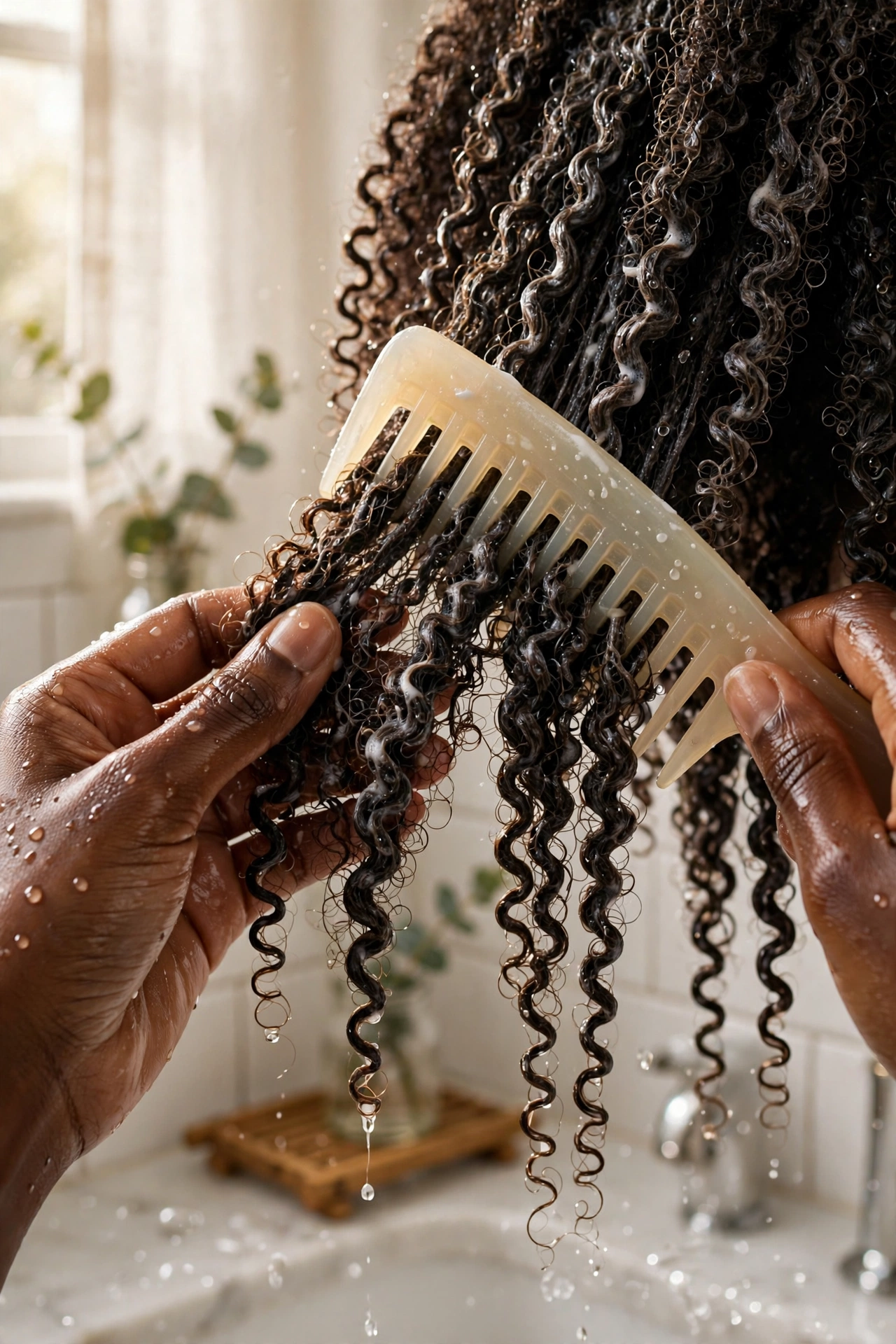
Dry detangling is the single most common way 4C hair gets broken on purpose — by its owner. When 4C hair is dry, its cuticles sit lifted and rough, and the coils interlock with each other like velcro. Dragging a comb through that state does not remove knots; it snaps the strands holding them. Dry detangling is fast, but the price is paid in broken hairs all over your bathroom floor.
How to tell you are making this mistake: You hear snapping sounds while you detangle. Your comb comes away with full-length broken strands (not short shed hairs with a white bulb at the end — those are normal shedding). Your hair feels rough and “catches” even when you pull gently.
Do this instead: Always detangle on damp, conditioned hair. Saturate your hair with water, apply a slippery conditioner or detangler, and work in small sections with your fingers or a wide-tooth comb, starting from the ends and moving up toward the roots. Our guide on how to detangle natural hair without breakage walks through the full technique section by section.
Mistake #2: Skipping Deep Conditioner
Regular rinse-out conditioner sits on the surface of the hair for a minute or two and washes away. 4C hair — the driest of all hair types, because scalp oils take far longer to travel down tight coils — needs more than surface treatment. A deep conditioner stays on for 15 to 30 minutes (often with gentle heat), giving humectants and emollients time to actually soften the strand and reduce friction. Skipping it turns every future styling session into a fight with dry, grabby hair.
How to tell you are making this mistake: Your hair feels stiff and “crunchy” the day after wash day. Styles fall apart fast. You keep adding leave-in products to compensate for a dryness that never quite goes away.
Do this instead: Deep condition every wash day, or at least every other one. Sit under a heat cap or warm towel for 15–20 minutes to help the product penetrate, then rinse with lukewarm water. If you are not sure which products are worth buying, see our roundup of the best deep conditioners for natural hair. And be honest with yourself about protein moisture balance in 4C hair: deep conditioners are moisturizing; if your hair feels mushy and stretches too much when wet, you may need a protein treatment instead — but for most people, the missing piece is moisture, not protein.
Mistake #3: Washing Too Often (Overwashing)
Because 4C hair dries out easily, many routines borrowed from looser hair types do damage here. Washing every two or three days strips the small amount of natural oil the scalp has managed to send down the shaft, and 4C hair cannot replace it quickly. The result is a permanent state of dryness that no amount of leave-in can fully fix. How often to wash 4C hair is one of the most searched 4C questions precisely because so many people were told to wash far too frequently.
How to tell you are making this mistake: Your hair is dry no matter what products you use. Your wash day feels like a battle against frizz from the first minute. You wash three or more times a week and wonder why nothing retains moisture.
Do this instead: Most people with 4C hair do well washing once a week or every 10–14 days, using a sulfate-free shampoo. Between washes, refresh the scalp and moisturize the ends without a full wash. If you exercise or sweat heavily, a water-only rinse with conditioner on the ends is gentler than another full shampoo.
Mistake #4: Never Shampooing — Co-Wash Only
This is the mirror image of mistake #3, and it is just as common now that co-washing is popular. Conditioner-only washing never fully removes the residue that conditioners, oils, butters, gels, and edge controls leave behind. Layer upon layer builds up on the scalp and strands. Co-wash vs shampoo for 4C hair is not an either/or question: co-washing between shampoos is fine, but shampoo is the only thing that actually cleans.
How to tell you are making this mistake: Your scalp feels coated or waxy even right after washing. Products seem to “sit on top” of your hair instead of absorbing. You have flakes, itching, or a dull film on your strands that no amount of product seems to fix. That film is product buildup on 4C hair, and it blocks moisture from getting in.
Do this instead: Use a clarifying or sulfate-free shampoo at least every 2–3 washes — or monthly as a reset — even if you co-wash in between. Massage the scalp thoroughly with your fingertips (never your nails) and rinse completely. If your scalp is itchy or flaky, that is a sign to shampoo more, not less.
Mistake #5: Heat Styling Without Protection — or Too Often
Heat on 4C hair is not evil, but heat without a barrier is. A flat iron or blow dryer at high temperatures boils the water inside the hair strand, bursting the cuticle from the inside out. Heat damage on 4C hair is special because it is often permanent: once a coil’s hydrogen bonds are broken by excessive heat, that section may never curl back — the dreaded “heat-trained” straight pieces that hang limp among your coils.
How to tell you are making this mistake: Some sections of your hair are straight or looser than the rest even when wet and clean. Your hair feels rough or “crispy” at the ends. You straighten or blow out weekly and skip heat protectant because it feels like “one more product.”
Do this instead: Always use a heat protectant — every single time, no exceptions. Keep flat irons at or below the lowest temperature that works (many people do not need more than 350°F / 175°C), make single passes, and limit straightening to special occasions rather than a weekly habit. Air-dry or use the tension method with a blow dryer on medium heat for a safer stretch.
Mistake #6: Tight Hairstyles
Constant tension — tight braids, ponytails pulled back hard, heavy extensions, edges gelled to the scalp — can cause traction alopecia, a form of hair loss caused by pulling. The American Academy of Dermatology warns that tight hairstyles can lead to traction alopecia, and it is the one hair loss type on this list that can become permanent: if follicles are scarred, the hair does not grow back.
How to tell you are making this mistake: You get tension bumps, headaches, or soreness after a style is installed. Your edges are thinning or your hairline is receding. You notice small broken hairs around the hairline. If a style hurts, it is damaging your follicles — pain is the signal.
Do this instead: Protective styles should protect, not punish. Tell your stylist immediately if braids hurt — “no pain, no gain” does not apply to hair follicles. Alternate tight styles with loose ones, give your edges regular breaks, and keep styles to 4–6 weeks max. If you are losing your edges, see our piece on 4C hair breakage for recovery guidance — and if thinning continues, see a dermatologist promptly, because early traction alopecia is reversible and late-stage scarring is not.
Mistake #7: Neglecting the Ends and Skipping Trims
The ends of your hair are the oldest part — they have survived years of wash days, styling, and weather. On 4C hair they are also the thinnest and most exposed. Split ends on 4C hair do not heal; once a strand splits, the split travels upward like a run in stockings, destroying healthy length above it. Many people avoid trims because they fear “losing length,” but skipping trims is precisely what loses length: split ends break off on their own, taking more hair with them than scissors ever would.
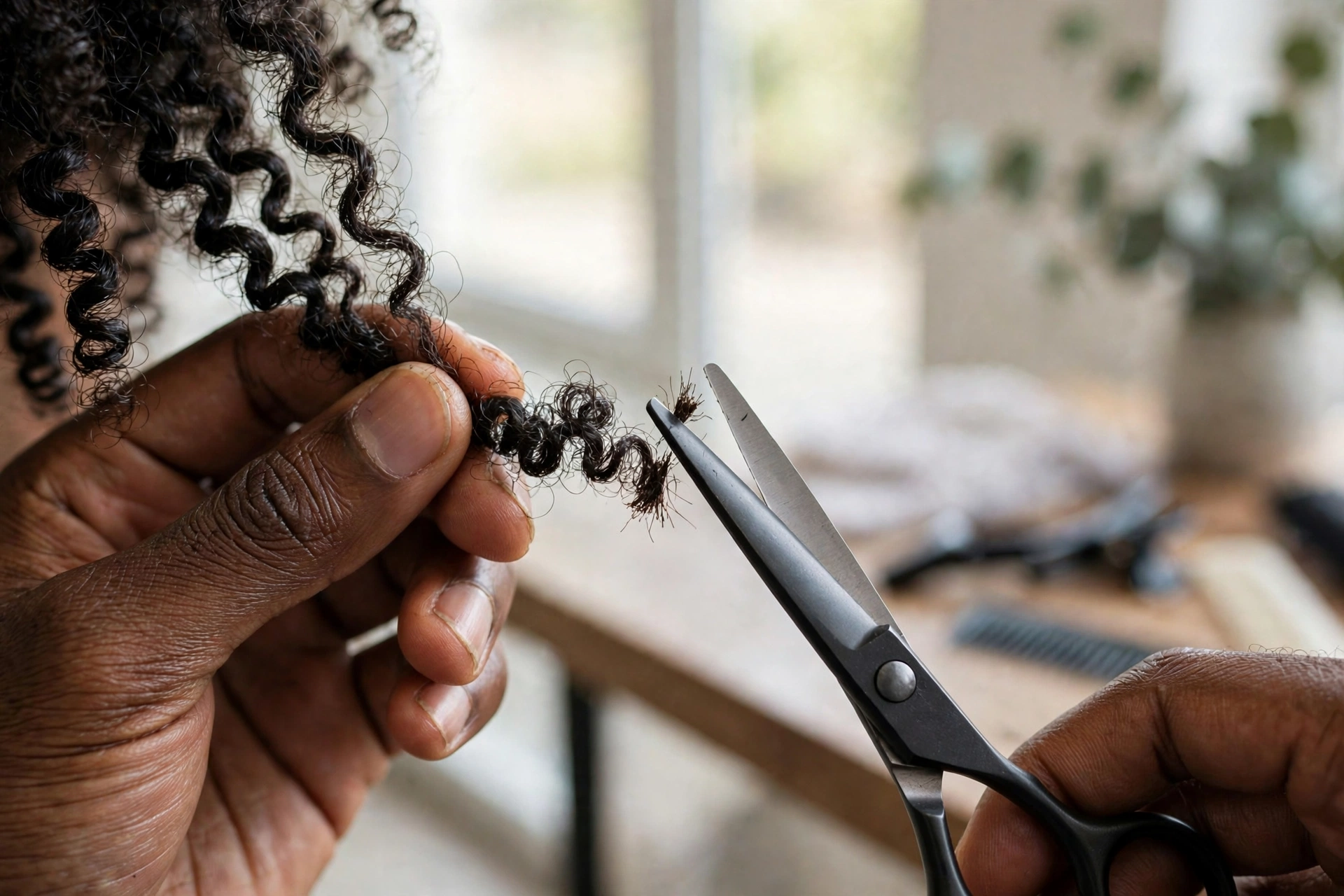
How to tell you are making this mistake: Your ends feel thin, see-through, or rough compared to the roots. You see tiny white dots or forked tips when you inspect single strands. Your hair grows at the roots but the length never increases — classic retention failure.
Do this instead: Trim every 8–12 weeks, or dust (trim a tiny amount) more often if your ends split easily. You do not need a big chop — removing a quarter inch of damaged ends preserves far more length over a year than letting splits eat their way up. And moisturize and seal your ends specifically on wash day; they dry out first.
Mistake #8: Product Overload and Constant Product-Hopping
Using ten products per wash day, or switching to a new product every week because an influencer praised it, makes it impossible to know what is actually working. Worse, layering product on product is the fastest route to the buildup described in mistake #4. If something goes wrong — breakage, dryness, itching — you cannot identify the culprit, so you add yet another product. The cycle feeds itself.
How to tell you are making this mistake: You cannot remember which products you used last wash day. Your bathroom shelf holds half-used bottles you have stopped trusting. Your hair feels coated, dull, or “heavy” even after washing, and changing products weekly has not fixed anything.
Do this instead: Run a minimal core routine for at least a month: one shampoo, one conditioner, one deep conditioner, one leave-in, one oil or butter for sealing. Change one product at a time and give it 3–4 washes before judging it. Products are not magic — the honest truth is that technique (how you detangle, how you moisturize, how you protect at night) matters more than any bottle.
Mistake #9: Wrong Detangling Tools (Fine-Tooth Combs)
A fine-tooth comb on 4C hair is a breakage machine. The teeth are too close together for thick, coily density — instead of passing through tangles, the comb snags and shears strands in half. Brushes with stiff, tightly packed bristles do the same on dry or even damp hair. The tool matters as much as the technique.
How to tell you are making this mistake: You lose a noticeable amount of hair every time you comb, in broken pieces rather than full shed strands. Combing feels like a workout. Your comb has fine teeth, or your brush was designed for straight hair.
Do this instead: Fingers first — they feel tangles before they break them. Then a wide-tooth comb or a detangling brush designed for thick, coily hair, always on damp, well-conditioned hair, in sections, ends to roots. Reserve fine-tooth combs for smoothing edges and parting only, never for detangling.
Mistake #10: Sleeping Without Protection
Cotton pillowcases are moisture thieves. Cotton absorbs the water and products you put into your hair, and the friction of tossing on cotton all night roughs up the cuticle, tangles the coils, and creates the dry, matted morning hair that then gets yanked through during detangling. Eight hours of friction every night is a lot of cumulative damage.

How to tell you are making this mistake: Your hair is noticeably drier and more tangled in the morning than when you went to bed. Your pillowcase has product stains. Wash day styles fall apart overnight and you restyle daily, adding more manipulation.
Do this instead: Sleep in a satin bonnet for 4C hair (or a silk/satin scarf), every night, no exceptions — including naps. If bonnets slip off, a satin pillowcase is a solid backup. Pineapple your hair (a loose high ponytail) or twist it into a few loose sections before covering to preserve stretched styles with less morning manipulation.
Mistake #11: Harsh Chemical Relaxers Without Recovery Care
Relaxers permanently break the disulfide bonds that give 4C hair its coil. That is a structural change, not a cosmetic one — the hair is weaker from that moment on, more porous, more breakage-prone, and needs deliberate recovery care (protein treatments, gentler handling, longer stretches between touch-ups). Treating relaxed hair like it is still fully natural is how severe breakage happens.
There is also a documented health association worth knowing about. An NIH study linked frequent chemical straightener use to higher uterine cancer risk: the 2022 Sister Study followed 33,497 women and found that those who used straightening chemicals frequently had a 4.05% risk of uterine cancer by age 70, compared with 1.64% among non-users. To be honest about what this means: this is an association, not proof that relaxers cause cancer in any individual, and the researchers noted the finding needs more study. But it is a real, peer-reviewed result from the NIH, and it deserves to be part of an informed decision.
How to tell you are making this mistake: You relax every 4–6 weeks without stretching, overlapping the relaxer onto already-relaxed hair. Your hair breaks at the line where new growth meets relaxed hair. You have never done a protein treatment or a dedicated recovery routine.
Do this instead: Stretch relaxers to 10–12 weeks if you can, never overlap onto previously relaxed hair, and build a recovery routine with protein treatments and deep conditioning. Consider whether you actually want to keep relaxing — many people transition to natural hair precisely to escape this cycle — but if you relax, do it on a professional’s schedule with recovery care, not as a rushed home routine.
Mistake #12: Ignoring the Scalp
Everything on this list is about the strands, but hair grows from the scalp — and a neglected scalp undermines all of it. Scalp buildup on 4C hair from infrequent shampooing, heavy butters applied directly to the scalp, and product residue can clog follicles, cause itching and flaking, and create the conditions for inflammation that weakens new growth. Your scalp is skin; it needs cleaning, not coating.
How to tell you are making this mistake: Your scalp itches regularly. You see flakes or a waxy layer when you scratch. You apply heavy oils and butters directly to the scalp “to moisturize it,” but it feels worse, not better. New growth feels weak or breaks easily near the roots.
Do this instead: Shampoo the scalp thoroughly and regularly (see mistakes #3 and #4 for the balance). Keep heavy butters and oils off the scalp — they belong on the lengths and ends. If itching, flaking, soreness, or patchy loss persists, see a dermatologist rather than buying more products; scalp conditions like seborrheic dermatitis need treatment, not heavier moisturizer.
4C Hair Mistakes: What Is Happening vs. The Fix
| Mistake | What is happening to your hair | Fix at a glance |
|---|---|---|
| Detangling dry hair | Coils interlock dry; combing snaps strands at the bends | Detangle damp, conditioned, in sections, ends to roots |
| Skipping deep conditioner | Strands stay chronically dry; styling fights you | Deep condition every wash day, 15–20 min with gentle heat |
| Washing too often | Natural oils stripped faster than 4C hair can replace them | Wash every 1–2 weeks with sulfate-free shampoo |
| Never shampooing | Product residue coats strands and blocks moisture | Shampoo every 2–3 washes; clarify monthly |
| Unprotected heat styling | Cuticles burst; coils may straighten permanently | Heat protectant every time; lower temps; less often |
| Tight hairstyles | Follicles pulled; traction alopecia can scar permanently | No-pain styles only; edges get regular breaks |
| Skipping trims | Splits travel upward, destroying healthy length | Trim every 8–12 weeks; moisturize ends specifically |
| Product overload | Buildup; impossible to tell what works | Minimal core routine for a month; change one thing at a time |
| Fine-tooth combs | Teeth shear strands instead of passing through tangles | Fingers first, then wide-tooth comb on damp hair |
| Sleeping unprotected | Cotton steals moisture; friction roughs up cuticles nightly | Satin bonnet or scarf every night |
| Relaxers without recovery | Permanently weakened bonds; breakage at the demarcation line | Stretch to 10–12 weeks; protein + deep conditioning recovery |
| Ignoring the scalp | Clogged follicles; itching, flaking, weaker new growth | Clean the scalp regularly; keep heavy products off it |
The 3 Most Damaging Mistakes, Ranked
All twelve matter, but if you only have the energy to fix three things, fix these — in this order:
#1 — Tight hairstyles. This is the only mistake on the list that can cause permanent, irreversible hair loss. Breakage grows back; scarred follicles do not. If your edges are thinning, this is not a styling preference issue — it is a medical one. Loosen the style today and see a dermatologist if thinning continues.
#2 — Dry detangling. It is the most frequent damage event in most 4C routines, happening every wash day and sometimes daily. The breakage is constant, invisible in the moment (a few strands here, a few there), and devastating over months. Switching to damp, conditioned detangling is the single biggest retention win most people can make.
#3 — Skipping deep conditioner. Everything else gets harder without it. Dry hair tangles more (making detangling worse), breaks more (making trims more urgent), and styles worse (making you reach for heat or tighter styles to compensate). Deep conditioning is the foundation the other eleven fixes stand on.
Frequently Asked Questions
Is it bad to detangle 4C hair dry?
Yes — it is one of the most damaging common habits. Dry 4C coils interlock, and forcing a comb through them snaps strands at their weakest bends. Always detangle on damp, conditioned hair in sections, working from the ends up. If you hear snapping, stop and add more conditioner, not more force.
How often should you wash 4C hair?
Most people with 4C hair do best washing once a week or every 10–14 days with a sulfate-free shampoo. Washing more often strips the natural oils that 4C hair cannot quickly replace; washing much less (or never shampooing) lets product buildup block moisture. Co-wash between shampoos if you like, but shampoo remains necessary.
Can tight braids cause permanent hair loss?
Yes. Tight braids can cause permanent hair loss through traction alopecia — follicles damaged by constant pulling can scar, and scarred follicles do not regrow hair. The American Academy of Dermatology identifies tight hairstyles as a cause. Warning signs include pain, tension bumps, and thinning edges. Early-stage traction alopecia is reversible if the tension stops; late-stage scarring is not, so act quickly and see a dermatologist if thinning continues.
Do you need to trim 4C hair to grow it?
You do not trim to make hair grow faster — growth happens at the scalp regardless. You trim to keep the length you already grew. Why 4C hair is “not growing” is almost always a retention problem: split ends travel upward and break off more length than a trim would remove. Trimming every 8–12 weeks preserves more length over a year than skipping trims.
Is heat always bad for 4C hair?
No — heat with protection, at reasonable temperatures, done occasionally, is a legitimate styling choice. What damages 4C hair is heat without protectant, excessive temperatures, and frequent straightening. Heat damage is uniquely punishing on 4C hair because overheated sections may never curl back. Use protectant every time, keep temperatures moderate, and straighten for occasions, not weekly.
Why is my 4C hair breaking even though I use products?
Products do not fix technique. The most common reasons 4C hair breaks despite a full product shelf: dry detangling, product buildup blocking moisture (especially from co-wash-only routines), skipped deep conditioning, tight styles, and unprotected sleep. Simplify to a minimal routine for a month and fix the habits first — then judge whether any product was ever the problem.
Can I only co-wash my 4C hair?
Co-washing between shampoos is fine, but co-wash-only routines let residue accumulate that conditioner cannot remove. Over time that buildup coats the strands, blocks moisture, and irritates the scalp. Shampoo every 2–3 washes at minimum, and clarify monthly.
Does diet really affect hair health?
Diet affects the hair your body grows, not the hair you already have — no food repairs a split end. Severe deficiencies (iron, protein, certain vitamins) can cause shedding or weaker new growth, and that is worth taking seriously. But for most people struggling with 4C breakage, the cause is mechanical (detangling, tension, dryness), not nutritional. Fix the routine first; see a doctor if you suspect a deficiency rather than self-prescribing supplements.
A Note on Low Porosity 4C Hair
If your 4C hair is low porosity — water beads up on it, products sit on top, it takes forever to get fully wet — most of the mistakes above still apply, with one adjustment: deep conditioning benefits even more from gentle heat (a heat cap or warm towel) to help the cuticle open and absorb product. The low porosity 4C note matters because low-porosity hair is also the most prone to product buildup, so the co-wash-only warning (mistake #4) applies doubly.
Disclaimer: This article is for general information only and is not medical advice. It is based on publicly available dermatological guidance and published research, not on clinical testing by the author. If you are experiencing persistent hair loss, scalp pain, itching, flaking, or patchy thinning, see a board-certified dermatologist — early diagnosis makes most hair and scalp conditions far easier to treat.
