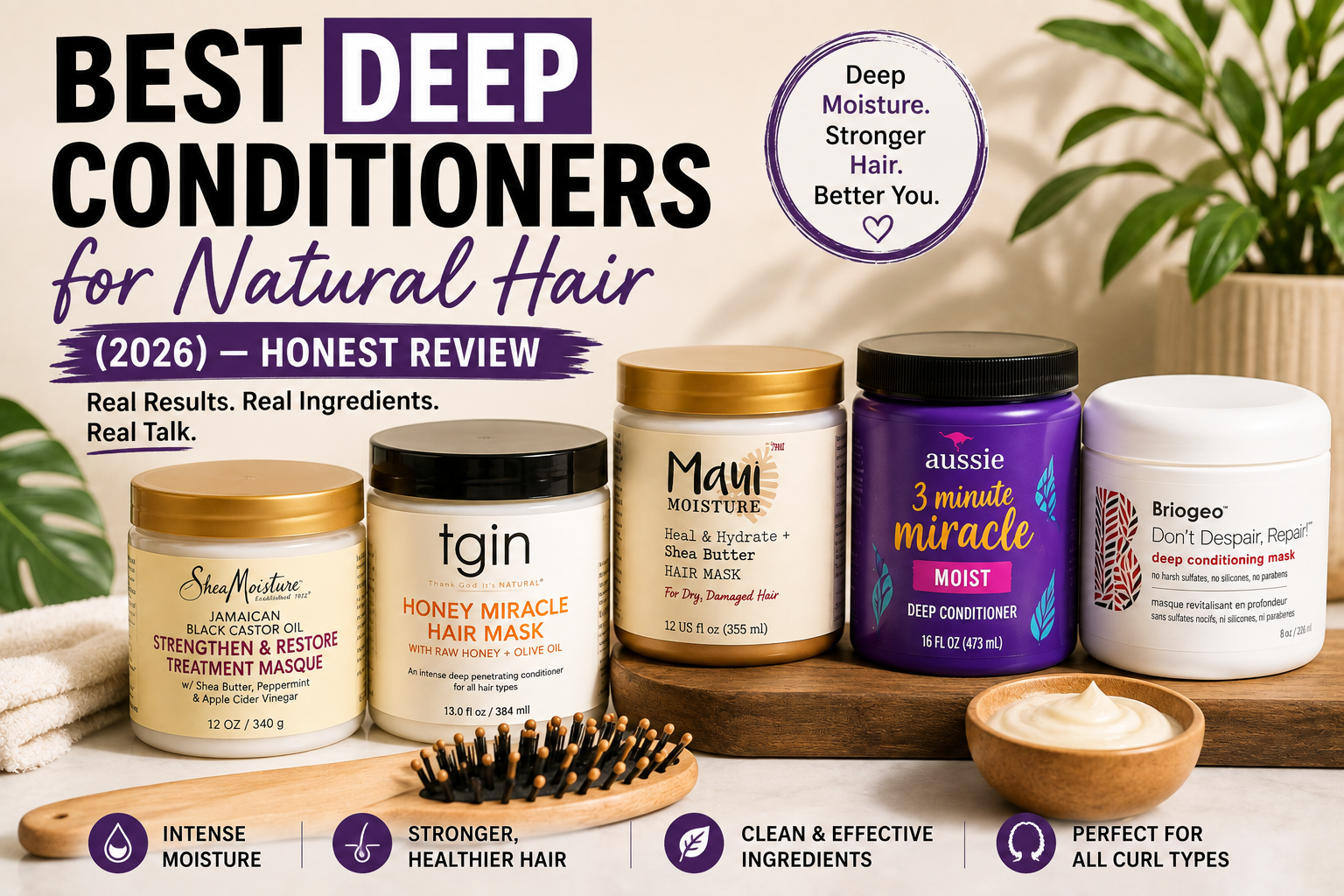
Best Leave-In Conditioners for Natural Hair (2026) — Honest Review
I’ve wasted money on leave-in conditioners that did nothing. Products with long ingredient lists and big promises that left my natural hair feeling exactly the same — or worse, weighed down and greasy by mid-afternoon. After going through more bottles than I’d like to admit, I’ve narrowed down what actually works.
This is a practical guide. No filler, no brand loyalty — just what I’ve found to genuinely help natural hair hold moisture longer and detangle more easily.
What a Leave-In Conditioner Actually Does for Natural Hair
A leave-in conditioner is not the same as your regular rinse-out conditioner. Regular conditioner works in 2-3 minutes and gets rinsed away. Leave-in stays in your hair all day — it’s your first layer of moisture after washing, and it sets the foundation for everything else you apply on top.
For natural hair specifically, a good leave-in does three things:
- It adds water-based moisture to the hair shaft — something natural hair constantly needs because the tight curl pattern makes it hard for scalp oils to travel down the strand
- It provides slip for detangling — reducing the resistance that causes breakage when combing through coily hair
- It prepares the hair for sealing — oils and butters applied after the leave-in lock in the moisture it delivered
Get the leave-in right and every other step in your routine works better. Skip it or use the wrong one and nothing else will compensate.
Best Leave-In Conditioners for Natural Hair in 2026
1. Kinky Curly Knot Today — Best Overall Leave-In for Natural Hair
Best for: All natural hair types, especially for wash day detangling
This is the one I recommend first to anyone asking about leave-ins for natural hair — and it’s been my personal go-to for over two years. What makes it different is that it’s genuinely lightweight. Most leave-ins heavy enough to work on 4C hair end up making hair feel sticky or weighed down. Knot Today threads that needle — it provides enough slip to make detangling significantly easier without the heaviness.
Apply it on soaking wet hair immediately after rinsing your conditioner. Work through in sections from ends to roots. It distributes easily and the difference in detangling resistance is noticeable from the first use — your wide-tooth comb moves through without the usual snagging and snapping.
It’s water-based and free of silicones, which matters if you’re trying to keep your natural hair routine clean. No silicone buildup means your hair keeps absorbing moisture over time instead of getting progressively drier as buildup accumulates.
- ✅ Genuinely lightweight — no sticky or greasy residue
- ✅ Real detangling slip that reduces breakage
- ✅ Works on 3A through 4C hair
- ✅ No silicones, no buildup over time
- ✅ Layers well under creams and butters
- ❌ Thin consistency — some people expect a thicker product
- ❌ Needs a heavier sealant on top for very dry 4C hair
Price: $11–$15
2. TGIN Miracle RepaiRx Curl Protein Reconstructor — Best for Dry or Damaged Natural Hair
Best for: Natural hair that breaks easily or feels weak and brittle
Most leave-ins focus entirely on moisture. This one balances moisture with protein — which is what natural hair that snaps and breaks actually needs. If your hair breaks when you stretch a strand even slightly, or if it feels mushy and limp when wet, adding more moisture won’t fix it. You need protein, and this leave-in delivers it.
The consistency is thicker than Knot Today — it coats the hair with more substance. Apply it to damp hair after washing, focusing on the ends where damage is most visible. Used consistently for four to six weeks, brittle natural hair becomes noticeably stronger and more resilient.
Use it as your leave-in one week, then alternate with a pure moisture leave-in the next. Rotating prevents protein overload, which makes hair stiff and prone to a different kind of breakage.
- ✅ Addresses protein deficiency that moisture products can’t fix
- ✅ Noticeably stronger hair with consistent use
- ✅ Good for 4B and 4C hair that feels weak
- ✅ Works well as a bi-weekly treatment leave-in
- ❌ Too much protein if used every wash day — alternate with a moisture leave-in
- ❌ Heavier feel than lightweight leave-ins
Price: $12–$16
3. SheaMoisture Manuka Honey & Yogurt Hydrate + Repair Multi-Action Leave-In — Best for High Porosity Natural Hair
Best for: Natural hair that absorbs moisture quickly but can’t seem to hold it
High porosity natural hair — common in hair that’s been colored, heat-damaged, or chemically treated — drinks up products immediately but loses moisture just as fast. Standard lightweight leave-ins evaporate too quickly to help. This SheaMoisture formula uses honey as a humectant alongside yogurt protein to both add moisture and slow down how fast it escapes.
It’s richer than most leave-ins, so use it sparingly on fine or low-porosity hair. On high-porosity natural hair it performs noticeably better than lighter alternatives — hair stays softer and more manageable several days after wash day instead of reverting to dry and frizzy by day two.
- ✅ Honey humectant helps high porosity hair hold moisture longer
- ✅ Protein from yogurt adds some strength alongside moisture
- ✅ Rich formula works well for color-treated natural hair
- ❌ Too heavy for low-porosity or fine natural hair
- ❌ Can cause buildup if used on hair that doesn’t need such a rich formula
Price: $13–$17
4. Mielle Organics Pomegranate & Honey Leave-In Conditioner — Best for 4C Hair
Best for: Very dry, tightly coiled 4C hair that needs a richer leave-in
Most lightweight leave-ins don’t cut it for 4C hair — the coils are too tight and the hair too dry for a thin product to make a meaningful difference. Mielle’s Pomegranate & Honey leave-in is thicker and richer than most, which makes it one of the few leave-ins that actually works as the sole moisture step for 4C hair without needing three more products layered on top.
Honey draws moisture into the hair shaft. Pomegranate oil is lightweight enough not to sit on the surface. The combination works well on 4C hair straight out of the shower — apply generously on soaking wet hair, work through in sections, and follow with a sealant. It has a pleasant scent and doesn’t leave white residue, which is a common complaint with richer leave-ins on darker hair.
- ✅ Rich enough to actually work on 4C hair as a standalone leave-in
- ✅ No white residue on dark hair
- ✅ Honey provides moisture retention, not just surface softness
- ✅ Pleasant scent that doesn’t linger too strongly
- ❌ Too heavy for looser curl patterns — avoid on 3A-3C hair
- ❌ Needs a sealant on top for all-day moisture on the driest 4C hair
Price: $11–$15
How to Apply Leave-In Conditioner to Natural Hair — The Right Way
The product matters, but how you apply it matters just as much. Wrong application makes even the best leave-in underperform.
- Apply on soaking wet hair. Not damp — wet. The water already in your hair is part of the moisture equation. Applying leave-in to wet hair helps it distribute evenly and seal in the water that’s already there as your hair dries.
- Work in sections. Divide your hair into four to six sections. Apply leave-in to each section separately and distribute with your fingers or a wide-tooth comb before moving to the next. Trying to apply it all at once means uneven distribution and some sections getting no coverage.
- Start from the ends. The ends of your hair are the oldest, driest, and most fragile part. Give them extra product and extra attention.
- Follow with a sealant. Leave-in adds moisture. Oil or butter seals it in. Always apply a sealant — argan oil, jojoba oil, or shea butter — over your leave-in before your hair dries completely. Without a sealant, moisture evaporates as hair dries and you’re back to square one within a few hours.
Leave-In Conditioner by Hair Porosity
Porosity — how well your hair absorbs and holds moisture — determines which leave-in will actually work for you more than curl type does.
Low porosity natural hair (products sit on top, water beads on the surface):
- Use lightweight, water-based leave-ins — Kinky Curly Knot Today is ideal
- Apply to hair that’s very wet and still warm from the shower — heat helps the cuticle open slightly
- Avoid thick, butter-heavy leave-ins — they coat the surface without absorbing
High porosity natural hair (absorbs products immediately but loses moisture fast):
- Use richer leave-ins with humectants like honey or glycerin — SheaMoisture Manuka Honey formula works well
- Seal immediately with a heavy butter after applying leave-in — don’t let hair start to dry before sealing
- Protein helps high porosity hair hold moisture — the TGIN protein leave-in is worth adding monthly
Not sure which type you have? Drop a clean strand of hair into a glass of water. If it sinks quickly, you likely have high porosity hair. If it floats for a while before sinking, low porosity is more likely. Our complete natural hair care guide covers this in more detail.
Common Leave-In Conditioner Mistakes
Applying to dry hair. Leave-in conditioner works by locking in moisture that’s already in the hair. Apply it to dry hair and there’s no moisture to lock in — it just sits on the surface and evaporates. Always apply to wet hair.
Using too much. More product doesn’t mean more moisture — it means buildup. Start with a small amount, distribute thoroughly, and add more only if sections still feel dry. Buildup from overuse blocks moisture over time and makes hair progressively harder to hydrate.
Skipping the sealant. Leave-in without a sealant on top is like filling a bucket with a hole in it. The moisture goes in and comes right back out as hair dries. Always follow with an oil or butter. See our guide on how to moisturize natural hair for the full LOC method explained simply.
Using a silicone-heavy leave-in without clarifying. Silicones make hair feel smooth and look shiny, but they build up on the hair shaft over time and eventually block moisture from entering at all. If your leave-in contains dimethicone or other silicones, use a clarifying shampoo monthly to remove the buildup. See our sulfate-free shampoo guide for clarifying options that won’t strip natural hair.
Frequently Asked Questions
How often should I use leave-in conditioner on natural hair?
Every wash day — without exception. Most natural hair types also benefit from a light application between wash days when hair feels dry, usually every 2-3 days. Apply a small amount to the driest sections (usually the ends) and follow with your sealing oil. You don’t need to rewet your hair fully between washes — just enough dampness to help the leave-in absorb.
Can I use regular conditioner as a leave-in?
Sometimes, with dilution. Regular conditioners are formulated to be rinsed out and can be too heavy if left in at full strength. If you want to try it, dilute your regular conditioner with water in a spray bottle — roughly one part conditioner to three parts water — and use that as a between-wash refresher. For wash day, a proper leave-in conditioner designed to stay in the hair performs better.
Should leave-in conditioner be applied to wet or dry hair?
Wet — always. The wetter the better, especially for natural hair. Water is the actual moisturizer. Leave-in helps seal it in as hair dries. Applying to dry hair means there’s no moisture to seal, and the product just sits on the surface without doing much.
What is the best leave-in conditioner for 4C natural hair?
4C hair needs a richer leave-in than looser curl patterns. The Mielle Pomegranate & Honey leave-in works well as a rich moisture leave-in for 4C hair. Kinky Curly Knot Today works for 4C as a detangling leave-in on very wet hair but usually needs a heavier cream or butter layered on top. Our full 4C natural hair product guide covers the complete routine.
How is leave-in conditioner different from deep conditioner?
Deep conditioner is used on wash day, left on for 20-45 minutes with heat, and rinsed out — it works from inside the hair shaft. Leave-in conditioner is applied after washing and stays in all day — it works on the surface to maintain moisture and manageability. You need both. Deep conditioning provides the foundation; leave-in maintains it between washes and wash days. Our deep conditioner guide covers what to use and how.
Final Thoughts
The right leave-in conditioner makes every other step in your natural hair routine work better. Get it wrong and you’re fighting against your own routine — adding moisture that evaporates immediately or weighing your hair down with product that doesn’t absorb.
Start with Kinky Curly Knot Today if you’re not sure where to begin — it works across most natural hair types and is the most consistently reliable option I’ve tested. Apply it to soaking wet hair, follow with a sealant, and give it four to six weeks of consistent use before judging whether it’s working.
More from PickHonestly on natural hair:
- Best Deep Conditioners for Natural Hair
- Best Sulfate-Free Shampoos for Natural Hair
- How to Moisturize Natural Hair — Complete Guide
- Best Products for 4C Natural Hair
- Complete Natural Hair Care Guide
Prices accurate as of publication. Verify current pricing before purchasing.