
Apple Cider Vinegar Rinse for Natural Hair: Honest Benefits, Recipe & How to Use It
An apple cider vinegar rinse for natural hair is one of the oldest DIY tricks in the natural-hair community — and one of the most misunderstood. Some blogs call it a miracle: it’ll balance your pH, cure dandruff, make your hair grow, and give you salon shine from a $5 bottle. Others warn it’s snake oil that will melt your strands.
Here is the honest middle ground. An ACV rinse is a genuinely useful, cheap clarifying treatment for natural hair — with real, limited benefits and a few real risks. This guide covers what it can and cannot do (with what the evidence actually says), the safe dilution recipe, ratios for coily, curly, and fine hair types, hard-water tips, and the mistakes that turn this simple rinse into a dryness disaster.
PickHonestly is a research-based site. We have not lab-tested this recipe ourselves — this guide is built from published dermatology and cosmetic-science research plus what reviewers with natural hair consistently report. We use no affiliate links anywhere on this site; product mentions are informational only.
What Is an Apple Cider Vinegar Rinse?
Apple cider vinegar (ACV) is made by fermenting apple juice: first into alcohol, then into acetic acid. A typical ACV rinse is just ACV diluted in water, poured over the hair after shampooing (sometimes before conditioning), left on briefly, and rinsed out.
Raw, unfiltered ACV contains the “mother” — a cloudy colony of acetic-acid bacteria and cellulose. Marketers claim the mother gives the rinse probiotic superpowers for your scalp. There is no published human evidence that the mother’s bacteria do anything meaningful for hair or scalp — treat that claim as marketing, not science. The active ingredient that matters is simple: diluted acetic acid.
The pH Story: Why ACV Might Actually Work
Hair and scalp are mildly acidic — healthy hair sits around pH 4.5–5.5. Many shampoos, hard water, and some styling products are alkaline and leave the hair’s outer layer (the cuticle) lifted and rough. ACV is acidic (around pH 2–3 undiluted). Diluted to rinse strength, it can nudge the hair surface back toward its natural acidity, helping cuticles lie flatter.
A flatter cuticle reflects more light (that’s the “shine”), catches less on neighboring strands (that’s the “slip”), and slows moisture loss. That’s the plausible, evidence-consistent mechanism behind an apple cider vinegar rinse — pH management and gentle residue removal, nothing more exotic.
What an ACV Rinse Can Honestly Do for Natural Hair
Here is what diluted ACV plausibly delivers, with the caveats attached:
1. Gentle buildup removal. ACV dissolves mineral deposits, styling-product residue, and light silicone film better than water alone. It is not a heavy-duty clarifier — a sulfate-based clarifying shampoo cleans more aggressively — but it is far gentler, which is exactly what fragile, coily hair needs.
2. Adds shine and slip. A smoother cuticle reflects light and reduces friction. Many reviewers with type 4 hair report easier detangling after an ACV rinse — especially useful on wash days when the hair is most vulnerable.
3. Soothes an oily or product-heavy scalp. A light acidic rinse can cut through scalp grease and lift dead-skin buildup between shampoos. It does not scrub anything — the dilution and your fingertips do the mechanical work.
4. Helps in hard-water areas. Hard water leaves calcium and magnesium deposits that make natural hair feel coated, dull, and “impossible to moisturize.” An acidic rinse helps dissolve mineral film. If this sounds familiar, our guide on hard water hair damage: signs and fixes walks through the full routine.
5. Supports — but does not replace — a sulfate-free routine. Botanical and sulfate-free shampoos are generally milder and less likely to disrupt the scalp’s natural pH and oil balance than harsh synthetics, as a peer-reviewed review on botanical shampoo ingredients summarizes. An ACV rinse pairs well with gentle cleansers: the shampoo cleans, the rinse resets the surface. For genuinely gentle options, see our roundup of the best sulfate-free shampoos for natural hair.
What an ACV Rinse Cannot Do (Honest Limits)
This is where most blogs go wrong. An apple cider vinegar rinse will not:
- Make your hair grow. Hair growth happens at the follicle under the skin. Rinsing the strands with vinegar cannot change your growth rate. A clean, calm scalp supports healthy growth — that is length retention, not growth speed.
- Repair damage. Nothing you pour on your hair repairs split ends or chemical damage. ACV can smooth the surface so hair looks healthier, which is cosmetic, not repair.
- Cure dandruff or scalp conditions. ACV has mild antimicrobial properties in a lab dish; no published clinical trial shows it treats seborrheic dermatitis, eczema, or psoriasis on human scalps. If flakes, redness, or sores persist, see a dermatologist — the American Academy of Dermatology’s guidance on caring for Black hair covers when professional care is the right call.
- Work as a daily treatment. Acid on acid, every day, dries hair out. This is an occasional treatment — weekly at most, often every 2–4 weeks.
ACV Rinse vs Clarifying Shampoo vs Co-Wash: Which Do You Need?
People often treat these as interchangeable. They are not.
| Method | Best For | Strength | Caution for Natural Hair |
|---|---|---|---|
| ACV rinse | Light product buildup, mineral film, hard water, shine boost | Mild | Must be diluted; overuse dries hair out |
| Clarifying shampoo | Heavy oil/product buildup, silicone removal | Strong | Can strip natural oils; follow with deep conditioning |
| Co-wash | Mid-week moisture refresh between shampoos | Very mild | Does not clarify — can worsen buildup over time |
| ACV + clarifying shampoo | Rare heavy-buildup reset days | Strongest | Use occasionally; deep condition afterward |

One honest nuance: silicones are not the villain they are made out to be. Dermatologists note that silicones protect the hair shaft and reduce breakage — but water-insoluble silicones (like dimethicone) do build up, and removing that buildup requires stronger cleansers, which is where dryness starts. A 2025 dermatology review on silicones in hair care recommends alternating between silicone-based and silicone-free products and clarifying periodically. An ACV rinse fits that “periodic, gentle clarifying” role well — it just can’t remove heavy dimethicone buildup the way a sulfate shampoo can.
The Safe ACV Rinse Recipe for Natural Hair
The entire recipe is two ingredients. The safety lives in the ratio and the steps.
You need: raw, unfiltered apple cider vinegar (any food-grade brand — “with the mother” is optional, not required), and clean water (distilled or filtered is ideal; tap water works if your water is not extremely hard).
Step 1: Mix the rinse before you get in the shower
Add 2–3 tablespoons of ACV to 2 cups (about 500 ml) of cool or lukewarm water in an applicator bottle, squeeze bottle, or jug. That is roughly a 1:8 to 1:10 ratio — the safe starting point for natural, coily hair. Never pour undiluted vinegar on your scalp. Shake or stir gently.
Step 2: Shampoo as usual
Wash with your normal shampoo and rinse it out fully. The ACV rinse is a finishing step, not a shampoo replacement. (Using sulfate-heavy shampoos often is the fastest route to dryness — Healthline’s overview of sulfates explains why sensitive scalps do better without them.)
Step 3: Pour slowly, focusing on the scalp first
Tilt your head back, pour the mixture slowly over your scalp, and let it run down the lengths. An applicator bottle lets you aim at the roots in sections, which matters for thick, dense hair where buildup hides.
Step 4: Massage gently for 30–60 seconds
Use your fingertips (not nails) to massage the scalp lightly. This loosens mineral and product residue. Do not pile your hair on top of your head — that invites tangles on coily textures.
Step 5: Let it sit for 1–2 minutes, no longer
More time is not more benefit. Two minutes is the ceiling for a first try. The rinse should never sting; if it does, rinse it out immediately and dilute more next time.
Step 6: Rinse thoroughly with cool water
Rinse for at least 30 seconds. The faint vinegar smell disappears as hair dries — if it lingers, you did not rinse enough.
Step 7: Condition or moisturize after
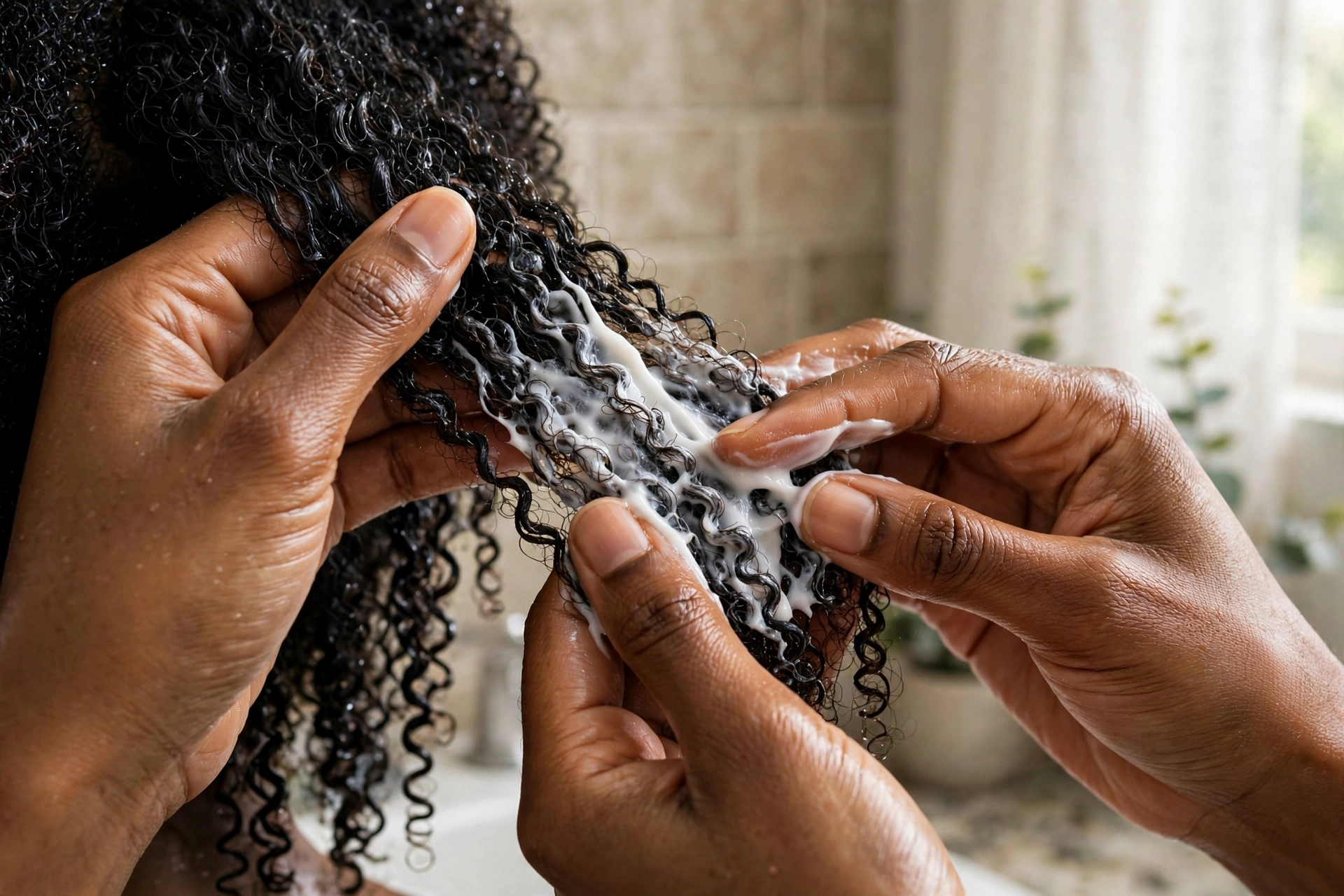
An ACV rinse is mildly astringent — always follow with a light conditioner or your leave-in moisturizer on the mid-lengths and ends to restore moisture balance. Our guide on how to moisturize natural hair covers the layering order that actually works.
Dilution Ratios by Hair Type
One ratio does not fit all natural hair. Start at the gentler end and adjust only if your hair asks for it.
| Hair Type / Situation | Suggested Ratio | How Often |
|---|---|---|
| Type 4 coily / kinky hair | 1:8 to 1:10 (2 tbsp ACV in 500 ml water) | Every 2–4 weeks |
| Type 3 curly hair | 1:6 to 1:8 | Every 2–3 weeks |
| Fine or wavy hair | 1:10 or gentler | Every 3–4 weeks |
| Oily scalp | 1:6 | Weekly at most |
| Hard water area | 1:6 to 1:8 | Weekly |
| Color-treated hair | 1:10, cool water, short contact | Every 3–4 weeks |
| Sensitive or reactive scalp | Patch-test first; start 1:12 | Monthly at most |
Porosity matters too. Low-porosity hair (cuticles tightly shut) is prone to product buildup sitting on the strand, so a gentle acidic rinse can help — but low-porosity hair also dries out fast, so keep the contact time short. If you are not sure of your porosity, take our natural hair porosity test before adjusting the recipe.
Hard Water + ACV Rinse: A Special Case
If your water is hard, an ACV rinse goes from optional to genuinely useful. Mineral deposits from calcium and magnesium form a chalky film that blocks moisture from entering the strand — the classic “my hair is always dry no matter what I use” problem. Used weekly at a 1:6–1:8 ratio, an ACV rinse dissolves that film. For the full picture (how to test your water, shower filters, and the complete routine), read our hard water hair damage guide.
6 Mistakes That Turn ACV Into a Problem
1. Using it undiluted. Neat vinegar (pH ~2–3) on the scalp is an irritant. There is no version of this recipe where “stronger” means “better.”
2. Using it too often. Weekly is the maximum, and only for oily scalps or hard water. Most natural hair does best every 2–4 weeks. Daily or twice-weekly use is how people end up with brittle ends.
3. Skipping conditioner afterward. The rinse is a clarifying step, not a conditioning one. Always follow with moisture.
4. Leaving it on too long. Overnight soaks and 30-minute “deep treatments” with vinegar are a bad idea. One to two minutes, then rinse.
5. Using it on broken or irritated skin. Keep ACV off cuts, scratches, eczema patches, and freshly braided/tight scalps. If it stings, stop.
6. Expecting it to fix everything. It will not grow your hair, cure dandruff, or repair damage. Used correctly, it is a cheap, effective clarifying rinse — and that is plenty.
Frequently Asked Questions
Can I use white vinegar instead of apple cider vinegar?
White distilled vinegar is more acidic (pH ~2.4) and harsher than ACV, with none of ACV’s trace minerals. It works in a pinch at an even weaker dilution, but ACV is the gentler, better-documented choice for hair.
Will an ACV rinse fade my hair color?
Anything that lifts cuticles can accelerate color fade, including acidic rinses used aggressively. At gentle dilutions (1:10) with short contact and cool water, the effect is minimal — but if you just spent money on color, skip ACV for the first two weeks after dyeing and patch-test a hidden section.
Can I leave the ACV rinse in instead of washing it out?
No. Leave-in vinegar keeps acid on the scalp and strands far longer than intended and invites irritation and dryness. Always rinse it out.
Does ACV help with dandruff?
Honestly: maybe mildly, unproven clinically. ACV’s acidity can loosen flakes and its lab-dish antimicrobial properties sound promising, but no published human trial shows it treats dandruff or seborrheic dermatitis. If flakes persist after two or three rinses, treat it as a scalp condition and see a dermatologist.
How do I know if my rinse is too strong?
Warning signs: stinging or burning during use, a tight or itchy scalp afterward, squeaky-rough strands, or hair that feels drier the next day. Any one of these means: dilute more, shorten the contact time, or skip it for a month.
Can I use an ACV rinse on relaxed or color-treated hair?
Yes, cautiously. Chemically processed hair is more fragile, so use the gentlest ratio (1:10), keep contact under a minute, and always follow with a deep conditioner. If your hair is severely damaged, skip acidic rinses until its condition improves.
Should I use ACV before or after conditioning?
After shampooing, before conditioning. Order: shampoo → ACV rinse → rinse out → conditioner or leave-in. Putting conditioner on first would block the rinse from reaching the hair surface.
Does the “mother” in raw ACV matter for hair?
Not that anyone has proven. The mother is a colony of acetic-acid bacteria; there is no published evidence its probiotic properties do anything for hair or scalp. Raw vs. filtered ACV makes no meaningful difference in a rinse — buy whichever is cheaper.
Disclaimer: This article is for general information only and is not medical advice. Apple cider vinegar can irritate sensitive skin and eyes; always dilute it, patch-test on a small area of skin first, and stop using it if you notice redness, burning, or increased shedding. If you have a scalp condition such as eczema, psoriasis, or seborrheic dermatitis, check with a dermatologist before using acidic rinses.