Best Leave-In Conditioner for 4C Hair: 8 Honest Picks + How to Use Them Right (2026)
Finding the best leave-in conditioner for 4C hair shouldn’t feel like guessing. With its tight coils, incredible density, and tendency to lose moisture fast, 4C hair needs a leave-in that hydrates without weighing it down, detangles without breakage, and keeps working between wash days. This guide is research-based: every pick below is chosen from what reviewers with 4C hair consistently report and from ingredient analysis — no fake lab-testing claims, no hype. For each product you’ll get an honest view of what it does well and what it can’t do, because a leave-in is a maintenance product, not a miracle.
Quick Picks: The 8 Best Leave-In Conditioners for 4C Hair
If you’re short on time, here’s the full shortlist. Below the table, each product gets a detailed breakdown with strengths and honest limitations — and a section on how to match any of them to your hair’s porosity.
| Product | Type | Best For | Price Tier | Porosity Match |
|---|---|---|---|---|
| tgin Green Tea Super Moist Leave-In | Cream | Best overall — balanced moisture + growth-supporting ingredients | Mid-range | All porosities |
| Aunt Jackie’s Quench Moisture Intensive | Cream | Best daily leave-in for coily hair | Budget | Medium to high |
| SheaMoisture Jamaican Black Castor Oil Strengthen & Restore | Cream | Best for breakage-prone, fragile strands | Mid-range | Medium to high |
| Carol’s Daughter Black Vanilla Leave-In | Spray | Best lightweight spray for daily refresh | Budget | Low porosity |
| Mizani 25 Miracle Milk | Spray | Best for heat styling (heat protectant) | Premium | All porosities |
| Mielle Organics Pomegranate & Honey | Lotion | Best for definition and wash-and-gos | Mid-range | Medium to high |
| Cantu Argan Oil Leave-In Conditioning Repair Cream | Cream | Best budget pick | Budget | Medium to high |
| Camille Rose Curl Love Moisture Milk | Lotion/milk | Best for low porosity 4C hair | Mid-range | Low porosity |
New to 4C care? Start with our guide to the best products for 4C natural hair — this article is one part of that cluster, and the full guide shows how leave-ins fit into the routine.
How to Choose the Right Leave-In for 4C Hair
Most roundups just list products. But the reason one person’s holy grail leaves your hair dry or weighed down is almost always porosity mismatch — none of the top-ranking articles on this topic explain this properly, so let’s fix that first.
Start with your porosity (it decides everything)
Hair porosity is how easily your strands absorb and hold water, and it matters more for leave-in choice than brand names do:
- Low porosity 4C hair has tightly closed cuticles. Water beads up and products sit on top. What works: lightweight, water-based sprays and milks (like Carol’s Daughter Black Vanilla or Camille Rose Moisture Milk). Heavy butters and thick creams tend to cause buildup without actually moisturizing.
- High porosity 4C hair has raised, damaged, or naturally open cuticles. It absorbs fast but loses moisture just as fast. What works: richer creams and lotions with sealing butters and oils (like SheaMoisture JBCO or Aunt Jackie’s Quench), applied to damp hair and sealed with an oil or butter.
- Medium/normal porosity sits in between — most leave-ins work, so pick by your main goal (definition, detangling, heat protection).
Not sure where you fall? Our hair porosity test guide walks you through the simple at-home tests and explains how porosity changes with heat, color, and damage.
The three leave-in formats, explained honestly
- Sprays — lightest. Best for daily refreshes, fine or low-porosity strands, and layering under stylers. They hydrate but rarely provide enough slip for serious detangling on their own.
- Lotions/milks — the middle ground. Enough body to detangle and define, light enough for most 4C hair. Often the best format for low-porosity hair that needs more than a mist.
- Creams — richest. Best for thick, dense, or high-porosity 4C hair, and for wash-day detangling sessions. The tradeoff: they can weigh down fine strands and build up faster, so clarify more often.
What to look for on the label
A good 4C leave-in usually combines three ingredient families: humectants (glycerin, honey, aloe vera — pull water into the hair), emollients (shea butter, oils, fatty alcohols — smooth and seal), and small amounts of protein (hydrolyzed silk, wheat, or soy protein — temporarily patch weak spots in damaged hair). A few honest notes: protein helps damaged hair feel stronger but cannot repair a split end; reviews of hair-cosmetic science note that conditioners mainly work on the hair’s surface — conditioning smooths the cuticle and reduces breakage from combing, it doesn’t rebuild the strand. Also avoid heavy drying alcohols high on the ingredient list; fatty alcohols (cetyl, cetearyl) are fine and actually conditioning.
The 8 Best Leave-In Conditioners for 4C Hair — Detailed Reviews
Each review below is research-based: ingredient analysis plus what reviewers with 4C hair consistently report across forums, retailer reviews, and hair-care communities. No fake “we tested these in our lab” claims — just honest patterns.
1. tgin Green Tea Super Moist Leave-In — Best Overall
tgin’s Green Tea line is a long-running staple in the 4C community, and this leave-in is the standout. Green tea extract brings antioxidant content, while cupuaçu butter and rosemary extract provide the moisture-sealing and scalp-comfort angle that reviewers consistently mention. It’s a true middleweight cream — substantial enough to detangle on, light enough to use without dread.
Strengths: balanced moisture without greasiness; pleasant slip for detangling; works across porosities; widely praised for keeping 4C hair soft between wash days.
Honest limitations: some reviewers with very fine strands find it slightly heavy for daily use — low-porosity hair should use it sparingly and only on damp hair. It’s also pricier than drugstore options. And the “growth” angle you see in marketing: no leave-in grows hair faster; green tea may support a healthy scalp environment, but growth happens at the follicle over months, not from a cream.
2. Aunt Jackie’s Quench Moisture Intensive — Best Daily Leave-In for Coily Hair
Aunt Jackie’s Quench is arguably the most-recommended budget leave-in in 4C spaces. The formula leads with aloe leaf juice and includes shea butter, olive oil, wheat protein, and marshmallow root — a combination that explains the famous slip. Reviewers consistently report it makes detangling dramatically easier.
Strengths: excellent slip and detangling power for the price; suits a wide range of 4A–4C textures; good for daily moisture maintenance.
Honest limitations: the most commonly reported issue is white flakes or residue if you use too much or layer it under incompatible stylers — use a small amount and test your gel combination first. The scent is strong and sweet; if you’re fragrance-sensitive, this isn’t your pick. Some low-porosity users find it a bit rich for daily use.
3. SheaMoisture Jamaican Black Castor Oil Strengthen & Restore — Best for Breakage-Prone Hair
If your 4C hair snaps easily, this is the leave-in the community reaches for most. Jamaican black castor oil, shea butter, and peppermint oil form a rich, strengthening blend. The protein content (including hydrolyzed proteins) gives it the “strengthen” angle — it makes fragile strands more resilient to handling.
Strengths: noticeably reduces breakage during styling for many reviewers; rich moisture for high-porosity hair; pleasant warming scent; silicone- and sulfate-free.
Honest limitations: it’s one of the heavier options here — low-porosity or fine hair can end up weighed down and sticky. Use it on damp hair and seal lightly, or skip it. Also, be honest with yourself: no product “repairs” damaged hair; protein-rich leave-ins patch and protect what’s there, which is genuinely useful for length retention, but they can’t reverse chemical or heat damage.
4. Carol’s Daughter Black Vanilla Leave-In — Best Lightweight Spray for Daily Refresh
A classic for a reason. This is a true spray — weightless, easy to distribute, usable on wet or dry hair. Soy protein and vitamin B5 hydrate without heaviness, and reviewers with low-porosity 4C hair rate it as one of the few sprays that actually registers as moisturizing rather than just wetting.
Strengths: genuinely lightweight; great for daily refreshes between wash days; works on dry hair without disturbing styles; affordable.
Honest limitations: it won’t replace a cream for heavy detangling sessions — there’s not enough slip for that. Needs reapplication through the week (it absorbs fully, which is the point, but it means it’s not a one-and-done product). The vanilla scent is divisive.
5. Mizani 25 Miracle Milk — Best for Heat Styling
The only pick here that doubles as a heat protectant (up to 450°F/232°C per the brand). Coconut oil–based, lightweight spray that primes coils before blow-drying or silk presses. The American Academy of Dermatology’s care tips for Black hair emphasize minimizing heat and always using protection — this is the leave-in to reach for when heat is non-negotiable.
Strengths: heat protection + moisture in one step; light enough for low-porosity hair; great slip for pre-detangling; professional-salon pedigree.
Honest limitations: premium price — roughly double the budget picks. And an important honesty note: heat protectants reduce heat damage, they don’t eliminate it. Even with protection, frequent high-heat styling degrades the hair shaft over time. Also, if you never heat-style, you’re paying for a benefit you don’t need.
6. Mielle Organics Pomegranate & Honey — Best for Definition and Wash-and-Gos
This is the definition pick. Pomegranate extract, honey, and babassu oil give it a moisture profile that reviewers say enhances curl clumping and bounce without the crunch. If your goal is a defined wash-and-go rather than just softness, this consistently outranks the sprays.
Strengths: real curl definition with softness; lightweight enough for medium-to-high porosity; works well layered under a gel for wash-and-gos.
Honest limitations: not the strongest detangler in this lineup — pair it with a slip-heavy product if your 4C tangles badly. The bottle is small for the price if you have long, dense hair. Low-porosity hair should apply to very wet hair for best absorption.
7. Cantu Argan Oil Leave-In Conditioning Repair Cream — Best Budget Pick
Cantu remains the most accessible entry point into 4C leave-ins. Argan oil, shea butter, and a cream format that works as both leave-in and rinse-out. No drying alcohols, no silicones. At its price, it’s the pick reviewers recommend to beginners who aren’t sure what their hair likes yet.
Strengths: cheapest quality option here; genuinely conditioning; versatile (leave-in or rinse-out); widely available.
Honest limitations: it’s heavy — over-application is the #1 complaint, leading to greasy-feeling, product-laden hair. Start with a dime-sized amount per section. The scent is strong. And it’s a maintenance product, not a treatment: it won’t fix damage, it will keep healthy hair moisturized.
8. Camille Rose Curl Love Moisture Milk — Best for Low Porosity 4C Hair
The porosity pick. Slippery elm bark, rice milk, rosehip oil, and macadamia seed oil in a true milk — light enough to absorb into low-porosity strands that reject creams. Reviewers with low-porosity 4C hair report this as one of the few leave-ins that actually penetrates rather than sitting on top. Our porosity test guide explains why milks often beat creams for this hair type.
Strengths: genuinely lightweight yet moisturizing; good slip from slippery elm; works on wet and dry hair; doesn’t build up quickly.
Honest limitations: high-porosity or very thick hair may find it too light — you’ll need to seal with an oil or butter after. Some reviewers note it needs reapplication mid-week. It’s mid-range priced for a smaller bottle.
How to Apply the Best Leave-In Conditioner for 4C Hair (Step by Step)
Using the right product wrong is the most common reason leave-ins “don’t work.” 4C hair needs method, not just product.
Step 1: Start on clean, damp hair
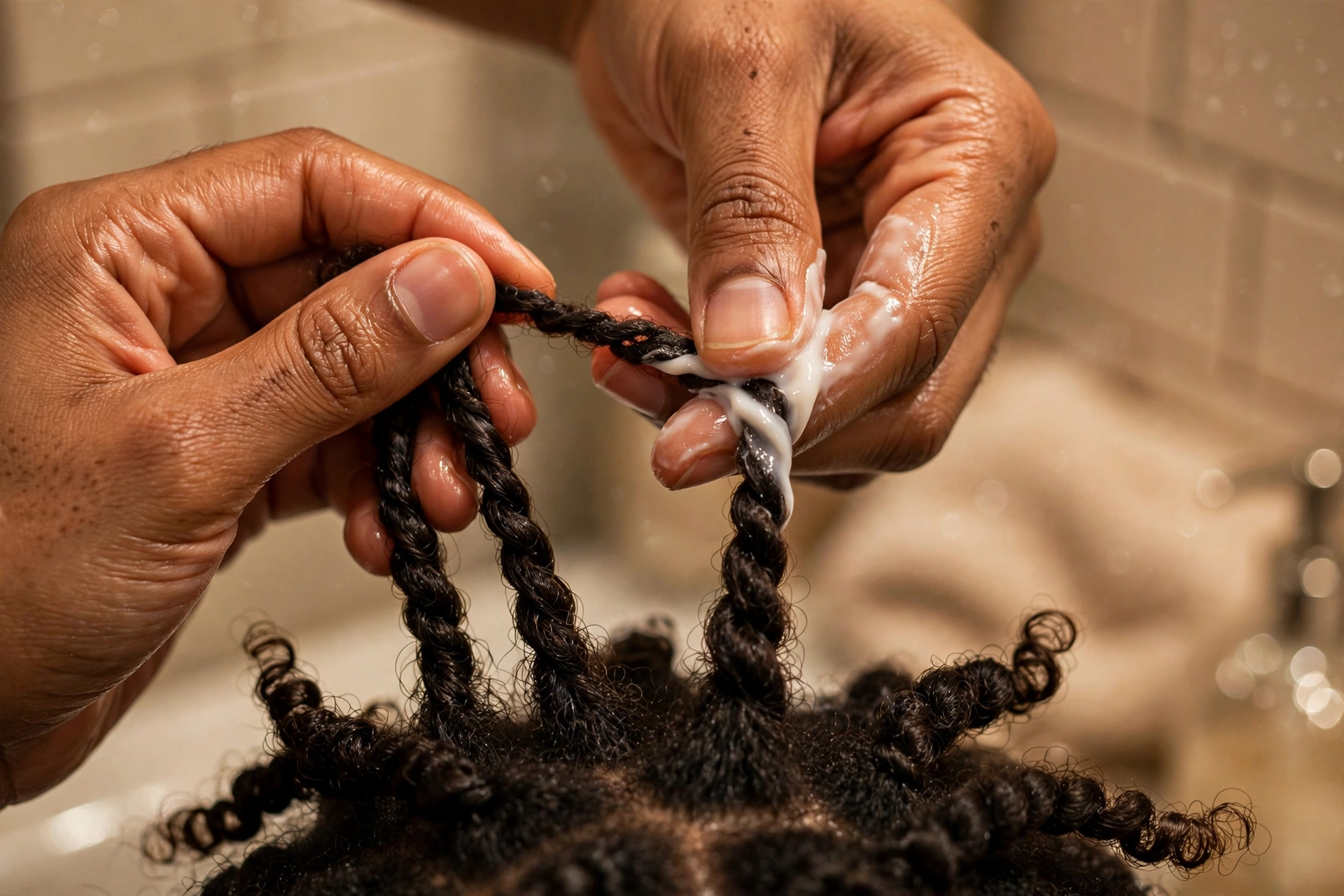
Apply leave-in to freshly washed and conditioned hair that’s damp — not dripping, not dry. For the best results with any leave-in conditioner for 4C hair, work in small sections (4–8 twists or braids) so every strand gets coated. If you’re refreshing between wash days, lightly mist with water first.
Step 2: Use a small amount per section
A dime- to quarter-sized amount per section is the starting point — adjust to your density. More product does not equal more moisture; it equals more buildup. You can always add more.
Step 3: Smooth from ends to roots
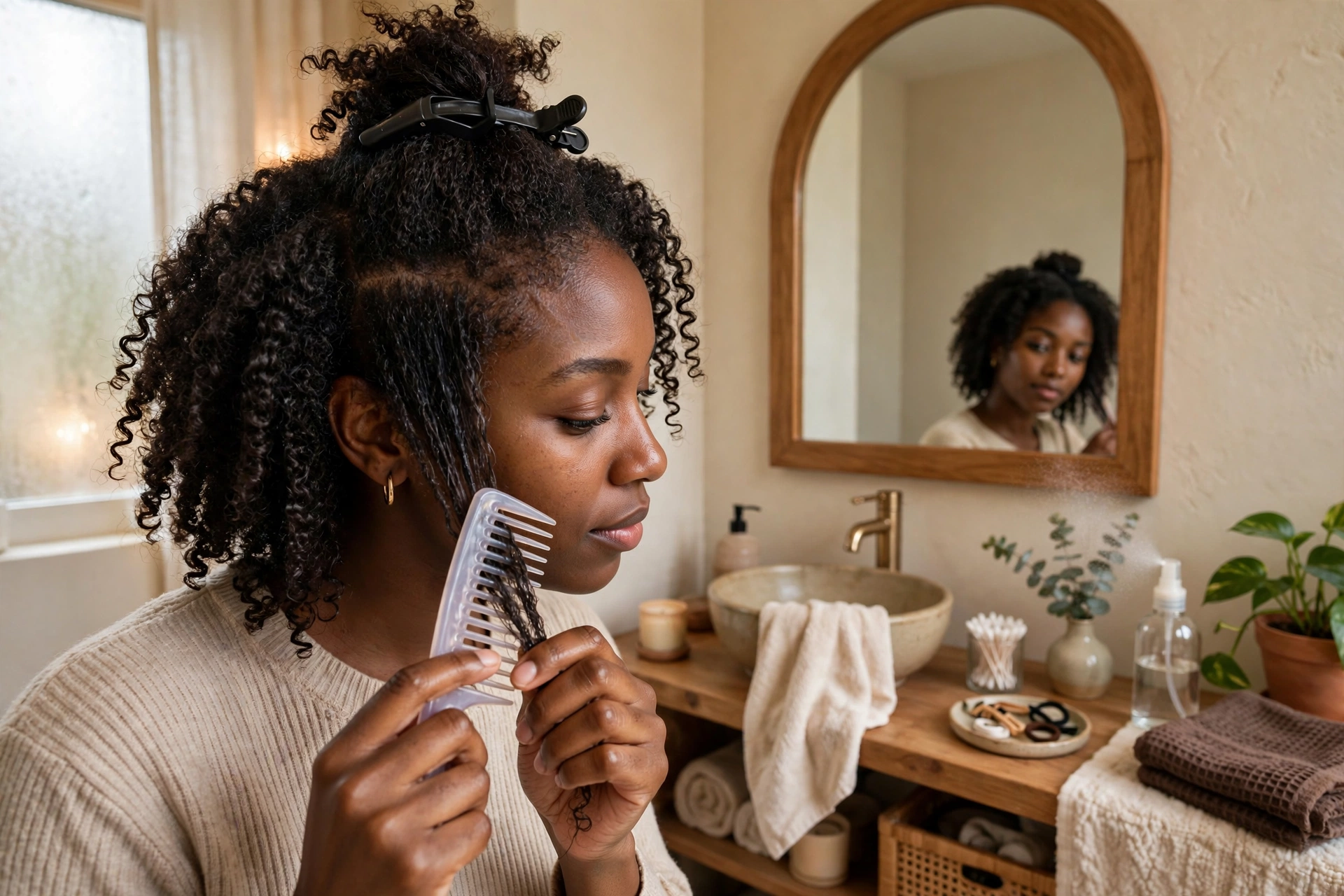
Work the product from the ends (the oldest, driest part of your hair) upward toward the roots. Finger-detangle as you go, then follow with a wide-tooth comb or brush if needed. For our full detangling technique, see our guide on how to detangle natural hair without breakage.
Step 4: Seal it in (the LOC or LCO method)
Leave-in alone evaporates. Follow it with an oil (L = liquid/leave-in, O = oil) or cream (C = cream) to lock moisture in — LOC (leave-in, oil, cream) suits high-porosity hair; LCO (leave-in, cream, oil) often works better for low-porosity hair. Our guide to moisturizing natural hair breaks down both methods.
Step 5: Style and refresh through the week
Style as usual — twist-outs, braid-outs, wash-and-gos, or protective styles. Mid-week, refresh with a spray leave-in (like Carol’s Daughter Black Vanilla) on lightly dampened sections instead of re-wetting fully.
Leave-In vs Rinse-Out Conditioner: Can a Leave-In Replace Your Regular Conditioner?
Short answer: no — they do different jobs. This is one of the most common questions (and a gap in the top-ranking articles, which never address it).
- Rinse-out conditioner is your wash-day workhorse: it provides the slip for detangling in the shower and deposits a conditioning base. See our best conditioner for 4C hair roundup for rinse-out picks.
- Leave-in conditioner is your between-wash maintenance: lighter, designed to stay on the hair, refreshable through the week. It’s a different formula, not a stronger version of the same thing.
- Using a rinse-out as a leave-in (or vice versa) usually backfires — rinse-outs are too heavy to leave on and cause buildup; leave-ins don’t provide enough slip for shower detangling.
If you want a general roundup beyond 4C-specific picks, our best leave-in conditioners for natural hair covers the wider natural-hair landscape.
What Leave-In Conditioners Can’t Do (Honest Limitations)
No roundup should end without this, because the marketing on these bottles is… enthusiastic.
- They don’t grow hair. No leave-in makes hair grow faster — growth happens at the scalp over months. Products that “support growth” actually just reduce breakage so you retain more length.
- They don’t repair damage. Protein-rich formulas temporarily patch weak spots, which is genuinely useful, but split ends and heat damage can’t be reversed by any cosmetic.
- They can’t replace water. A leave-in seals and smooths; it doesn’t hydrate on its own. Applied to bone-dry hair, even the best leave-in underperforms — damp hair first, always.
- More is not better. Over-application is the fastest route to buildup, dullness, and the white flakes reviewers complain about. Clarify regularly if you use creams daily.
5 Mistakes 4C Wearers Make with Leave-In Conditioners
- Applying to dry hair. Leave-in on dry hair mostly coats the surface. Dampen first — even a light mist changes absorption completely.
- Skipping sections. The back and crown get neglected. Work in visible sections so every part gets product.
- Using a cream when your porosity needs a milk. If your hair feels coated but still dry, your formula is probably too heavy — not too light. Revisit the porosity section above.
- Putting heavy cream on the scalp. Leave-ins belong on the strands. Heavy product on the scalp causes itching and buildup — a point the AAD’s guidance for Black hair reinforces through its focus on gentle, non-irritating care.
- Never clarifying. Daily leave-in use builds up. A clarifying shampoo every few weeks keeps products working — see our sulfate-free shampoo roundup for gentle options.
Frequently Asked Questions
Can you put leave-in conditioner on 4C hair every day?
Yes, if your hair needs it — many 4C wearers refresh with a light leave-in daily or every other day. The caveat is buildup: daily cream use without regular clarifying leads to dull, coated hair. Alternate heavy wash-day application with light mid-week refreshes, and clarify every few weeks.
How often should you use leave-in conditioner on 4C hair?
Apply a full leave-in treatment on every wash day (weekly or bi-weekly for most), then refresh lightly between washes as needed. High-porosity hair usually needs more frequent refreshing; low-porosity hair often does better with lighter, less frequent application.
Is leave-in conditioner good for 4C hair?
Yes — it’s one of the most useful product categories for 4C hair because the tight coil pattern makes it hard for natural scalp oils to travel down the strand. A leave-in bridges that gap, reducing dryness, easing detangling, and cutting breakage. It’s a maintenance essential, not an optional extra.
Why is my 4C hair still dry after using leave-in conditioner?
Three usual causes: (1) you applied it to dry hair — leave-ins need damp hair to work with; (2) porosity mismatch — a heavy cream on low-porosity hair coats without absorbing; (3) you skipped sealing — without an oil or cream on top (the LOC/LCO method), moisture evaporates. Healthline’s porosity guide explains how cuticle behavior drives this.
Can I sleep with leave-in conditioner in my hair?
Yes — leave-ins are designed to stay in. Protect your hair overnight with a satin or silk bonnet or pillowcase to reduce friction and moisture loss. Avoid cotton pillowcases, which absorb both product and moisture.
Can leave-in conditioner go on the scalp?
Generally, apply leave-in to the strands, not the scalp. Heavy creams on the scalp can clog follicles, cause itching, and create buildup. If your scalp is dry, use a dedicated light scalp oil instead.
What’s the difference between a leave-in and a regular conditioner?
Rinse-out conditioners are heavier, wash-day products built for in-shower detangling; leave-ins are lighter formulas designed to stay on the hair and be refreshed through the week. You need both — a leave-in can’t replace your rinse-out.
Does leave-in conditioner help 4C hair grow?
Not directly. No topical product speeds up growth at the follicle. What a good leave-in does is reduce breakage and split ends, so you retain more of the length you grow — which over months looks like “faster growth.” Be skeptical of any product claiming to accelerate growth itself.
The Honest Bottom Line
The best leave-in conditioner for 4C hair is the one matched to your porosity and used with the right method — damp hair, small amounts, sealed with oil or cream. Start with tgin for an all-rounder, Aunt Jackie’s or Cantu for budget, Mizani if you heat-style, and Camille Rose if your low-porosity hair rejects everything else. And remember: no bottle replaces consistent wash days and gentle handling.
Disclaimer: This article is for informational purposes only and reflects research-based analysis plus reported user experiences, not hands-on lab testing. Everyone’s hair responds differently — patch-test new products and discontinue use if irritation occurs. This is not medical or dermatological advice; consult a dermatologist for persistent scalp or hair-loss concerns.