
Wash Day Routine for 4C Hair: The Honest Step-by-Step Guide
A wash day routine for 4C hair is the most important part of a natural hair regimen — and the part most people dread. It takes longer than any other hair type, uses the most product, and if one step goes wrong, you feel it all week. But a good wash day routine for 4C hair is not about doing more steps. It is about doing the right steps, in the right order, with realistic expectations. This guide walks through every step honestly: what each one does, how long it takes, how to adjust it for your porosity, and what to fix when wash day goes wrong.
What a Good 4C Wash Day Actually Does (and What It Can’t)
Before the steps, let us set the bar honestly. A proper wash day routine for 4C hair will:
- Remove buildup from the scalp — sweat, dead skin, and layers of gel, oil, and butter that water alone cannot move.
- Replenish moisture through conditioning, which is the main event for 4C hair. Tight coils make it hard for your scalp’s natural oils to travel down the hair shaft, so conditioning has to do the work those oils cannot.
- Reduce breakage by detangling on wet, conditioned hair instead of dry hair — the American Academy of Dermatology specifically recommends conditioning after every shampoo and detangling textured hair while damp.
- Set up your week — hair that is properly cleansed and conditioned is dramatically easier to style and maintain than hair carrying two weeks of product.
What wash day will not do: it will not make your hair grow faster (growth happens at the follicle; a good routine helps you retain the length you grow), it will not permanently fix damage (split ends have to be trimmed), and it will not transform your curl pattern. Anyone promising that is selling something.
How Long Does a 4C Wash Day Take?
Almost no article answers this, so let us be practical. For medium-density, shoulder-length 4C hair, budget this much time per step:
| Step | Typical time |
|---|---|
| Pre-poo + finger detangle | 10–20 min |
| Sectioning | 5 min |
| Shampoo (two rounds) | 10–15 min |
| Rinse-out conditioner + detangle | 15–25 min |
| Deep condition (with heat cap) | 20–30 min |
| Final rinse | 5 min |
| Leave-in + seal + dry + style | 30–60 min |
| Total | ~1.5–2.5 hours |
Longer or denser hair takes more time; shorter hair takes less. If your wash day regularly eats four hours, the problem is usually too many products or re-detangling the same section repeatedly — not your hair.
The Full 4C Wash Day Routine, Step by Step
Step 1: Pre-Poo (Optional but Smart)
A pre-poo is a treatment applied before shampoo — usually an oil, a conditioner, or a DIY mix — left on for 15–30 minutes. Its job is simple: it gives the shampoo something to wash off besides your hair’s own moisture, and it adds slip so dry hair does not tangle further before water even touches it.
Who benefits most: anyone whose hair feels stripped and squeaky after shampooing, and anyone washing hair that has been in a protective style for weeks. If your hair feels fine after shampoo already, you can skip this step without guilt. Our full breakdown is here: pre-poo treatments for natural hair.
Step 2: Work in Sections — Always
This is the single highest-leverage habit in a wash day routine for 4C hair. Before water touches your hair, divide it into 4–8 sections and loosely twist or clip each one. Wash, condition, and detangle one section at a time, re-twisting each finished section.
Why it matters: loose 4C hair in a shower stream tangles on itself within seconds. Sections keep shed hair contained, give you access to the scalp, and stop you from detangling the same knot five times. Dense, long, or tangle-prone hair should lean toward 6–8 sections.
Step 3: Shampoo the Scalp, Not the Lengths
Shampoo exists to clean the scalp — sweat, sebum, dead skin, and product buildup. The lengths and ends of 4C hair are the oldest, driest part of your hair and produce no oil of their own. Scrubbing shampoo through them is pure damage for zero benefit.
Do this instead: apply a sulfate-free shampoo to the scalp with the pads of your fingers (not nails), massage gently, and let the rinse water carry the diluted lather down the lengths. That runoff is enough to cleanse them. The AAD gives the same advice for fragile hair: apply shampoo to the scalp rather than rubbing it through the full length, which can be unnecessarily drying.
Two rounds is the honest standard: the first loosens buildup, the second actually cleans. If the second round barely lathers, you needed it. Once every 3–4 wash days, swap in a clarifying shampoo — especially if you use heavy butters, gels, or silicones. Signs you are overdue for clarifying: hair that feels coated but still dry, shampoo that never lathers, or flakes that do not rinse away. See our guide to sulfate-free shampoos for natural hair.
Step 4: Condition Generously, Then Detangle
Work a rinse-out conditioner through one section at a time, concentrating on the mid-lengths and ends — the oldest hair, which has survived every style since it grew out. Then detangle while the hair is saturated and slippery. Start at the ends, work upward in small increments, fingers first, then a wide-tooth comb or detangling brush only if your hair responds well to one.
Never detangle dry 4C hair to “save time.” Dry detangling is one of the fastest ways to snap hair, and it is the first habit on our 4C hair mistakes list. If a section resists, add more conditioner and water — not more force.

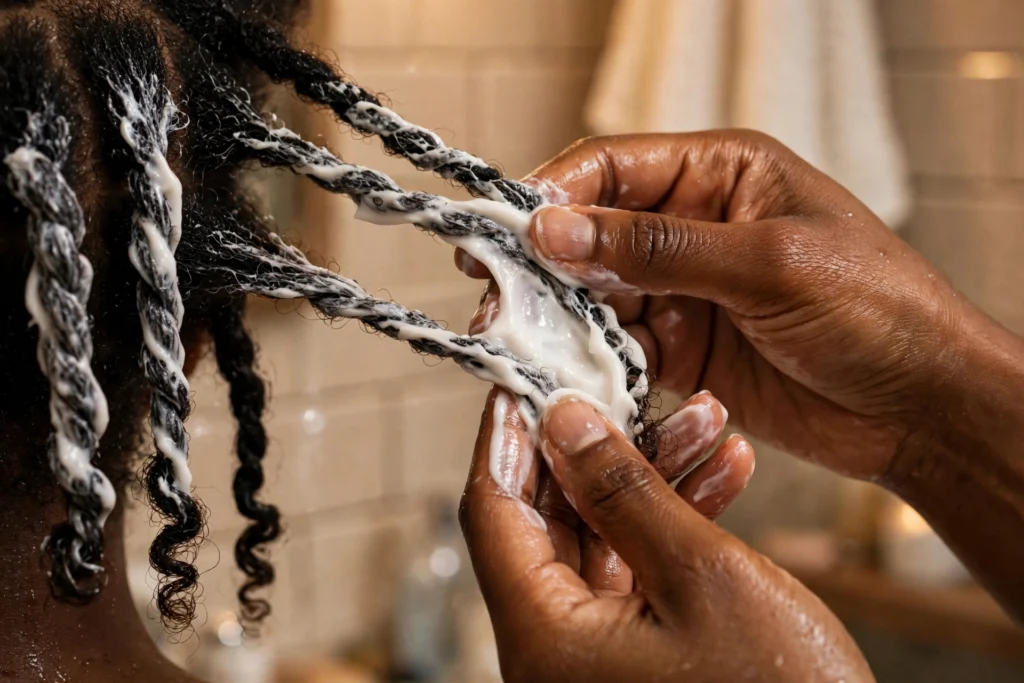
Step 5: Deep Condition — Moisture or Protein, Not Both Blindly
Deep conditioning is where most wash day routines either earn their time or waste it. The key decision: does your hair need moisture or protein right now?
| Your hair feels… | It probably needs | Look for |
|---|---|---|
| Dry, rough, brittle, tangles easily | Moisture | Glycerin, aloe, honey, fatty alcohols (cetyl/cetearyl) |
| Mushy when wet, stretches then snaps, limp | Protein | Hydrolyzed keratin, wheat or silk protein, amino acids |
| Fine after regular conditioning | Neither — skip it this week | Do not deep condition out of habit |
Apply to damp, sectioned hair, cover with a shower cap (a heat cap or warm towel for 20–30 minutes helps the product penetrate), then rinse thoroughly. Deep conditioning every single wash day is not mandatory — every 1–2 weeks is plenty for most people, and overdoing protein is a real way to make hair stiff and brittle. Our researched roundup: best deep conditioners for 4C hair.
Step 6: The Final Rinse
Rinse with lukewarm water. Hot water feels good and cleans faster, but it also lifts the cuticle and leaves hair rougher — noticeable on 4C hair by wash day +2. A final cool rinse is a nice-to-have, not a miracle; lukewarm throughout is the realistic target. Rinse until the water runs clear and the hair feels clean but not squeaky. Squeaky means stripped.
Step 7: Leave-In, Then Seal
On damp — not dripping, not dry — hair, apply a leave-in conditioner section by section, then seal with an oil or cream. The order that works for most 4C hair is LCO (liquid, cream, oil) or LOC (liquid, oil, cream); try both for two wash days each and keep whichever leaves your hair softer on day 3. Use a small amount and concentrate on the lengths and ends. Half a bottle of leave-in does not moisturize twice as well — it just builds up twice as fast.
Step 8: Dry It Right — Air Dry vs. Hooded Dryer
How you dry matters as much as how you wash. Here is the honest comparison:
| Air drying | Hooded dryer (low/medium heat) | |
|---|---|---|
| Time | 4–8+ hours for dense 4C hair | 45–90 minutes |
| Heat damage risk | None | Low if heat stays moderate and hair is conditioned |
| Best for | Wash-and-gos, twist-outs, low-manipulation weeks | Stretching for styles, humid climates, tight schedules |
| Watch out for | Hair staying damp too long can feel mushy; don’t sleep on wet hair | Always use heat protectant; high heat undoes wash day’s work |
Never sleep on soaking-wet hair, and never blast it with a high-heat blow dryer with no nozzle and no protectant. A cotton T-shirt or microfiber towel to squeeze out excess water beats rough towel-drying, which roughs up the cuticle.
Step 9: Style for the Week You Actually Have
End wash day with a style that matches your real schedule, not your aspirations. Busy week? Two-strand twists, flat twists, or a low-manipulation bun. Want your coils out? A wash-and-go. The goal of wash day styling is to protect the work you just did — low tension, low daily manipulation. Tight styles that pull at your edges are not “protective,” whatever the tutorial says.
How Often Should You Wash 4C Hair?
There is no universal seven-day law — your scalp gets a vote. The honest framework:
- The dermatologist baseline: the American Academy of Dermatology advises that tight curls and textured hair be washed at least every two to three weeks, and Healthline’s dermatologist-reviewed guide notes textured hair generally needs washing no more than once a week or every other week.
- The practical starting point: most naturals land at every 7–14 days. Heavy product users, frequent exercisers, and people in humid climates trend shorter; low-product protective-style wearers trend longer.
- The evidence nuance: a peer-reviewed study on shampoo wash frequency found that more frequent washing with a mild shampoo did not damage hair quality — but it studied Asian participants with straight hair, so it does not directly prove the same for coily hair. Interestingly, the same paper cites preliminary data from Nigerian women suggesting higher wash frequency was associated with fewer hair complaints. The honest takeaway: frequency matters less than gentleness — a mild shampoo and proper conditioning beat any magic number of days.
Wash sooner when: your scalp itches, flakes appear, styles look dull despite refreshing, or you can smell product buildup. You can stretch when: the scalp is calm and comfortable and hair still responds to light refreshing.
Low vs. High Porosity: Adjust Your Wash Day
Almost none of the top-ranking wash day articles mention porosity, yet it changes nearly every step. (Not sure of yours? Take our natural hair porosity test.)
| Step | Low porosity 4C hair | High porosity 4C hair |
|---|---|---|
| Water temperature | Warm water helps lift the tight cuticle so products absorb | Lukewarm is fine; avoid hot water, which worsens moisture loss |
| Deep conditioning | Use heat (heat cap 20–30 min); lighter formulas absorb better | Richer, thicker formulas; protein treatments more often |
| Leave-in amount | Light layer — product sits on top and builds up fast | Generous layer; hair drinks it up |
| Sealing | Light oils (grapeseed, argan); heavy butters cause buildup | Heavier butters and creams help hold moisture in |
| Protein | Less often — low-porosity hair is often protein-sensitive | More often — gaps in the cuticle benefit from filler protein |
The 45-Minute Wash Day (for Busy Weeks)
Some weeks you do not have two hours. The honest shortcut that still counts as a real wash day:
- Quick pre-detangle in 4 sections with water + conditioner (10 min)
- One thorough shampoo round on the scalp (5 min)
- Conditioner, detangle, rinse (10 min)
- Skip the deep conditioner — do it next wash day (0 min)
- Leave-in + oil, twist into 6–8 chunky twists (15 min)
- Air dry in the twists; unravel tomorrow (0 min today)
What you sacrificed: the deep treatment and the polished style. What you kept: a clean scalp, detangled hair, and sealed moisture — the three things that actually protect your hair between wash days.
Wash Day Troubleshooting: When Something Feels Wrong
| Problem | Likely cause | Fix |
|---|---|---|
| Hair feels dry right after wash day | Shampoo too harsh, or conditioner not left on long enough | Switch to a sulfate-free shampoo; leave conditioner on 3–5 min per section |
| Hair feels coated but still dry | Product buildup blocking moisture | Clarify once, then restart with lighter products |
| Scalp itches within days | Buildup, infrequent washing, or sensitivity to an ingredient | Wash more often; check for heavy butters/waxes near the scalp |
| Excessive shedding in the shower | Normal shed hair released at once — or rough detangling | Track it: a palmful across wash day is normal; clumps with bulbs + breakage are not — see a dermatologist if it persists |
| Tangles worse than before you started | Washing loose instead of in sections | Section first, every time — no exceptions |
| Hair smells musty a day later | Hair stayed damp too long | Dry fully on wash day; never sleep on wet hair |
| White residue after rinsing | Hard water mineral deposits | A published study found hard water measurably reduces hair strength — a chelating/clarifying shampoo helps; see our hard water hair damage guide |
What Your Wash Day Can’t Do — Honest Limits
- It cannot speed up growth. Hair grows roughly half an inch per month from the follicle regardless of your routine. Wash day protects length from breakage — that is retention, not faster growth.
- It cannot repair split ends. Conditioning smooths them temporarily; only a trim removes them.
- It cannot fix a routine problem in one session. If breakage comes from months of tight styles or heat, one perfect wash day is triage, not a cure.
- More products do not mean a better wash day. Every extra product is another layer to rinse out and another buildup source. The best wash day is the simplest one your hair responds to.
Frequently Asked Questions
How often should I wash my 4C hair?
Every 7–14 days works for most people, with at least every 2–3 weeks as the dermatologist-backed minimum. Adjust based on your scalp: itching, flakes, or dull buildup mean wash sooner; a calm scalp means you can stretch it.
Should I wash 4C hair in sections?
Yes — always. Wash, condition, and detangle in 4–8 sections, completing one before moving to the next. It is the single most effective way to prevent tangling and breakage during wash day.
Is it better to wash 4C hair with cold or warm water?
Lukewarm is the practical answer. Warm water helps low-porosity hair absorb products; hot water lifts the cuticle and leaves hair rougher. A cool final rinse is optional, not essential.
How long should I leave deep conditioner on 4C hair?
20–30 minutes with a shower cap, ideally with gentle heat (heat cap or warm towel). Longer is not better — once the hair is saturated, extra time adds nothing, and overdoing protein treatments can make hair stiff.
Can I skip deep conditioner on wash day?
Yes, occasionally. If your hair feels fine after regular conditioning, deep conditioning every 1–2 weeks is plenty. The 45-minute wash day above skips it deliberately.
Why does my 4C hair tangle so much when I wash it?
Almost always because it is being washed loose instead of in sections. Tight coils interlock the moment they move freely in water. Section first, keep sections twisted until you work on them, and detangle only on conditioner-saturated hair.
Should I use a clarifying shampoo on 4C hair?
Yes, every 3–4 wash days — or whenever hair feels coated-but-dry, shampoo stops lathering, or flakes won’t rinse out. Clarifying removes the buildup that regular sulfate-free shampoos leave behind.
Air dry or hooded dryer for 4C hair?
Both work. Air drying is gentlest but takes 4–8+ hours on dense hair; a hooded dryer on low/medium heat finishes in 45–90 minutes with low damage risk if you use heat protectant. Never sleep on soaking-wet hair either way.
Does wash day help 4C hair grow?
Not directly — growth rate is set at the follicle. What wash day does is prevent the breakage that erases your growth, so you retain more length over time. That distinction matters.
What is the correct order of a 4C wash day?
Pre-poo (optional) → section → shampoo the scalp → condition + detangle → deep condition → final rinse → leave-in + seal → dry → style for the week. For the bigger picture, see our 4C hair care routine guide.
Disclaimer: This article is for general hair-care information only and is not medical advice. Hair loss, persistent scalp pain, itching, or flaking can signal conditions that need a dermatologist — please see one rather than treating it with products alone.